Studying in Santa Rosa, United States: universities, housing and student life
A practical guide to studying in Santa Rosa and Rohnert Park — Sonoma State, Empire College of Law, the junior college, where to live, what it costs, and the honest trade-offs of wine-country student life.
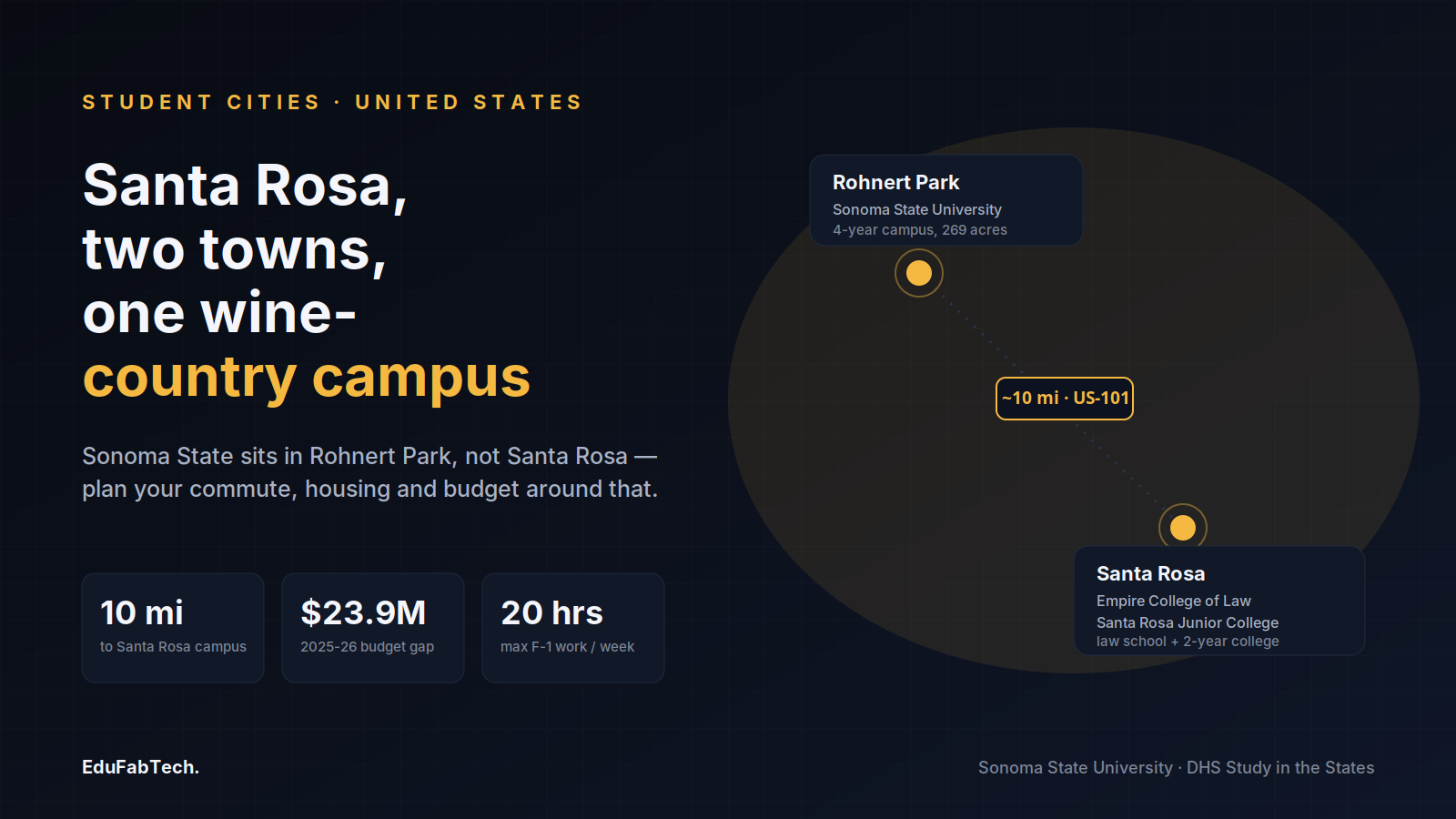
Santa Rosa is the county seat of Sonoma County, in the North Bay about 50 miles north of San Francisco, sitting on Santa Rosa Creek at the foot of the Sonoma Mountains. It is the commercial centre of a county better known abroad for its vineyards than its lecture halls, and that wine-country setting shapes daily life more than any single institution: long dry summers, a short wet winter, a wildfire-and-smoke season that locals plan around, and rents pushed up by a region where visitors outnumber students by a wide margin.
The city has a strong local identity. The cartoonist Charles M. Schulz, who drew Peanuts, lived and worked here for decades; the regional airport carries his name, and so does the library building at the area's main university. That is a useful tie to keep in mind, because the one fact that surprises most new students is geographic: the four-year public campus is not in Santa Rosa at all. It is in Rohnert Park, the next town roughly ten miles south down the US-101 corridor, and the daily rhythm of a Sonoma State student is really a two-town rhythm.
So before anything else, decide which campus you are attending, because "studying in Santa Rosa" can mean three different commutes. The degree-granting institutions a student is likely to deal with are Sonoma State University in Rohnert Park, the law school now called Empire College of Law in Santa Rosa itself, and the large public two-year college, Santa Rosa Junior College, whose main campus sits just north of downtown.
The universities: Sonoma State, Empire College of Law and the junior college
Sonoma State University is the region's four-year campus and part of the California State University system, the largest public university system in the United States, as the university states on its about page. According to Sonoma State's own facts page, the university was founded in 1961, occupies a 269-acre campus in Rohnert Park at the foot of the Sonoma Mountains, enrolled about 5,000 students in Fall 2025 (87.8% undergraduates), offers more than 40 degrees, and is a federally designated Hispanic-Serving Institution with 43% of students identifying as Latinx. It is one of the few campuses in the country with a Wine Business programme, which makes sense given where it is. On campus, Weill Hall at the Green Music Center is a working concert venue that students can reach on foot.
Prospective students should also know the recent history honestly. In an announcement dated 22 January 2025, Sonoma State said it faced a $23.9-million budget deficit for 2025-26, that enrolment had dropped 38% since 2015, and that it would not renew the contracts of roughly 46 faculty, close around 23 degree programmes and six departments, and eliminate its NCAA Division II athletics. If you are choosing a major, confirm in writing that your specific programme is still running and fully staffed for the year you will be there — this is not a campus where you should assume last decade's catalogue still applies.
Empire College of Law is the degree-granting institution inside Santa Rosa city limits. Per its own history page, Empire College was established in 1961, discontinued its School of Business in 2020 to focus solely on law, and in July 2022 partnered with Monterey College of Law to operate as a branch campus in Santa Rosa. It is a small law school at 3035 Cleveland Avenue, not a general undergraduate college — relevant only if law is your path.
Santa Rosa Junior College is the institution most local residents actually attend. It is a public two-year college granting associate degrees and certificates across a wide range of fields, with its main campus and the Doyle Library just north of downtown Santa Rosa. Many students use it as an affordable route toward transferring to a four-year campus, and — as noted below — its enrolled students ride the city bus free.
Where a Santa Rosa student actually sleeps
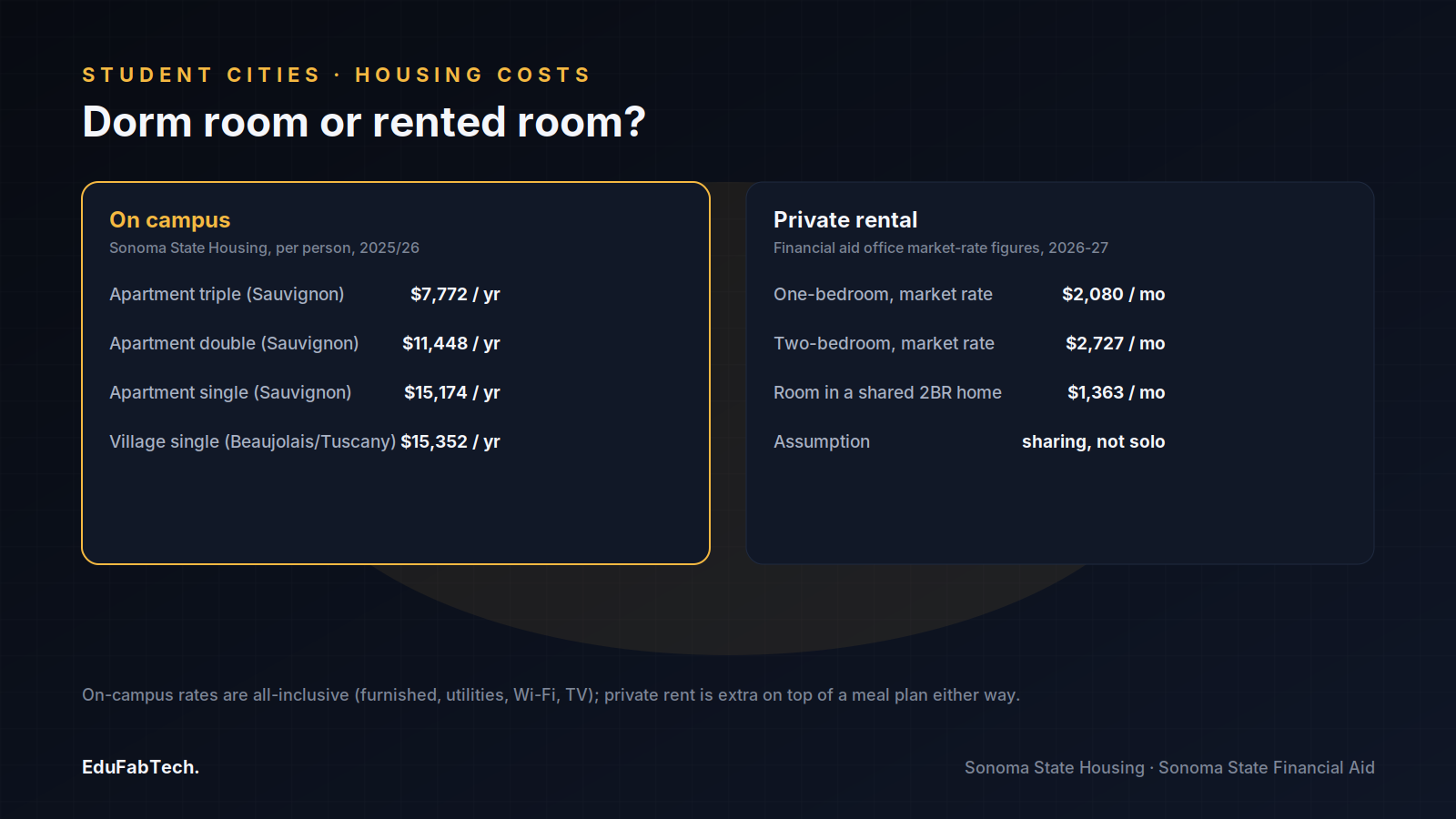
If you attend Sonoma State, the simplest first-year option is on-campus housing in the residential villages. Sonoma State Housing's published second-year-and-above rates for 2025/26 list, for example, Sauvignon Village at $7,772 a year for an apartment triple, $11,448 for an apartment double and $15,174 for an apartment single, with the rates described as all-inclusive — furnished space plus utilities, Wi-Fi and TV — for the period 14 August 2025 to 22 May 2026. Beaujolais and Tuscany village singles are listed at $15,352 for the year. Those are per-person figures, they assume you keep the licence for both semesters, and a meal plan is extra.
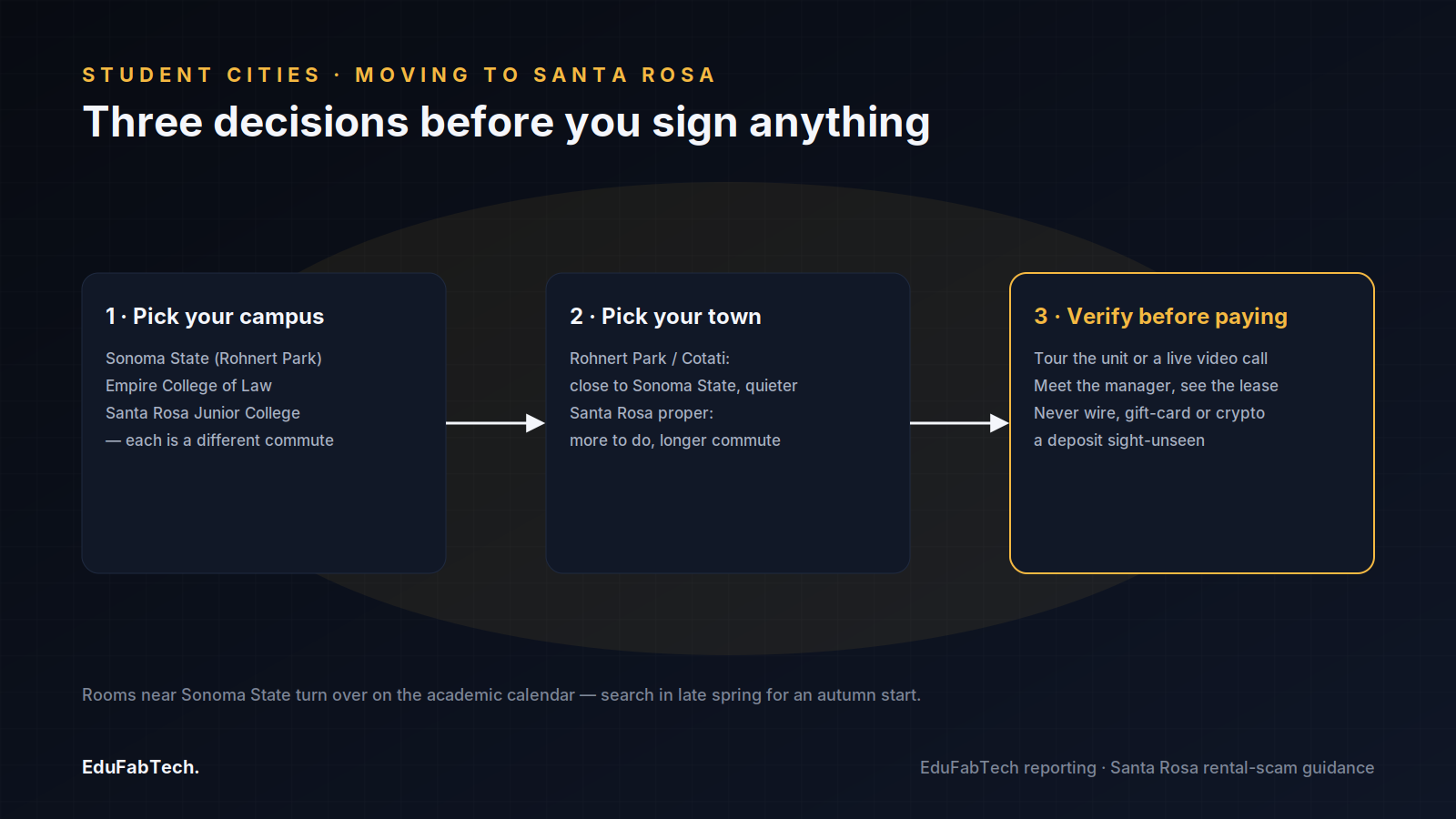
Most upper-year and transfer students, and nearly everyone at the law school or junior college, rent privately. The practical catch is that the four-year campus and the city are ten miles apart, so you are really choosing between Rohnert Park and Cotati (close to Sonoma State, quieter, student-heavy) and Santa Rosa proper (more to do, longer commute to the Rohnert Park campus). Private rent here is not cheap: Sonoma State's financial aid office, in its 2026-27 cost figures, uses market rates of $2,080 a month for a one-bedroom, $2,727 for a two-bedroom and $1,363 for a room in a two-bedroom home, and explicitly assumes students will share rather than live alone.
Start the search early. Rooms near Sonoma State turn over on the academic calendar, so the strongest choice is in late spring and early summer for an autumn start; by August the good shared houses in Rohnert Park and Cotati are gone. Before you pay anything, confirm the exact address exists and matches the listing, see the actual unit (in person, or via a live video walk-through with a trusted contact already in the area if you are coming from abroad), meet whoever claims to manage it, and get a written lease naming the real property. EduFabTech keeps local listings for the city at Santa Rosa and specifically for rooms and places to stay.
Paying a deposit without losing it
Rental scams in this area follow a pattern: a listing priced noticeably below the market rents above, a "landlord" who is conveniently out of town and cannot show the place, and pressure to send a holding deposit immediately. The rule that protects you is simple and absolute — never send money by bank wire, gift card or cryptocurrency to "hold" a room you have not seen, and never to someone you have not met or whose claim to the property you cannot verify. Legitimate Sonoma County landlords take a deposit by cheque or normal transfer after you have toured the unit and signed a lease, not before. If someone asks to skip the viewing because you are an international student, treat that as the warning it is.
Kitting out a room: flea markets, farmers' stalls and resale
Furnishing cheaply in Santa Rosa leans on second-hand channels and the county's strong market culture. The Santa Rosa Community Farmers' Market, per Sonoma County Tourism, runs year-round at the Santa Rosa Veterans' Memorial Building, 1351 Maple Avenue, on Saturdays 8:30 a.m. to 1 p.m. and Wednesdays 9 a.m. to 1:30 p.m. — the place to sort out food, not furniture. For household goods and the kind of browsing that fills a room, Midgley's Country Flea Market is the long-running option in the area, though note it is a short drive west in Sebastopol rather than in Santa Rosa itself. For the rest — desks, chairs, kitchen kit, a bike — work the local resale and giveaway networks rather than buying new. EduFabTech lists second-hand things and second-hand furniture in the city, including items being given away free.
Working while you study
If you are on an F-1 student visa, the work rules are federal, not local, and you should read them from the source rather than from a landlord or employer. The U.S. Department of Homeland Security's Study in the States guidance states that on-campus employment is work F-1 students whose status is active in SEVIS may apply for, that you "may not work more than 20 hours per week when school is in session," and that "the first step is always to talk with your designated school official (DSO)." Off-campus work, including Curricular Practical Training and Optional Practical Training, is possible only with specific authorisation arranged through your DSO — so the practical advice is to make the international-student office your first stop, not an afterthought. This is general information, not legal advice; confirm your own case with your DSO. Local openings aimed at students are collected on EduFabTech's Santa Rosa jobs page.
Reading rooms, from the Schulz Center to E Street
On the Sonoma State campus, the library is the Jean and Charles Schulz Information Center, which opened in August 2000 and runs to 215,000 square feet over three floors. Beyond study desks and computer and print stations, it houses a Makerspace with 3D printers, milling and cutting machines, sewing machines and VR equipment — genuinely useful if your work is hands-on. In the city, the public option is the Central Santa Rosa Library at 211 E Street, part of the Sonoma County Library system, open Monday, Thursday, Friday and Saturday 10 a.m.–6 p.m., Tuesday and Wednesday 10 a.m.–8 p.m., and Sunday 1–5 p.m.; it offers study pods, laptop kiosks, a free library card and up to $5 of free printing a day with that card. More desks and quiet corners around town are listed on EduFabTech's study spaces page.
Buses, the SMART train and a lot of car keys
Within the city, Santa Rosa CityBus is the local operator. Its fares page sets the adult single-ride fare at $1.50, payable in cash or with a Clipper card, the Bay Area's regional fare card. Its discount-programs page makes youth aged 5–18 ride free with valid ID and — notably for students — lets Santa Rosa Junior College students ride free with a current student ID. Between towns, the SMART train (Sonoma–Marin Area Rail Transit) connects Santa Rosa south through the county; its fares page states that youth aged 0–18 travel fare free with no ticket needed, that adults pay $1.50 per zone by Clipper or the SMART eTickets app, and that Clipper users get a $1.50 transfer discount when moving to connecting buses including Santa Rosa CityBus. Sonoma County Transit covers the wider county, including the Rohnert Park corridor to Sonoma State. Be realistic, though: this is a car-oriented region, the campus-to-city gap is real, and many students end up driving and budgeting for parking.
What it costs, and the honest trade
Putting the sourced figures together: for 2026-27, Sonoma State's cost-of-attendance tables list a tuition fee of $6,838 for California residents plus $2,668 in campus-based fees — $9,506 in mandatory charges — with non-resident students adding $14,130 for $23,636 in all, and on-campus living expenses (housing and food) of $10,728. Against the private rents quoted earlier — $1,363 a month for a shared room, rising past $2,000 for a one-bedroom — the all-inclusive dormitory rates can be the easier first-year choice even though the headline numbers look large.
What is genuinely good here: a four-year campus with small classes and a distinctive Wine Business programme, a well-equipped library with a makerspace, a concert hall on campus, a mild climate, and real countryside minutes away. What is genuinely hard: housing is expensive and the vacancy picture is tight; the main university is ten miles from the city it is associated with, so you commute one way or the other; the region leans on cars; late summer and autumn bring wildfire smoke; and Sonoma State is in the middle of deep budget cuts, so the programme you want may be smaller — or gone — compared with older course lists. None of that is a reason to stay away, but all of it is a reason to confirm the specifics for your year before you commit.
First fortnight checklist
- If you are international, meet your DSO at the international-student office before term and confirm your work options in writing before taking any job.
- Confirm your specific degree programme at Sonoma State is running and staffed for your year — ask the department directly.
- Lock housing early; see the unit in person or by live video, sign a written lease, and pay no deposit by wire, gift card or crypto.
- Get a Clipper card and load it; it works on CityBus and the SMART train.
- If you attend the junior college, carry your student ID for free CityBus rides.
- Get a free Sonoma County Library card at the Central Santa Rosa branch, and set up Schulz Information Center access if you are at Sonoma State.
- Furnish from the Saturday farmers' market, nearby flea markets and local resale and free-stuff listings rather than buying new.
- Plan your commute between Santa Rosa and the Rohnert Park campus before classes start, not on the first morning.
A quick question for readers
Do you work part-time while you study?
Many students work to pay the bills. See how common it is — and how many hours people really do.
Pick an answer, create a free account in a minute, and your vote counts. Already a member? Sign in
Comments 3
Comment-
The budget section is the one that actually matters and the piece buries it near the end. A $23.9-million deficit, enrolment down 38% since…
-
The number that actually lands the trade-off is the $23.9-million deficit next to the 38% enrolment drop since 2015 - that's not a universit…
-
The number that actually matters here is the 38% enrolment drop since 2015 against that $23.9-million deficit, because those two facts expla…
Join free to read the full comments and reply Comments are between members; an account takes a minute.
Source: Sonoma State University
Sources (5)
- Sonoma State University Financial Aid Office. 2026-27 Costs (Cost of Attendance). Sonoma State University, 2026. financialaid.sonoma.edu ↗ · checked 28 Oct 2026
- Sonoma State University Housing. Second Year and Above Rates 25/26. Sonoma State University, 2025. housing.sonoma.edu ↗ · checked 28 Oct 2026
- Sonoma State University. SSU takes major steps to address $23.9-million deficit in 2025-26. Sonoma State University Newscenter, 2025. news.sonoma.edu ↗ · checked 28 Oct 2026
- Santa Rosa CityBus. Discount Fares and Programs. City of Santa Rosa, 2026. srcitybus.org ↗ · checked 28 Oct 2026
- U.S. Department of Homeland Security. Working in the United States (F-1 students). Study in the States, 2026. studyinthestates.dhs.gov ↗ · checked 28 Oct 2026