Studying in Seattle: universities, housing and student life
A practical, sourced guide to Seattle's universities, the neighbourhoods students live in, housing and costs, transit, study spaces and part-time work — with figures traced to the institutions that published them.
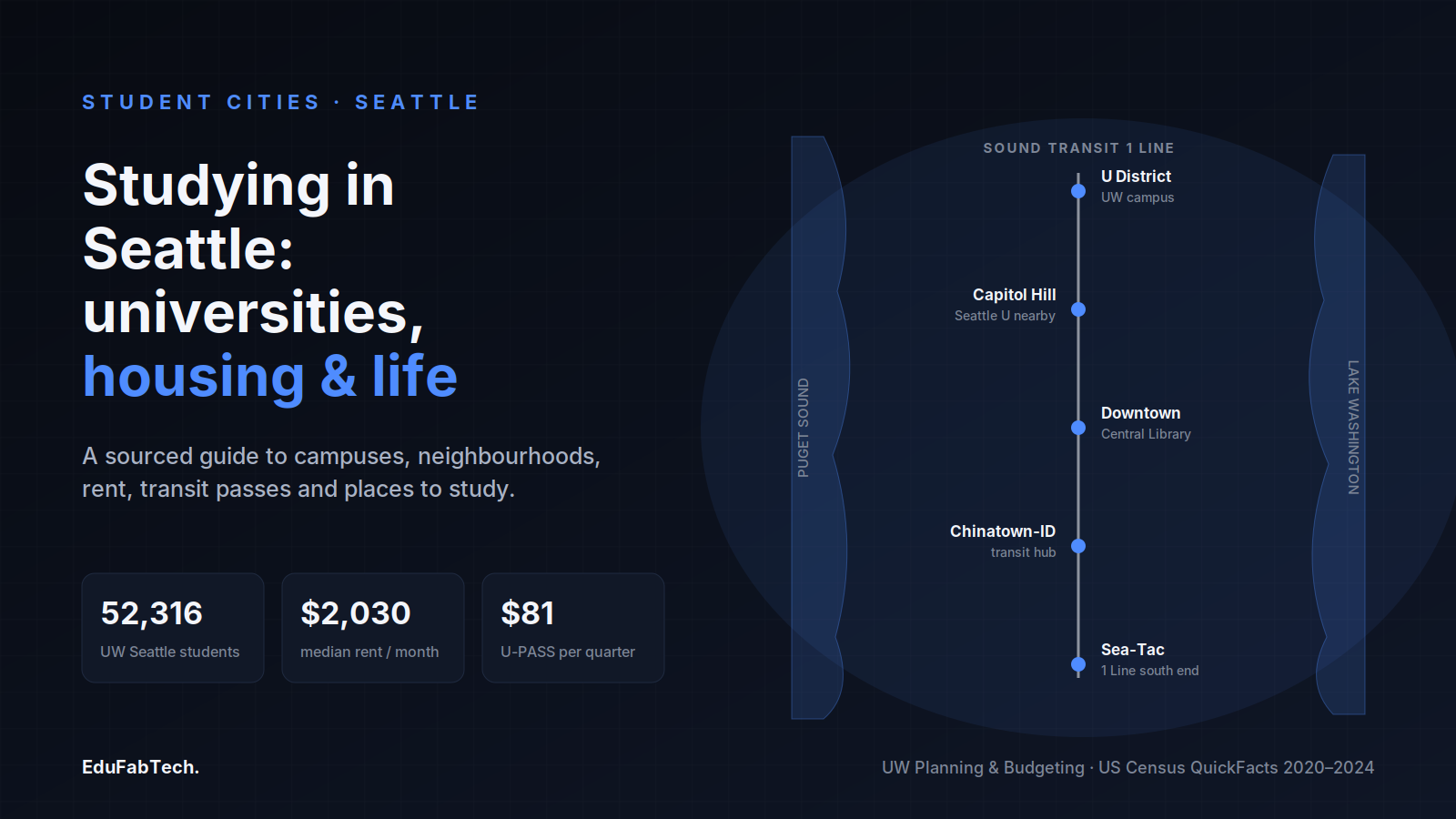
Seattle is squeezed onto a narrow strip of land between the saltwater of Puget Sound to the west and the freshwater of Lake Washington to the east, cut through the middle by the Lake Washington Ship Canal. That geography shapes student life more than any brochure will admit: a bus or a bridge is often between you and your campus, hills are steep, the water is everywhere, and the grey drizzle of the long winter is real. It is also a city of universities, research hospitals and software firms, where a large share of the people on the pavement are students or recent graduates.
The campuses sit in a ring around the water. The flagship is in the city itself; several smaller and more specialised institutions are scattered through the suburbs on the Eastside and to the north. This guide names the ones that currently operate and grant degrees, and is honest about what each is for.
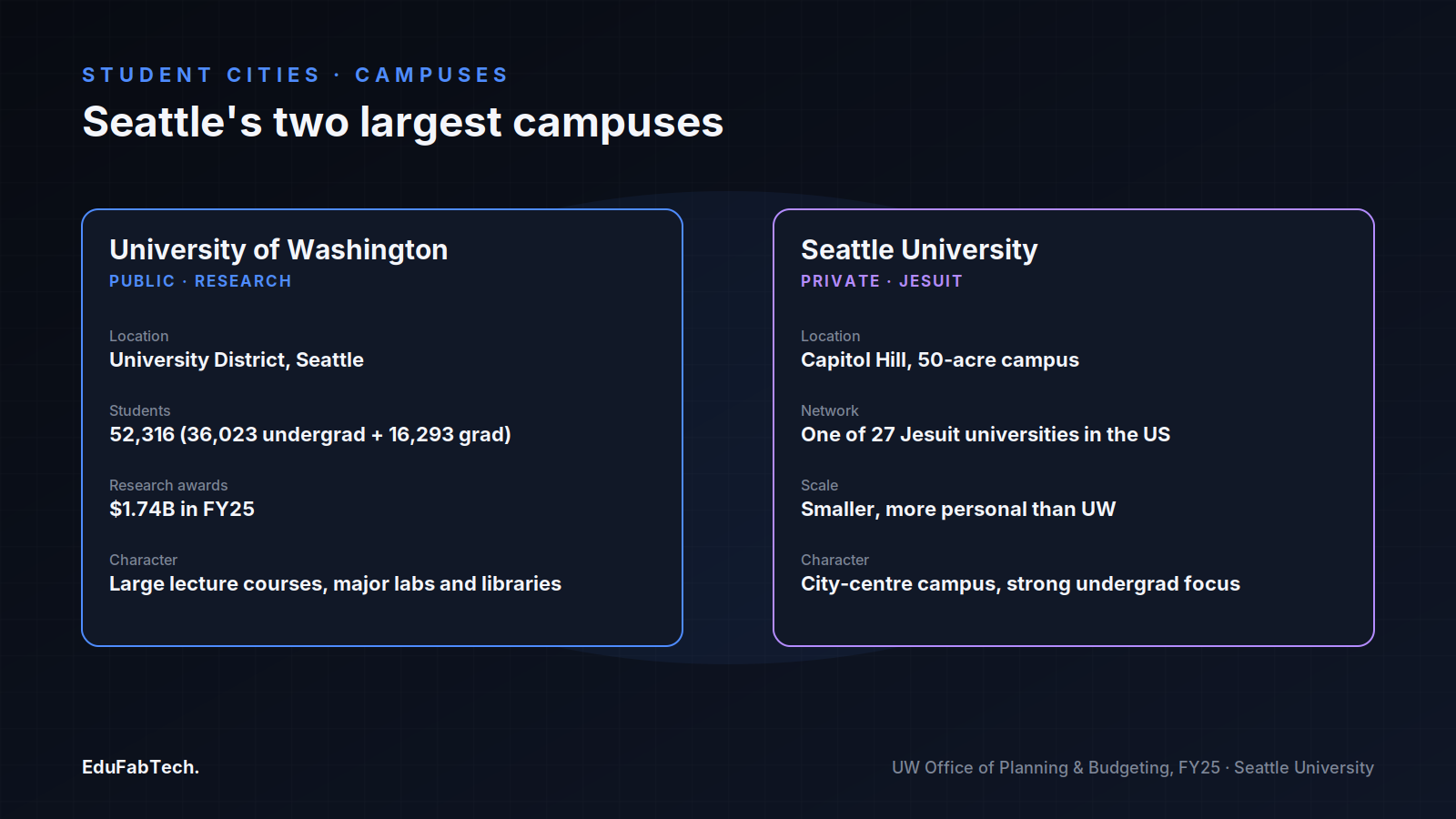
The anchor is the University of Washington, whose main campus occupies the University District north of the Ship Canal. The UW's Office of Planning & Budgeting reports 52,316 students on the Seattle campus (36,023 undergraduate and 16,293 graduate and professional) and that the university received $1.74 billion in research awards in FY25, more federal research money than any other US public university. Studying there means a large, research-heavy environment: big lecture courses in the first years, major research libraries and labs, and a campus whose cherry trees in the Quad draw crowds every spring. Seattle University, a private Jesuit institution on a 50-acre campus on Capitol Hill, is the other large option inside the city; its own website describes it as one of 27 Jesuit universities in the United States, with a smaller, more personal feel.
The rest are smaller and more defined. Seattle Pacific University is a Christian university on the north slope of Queen Anne Hill, offering undergraduate through doctoral degrees per its own catalog. City University of Seattle is a private non-profit whose headquarters and main campus are downtown on Wall Street, built around working adults and online study. Antioch University Seattle offers progressive graduate and undergraduate programmes in psychology, counselling and education. On the Eastside and to the north sit several specialised campuses: DigiPen Institute of Technology in Redmond grants degrees in game design, computer science, digital art and sound; Northwest University in Kirkland is a Christ-centred institution that awards associate through doctoral degrees; and Bastyr University in Kenmore is, by its own account, a pioneer in science-based natural medicine. For two-year and applied degrees, Edmonds College in Lynnwood grants associate and Bachelor of Applied Science degrees (as recorded by the US Department of Education's College Navigator), while Bellevue College, Highline College in Des Moines, University of Washington Bothell and the South Seattle College Georgetown Campus round out the region's transfer and trades pathways. The Georgetown campus is, in its own words, Washington State's largest apprenticeship training institution.
The neighbourhoods students actually choose
Seattle is a city of distinct neighbourhoods separated by water, hills and bridges, so where you live determines how long your commute is more than the distance on a map suggests. Sound Transit's 1 Line light rail now links several of them directly, which has reshaped where students look.
The University District ("the U-District") is the obvious first stop: the dense strip along University Way NE — "the Ave" — sits right against the UW campus, packed with cheap food, cafés and student flats, and served by U District Station on the light rail. It is convenient and lively but tightly contested every spring. Roosevelt and Ravenna, a little further north, are quieter, more residential, and a short hop down the line from U District Station — popular with graduate students and anyone who wants calm within reach of campus. Wallingford and Fremont, west along the Ship Canal, are leafy and walkable; Fremont leans quirky and self-consciously bohemian, with good buses rather than a train. Capitol Hill is the city's densest and most social neighbourhood — nightlife, music, the heart of LGBTQ+ Seattle — and its own light-rail station puts both downtown and the UW minutes away, which makes it a favourite for Seattle University students. Ballard, further northwest, keeps its old Scandinavian maritime character under a layer of breweries and boutiques; it is bus-served and further from the UW. The Chinatown–International District, just south of downtown, is a historic, multicultural core with excellent food and a major transit hub. West Seattle and Georgetown, across the Duwamish to the south, trade a longer commute for comparatively more space and lower rents. You can browse what is currently listed across these areas on EduFabTech's Seattle pages.
Finding a room on a tight, water-divided market
Seattle's rental market is expensive and moves fast around the academic calendar. The US Census Bureau's QuickFacts put the median gross rent in Seattle at $2,030 a month for 2020–2024, and demand near the UW spikes hard in late spring as leases turn over for the autumn quarter. If you want to live in the U-District, Roosevelt or Capitol Hill, start looking two to three months ahead; purpose-built student housing and university residence halls have their own, earlier deadlines.
The safest first move for a newcomer — especially anyone arriving from abroad — is a university room for the first year, then switching to a shared flat once you know the city. Check the exact start and end dates of any contract (the UW's own residence agreement, for example, runs from mid-September to mid-June, not a full calendar year), what the deposit is, and whether utilities and internet are included.
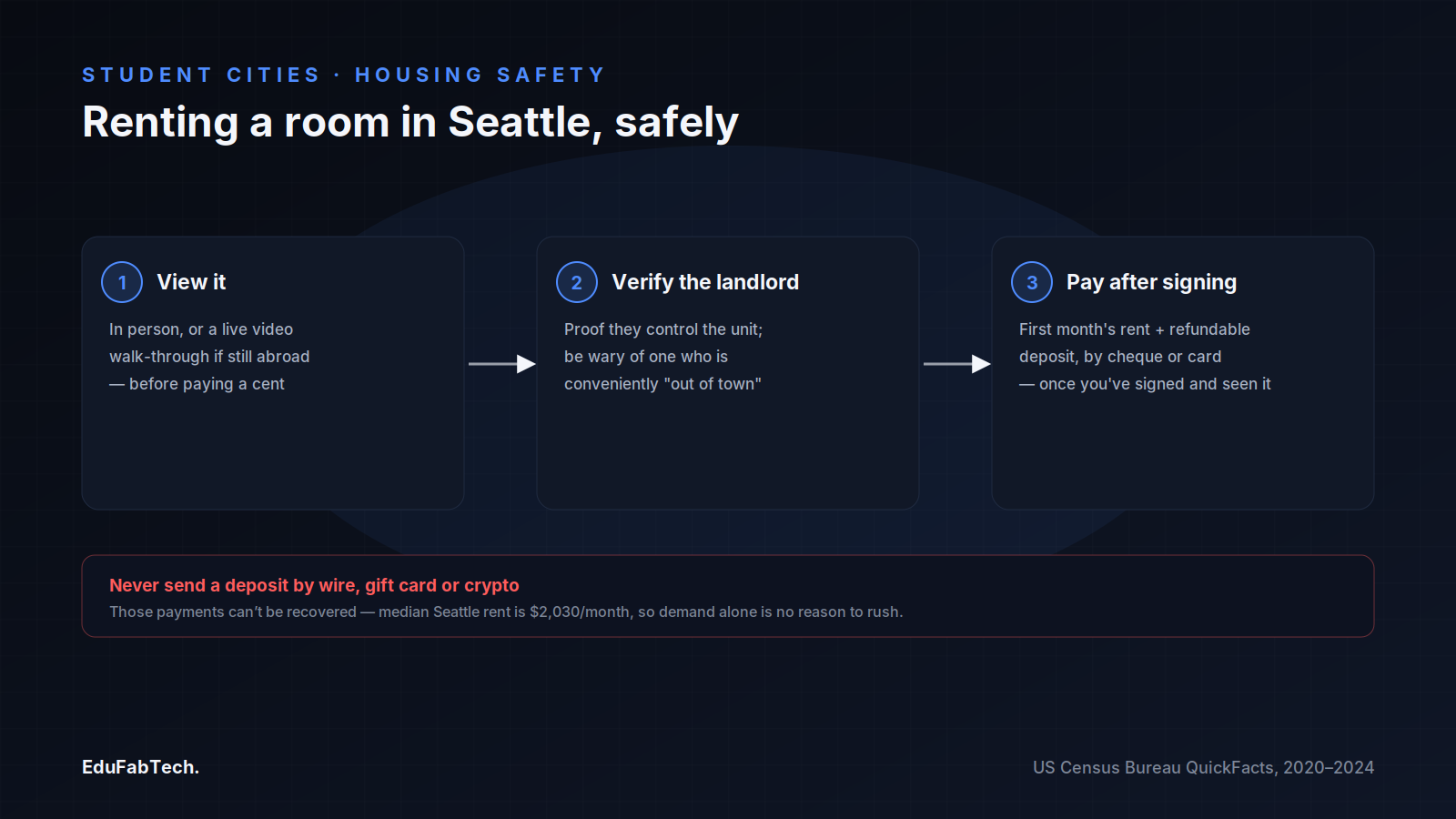
Rental scams in Seattle follow a familiar pattern: a listing that is cheaper than everything comparable in the same neighbourhood, a "landlord" who is conveniently out of town, and pressure to send money before you can see the place. Insist on viewing the unit in person — or, if you are still overseas, on a live video walk-through plus proof the person controls the property — before you pay anything. Never send a deposit or "holding fee" by bank wire, gift card or cryptocurrency; those payments cannot be recovered, and no legitimate Seattle landlord needs them to hold a room. A normal arrangement here is first month's rent plus a refundable security deposit paid by cheque or card once you have signed and seen the place. When you are ready to compare real options, rooms listed on EduFabTech are a reasonable place to start.
Furnishing a room without buying new
Seattle takes its markets seriously, and that works in a student's favour. Pike Place Market, which has operated as a public market since 1907, is the famous one — more use for produce, fish and cheap lunches than furniture, but a genuine part of city life. For second-hand goods, the Fremont Sunday Market runs year-round, 10am to 4pm by the Fremont Bridge, mixing a flea market with street food and vintage stalls. For the basics of kitting out a room, Evergreen Goodwill operates a chain of non-profit thrift stores across the area, including shops in Ballard and on Capitol Hill. And the University District Farmers Market, running Saturdays since 1993, is a weekly fixture a few blocks from the UW for groceries. Online, students pass furniture around constantly at the start and end of each quarter; EduFabTech lists second-hand items and things given away free in the city.
Getting around: Link, Metro, ORCA and the U-PASS
Two agencies run most of the system. King County Metro operates the buses and RapidRide lines; Sound Transit runs the Link light rail, whose 1 Line connects the UW and the U-District through downtown all the way to Sea-Tac airport. Both — plus the regional ferries and other county operators — are paid with a single tap card, ORCA, now managed at myorca.com.
Students at the UW get an unusually good deal. UW Transportation Services states that students who pay the Services & Activities Fee are automatically enrolled in the Universal Student U-PASS — an $81-per-quarter transit pass giving unlimited rides on King County Metro, Sound Transit Link, Community Transit, Pierce Transit, Kitsap Transit and Everett Transit. For younger students, the ORCA programme also makes transit free for riders aged 6 to 18. Check your own institution: not every campus bundles a pass into fees, and if yours does not, a standard ORCA card is the way to pay.
Libraries and places to study
The Seattle Public Library's Central Library downtown is both a working library and an architectural landmark — the glass-and-steel Rem Koolhaas building opened in 2004, with its spiralling "Books Spiral" and reading floors open to anyone. On the UW campus, the Suzzallo Library's third-floor Reading Room offers, in the library's own description, silent study in a cathedral-like hall, while the Odegaard Undergraduate Library is the main undergraduate workspace — open late on weekdays but, contrary to a common belief, not 24 hours, closing at midnight most nights and requiring a Husky card. Between the public branches, the campus libraries and the city's many cafés, desk space is one thing Seattle is not short of; EduFabTech also lists bookable study spaces in the city.
Costs, wages and part-time work
Seattle is an expensive city with correspondingly high pay for the hours you do work. The City of Seattle's Office of Labor Standards set the citywide minimum wage at $21.30 an hour from 1 January 2026 — among the highest of any US city. On the housing side, the University of Washington's Housing & Food Services lists 2026–27 residence-hall rates approved by the Board of Regents on 12 March 2026: a double room with a private bath in Lander Hall is $4,396 per quarter ($13,188 for the academic year), while a four-person suite in Hansee Hall is $2,208 per quarter ($6,624 for the year). Those are useful anchors against which to judge any private rent.
Part-time work is realistic but regulated, and the rules are strict for international students. The US Department of Homeland Security's Study in the States portal states that an F-1 student in on-campus employment "may not work more than 20 hours per week when school is in session," and that off-campus training such as Curricular Practical Training (CPT) and Optional Practical Training (OPT) must be authorised first. This is not legal advice: the authority that matters for your own case is your campus's Designated School Official, working from your I-20 and the DHS rules — confirm anything before you accept a job. Domestic students face no such cap. Current openings are collected on EduFabTech's Seattle jobs page.
What is good, and what is hard
The good is substantial: a concentration of research universities and employers in software, aerospace, biotech and global health; a generous transit pass for UW students and a light-rail spine that keeps growing; mountains, water and forest within an hour; and a minimum wage that makes part-time hours go further than in most US cities. The study infrastructure — libraries, cafés, markets — is genuinely strong.
The hard is just as real. Rent is high and the market near the UW is tight, so the cheapest rooms go to whoever looks earliest. The water and hills that make Seattle beautiful also lengthen commutes: a neighbourhood that looks close can be a bridge and two buses away. The winters are long, dark and persistently wet rather than dramatically cold, which some people find harder than snow. And like any large US city, Seattle has visible inequality and neighbourhood-by-neighbourhood differences in how comfortable the streets feel at night — worth learning block by block rather than from headlines.
A checklist for the first weeks
- Sort out transit immediately: if you are a UW student, confirm your U-PASS is active; otherwise buy an ORCA card at a Link station and load it.
- If you are an international student, meet your Designated School Official early to confirm what on-campus work and CPT/OPT you are allowed before taking any job.
- Do not pay any deposit before seeing a place in person (or by live video with proof of ownership); never pay by wire, gift card or crypto.
- Get a library card from the Seattle Public Library and activate your campus library and Husky/student card for after-hours access.
- Furnish from the Fremont Sunday Market, Evergreen Goodwill and student give-aways at quarter's end rather than buying new.
- Pick a neighbourhood by commute, not just rent: check which light-rail station or bus line actually serves it before you sign.
- Prepare for the weather — a waterproof layer matters more here than an umbrella — and plan something for the dark months.
A quick question for readers
Do you work part-time while you study?
Many students work to pay the bills. See how common it is — and how many hours people really do.
Pick an answer, create a free account in a minute, and your vote counts. Already a member? Sign in
Source: University of Washington Housing & Food Services
Sources (5)
- University of Washington Housing & Food Services. 2026–27 Housing and Dining Rates. University of Washington, 2026. hfs.uw.edu ↗ · checked 5 Oct 2026
- City of Seattle Office of Labor Standards. Minimum Wage Ordinance. City of Seattle, 2026. seattle.gov ↗ · checked 5 Oct 2026
- University of Washington Office of Planning & Budgeting. UW Fast Facts. University of Washington, 2025. washington.edu ↗ · checked 5 Oct 2026
- UW Transportation Services. Universal Student U-PASS. University of Washington, 2026. transportation.uw.edu ↗ · checked 5 Oct 2026
- U.S. Department of Homeland Security. Working in the United States (Study in the States). U.S. Immigration and Customs Enforcement, 2026. studyinthestates.dhs.gov ↗ · checked 5 Oct 2026