Studying in Siegen: universities, housing and student life
A practical, sourced guide to the University of Siegen, finding a room in a hilly Südwestfalen town, the Deutschland-Semesterticket, markets and what a semester really costs.
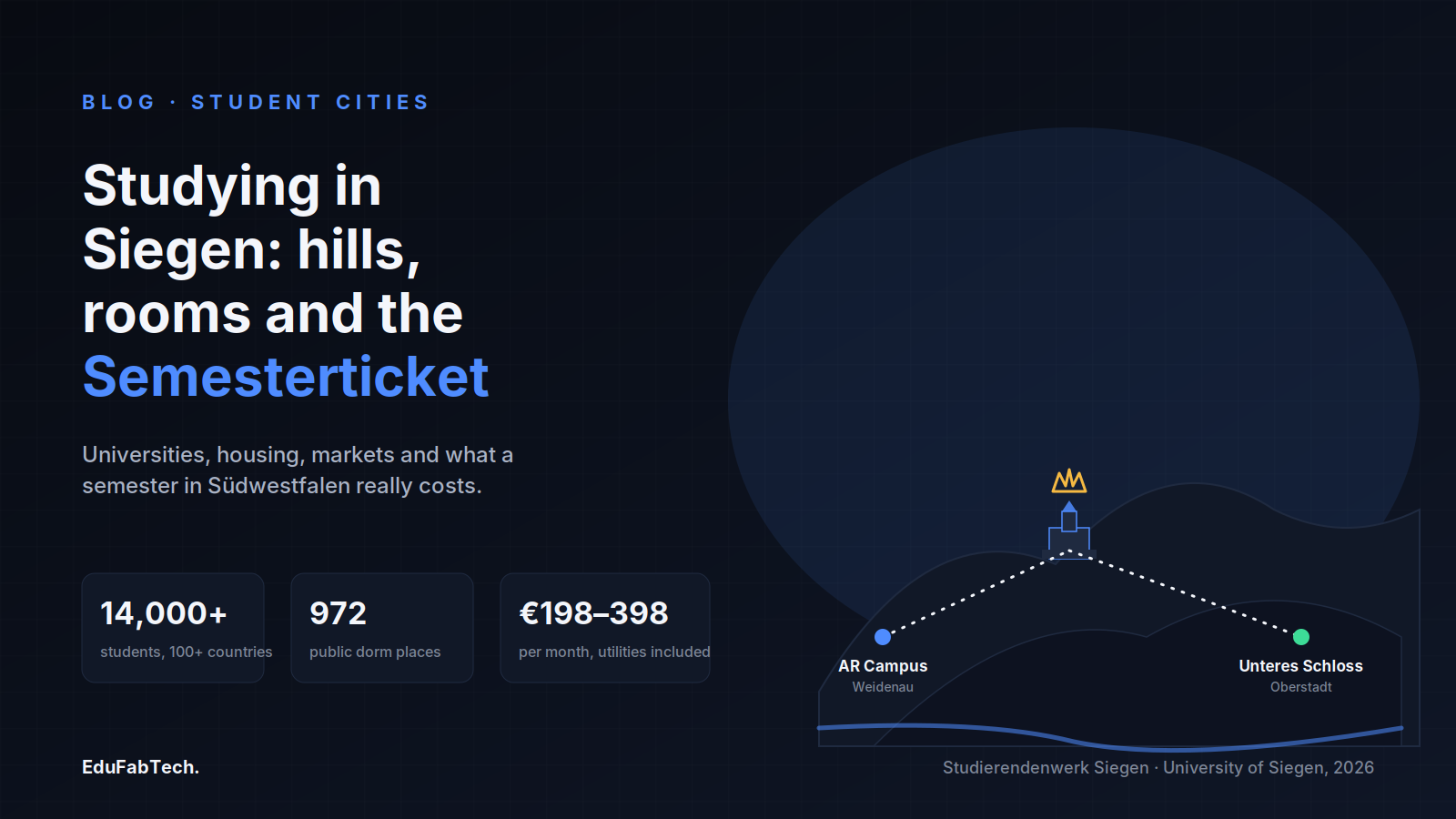
Siegen sits where the river Sieg gathers itself in the hills of Südwestfalen, near the point where North Rhine-Westphalia meets Hesse and Rhineland-Palatinate. It is a town of roughly 100,000 people built across steep slopes, and so much of the surrounding district is wooded that locals and tourism pages alike call it one of Germany's greenest cities. Above the old town stands the Nikolaikirche with its gilded Krönchen — the little crown that gives Siegen its nickname — and two castles, the medieval Oberes Schloss on the Siegberg and the Unteres Schloss below, the latter now part of the university. The Siegerland made its money for centuries from iron ore mining and smelting, and the region still leans engineering and industry.
For a student, the first thing to understand about Siegen is its shape. This is not a flat grid city where everything is a ten-minute cycle away. Campuses, dormitories and the centre are spread between valleys and hillsides, linked by buses that grind up gradients a bicycle would make you regret. That geography colours everything below — where you live, how long you commute, and why the free regional transport ticket matters more here than it would on the plains.
The city is also a genuinely international student town relative to its size, with students from well over a hundred countries, and it has spent the past decade pulling its main teaching sites down off the hill and into the centre. If you arrive expecting a large, anonymous campus, you will instead find the university woven through an ordinary working town.
The University of Siegen — and the Bundesbank's school down in Hachenburg
The University of Siegen was founded in 1972 as one of five new Gesamthochschulen in North Rhine-Westphalia, according to the Kreis Siegen-Wittgenstein, the surrounding district. Today the university's own profile page describes it as having more than 14,000 students, which makes it a mid-sized institution where the subject range is deliberately broad: the humanities and media, teacher education, economics and business informatics, the natural sciences and engineering, and more recently the life sciences and medicine. Siegen is also one of the partners in the ATHENA European University alliance, so exchange routes within Europe run through the same offices that handle incoming students.
Teacher training is one of Siegen's historic strengths, and the faculty for education, architecture and the arts keeps the Lehramt tradition alive; media studies and the digital-society research around it are another visible thread. What studying here feels like, day to day, is shaped less by prestige than by scale — smaller cohorts, lecturers you can actually reach, and a campus culture that is practical rather than showy.
A second institution often mentioned alongside Siegen is the Hochschule der Deutschen Bundesbank, and it is worth being precise about it: this school is in Hachenburg, in the Westerwald in neighbouring Rhineland-Palatinate, not in Siegen itself. It is a specialised institution that runs a dual Bachelor's degree in Zentralbankwesen/Central Banking for future staff of the Deutsche Bundesbank — a trainee programme you apply to through the central bank, not an open university you enrol in while living in Siegen. If central banking is your field, note that your campus would be an hour or so south, in a different federal state.
Three campuses, two valleys: where you study and where you read
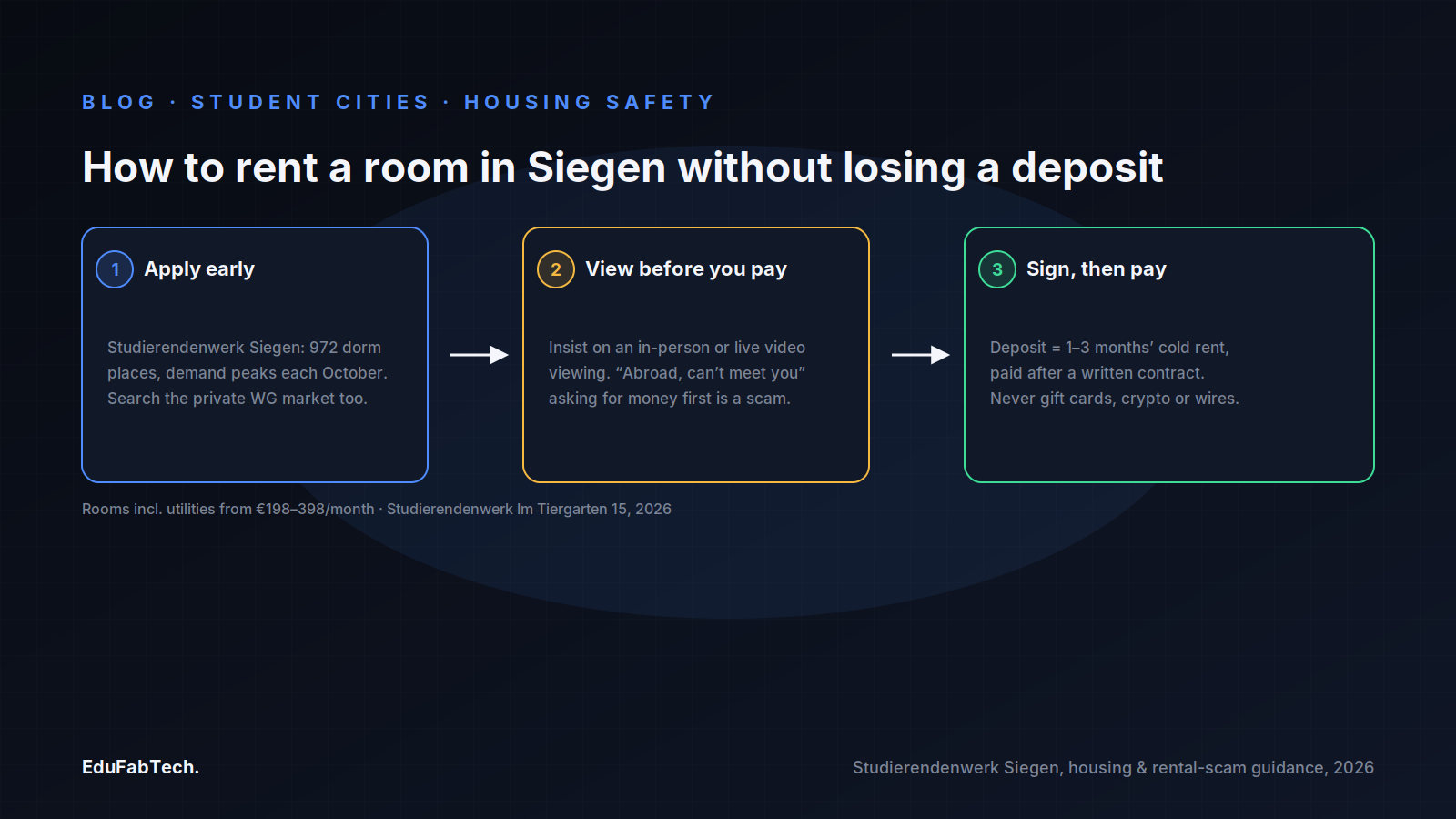
For decades the heart of the university sat on the Haardter Berg hill above the Weidenau district, and much of the science and engineering teaching is still there. The main Adolf-Reichwein-Straße campus (AR) is at Adolf-Reichwein-Straße 2 in Siegen-Weidenau, north of the centre, and it holds the Audimax, the main Mensa and the central library. Over the past years the university has pulled faculties into the old town around the Unteres Schloss (US) campus, so economics, humanities and parts of the arts now sit among the shops and squares of the Oberstadt. Smaller sites — the Emmy-Noether-Campus, Hölderlinstraße and Paul-Bonatz-Straße — fill in the gaps.
This split matters for your timetable: a morning lecture at Unteres Schloss and an afternoon lab on the Haardter Berg can mean a real cross-town bus ride, not a stroll. Check which campus your department actually sits on before you choose a room.
The Universitätsbibliothek gives you study desks across the city. Per the library's own locations and opening-hours page, the main library at the AR campus (Adolf-Reichwein-Straße 2) is open Monday to Friday 09:00–20:00 and Saturday 10:00–18:00, while the Unteres Schloss branch in the centre keeps longer weekday hours, Monday to Friday 08:00–21:00 and Saturday 10:00–18:00. There are further reading rooms at the Emmy-Noether-Campus, Hölderlinstraße and Paul-Bonatz-Straße, all listed on that same page and all closed on Sundays. In exam season those few extra evening hours at Unteres Schloss are worth knowing about. You can also browse desks and quiet corners students share on EduFabTech's study-spaces listings for the city.
Rooms in Weidenau, the old town and beyond
Students cluster where the buses and the campuses are: Weidenau, strung along the valley below the Haardter Berg, is the classic student quarter, close to the AR campus and the big Mensa; the Oberstadt and city centre have become more attractive as teaching moved to the Unteres Schloss; and cheaper rooms turn up in outer districts such as Geisweid, Eiserfeld or Weidenau's edges, at the price of a longer, hillier commute. A shared flat — a Wohngemeinschaft, or WG — is the normal way in, and a private room in one typically comes unfurnished or part-furnished.
The Studierendenwerk Siegen runs the public dormitories, and its housing overview lists 972 student places spread across houses at addresses including Im Tiergarten 15 and 19, Glückaufstraße 48–54, Adolf-Reichwein-Straße 11–17, Engsbachstraße 56 and 58, Am Eichenhang 66, Am Nordstern 38, Friedrichstraße 87, Hubertusweg 60, 82 and 84, and the Max-Kade-Haus in Andreas-Schlüter-Straße. The same page states that all utility costs (Nebenkosten) — water, electricity, heating and internet — are included in the quoted rents, a real advantage because it means no winter heating surprise. As a concrete, dated figure, the Studierendenwerk's page for its Im Tiergarten 15 house quotes rooms from 198.00 € to 398.00 € per month including utilities as of 2026, spanning single rooms of roughly 9–27 m², double rooms and small apartments.
Demand peaks sharply around the start of the winter semester in October, so apply to the Studierendenwerk early and keep looking on the private market in parallel. For the private side, EduFabTech collects local openings on its rooms page for Siegen, and the broader city listings gather everything in one place; the near-the-University-of-Siegen view is useful if you want to minimise the hill climb.
Paying a deposit in Siegen without being scammed
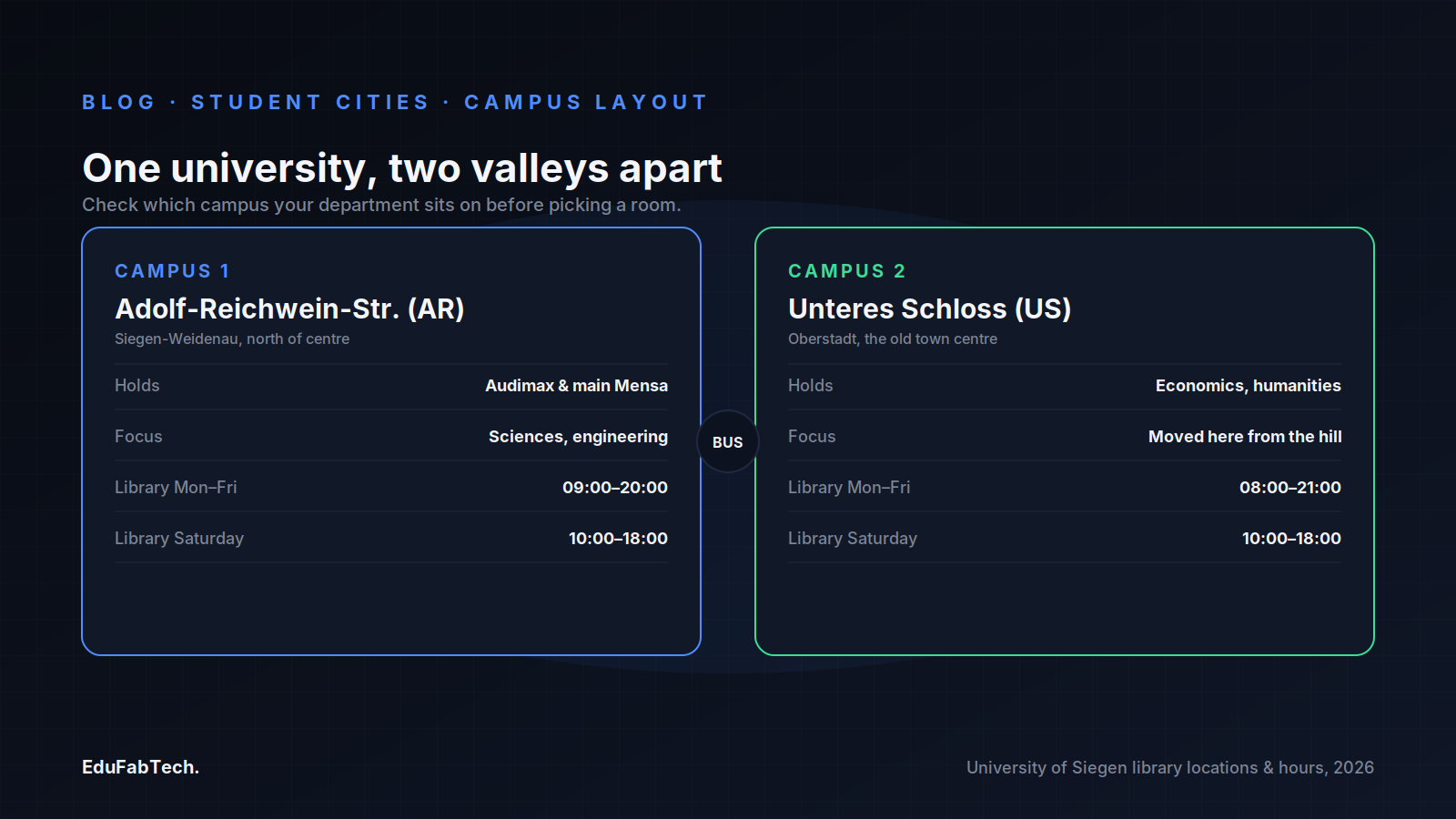
Most Siegen room hunting happens online, and that is exactly where the risk sits. The pattern to watch for is a listing — often a suspiciously cheap WG room in Weidenau or the Oberstadt — where the supposed landlord is "abroad", cannot meet you, and asks you to wire a deposit or the first month's rent to "reserve" the room before you have seen it. Do not. A legitimate landlord or the Studierendenwerk will let you view the place in person, or at least over a live video call, and will give you a written contract before any money moves.
In Germany a private deposit (Kaution) of one to three months' cold rent is normal, and it should be paid only after you have signed a contract and ideally into a separate deposit account, not handed over in cash to hold a viewing slot. Never send money by gift card, cryptocurrency or an irreversible instant bank transfer to someone you have not met; no genuine Siegen landlord and no student-services office asks for that. If you are arriving from abroad, consider booking a dormitory place or short-term room for the first weeks and doing your serious WG search once you can view flats yourself — it is slower, but it is how you avoid losing a deposit you will never see again.
Kitting out a room: second-hand, flea markets and the Krönchen market
A room in a WG often comes bare, so expect to furnish it. Siegen has a steady flea-market habit: the Siegerlandhalle on Koblenzer Straße regularly hosts indoor flea markets, and open-air Trödelmärkte turn up at retail sites around the city through the year — good hunting grounds for a desk, a lamp or a bike. For food and the weekly rhythm of the town, the weekly market under the Krönchen runs, per the city's visitSiegen pages, on Wednesdays 11:00–15:00 and Saturdays 07:00–13:00 in the centre, with further markets in Weidenau (Wednesdays and Saturdays) and Geisweid (Saturdays); stalls bring vegetables from the Westerwald, potatoes from nearby Freudenberg and regional cheeses and meats.
For the furniture itself, the cheapest route is other students moving out. EduFabTech keeps Siegen-specific boards for second-hand things, used furniture and items people simply give away for free — worth checking at the end of each semester, when departing tenants clear out beds, shelves and kitchen kit they cannot take with them.
The Semesterticket, the hills and getting around
Because Siegen is built on slopes and spread across districts, buses do most of the work; the local operator is VWS (Verkehrsbetriebe Westfalen-Süd), and UniExpress (UX) lines run faster connections to the campuses during the semester. The decisive benefit for students is the Deutschland-Semesterticket, which is bundled into the compulsory semester fee and valid on local and regional public transport across Germany — not just within the region, as the older NRW ticket was. The university's semester-fee page puts the ticket's share of the fee at 226.80 € for the 2026/27 winter semester, and the ticket is provided digitally rather than as a paper card.
In practice this means your commute from an outer-district room, and your weekend trips out of the Siegerland by regional train, are already paid for. It also softens the main downside of cheaper housing: a room two valleys over costs you time, but not extra fare. A bike helps on the flatter stretches, but be honest with yourself about the gradients before you rely on one.
What a semester costs, and working alongside it
The clearest fixed cost is the semester fee. For the 2026/27 winter semester the University of Siegen's own page gives the total as 393.80 €, made up of the 226.80 € Deutschland-Semesterticket, a 140.00 € social contribution to the Studierendenwerk, a 20.00 € AStA (student union) fee and a 7.00 € solidarity contribution; it also notes that students enrolled in preparatory German-language courses pay an extra 500.00 €. There are no general tuition fees for regular study. Rent is the real variable: the Studierendenwerk's dormitory rents, with utilities included, start at the low end noted above, while private WG rooms vary with district and distance from campus.
Many students work part-time to cover the rest. If you are an international student from outside the EU/EEA, the rules on how much you may work are set in law and tied to your residence status, and this is not something to improvise. The University of Siegen's financing information for incoming students states that non-EU/EEA students may work 140 full or 280 half days per calendar year (more than four hours counting as a full day), and points students to the German Studierendenwerk guidance for the detail. Treat that page and your residence permit as the authority, confirm your own limits with the Ausländerbehörde before signing a contract, and do not take the general figure as personal legal advice. EduFabTech's Siegen jobs board lists local openings, and campus student-assistant roles are a common first step.
The honest balance — and a first-weeks checklist
What is good about Siegen is tangible: it is relatively affordable by western-German standards, it is small enough that the university is reachable and human-scaled, the free nationwide transport ticket stretches your money well beyond the town, and the surrounding forest and hills are genuinely close — you can be walking in the Siegerland countryside within minutes of a lecture. The international student mix is larger than the town's size would suggest, which makes it easier to arrive from abroad.
What is hard is mostly the geography and the housing calendar. The hills make for gradients and for a university scattered across valleys, so some days you will commute more than you would in a compact city. Rooms get tight every October, and the cheapest ones sit furthest out. Siegen is not a glamorous metropolis; its pleasures are quieter — the market, the castle grounds, the woods — and its grey, wet weather is a real part of the deal. Go in expecting a working town rather than a postcard, and it treats students well.
A checklist for the first weeks
- Confirm which campus — Adolf-Reichwein-Straße, Unteres Schloss or a smaller site — your department actually uses, then search for a room near it.
- Apply to the Studierendenwerk and other room sources early; arrange a viewing (in person or live video) before paying anything, and never wire a deposit to "hold" an unseen room.
- Complete enrolment so your semester fee is paid, then activate your Deutschland-Semesterticket, which is provided digitally once you are enrolled.
- Register your address at the city's Bürgerbüro (the Anmeldung), which you will need for almost everything else; non-EU students should check in with the Ausländerbehörde about residence-permit and work limits.
- Get a library account and scout the Unteres Schloss branch's longer evening hours for exam season; furnish the room from second-hand boards and the Siegerlandhalle flea markets.
- Learn your two or three key bus lines, including the UniExpress connections between campuses, before term fills them up.
A quick question for readers
Do you work part-time while you study?
Many students work to pay the bills. See how common it is — and how many hours people really do.
Pick an answer, create a free account in a minute, and your vote counts. Already a member? Sign in
Comments 0
CommentNo comments yet. Members start the conversation.
Source: University of Siegen
Sources (5)
- University of Siegen. Semester fee at the University of Siegen. University of Siegen, 2026. uni-siegen.de ↗ · checked 29 Nov 2026
- Studierendenwerk Siegen. Wohnen (student housing overview). Studierendenwerk Siegen, 2026. studierendenwerk-siegen.de ↗ · checked 29 Nov 2026
- University of Siegen. Standorte und Öffnungszeiten der Universitätsbibliothek. University of Siegen, 2026. uni-siegen.de ↗ · checked 29 Nov 2026
- Kreis Siegen-Wittgenstein. Universität Siegen. Kreis Siegen-Wittgenstein, 2026. siegen-wittgenstein.de ↗ · checked 29 Nov 2026
- visitSiegen. Saturday and Wednesday markets. Stadt Siegen, 2026. visitsiegen.de ↗ · checked 29 Nov 2026