Studying in Springfield, Massachusetts: universities, housing and student life
A practical guide for students in Springfield and the lower Pioneer Valley — the universities, where to live, what it costs, how to get around, and the honest trade-offs.
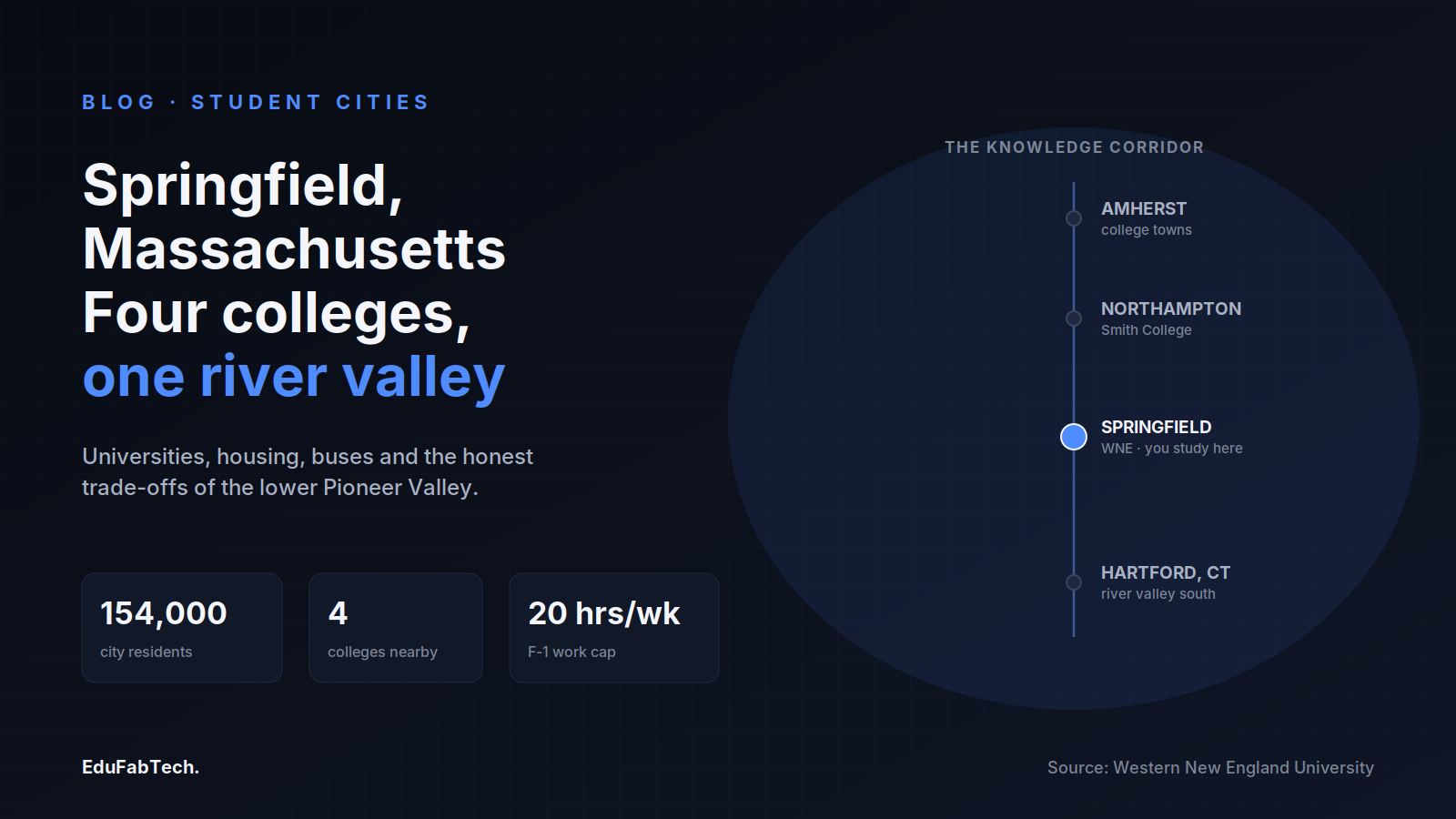
Springfield sits on the east bank of the Connecticut River in western Massachusetts, the third-largest city in the state with about 154,000 residents, according to Western New England University. It is the commercial centre of the lower Pioneer Valley and the southern anchor of what the region calls the Knowledge Corridor — the band of college towns that runs up the river from Hartford, Connecticut, through Springfield to Northampton and Amherst. For a student that geography matters more than any single campus: four very different institutions sit within a short drive of one another, and the regional bus network stitches them together.
This is not a one-university town where everything orbits a single quad. A student in Springfield might take classes at a private university in the city, live in a converted triple-decker house a mile away, study in a century-old Carnegie library downtown, and ride a free bus to a farmers' market or a train station. The pieces are spread out, and knowing how they fit saves both money and frustration. You can see current local listings, rooms and events for the city on EduFabTech at the Springfield page.
The universities in and around Springfield
The one degree-granting university inside the city is Western New England University (WNE), a private institution at 1215 Wilbraham Road in the eastern Sixteen Acres section of Springfield. The university describes a 215-acre campus with 28 major buildings — ten of them residence facilities — clustered around a walkable core, and enrolment of over 3,500 undergraduate, graduate and law students. Its academic units are the Colleges of Arts and Sciences, Business, Engineering, and Pharmacy and Health Sciences, plus a School of Law. The outdoor sports complex is anchored by the 1,500-seat Golden Bear Stadium.
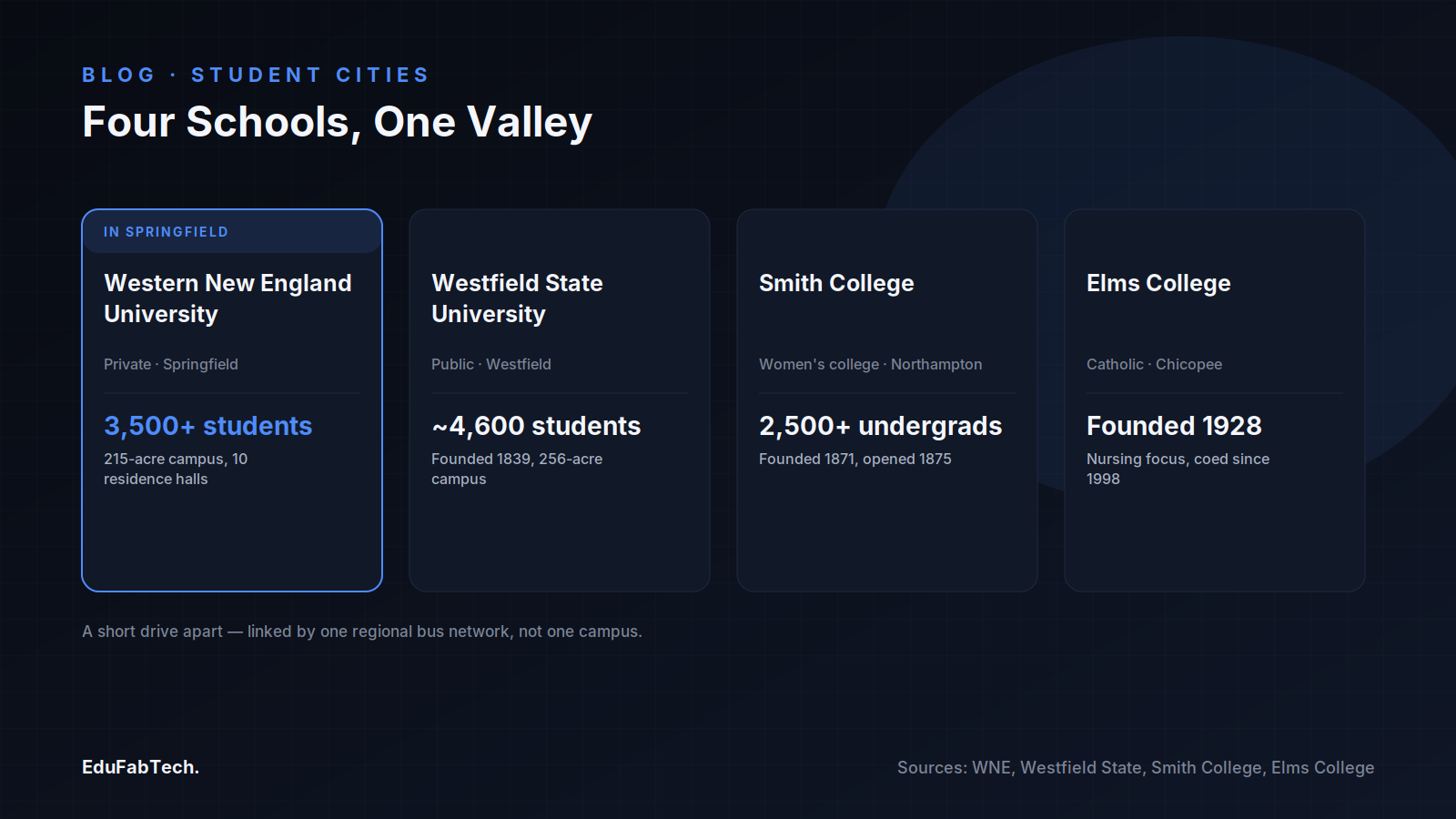
About 20 minutes west of the city, in the town of Westfield, is Westfield State University, a public university that says it was founded in 1839 by the education reformer Horace Mann and now enrolls about 4,600 students on a 256-acre campus next to Stanley Park. As a Massachusetts public university, it is a lower-cost, traditional residential-college option; listings near it are collected on EduFabTech at the Westfield State page. Half an hour north, in Northampton, Smith College is an undergraduate women's college that, by its own account, was founded in 1871 and opened in 1875 with 14 students; it now enrolls more than 2,500 undergraduates and admits both men and women as graduate students. Smith is one of the historic Seven Sisters women's colleges. Finally, in neighbouring Chicopee, Elms College is a private Catholic college founded in 1928 by the Sisters of St. Joseph, coeducational since 1998, granting degrees from the associate through the doctoral level, with a strong nursing programme.
These four do not share a campus or a registrar, but they share a valley, a bus authority and, to a large extent, a rental market. Where you study shapes where it makes sense to live.
Where students live
At WNE most undergraduates in the first years live on campus, which simplifies the housing question enormously for new arrivals: you apply for a room through the university rather than hunting in the city. The ten residence facilities range from traditional quad-style halls to apartment-style buildings, and because the campus is in a residential corner of Springfield rather than downtown, the immediate surroundings are quiet, leafy streets rather than nightlife.
Students who move off campus — and most upper-year and graduate students eventually do — tend to stay in the city's southern and eastern residential neighbourhoods, which feel suburban: Sixteen Acres, East Forest Park and Forest Park. These are districts of single-family homes, bungalows and the three-decker apartment houses that are a signature of New England cities, where a landlord lives on one floor and rents the other two. Forest Park, the neighbourhood, wraps around the large municipal park of the same name and is popular for its mix of older housing and green space. Rooms and whole-apartment listings in the city are gathered on EduFabTech at the Springfield rooms page.
Because the campuses are scattered, the sensible order of decisions is: pick your institution first, then your neighbourhood relative to the bus routes that serve it, then the room. A cheap room that forces a 50-minute multi-bus commute is rarely cheaper once you count the time.
Renting off campus without losing a deposit
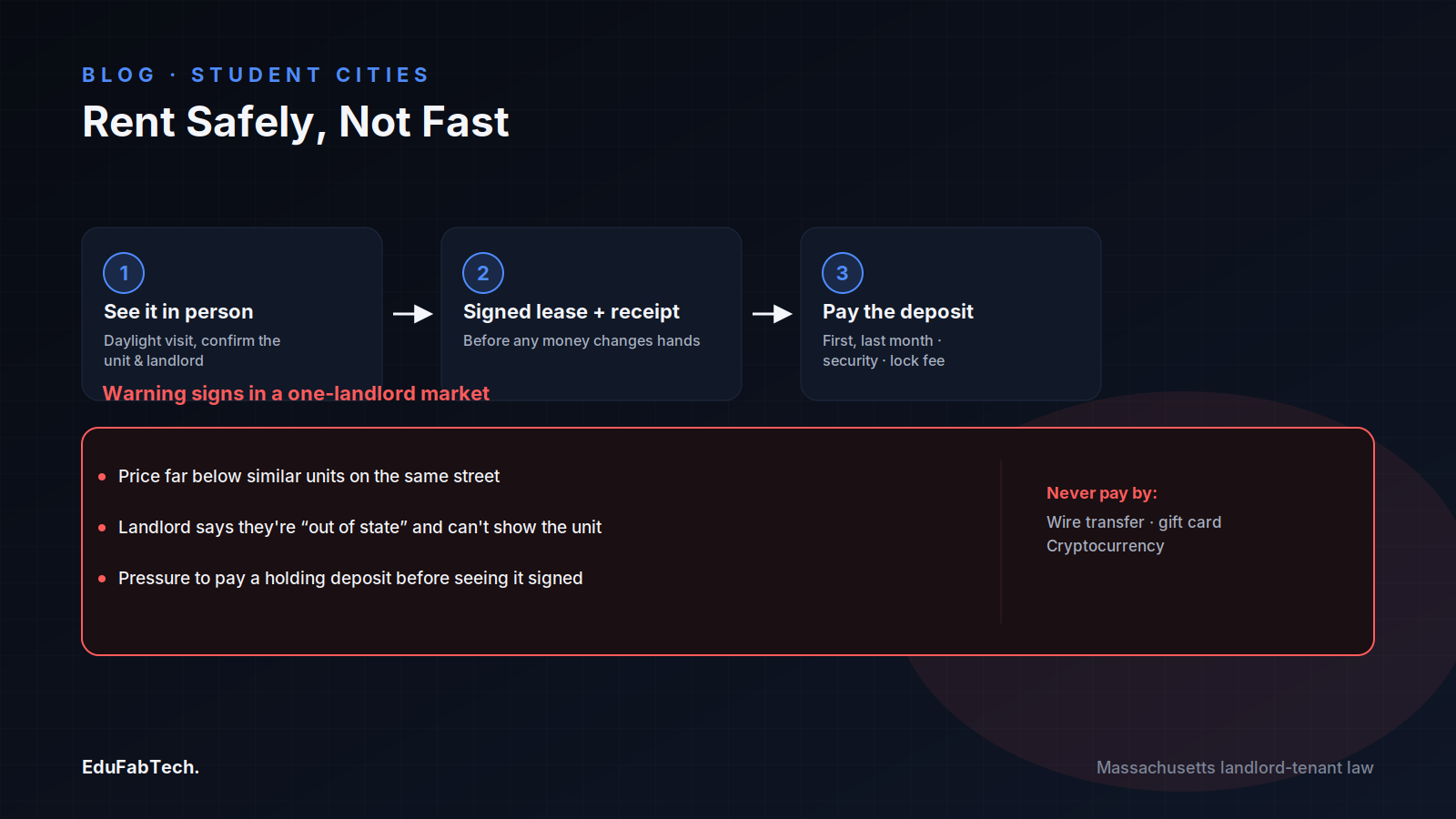
Springfield's off-campus stock is dominated by small private landlords renting flats in two- and three-family houses rather than by large purpose-built student blocks. That shapes how scams work here. The warning signs in this city are the familiar ones for a market of individual landlords: a listing for a triple-decker flat priced well below the others on the same street, a "landlord" who says they are out of state and cannot show the unit, and pressure to pay a holding deposit before you have seen the place or signed anything.
The protective habits are simple and local. See the actual apartment in person, in daylight — in a neighbourhood of similar-looking houses it is worth confirming the unit number and that the person showing it controls the building. Massachusetts law limits and regulates what a landlord may collect up front (first month, last month, a security deposit and a lock fee are the traditional categories), so treat a demand for several months at once, or for vague "fees," as a reason to slow down. Never send money by bank wire transfer, gift card or cryptocurrency to "hold" a room — no legitimate Springfield landlord needs payment in those forms, and they are the methods that cannot be reversed. A signed written lease and a receipt should come before any money changes hands.
Furnishing a room, and where the markets are
An unfurnished flat is the norm off campus, so budget for a bed, a desk and kitchen basics. The cheapest route is almost always second-hand, and the turnover of a student population means furniture circulates constantly at the start and end of each term. EduFabTech keeps a running local list of second-hand furniture in the city — worth checking in late May and late August, when departing tenants leave usable furniture on the kerb.
For food and everyday goods, the seasonal market worth knowing is the Farmers' Market at Forest Park, which — according to Mass Farmers Markets — has run since 1998 and opens every Tuesday from 12:30pm to 6pm through the warmer months, at the Forest Park grounds off Sumner Avenue. It is a produce-and-crafts market rather than a flea market, but it is a cheap, pleasant way to shop and to see the park that gives the neighbourhood its name.
Working while you study
Rules for part-time work depend on your status, and this is one area where you should rely on the official source rather than second-hand advice. For international students on an F-1 visa, the U.S. Citizenship and Immigration Services policy manual states that a student may work at an on-campus job for up to 20 hours per week when school is in session (full-time hours are allowed during official breaks). On-campus work does not require separate employment authorisation from USCIS, but it must be coordinated with your school's Designated School Official (DSO) — the staff member in the international student office who maintains your immigration record. Off-campus work for F-1 students is tightly restricted and generally requires specific authorisation such as Curricular or Optional Practical Training.
Treat the paragraph above as a pointer, not legal advice: confirm your own situation with the international student office at WNE, Westfield State, Smith or Elms before you accept any job, and check the current USCIS text, because the details change. Domestic students face no such federal limit and often find campus jobs the easiest to combine with a timetable. Local openings are collected on EduFabTech at the Springfield jobs page.
Libraries and quiet places to read
On campus, WNE's D'Amour Library is the main study hub, with bookable individual and group study rooms, computer labs and — usefully during exams — a 24-hour study area and a basement computer lab (G26) open around the clock to current students; during term the building itself is open from 7:45am to midnight on weekdays. The other campuses have their own libraries, and Smith and Westfield State both maintain substantial collections open to their students.
Off campus, the Springfield City Library is a genuine resource, not just a fallback. Its Central Library at 220 State Street is a white-marble Carnegie building that opened in 1912, with free Wi-Fi, two dozen public internet computers in Wellman Hall, and reservable meeting rooms. The system runs branches across the city, including ones in the residential neighbourhoods where students cluster — Sixteen Acres on Parker Street, East Forest Park and Forest Park — so a quiet desk is rarely far away. EduFabTech also lists bookable desks and study spaces around the city.
Getting around the Pioneer Valley
The regional operator is the Pioneer Valley Transit Authority (PVTA), whose buses connect Springfield with Westfield, Chicopee, Holyoke, Northampton and Amherst. As of a notice posted on the PVTA website in July 2026, the state-funded "Try Transit" free-fare programme was continuing, meaning fixed-route buses have been fare-free for all riders — but this is a programme with an expiry date that keeps being renewed, so check pvta.com for the current status before you rely on it. Several routes through the Five College towns to the north are run by UMass Transit and are free to those campuses' students year-round. Even when fares return, students should ask their own college about discounted or sponsored passes rather than assume.
The rail hub is Springfield Union Station, a 1926 building downtown that now works as an intermodal centre served by Amtrak intercity trains, CTrail commuter service down the valley toward Hartford and New Haven, and long-distance buses — handy for trips to Boston (less than 90 miles east, per Western New England University) or New York. Springfield is a car-oriented city at heart, laced by Interstates 91 and 90, so a student without a car should weigh commutes carefully; a bike is workable in the flatter river-valley districts but less so in the hillier eastern neighbourhoods.
What it costs, and the honest trade-offs
The clearest dated housing figure comes from the university's own fee page. For the 2026–2027 year, Western New England University lists residence-hall charges (double occupancy) from $8,280 for the traditional quad halls (Berkshire, Franklin, Hampden and Windham) up to $14,180 for the apartment-style Southwood Hall and Evergreen Village, with Commonwealth Hall and the LaRivière Center at $10,450 and Gateway Village at $11,490 — before meal plans. The same page notes a state health-insurance requirement that most students overlook: Massachusetts required most enrolled students to carry insurance, which WNE priced at $2,590 for the 2025–26 year, charged unless you waive it with your own comparable coverage. Build that line into your budget.
Off campus, Springfield is relatively affordable by Massachusetts standards; the U.S. Census Bureau's 2024 American Community Survey one-year estimate, reported via Census Reporter, put the city's median household income at $57,384, a reminder that this is a working city rather than a wealthy college enclave. That is part of the honest picture. In its favour, Springfield offers cheaper rents than Boston or the pricier Five College towns, a real public library system, free buses while the programme lasts, and a river-valley setting with Forest Park and the Berkshires close by. Against it: student life is dispersed rather than concentrated, so the lively single-campus atmosphere of a college town is thinner here; a car makes life much easier; winters are genuinely cold and snowy; and parts of the city have the uneven economic fortunes common to mid-sized post-industrial New England cities, which makes choosing a neighbourhood and seeing a flat in person worth the effort.
Your first two weeks: a checklist
- Confirm your housing: either accept a university room offer, or view any off-campus flat in person before paying, and get a signed lease and receipt first.
- Never pay a deposit by wire transfer, gift card or crypto to hold a room.
- If you are an international student, meet your DSO at the international student office and confirm what work, if any, you may do under your visa.
- Check pvta.com for the current fare status and map the bus routes between your room and your campus.
- Get a Springfield City Library card at the Central Library on State Street, or at a branch near you.
- Budget for the Massachusetts student health-insurance charge, and waive it with proof if you already have comparable cover.
- Furnish from second-hand and free listings in late August, when departing tenants give furniture away.
- If you have no car, test your real commute once before term starts — timing beats guessing.
A quick question for readers
Do you work part-time while you study?
Many students work to pay the bills. See how common it is — and how many hours people really do.
Pick an answer, create a free account in a minute, and your vote counts. Already a member? Sign in
Comments 0
CommentNo comments yet. Members start the conversation.
Source: Western New England University
Sources (5)
- Western New England University. Campus and Undergraduate Cost pages. Western New England University, 2026. wne.edu ↗ · checked 10 Oct 2026
- Westfield State University. About Westfield State. Westfield State University, 2026. westfield.ma.edu ↗ · checked 10 Oct 2026
- Smith College. Smith at a Glance. Smith College, 2026. smith.edu ↗ · checked 10 Oct 2026
- U.S. Citizenship and Immigration Services. Policy Manual, Volume 2, Part F, Chapter 6: Employment. USCIS, 2026. uscis.gov ↗ · checked 10 Oct 2026
- Mass Farmers Markets. The Farmers' Market at Forest Park. Mass Farmers Markets, 2026. massfarmersmarkets.org ↗ · checked 10 Oct 2026