Studying in St. Louis: universities, housing and student life
A practical guide to the city's campuses, the neighbourhoods students rent in, what a room costs, and how to get around on Metro — with every figure traced to its source.
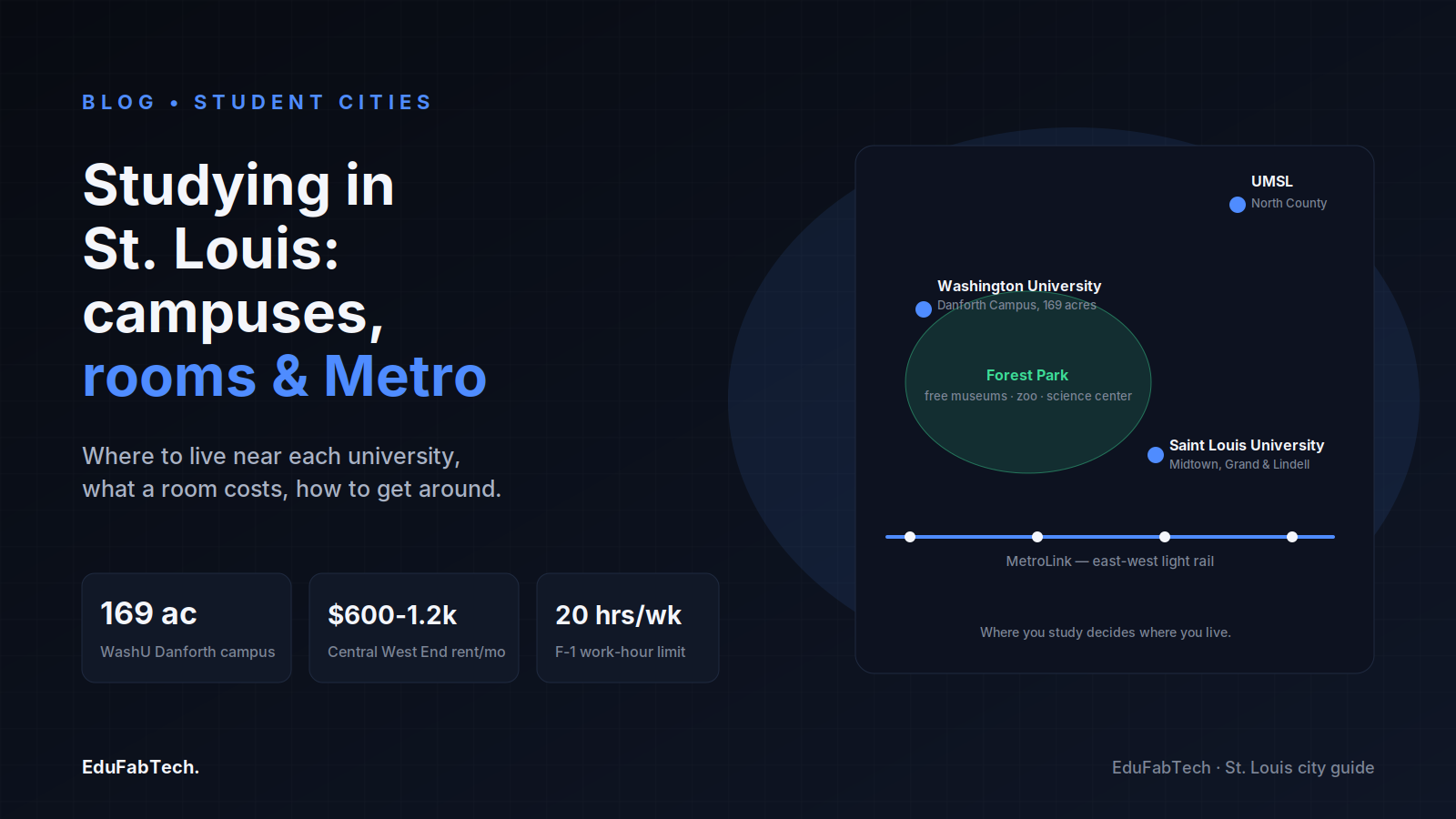
St. Louis sits on the west bank of the Mississippi River, where the Gateway Arch marks the old edge of the United States and the land tips westward into brick neighbourhoods and rolling county suburbs. Its gravitational centre for students is not a downtown but a park: Forest Park, a large municipal park ringed by free institutions — the Saint Louis Art Museum, the Saint Louis Zoo and the Saint Louis Science Center all charge no general admission. A student here can spend a Sunday among paintings or primates without opening a wallet, which changes what a low budget feels like.
There is no single campus quarter. The universities are scattered across the City of St. Louis and a ring of independent municipalities — University City, Clayton, Webster Groves, Creve Coeur, St. Charles — and one sits across the river in Illinois. Where you study largely decides where you live, because the city's spine of public transit, the east–west MetroLink light rail, connects some campuses tightly and skips others entirely.
The texture of the place is red brick: two-family flats, gabled "painted brick" fronts, and the dense older neighbourhoods south and west of downtown. Rents are modest by the standards of American coastal cities, and that is the city's quiet advantage for students. It is also a city shaped by a sharp north–south geography of wealth and investment — locally known from the Delmar Boulevard dividing line — so safety and upkeep can change block to block rather than district to district. Winters are genuinely cold and summers hot and humid.
From the Danforth Campus to Midtown: the universities
The two largest private universities anchor opposite sides of Forest Park. Washington University in St. Louis centres on its Danforth Campus, which the university describes as a roughly 169-acre expanse of collegiate-gothic buildings bordered by Forest Park and the municipalities of Clayton and University City (facilities.wustl.edu). Most undergraduates study within Arts and Sciences at Washington University in St. Louis, the liberal-arts core, while the medical school and hospitals sit a couple of miles east in the Central West End. WashU is best known internationally for medicine and research.
Saint Louis University is a Jesuit university in Midtown, clustered around Grand and Lindell Boulevards a few miles west of the riverfront (slu.edu). Its undergraduate liberal-arts programmes run largely through the Saint Louis University College of Arts and Sciences, and the campus is a walkable mix of historic halls, the College Church and the Chaifetz Arena. A short distance away, also in Midtown, Harris–Stowe State University is the city's historically Black public university, on Laclede Avenue; it traces its origins to an 1857 teachers' college, the first public normal school west of the Mississippi (hssu.edu).
The public option within the city limits' orbit is University of Missouri–St. Louis, which calls itself the largest public research university in eastern Missouri, with a campus of rolling hills in north St. Louis County split into North and South Campus by Natural Bridge Road and established in 1963 (umsl.edu). Around the suburbs sit several more degree-granting institutions. Webster University has its main campus in the leafy suburb of Webster Groves, founded in 1915 as Loretto College and now running campuses on several continents, including Geneva and Vienna (webster.edu). Maryville University is a private university in Town and Country, founded in 1872 (maryville.edu). Lindenwood University occupies a historic campus in St. Charles, west across the Missouri River, with roots going back to 1827 (lindenwood.edu). Missouri Baptist University is a private Christian university in west St. Louis County near Creve Coeur (mobap.edu), and Concordia Seminary in Clayton is a Lutheran Church–Missouri Synod seminary established in 1839 that trains pastors and church leaders (csl.edu). Across the river, Southern Illinois University Edwardsville is a large public university on a wooded campus in Edwardsville, Illinois, a short drive from downtown (siue.edu).
Two smaller campuses are worth knowing. The University of Health Sciences and Pharmacy in St. Louis sits within the Washington University Medical Campus in the Central West End, a block from a MetroLink stop (uhsp.edu; WashU announced in February 2026 that it plans to acquire it and turn its pharmacy programme into a new WashU school). For two-year programmes and transfer pathways, St. Louis Community College–Florissant Valley serves the north county in Dellwood. You can browse student listings across all of these on EduFabTech's St. Louis city page.
Neighbourhoods students actually rent in
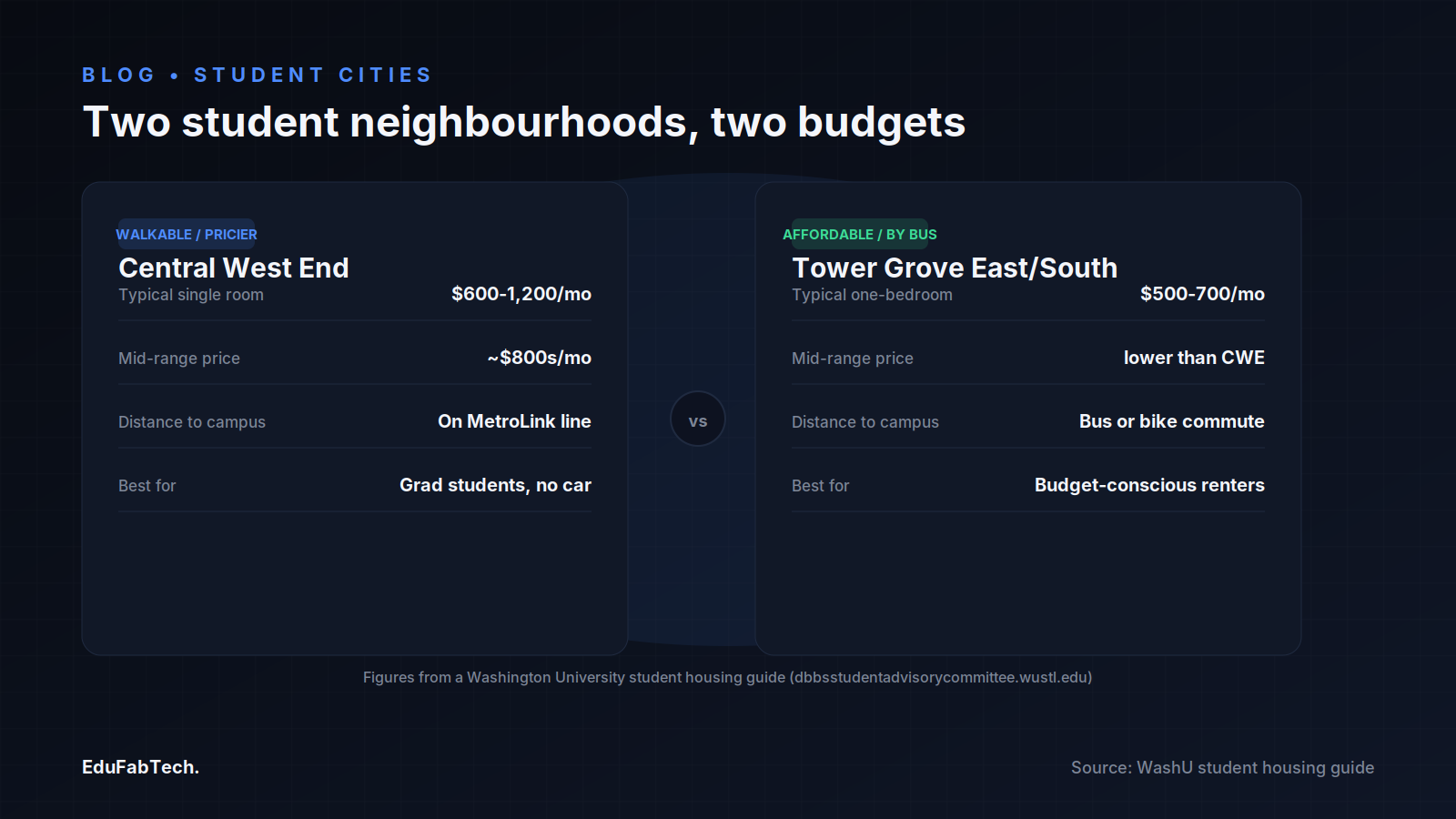
The Central West End is the dense, walkable district beside Forest Park and the medical campuses, with dozens of restaurants, cafés and its own MetroLink station; it is popular with graduate students, young doctors and anyone who wants to live without a car, and it is one of the pricier city neighbourhoods. A Washington University student guide lists Central West End single rooms running roughly US$600–1,200 a month, with the mid-$800s typical (dbbsstudentadvisorycommittee.wustl.edu).
Skinker-DeBaliviere tucks between Forest Park and the Delmar Loop, a residential pocket of renovated buildings a couple of MetroLink stops from the Danforth Campus, which makes it a favourite of WashU students who want a quieter street but a fast commute. Immediately north, the Delmar Loop in University City is the student entertainment strip — music venues, cheap eats and coffee shops that fill with undergraduates in term — with housing from student flats to family homes. Midtown and Grand Center, the arts district around SLU and Harris–Stowe, puts you within walking distance of class and the theatres, though some blocks are still filling in.
Tower Grove East and Tower Grove South, in the south city beside Tower Grove Park and the Missouri Botanical Garden, are diverse, lower-cost neighbourhoods popular with students willing to commute by bus or bike; the same WashU guide puts one-bedroom flats around the Grand and Tower Grove area near US$500–700. Dogtown, a historic, quiet residential neighbourhood just south of Forest Park, offers older houses and classic bars but is not walkable to campus — you will want a bike, a bus route or a car. You can filter rooms by area on EduFabTech's St. Louis rooms page, or by campus near Washington University in St. Louis and Saint Louis University.
Finding a room without losing a deposit
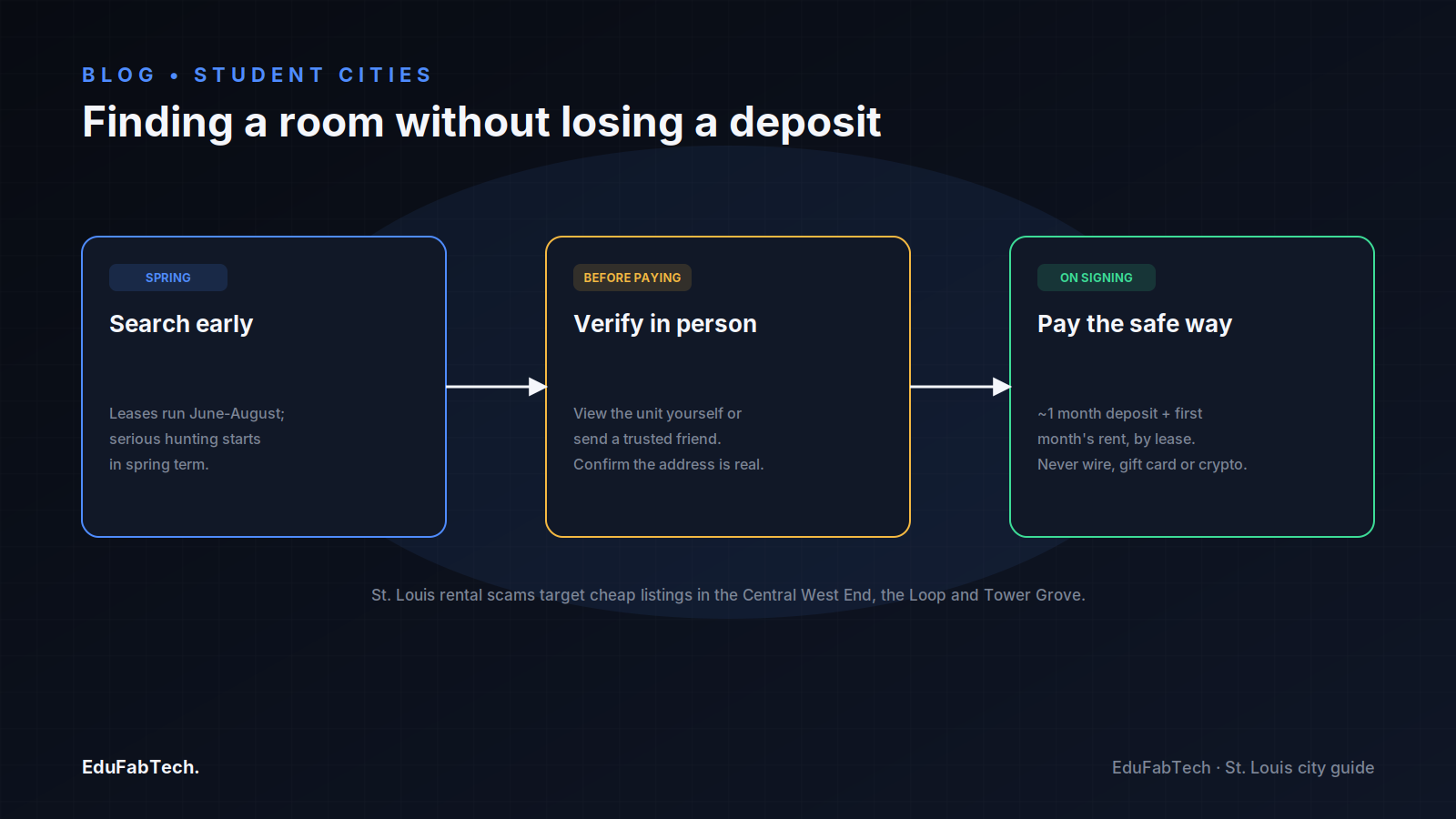
The academic year opens in mid-to-late August, and the city's private rental market turns over with it: most leases run from June through August, so the serious looking happens in spring. If you want a university dormitory, reserve it as early as your housing portal allows, because the closest halls fill first. For off-campus flats, expect to pay a security deposit — commonly about one month's rent — plus the first month on signing.
St. Louis rental scams tend to follow the same pattern: an unusually cheap listing in a desirable area like the Central West End, the Loop or Tower Grove, posted by someone who is "out of town" and cannot show the unit, who then asks you to secure it before anyone else. See the place in person before you pay anything, or send a friend or current student to view it for you and confirm the address is a real, rentable unit. Never send a deposit or "holding fee" by bank wire, gift card or cryptocurrency — legitimate landlords here do not need money moved that way to hold a room, and those transfers cannot be reversed. Keep every receipt and a signed lease.
Furnishing a room on the cheap
The city rewards second-hand shoppers. Cherokee Antique Row, along the 1900–2300 blocks of Cherokee Street, is a stretch of independent antique, vintage and art shops where, as Explore St. Louis puts it, "you'll find antiques, fashion, local art and delightful gifts dotted along this historic street" (explorestlouis.com) — good for a desk, a lamp or a chair with character. For food, the Soulard Farmers Market, operated by the City of St. Louis in the Soulard neighbourhood and open Wednesday through Saturday, is a cheap and central source of produce (stlouis-mo.gov). Estate sales are a local institution in the older suburbs, and at the end of the spring semester departing students give away furniture in bulk. EduFabTech lists local second-hand things, used furniture and items offered free in the city.
Working while you study
Most students start with on-campus jobs — library desks, dining halls, research and teaching assistance. The rules are different for international students. A person on an F-1 student visa may work at a qualifying on-campus job and, as U.S. Immigration and Customs Enforcement states, "may work up to 20 hours per week while school is in session," with full-time hours allowed during official breaks (ice.gov). Off-campus work and training programmes such as Curricular Practical Training and Optional Practical Training require separate authorisation and eligibility. This is general information, not legal advice: confirm your own situation with your university's international student office and the official ICE guidance before you accept any job. Local openings are collected on EduFabTech's St. Louis jobs page.
Libraries and places to read
Beyond your own campus library, the St. Louis Public Library system is open to the public and free to join. Its Central Library downtown at 1301 Olive Street opens Monday through Thursday until 8 p.m., with shorter weekend hours, and offers reservable meeting rooms, free Wi-Fi and quiet desks (slpl.org). The Schlafly Library in the Central West End, at 225 N. Euclid Avenue, is a second branch with meeting rooms and Wi-Fi close to the medical campuses (slpl.org). A library card gives you a desk and reliable internet in two parts of the city at once. EduFabTech also lists bookable study spaces and desks around town.
Getting around on Metro
Public transit here is run by Metro Transit, which operates the two MetroLink light-rail lines and the MetroBus network. MetroLink's east–west route is the practical student artery: stations at Central West End, Forest Park-DeBaliviere, Skinker, University City–Big Bend and the Delmar Loop link the WashU neighbourhoods, while the Grand station serves Midtown near SLU. Five local institutions — Saint Louis University, University of Missouri–St. Louis, St. Louis Community College, Washington University in St. Louis and Southwestern Illinois College — run a customised Metro U-Pass for unlimited rides (metrostlouis.org). Washington University provides full-time registered students a complimentary U-Pass (universityservices.washu.edu). Full-time students who attend a college or university within the Metro service area can buy a Metro Student Semester Pass for US$175 with a valid student ID and proof of full-time enrolment (metrostlouis.org). Away from the rail line, you will lean on buses, a bike or a car; much of the inner city is flat and ridable.
What a year costs
The clearest figures come from the universities' own fee pages. For 2026-27, Washington University in St. Louis set undergraduate tuition at US$71,310, a double room between US$14,530 and US$15,150 for the year, and meal plans from US$6,032 to US$9,122 (source.washu.edu). Saint Louis University's published 2026-27 residence-hall rates are charged per semester — for example, a standard double room in Griesedieck Hall is US$4,038 and a single in Reinert Hall with a private bath is US$5,394 (slu.edu). Those dormitory figures, plus the US$175 Metro semester pass, are the housing-and-transport numbers you can rely on from a primary source; the broad off-campus rent ranges above come from a university student guide rather than an official statistics office, so treat them as indicative. Tuition at the public and suburban universities differs widely and depends on residency, so check each institution's own cost-of-attendance page.
What is good, and what is hard
For students, St. Louis buys a lot for a modest budget: housing cheaper than the coasts, Forest Park's free museums and zoo, genuine neighbourhoods with their own character, short commutes along the MetroLink spine, and a sports-and-music culture that is easy to join. What is hard is just as real. Beyond the rail line the city is car-oriented, and bus trips can be slow. Investment and safety vary sharply by block rather than by broad district, so the specific street matters when you choose a room. The weather swings from cold winters to heavy summer humidity. And the smaller colleges face financial strain — Fontbonne University in Clayton, a century-old institution, closed after its summer 2025 session — a reminder to check that any programme you join is on solid footing.
A checklist for the first weeks
- Confirm your housing in writing, view the unit in person or through someone you trust, and keep copies of the lease and every deposit receipt.
- Collect your student ID, then register your Metro U-Pass if your university offers one, or buy the US$175 Student Semester Pass.
- If you are an international student, visit your international student office in person and make sure you understand the 20-hour on-campus work limit before accepting any job.
- Get a free St. Louis Public Library card for desks and internet at the Central Library and Schlafly Library.
- Learn your nearest MetroLink station and the bus routes that reach your campus.
- Furnish cheaply on Cherokee Antique Row, at estate sales, and through end-of-term giveaways; check EduFabTech's St. Louis events for move-in season.
A quick question for readers
Do you work part-time while you study?
Many students work to pay the bills. See how common it is — and how many hours people really do.
Pick an answer, create a free account in a minute, and your vote counts. Already a member? Sign in
Source: Washington University in St. Louis (The Source)
Sources (5)
- Washington University in St. Louis. 2026-27 tuition, housing, meal plans, fees announced. The Source (WashU), 2026. source.washu.edu ↗ · checked 3 Oct 2026
- Saint Louis University. Room and Board Rates. Saint Louis University, 2026. slu.edu ↗ · checked 3 Oct 2026
- Metro Transit. Student Passes. Metro Transit (Bi-State Development), St. Louis, 2026. metrostlouis.org ↗ · checked 3 Oct 2026
- U.S. Immigration and Customs Enforcement. Employment (SEVIS, F-1 students). ICE, 2026. ice.gov ↗ · checked 3 Oct 2026
- St. Louis Public Library. Central Library. St. Louis Public Library, 2026. slpl.org ↗ · checked 3 Oct 2026