Studying in State College: universities, housing and student life
A practical, sourced guide to living and studying in State College, Pennsylvania — a town built around one very large campus, with named figures for housing, transport and student work.
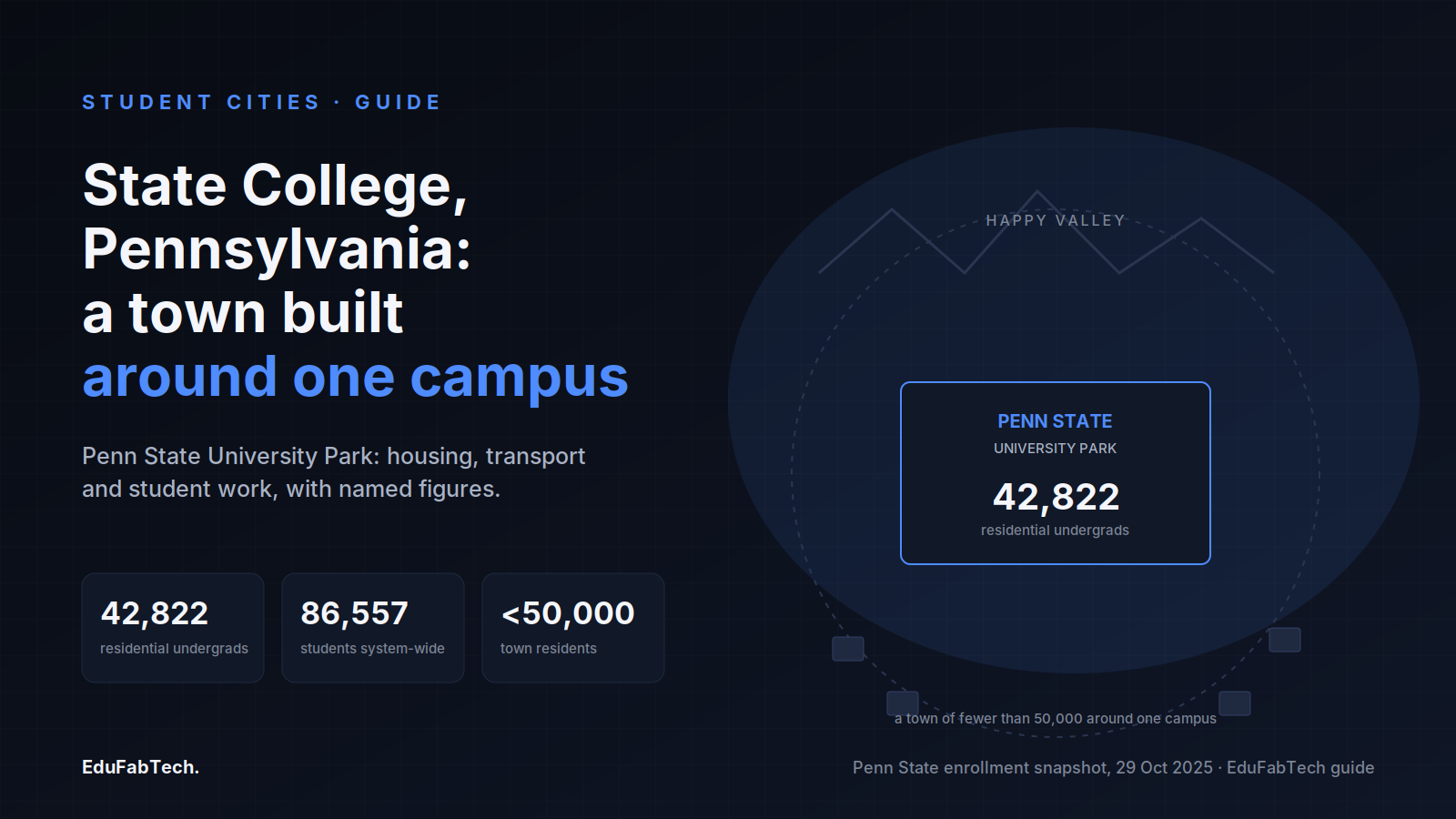
State College sits in a mountain-ringed bowl of central Pennsylvania that locals call Happy Valley, roughly equidistant from Pittsburgh, Philadelphia and the New York line and close to nothing in particular. That isolation shapes everything about student life here: the town exists because the university does. The borough of State College and the surrounding College, Harris and Patton townships in Centre County wrap tightly around one campus, and when the semester empties out the population of the area drops by tens of thousands. Almost every rhythm — rents, bus timetables, the queue at a coffee shop — tracks the academic calendar.
The campus is Penn State University Park, the flagship of The Pennsylvania State University, which was founded in 1855 as the Farmers' High School of Pennsylvania and became the state's land-grant institution in 1863. Penn State's own facts page describes it as one of only three land-, space-, sun- and sea-grant universities in the United States, with more than 86,000 students system-wide across its campuses. University Park is by far the largest of those campuses, and it is the one physically in State College.
How large is "large"? According to Penn State's enrollment snapshot released on 29 October 2025, a record 42,822 residential undergraduates were enrolled at University Park that autumn, part of 86,557 students across the whole university. A town of fewer than 50,000 permanent residents therefore hosts a campus population larger than many small cities. For a new student that means a vast range of courses, libraries, labs and events — and a competition for rooms every August that newcomers underestimate.
Penn State University Park, and the hospitality school within it
University Park is a comprehensive research university: engineering, agricultural sciences, the Smeal College of Business, the liberal arts and a large College of Health and Human Development all sit on one contiguous campus. For international and out-of-state applicants the name to know besides the university itself is the Pennsylvania State University School of Hospitality Management, housed in the College of Health and Human Development. It grants a Bachelor of Science in Hospitality Management alongside master's and doctoral degrees, with emphases across restaurant, hotel and institutional operations — a distinct degree, not a short course, taught on the same University Park campus.
Studying here feels less like being in a city and more like being inside an institution that happens to have a town attached. The campus runs its own bus loops, its own ice rink, its own creamery; downtown State College begins immediately at the campus's southern edge along College Avenue and Beaver Avenue, so the walk from a lecture hall to a sandwich shop can be shorter than the walk between two lecture halls. Autumn Saturdays reorganise the whole area around football at Beaver Stadium, and anyone planning to study, shop or travel on a home-game weekend should check the schedule first.
Where students live, from East Halls to the downtown high-rises
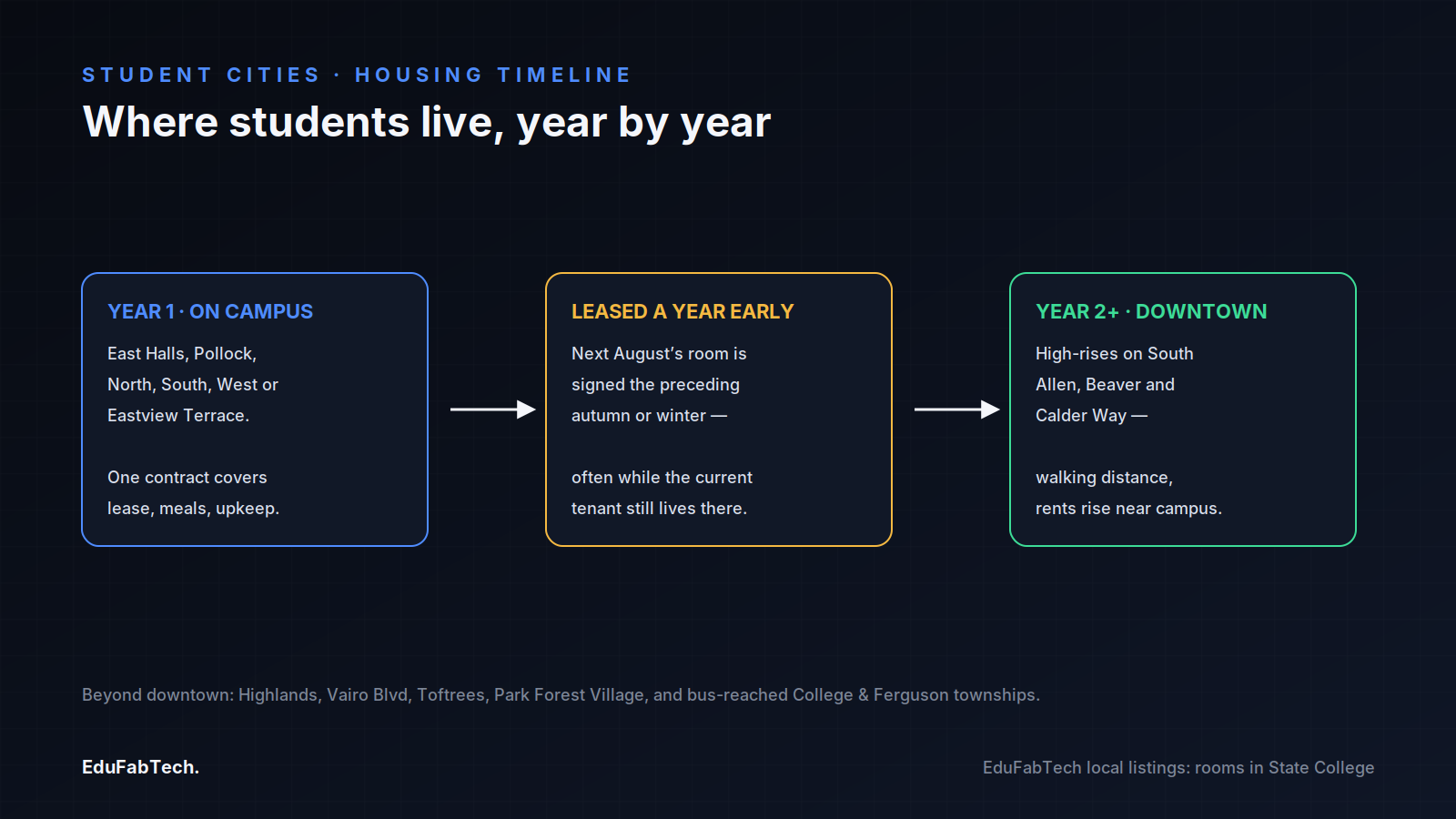
First-year undergraduates are generally housed on campus, and Penn State's residence halls are grouped into named precincts a new arrival will hear constantly: East Halls (the largest, closest to the engineering and science buildings and to most first-years), Pollock, North, South, West and the apartment-style Eastview Terrace. Living in one of these for the first year is the simplest way to land softly, because the contract, the meal plan and the maintenance all run through one office rather than a private lease.
After first year most students move off campus, and in State College "off campus" has a particular geography. The downtown blocks along South Allen, Beaver and Calder Way are dense with purpose-built student apartment buildings, many of them high-rises, within walking distance of class. Beyond downtown the search spreads outward: the Highlands neighbourhood immediately south of campus, the apartment clusters along Vairo Boulevard and Toftrees to the north, Park Forest Village to the west, and the student complexes in College Township and Ferguson Township reached by bus. Rents fall as you move away from College Avenue and rise sharply the closer you get to it. If you want to compare what is on offer before you arrive, EduFabTech keeps local listings at rooms in State College and a wider index at all student listings in the city.
The timing here is unusual and catches people out. Because demand is concentrated and supply is finite, leases for the following August are frequently signed the preceding autumn or winter — students often commit to a September room while the previous tenant is still living in it. That early cycle is normal locally, but it should never pressure you into paying before you have seen what you are renting.
Renting without being scammed in a tight market
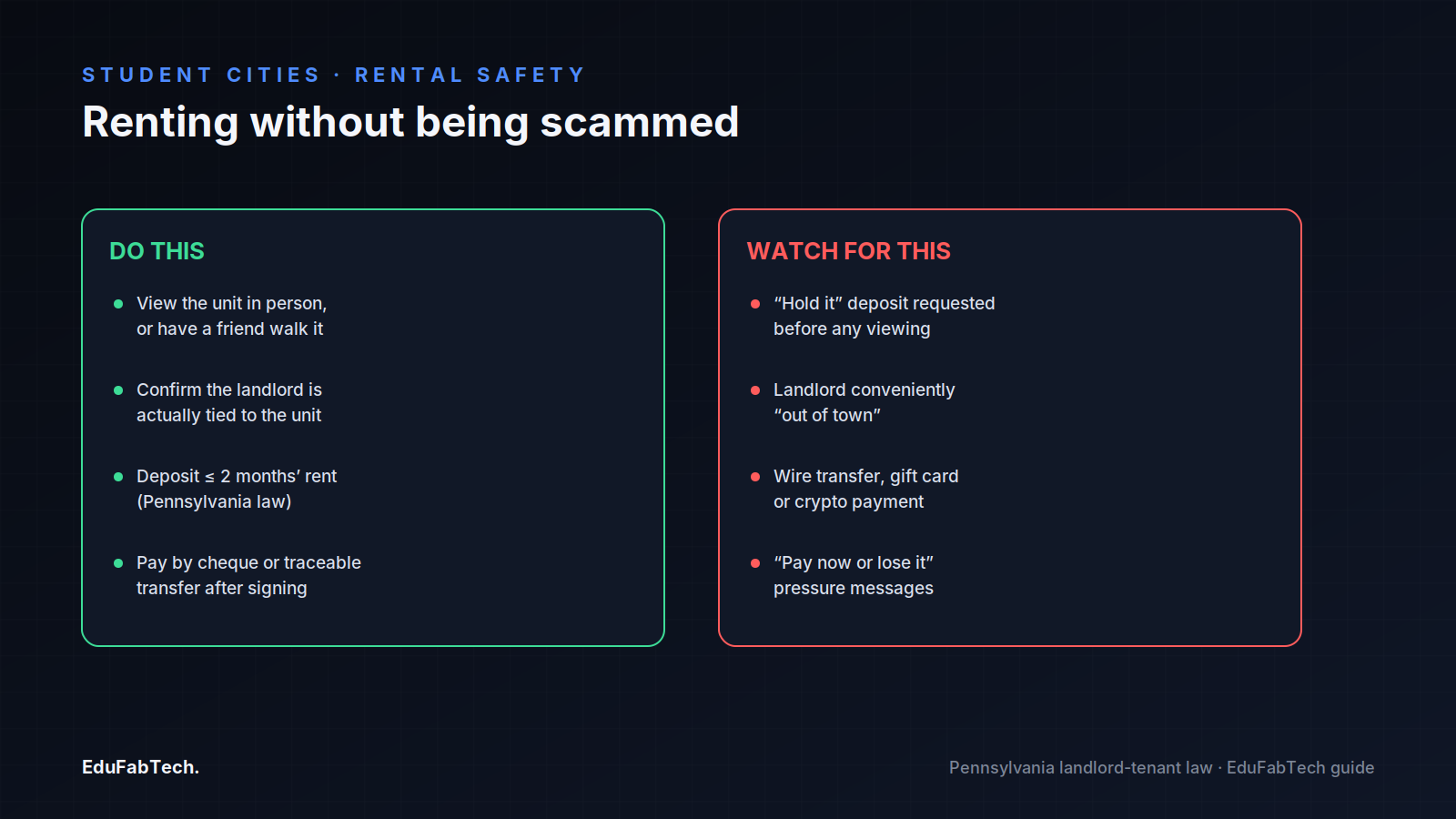
The scam pattern in State College follows the shortage. When rooms near campus are scarce and leased far in advance, fake "available now" or "sublet for the semester" posts appear — often a real building downtown, a price slightly below the going rate, and a landlord who is conveniently out of town. The request that follows is always the same: send a deposit or a month's rent to "hold" it before you can view it.
Do not. In State College you can almost always arrange an in-person viewing, or ask a friend already in town to walk through a unit, because the inventory is physically compact and concentrated downtown. Confirm that the building and unit exist and that the person collecting money is actually connected to it. A normal local arrangement is a security deposit plus first month's rent paid by cheque or traceable transfer once you have a signed lease; under Pennsylvania's landlord-tenant law a security deposit in the first year may not exceed two months' rent. Never pay a deposit by bank wire to an individual, by gift card, or by cryptocurrency to reserve a room sight unseen — those methods are untraceable and are the tell-tale of a fraud. Treat any "pay now or lose it" message as a reason to slow down, not to hurry.
Furnishing a room cheaply: thrift stores and the Friday market
Because thousands of students arrive and leave every year, State College has a steady churn of second-hand furniture, kitchenware and bikes — especially at the end of spring semester, when departing tenants give things away. A local guide published by StateCollege.com lists, among others, a St. Vincent de Paul thrift store at 1300 Benner Pike and a Salvation Army store at 2790 West College Avenue, both in State College and reachable by bus. For food, the Downtown State College Farmers Market is marking its 50th anniversary in 2026; StateCollege.com reports it is held on Locust Lane off College Avenue every Friday through the growing season, and it is a cheaper, fresher alternative to the supermarkets for part of the year.
The end-of-year handover is also where free furnishing happens: couches, lamps, fans and desks left in lobbies and on kerbs in the downtown apartment blocks every May. If you are arriving for the autumn, it is worth asking outgoing students in your building what they are discarding. EduFabTech's local page for second-hand furniture in State College collects some of this in one place.
Part-time work, and what the rules are for international students
Term-time jobs in State College cluster around the university and the downtown it feeds: dining halls, the library system, research labs, cafés, shops and the hospitality businesses that fill up on game weekends. EduFabTech lists openings on its State College jobs page, but what you are allowed to do depends on your immigration status, and that is governed by federal rules, not local ones.
For students on an F-1 visa, the U.S. Citizenship and Immigration Services policy manual states that F-1 status permits students, with Designated School Official approval, to work at an on-campus job for up to 20 hours per week when school is in session, and that F-1 students engaged in on-campus employment are not required to apply for employment authorization with USCIS. That 20-hour ceiling is a combined total across all jobs, and off-campus work (including CPT and OPT) has separate conditions. This is a summary of a public rule, not legal advice: before accepting any job, confirm your own case with Penn State's Directorate of International Student and Scholar Advising, whose office you can reach through the University Office of Global Programs. They handle the paperwork and the Social Security number process that paid on-campus work requires.
Libraries and places to study
The centre of academic life is the connected Pattee Library and Paterno Library on the campus mall. Beyond the collections, the buildings are organised around study: Penn State University Libraries describes quiet study floors in both wings and a Knowledge Commons in West Pattee whose group study rooms can be reserved for up to three hours, equipped with whiteboards and large screens for wireless projection. There is a Central Atrium with open seating, a Collaboration Commons in West Pattee where talking is allowed, and quiet floors in both wings where it is not.
The library system runs well beyond this one building — there are subject libraries across campus for engineering, the physical sciences, business and the arts — and quiet corners also exist in the HUB-Robeson Center student union and in the downtown coffee shops along College Avenue. For desks and study-space listings close to campus, EduFabTech keeps a study spaces page. A practical note: at exam time the main library fills early, so the reservable group rooms are worth booking a day ahead rather than hoping for a free table.
Getting around: CATA, the free campus loops, and the car question
Public transport in State College is run by the Centre Area Transportation Authority (CATA), and it is unusually good for a town this size precisely because it was built around the university. CATA's fare page lists a full cash fare of $2.50 per trip, with a one-month OnePass at $98.00 and a four-month pass at $383.00. Two routes that circulate through campus and downtown — the LOOP and the LINK — are fare-free for everyone, which covers a large share of the trips a student actually makes. CATA also notes that its reduced-fare RIDEpass programme serves eligible full-time Penn State employees and graduate students, so check your own eligibility rather than assuming a blanket student discount.
The upshot is that you can live car-free in State College more comfortably than in most American towns of its scale, especially if you stay within the LOOP and LINK corridors or along a frequent CATA line. A car is useful mainly for leaving the valley — the nearest larger cities are a two-to-three-hour drive — and downtown parking is limited and metered. Many students never bring one.
What things cost — the figures you can check
The one housing cost you can verify from a primary source is the on-campus rate. For the 2026-27 academic year, Penn State's Board of Trustees set the University Park rate for a traditional double room at $4,150 per semester, with the mid-level meal plan at $2,988, for a combined $7,138 per semester; the university put the aggregate increase at 2.85%, its smallest in seven years, and the projected annual housing-and-food cost of $14,276 below the Big Ten average of $15,505. Those are Penn State's own figures for a dormitory room and meal plan, published in 2026.
Off-campus rents are harder to pin to a single authoritative number because they vary so much by distance from College Avenue and by how many people share a unit, so treat any single figure with caution and compare several current listings yourself. Tuition, likewise, differs by residency and by college and is best read directly from the Penn State bursar rather than from summaries; it is substantially higher for out-of-state and international students than for Pennsylvania residents. Build your budget from the numbers you can source — the dormitory rate above, the bus fares above — and verify the rest against official pages before you commit.
What is good, and what is hard
The good is real. State College is compact, walkable and well served by free and cheap buses; the university concentrates libraries, jobs, sport and events within a short radius; and the setting is genuinely beautiful. For a student who wants a self-contained campus life without a car, few American towns deliver it better.
The hard is equally real. The isolation that makes the valley feel self-contained also puts it far from a major airport or a big city, which matters for international students flying home. Housing near campus is tight and leased far ahead, pushing prices up and forcing decisions early. Game weekends flood the town. And the winters in central Pennsylvania are long, grey and cold, with real snow — something students from warmer places routinely underestimate. None of this is a reason to stay away; all of it is a reason to arrive prepared.
A short checklist for the first weeks
- Sort housing before you sign anything: view the unit in person or have someone you trust view it, confirm the address and the landlord, and never wire a deposit to hold a room you have not seen.
- If you are on an F-1 visa, meet Penn State's international advising office early, get your paperwork and Social Security process started, and keep on-campus work within the 20-hour weekly limit while classes are in session.
- Download the CATA schedule, learn which stops near you are on the free LOOP and LINK routes, and decide honestly whether you need a car (most don't).
- Reserve a Knowledge Commons group room in advance for busy weeks instead of hunting for a seat at the last minute.
- Furnish from the Benner Pike thrift stores and the end-of-semester giveaways rather than buying new, and use the downtown farmers market while it runs.
- Use EduFabTech's listings near Penn State to find rooms and services in your first fortnight.
A quick question for readers
Do you work part-time while you study?
Many students work to pay the bills. See how common it is — and how many hours people really do.
Pick an answer, create a free account in a minute, and your vote counts. Already a member? Sign in
Comments 0
CommentNo comments yet. Members start the conversation.
Source: The Pennsylvania State University
Sources (5)
- The Pennsylvania State University. Board of Trustees approves modest increases to 2026-27 housing and food rates. Penn State News, 2026. psu.edu ↗ · checked 8 Oct 2026
- The Pennsylvania State University. Penn State remains a top higher education destination in 2025. Penn State News, 2025. psu.edu ↗ · checked 8 Oct 2026
- Centre Area Transportation Authority. Fare Options & Information. CATA, 2026. catabus.com ↗ · checked 8 Oct 2026
- The Pennsylvania State University. Pattee Library and Paterno Library — Rooms & Spaces. Penn State University Libraries, 2026. libraries.psu.edu ↗ · checked 8 Oct 2026
- U.S. Citizenship and Immigration Services. Policy Manual, Volume 2, Part F, Chapter 6: Employment. USCIS, 2026. uscis.gov ↗ · checked 8 Oct 2026