Studying in Statesboro: Georgia Southern University, housing and student life
A practical, sourced guide to Georgia Southern's home town in the Georgia coastal plain — halls, rents, the $1 city bus, second-hand shops, work rules and the honest trade-offs.
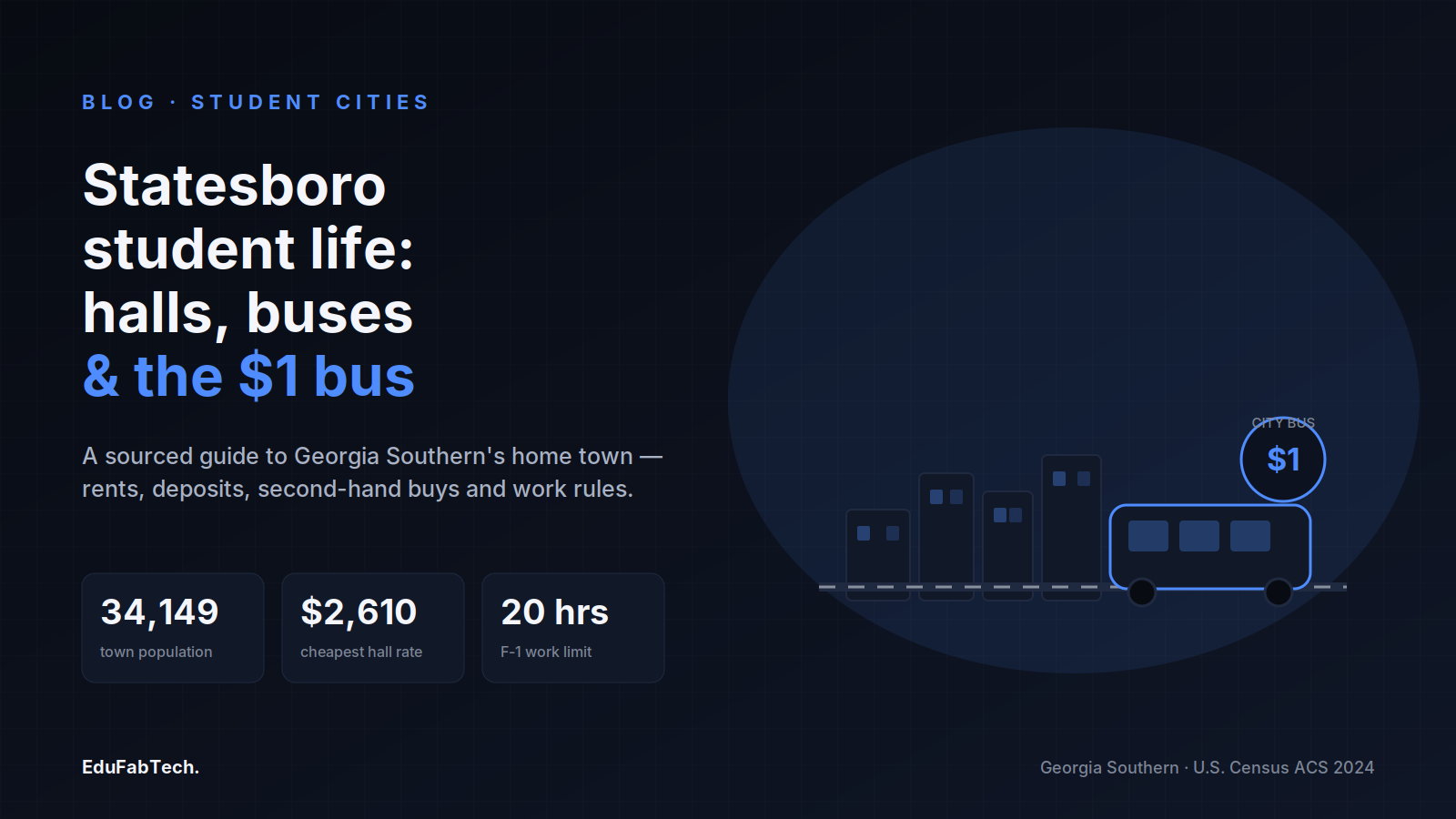
Statesboro sits in the flat pine country of the Georgia coastal plain, in Bulloch County, roughly an hour's drive inland from Savannah and the Atlantic. It is a small city built around one large institution: take the students away and the population would be a fraction of what it is. The U.S. Census Bureau's American Community Survey (ACS 2024 five-year estimates, via Census Reporter) counts about 34,149 residents and a median household income of $44,737 — a reminder that, outside term, this is a modest working town, not a wealthy suburb.
That matters for anyone planning to live here. Summers are long, hot and humid; the academic rhythm, football Saturdays and the slow emptying of the town over winter break shape everything from bus timetables to how easy it is to find a cheap sofa in January. This guide pulls together the figures that are actually published — residence-hall rates, bus fares, census numbers, federal work rules — and is honest about the rest.
What you will not find here is a ranking of the university; where a figure has a reliable source it is named and linked, and where none exists that is said plainly.
Georgia Southern University: one university, several campuses
Georgia Southern University is the reason most students come to Statesboro. The university's own About page dates its institutional life to 1906, when it began with four faculty and 15 students, and describes a present-day institution of more than 27,500 students and 2,000 faculty and staff, organised into ten colleges offering certificates and undergraduate, graduate and doctoral degrees. It is a public university in the University System of Georgia.
The same page explains something that confuses newcomers: Georgia Southern is not only in Statesboro. It runs several campuses — the residential Statesboro campus, the Armstrong campus in Savannah and the Liberty campus in Hinesville — alongside online programmes. For most undergraduates the Statesboro campus is the one that defines daily life: a large, pedestrian-centred core campus with its own transit loop and the residential college atmosphere Georgia Southern is known for. If you are comparing programmes between the Statesboro and Savannah campuses, check which buildings your specific courses meet in before you sign a lease, because the two are about an hour apart.
Studying here is shaped by scale. With tens of thousands of students in a town this size, large introductory lectures, busy labs and a packed first-week housing rush are normal. The upside is that almost everything — library, gym, dining, the Saturday farmers' market, the main student bars — is within a short ride, and the cost of living reflects a small Southern town rather than a coastal city.
Where students sleep: halls first, then the apartment belt
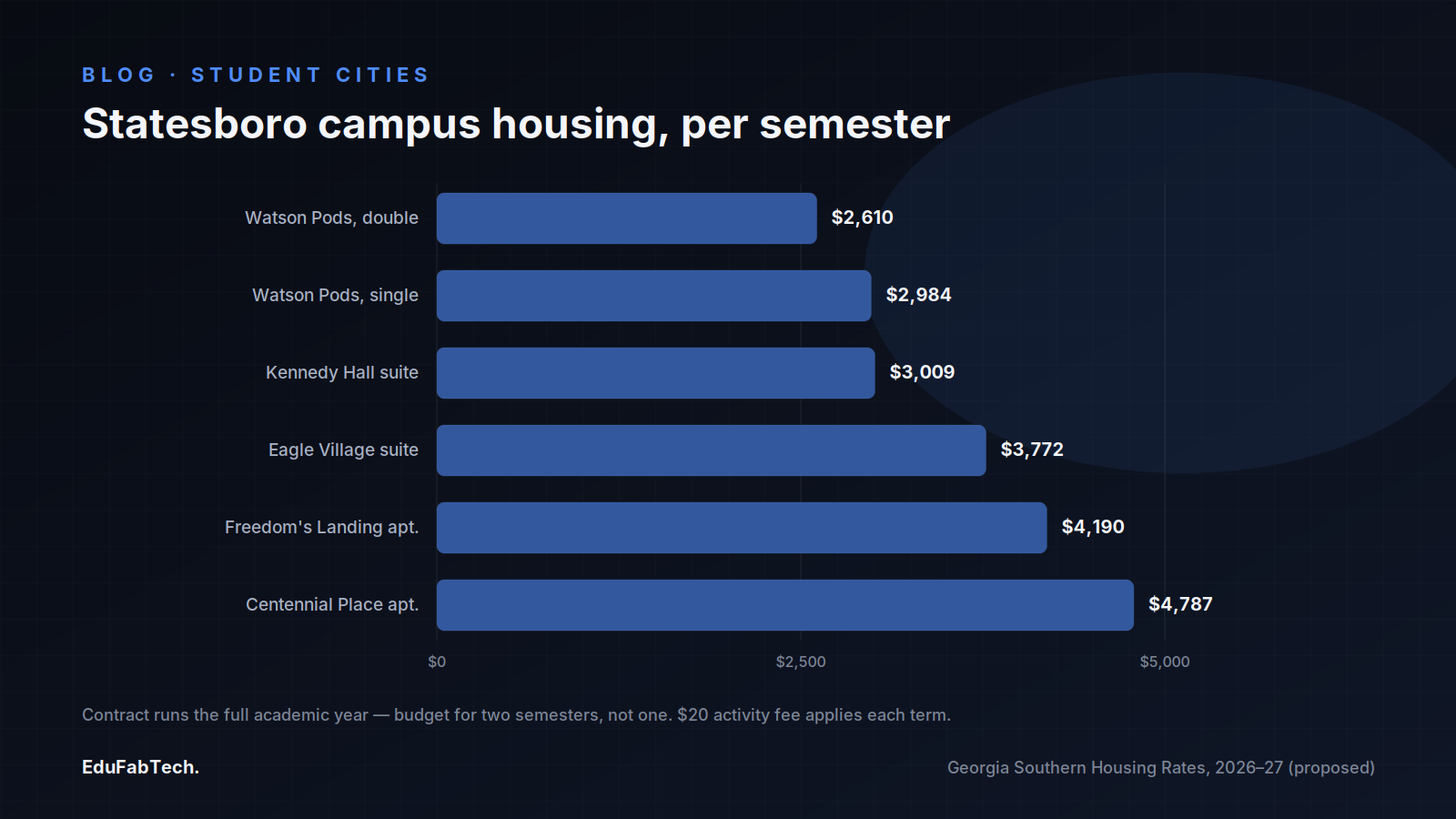
First-year undergraduates at Georgia Southern typically start in university housing, and the rates are published in full. For the Statesboro campus in 2026-2027, Georgia Southern's housing rates page lists the cheapest option as a double room in the Watson Pods at $2,610 per semester, with a large single there at $2,984. Suite-style halls run higher — Kennedy Hall connected suites at $3,009, Eagle Village four-bedroom suites at $3,772 — and apartment-style living is dearer still, with Centennial Place two-bedroom apartments at $4,787 and Freedom's Landing four-bedroom/four-bath apartments at $4,190, all per semester. The page notes these are proposed figures subject to University System of Georgia Board of Regents approval, and that a $20 activity fee applies per semester; the housing contract runs for the full academic year, so budget for two semesters, not one.
Beyond first year, most students move into the private apartment belt that rings the campus, especially along Lanier Drive, Chandler Road, Old Register Road and the stretches off Georgia Highway 67 and Fair Road. These are overwhelmingly purpose-built student complexes leasing by the bedroom, often with a roommate-matching option and a 12-month lease that includes the summer. Because they are marketed to students, they fill from late autumn onward for the following August — if you want a specific complex or a private bedroom, start looking the winter before, not in July.
The published housing rate above is the one solid, dated cost figure for living in Statesboro; a reliable, current median rent specifically for student apartments is not published, so treat any single "average rent" number you see online with caution and compare several complexes directly. You can browse what EduFabTech users currently list on the Statesboro rooms page and in listings near Georgia Southern University.
Paying a deposit without being cheated
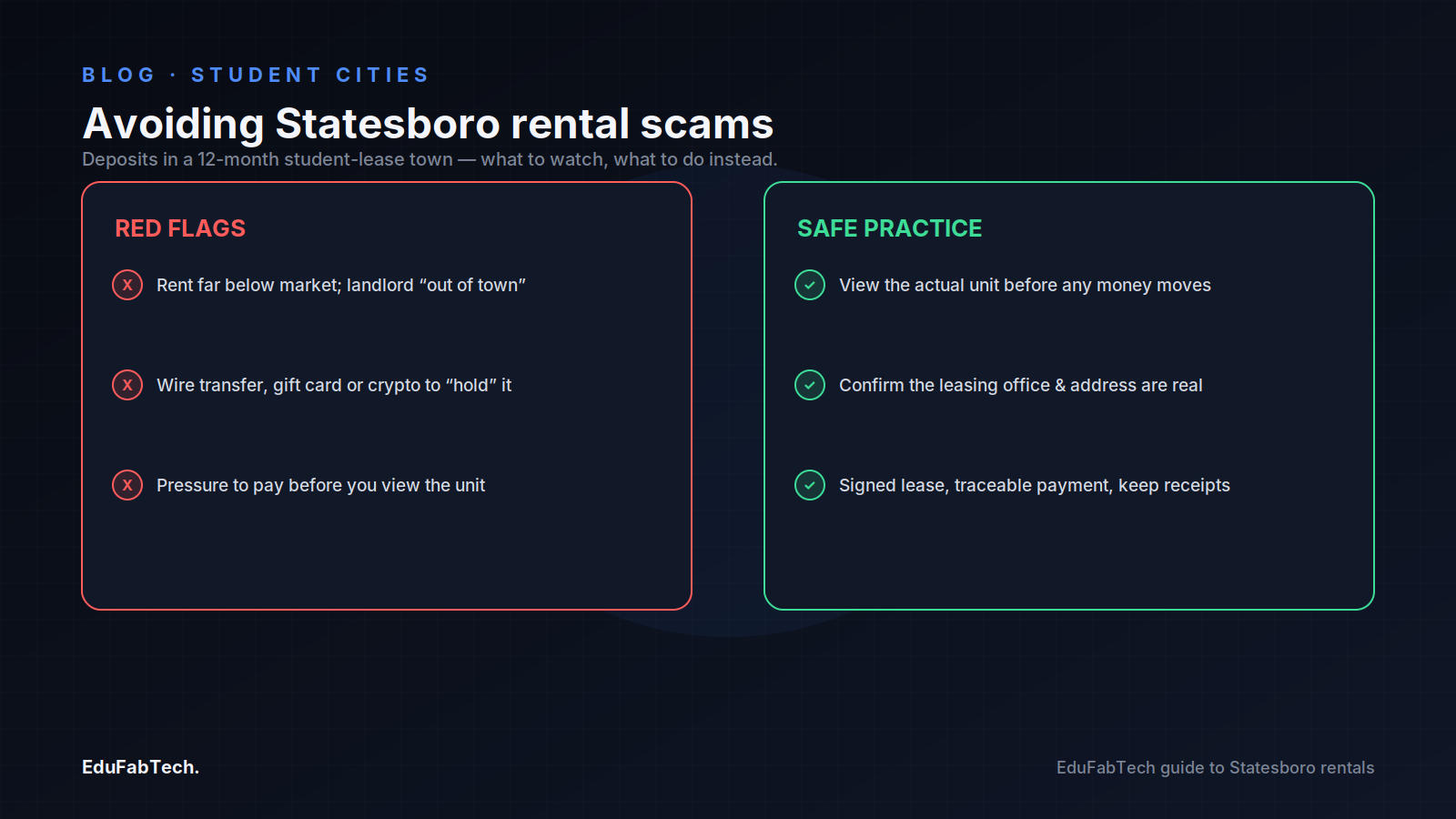
Statesboro's rental scams follow the national pattern, adapted to a student town. The listings that cause trouble tend to appear in the summer scramble, when demand outruns supply: a room or a whole apartment offered below the going rate, a landlord who is conveniently "out of town," and pressure to send a holding deposit before you can see the place. In a town built on 12-month student leases, the normal path is a signed lease with a named leasing office and a deposit paid by a traceable method — never by bank wire, gift card or cryptocurrency to "hold" a room, which is the single clearest sign of a scam.
Three habits protect you here. First, view the actual unit — or have someone you trust view it — before any money changes hands; the complexes cluster within a few miles of campus, so an in-person look is realistic even mid-term. Second, confirm the leasing office and address are real and currently operating before you pay, rather than relying on photos sent to you. Third, keep every payment receipt and a copy of the signed lease. If a deal can only proceed by an untraceable transfer, walk away. The same caution applies to furniture and "free room" offers on social media.
Furnishing a room cheaply: Goodwill and the Saturday market
Statesboro is a good town for second-hand furnishing precisely because students cycle through it every year, leaving furniture behind each May. Goodwill Southeast Georgia operates a store and donation centre in Statesboro, listed on the organisation's store finder, selling donated clothing, household goods, books and electronics — a reliable first stop for a desk, a bed frame or a set of pots.
For food and local goods, the Statesboro Main Street Farmers Market is the town fixture. The Statesboro Herald reports that the 2026 market runs on Saturdays from 9 a.m. to 12:30 p.m. at the market at Visit Statesboro on South Main Street, continuing through 21 November, selling fresh produce, meats, prepared food and artisan goods (Statesboro Herald). The end-of-semester move-out in spring is the best time to pick up near-new furniture for little or nothing. EduFabTech's local pages collect what is currently on offer: second-hand things and furniture.
Working while you study
Many students want part-time work, and for international students the rules are set federally, not by the university. According to U.S. Immigration and Customs Enforcement's Student and Exchange Visitor Program, F-1 students may work on campus up to 20 hours per week while school is in session, and full-time during periods when school is not in session or during the annual vacation; the program's Employment page also states that this work must be arranged with the student's Designated School Official (DSO), who counsels the student on permissible hours. Off-campus work, and training options such as Curricular Practical Training and Optional Practical Training, have separate conditions.
This guide cannot give legal advice, and the rules change — so before accepting any job, confirm your own situation with Georgia Southern's international student office (your DSO) and the official SEVP guidance linked above. For domestic students, on-campus jobs, retail and food-service roles around campus and downtown are the usual options. Current openings that EduFabTech users post are on the Statesboro jobs page.
Libraries and places to study
The main study building is the Zach S. Henderson Library at 1400 Southern Drive on the Statesboro campus, which Georgia Southern describes as the research centre of the campus, with collections, digital tools, study spaces and study rooms that can be reserved (Georgia Southern Libraries). Book a group room ahead in exam weeks, when demand peaks.
Beyond the library, the campus has the usual scattering of study nooks in academic buildings and the student union, and downtown cafés fill up during term. EduFabTech lists desks and quiet spaces users have flagged on the Statesboro study-spaces page.
Getting around: Southern Express and the $1 city bus
Statesboro has two transit systems worth knowing, and they do different jobs. On campus, Georgia Southern runs Southern Express, a free shuttle that loops the Statesboro campus during classes, finals, football game days and spring commencement; the university's Campus Transit page notes it is funded by the semester transportation fee rather than per-ride fares, begins at 7 a.m. on weekdays with a reduced evening service, and does not run between semesters, on campus holidays or at weekends.
For the city itself, the Statesboro Area Transit (SAT) is the municipal bus system. The City of Statesboro's SAT page lists a fare of $1 for a one-way trip and $2 round trip, cash and exact change only, running two fixed routes (Blue and Red) with over 30 stops, Monday to Friday from 6 a.m. to 6 p.m. and closed at weekends. The same page says discounted fares are available for college students, seniors and people with disabilities, with a discount card issued by the city at City Hall. That makes SAT useful for reaching shops, the grocery and off-campus apartments on weekdays, but it is not a late-night or Sunday option — plan accordingly. Statesboro is a driving town at heart, and many students keep a car.
What is good, and what is hard
The honest case for Statesboro is affordability and a genuine college-town feel. Housing costs are low by national standards — a university double room at $2,610 per semester for 2026-2027 is cheap compared with big-city campuses — and a compact campus with a free shuttle keeps daily costs down. The town is friendly to students because it is, in large part, built around them.
The hard parts are the flip side of the same facts. Statesboro is small and inland: the nearest city, Savannah, is about an hour away, and without a car you depend on a weekday-only city bus and a campus shuttle that stops in the holidays. Summers are hot and humid. The housing market is dominated by 12-month student leases, so a year's lease can bind you to summer rent you may not use, and the best units go early. The large student body relative to the town means big first-year classes. For students who want a quiet, car-light, big-city life, this is not that; for students who want a low-cost, self-contained campus town, it fits well.
A short checklist for your first weeks
- Sort housing early. If you want a university hall or a specific private complex, apply the winter before August; check the full-academic-year contract and the $20-per-semester activity fee on the official rates page.
- Never wire a deposit sight-unseen. View the unit, confirm the leasing office is real, pay by a traceable method and keep the signed lease.
- International students: see your DSO first. Confirm on-campus work limits with Georgia Southern's international office and the SEVP Employment guidance before taking any job.
- Learn the two bus systems. Southern Express for campus (free, term-time), SAT for the city ($1 standard fare, cash, weekdays only, with a college-student discount card from City Hall).
- Furnish second-hand. Hit Goodwill and watch for spring move-out giveaways.
- Find your study spot. Reserve a Henderson Library group room ahead of exam weeks.
A quick question for readers
Do you work part-time while you study?
Many students work to pay the bills. See how common it is — and how many hours people really do.
Pick an answer, create a free account in a minute, and your vote counts. Already a member? Sign in
Comments 3
Comment-
The $1 SAT bus gets top billing but the schedule underneath it is the real story: two routes, 30-odd stops, 6 a.m. to 6 p.m. weekdays only,…
-
The transit section is the honest part, and it quietly undercuts the 'affordable' pitch. SAT only runs Monday-Friday 6-6, cash only, no week…
-
Calling the $2,610 double room "the one solid, dated cost figure" and then noting two sentences later that it's a proposed rate still waitin…
Join free to read the full comments and reply Comments are between members; an account takes a minute.
Source: Georgia Southern University
Sources (5)
- Georgia Southern University. Statesboro Campus Housing Rates 2026-2027. Georgia Southern University, 2026. georgiasouthern.edu ↗ · checked 30 Oct 2026
- City of Statesboro. SAT — Statesboro Area Transit. City of Statesboro, 2026. statesboroga.gov ↗ · checked 30 Oct 2026
- U.S. Immigration and Customs Enforcement (SEVP). Employment. U.S. Department of Homeland Security, 2026. ice.gov ↗ · checked 30 Oct 2026
- U.S. Census Bureau. Statesboro, GA — ACS 2024 5-year estimates. Census Reporter, 2024. censusreporter.org ↗ · checked 30 Oct 2026
- Georgia Southern University. About. Georgia Southern University, 2026. georgiasouthern.edu ↗ · checked 30 Oct 2026