Studying in Stuttgart: universities, housing and student life
A practical, sourced guide to Stuttgart's universities, where students live, dorm rents, flea markets, part-time work rules, libraries and the VVS fares that get you around the basin.
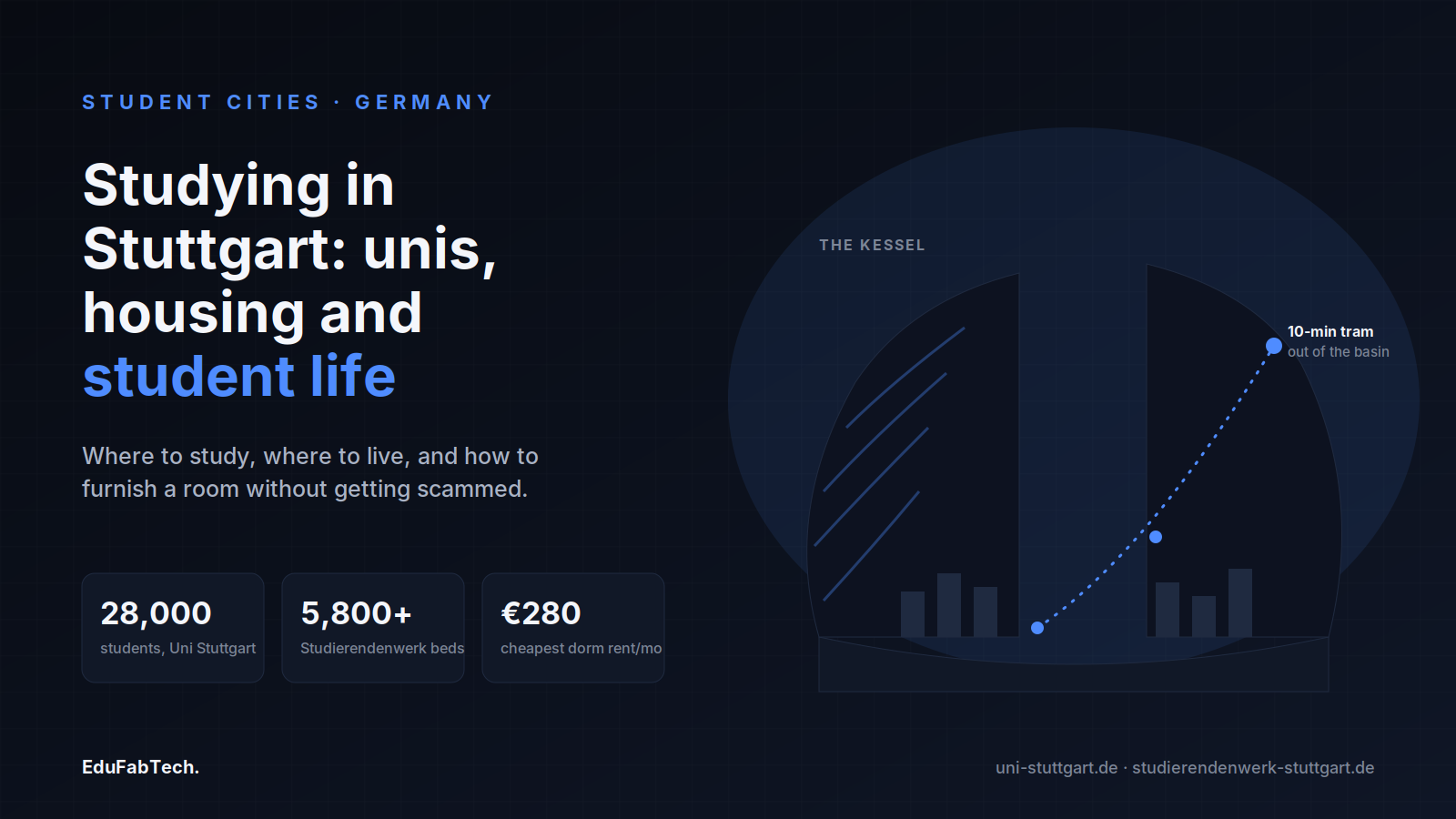
Stuttgart sits in a bowl. The old centre fills the floor of a basin that locals call the Kessel, and the city climbs out of it on steep slopes planted with vineyards, so that a tram ride of ten minutes can leave you looking down on the rooftops you started from. It is a wealthy, engineering-minded place — the home towns of Mercedes-Benz and Porsche are inside the city limits — and that shapes student life in ways both good (money for libraries and labs, dense public transport) and hard (some of the tightest housing in Germany).
The university landscape is spread across the basin and the towns around it rather than gathered on one campus. Knowing which institution sits where, and which valley or hillside you would be commuting from, matters more here than in a flatter, more compact city. This guide walks through the universities, the districts students settle in, how to find a room without losing money, where to furnish it cheaply, the rules on working, the study spaces, and what it actually costs to get around.
The universities, from the Kessel to the vineyards
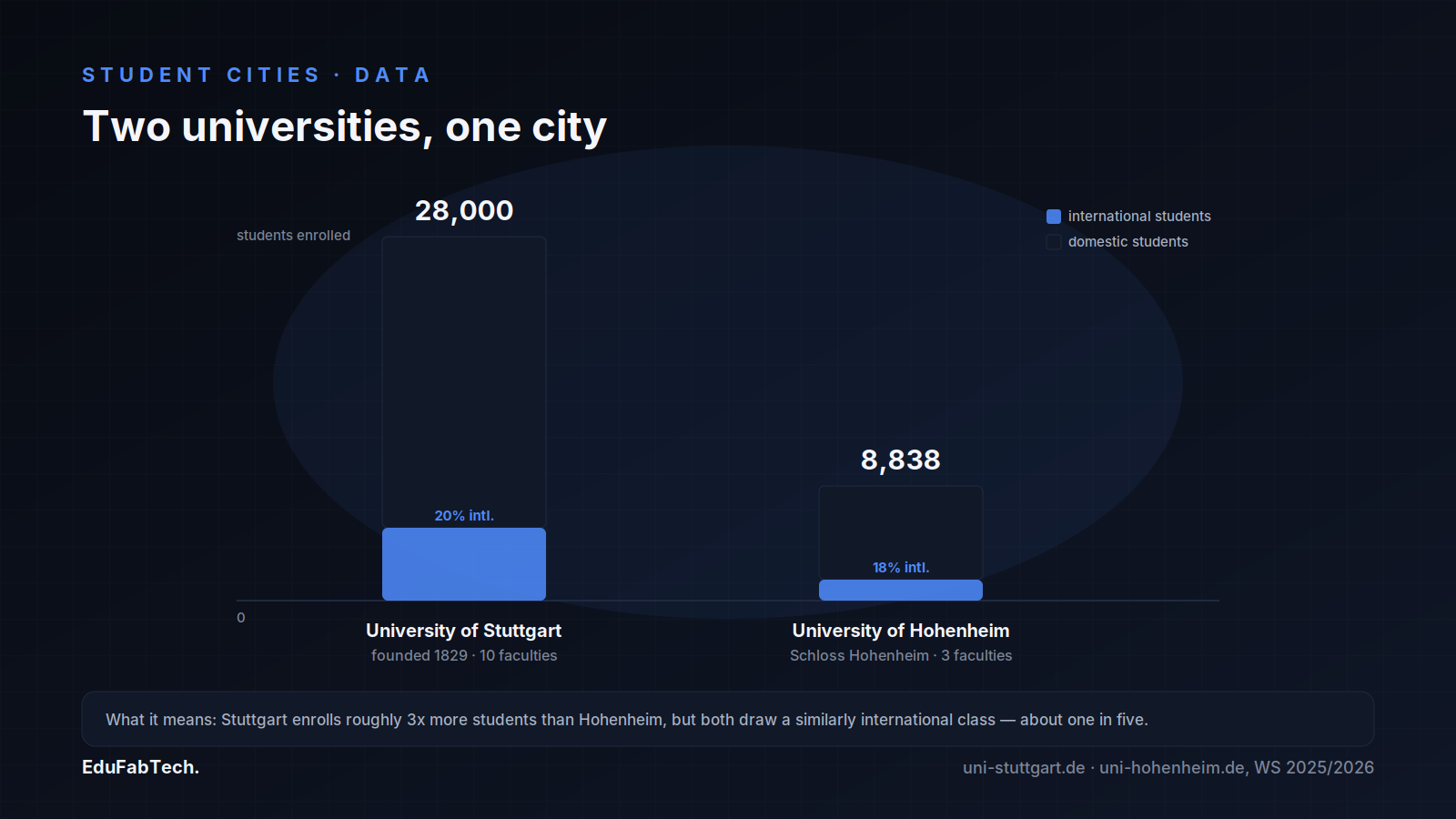
The University of Stuttgart is the research anchor. Its own profile page describes around 28,000 students in roughly 150 degree programmes across ten faculties, with about 20 percent coming from abroad, and dates the institution to 1829, calling itself one of Germany's leading technically oriented universities (uni-stuttgart.de). It runs two campuses: Stadtmitte, tucked into the city centre near the main station, and the larger, greener campus out at Vaihingen in the south-west, where most of the engineering and computing institutes sit. The two are a short Stadtbahn ride apart.
The University of Hohenheim is the other full university inside the city. Its "University at a glance" page records 8,838 students in winter semester 2025/2026, of whom 1,601 are international (uni-hohenheim.de). It is built around a Baroque palace, Schloss Hohenheim, on the city's southern edge, and the same page names agricultural sciences, natural sciences and economic and social sciences as its three faculties — it is best known for agricultural and food research.
Several applied-sciences and arts institutions round out the picture inside Stuttgart. Stuttgart Media University (Hochschule der Medien) sits on the Vaihingen campus and teaches print, electronic media and information science. The University of Applied Sciences Stuttgart (Hochschule für Technik) is a city-centre school for architecture, engineering and surveying near the main station. DHBW Stuttgart is one of the largest locations of Baden-Württemberg's cooperative university, where degrees alternate between lecture blocks and paid phases at a partner company. The State University of Music and Performing Arts Stuttgart trains musicians and actors on the cultural mile in the centre. Esslingen University of Applied Sciences is an engineering school based in nearby Esslingen with programmes also taught in the region. Merz Akademie is a small private university of applied sciences for design, film and new media in Stuttgart, and AKAD University is a Stuttgart-headquartered distance-learning university aimed at people studying while they work. The private VWA Hochschule offers part-time degrees in the city for working students.
Students should also know the institutions clustered in the surrounding towns, because many commute to them. The University of Tübingen, founded in 1477, is one of Germany's oldest universities and lies about an hour south in Tübingen. In Ludwigsburg, north of the city, are the Film Academy Baden-Württemberg and the Academy of Performing Arts Baden-Wuerttemberg, two state schools for film and stage, alongside the University of Applied Sciences Ludwigsburg for public administration and finance. Nürtingen-Geislingen University of Applied Science sits south-east in Nürtingen and teaches business, agriculture and landscape subjects. The Akademie für Datenverarbeitung Böblingen in Böblingen is an IT training academy whose course leads to a bachelor's degree awarded with partner higher-education institutions rather than by the academy itself. You can browse what EduFabTech has gathered across the whole city at /in/germany/stuttgart, and listings around the two big universities at /near/university-of-stuttgart and /near/university-of-hohenheim.
The neighbourhoods students actually settle in
Stuttgart-West is the classic student quarter: a dense grid of Wilhelmine apartment blocks on the slope above the centre, full of cafés and small shops, walkable to the Stadtmitte campus and the city library. Rooms there are sought-after and priced to match. Stuttgart-Süd, around Marienplatz and the Heslach slope, is younger and a little scruffier, with cheap eats and nightlife and a funicular (the Standseilbahn) that climbs the hill. Stuttgart-Ost, stretching up toward the Neckar, tends to be gentler on the budget while staying a few minutes from the centre by S-Bahn.
Vaihingen, out to the south-west, is the practical choice if you study engineering or media: the main University of Stuttgart campus and Stuttgart Media University are here, it has its own S-Bahn hub, but it feels more like a suburb than the inner city. Bad Cannstatt, across the Neckar to the north-east, is Stuttgart's oldest and largest district — mineral springs, the big festival grounds on the Wasen, and generally more affordable rooms with quick S-Bahn links into town. Möhringen and Degerloch, up on the southern plateau, put you near Hohenheim and on the Stadtbahn lines, a calmer and often cheaper option if you do not mind the climb out of the basin. Wherever you look, remember Stuttgart's topography: an address that seems central on a map can still mean stairs, a funicular or a rack railway between you and your front door.
Getting a dorm room — and not getting scammed looking for one
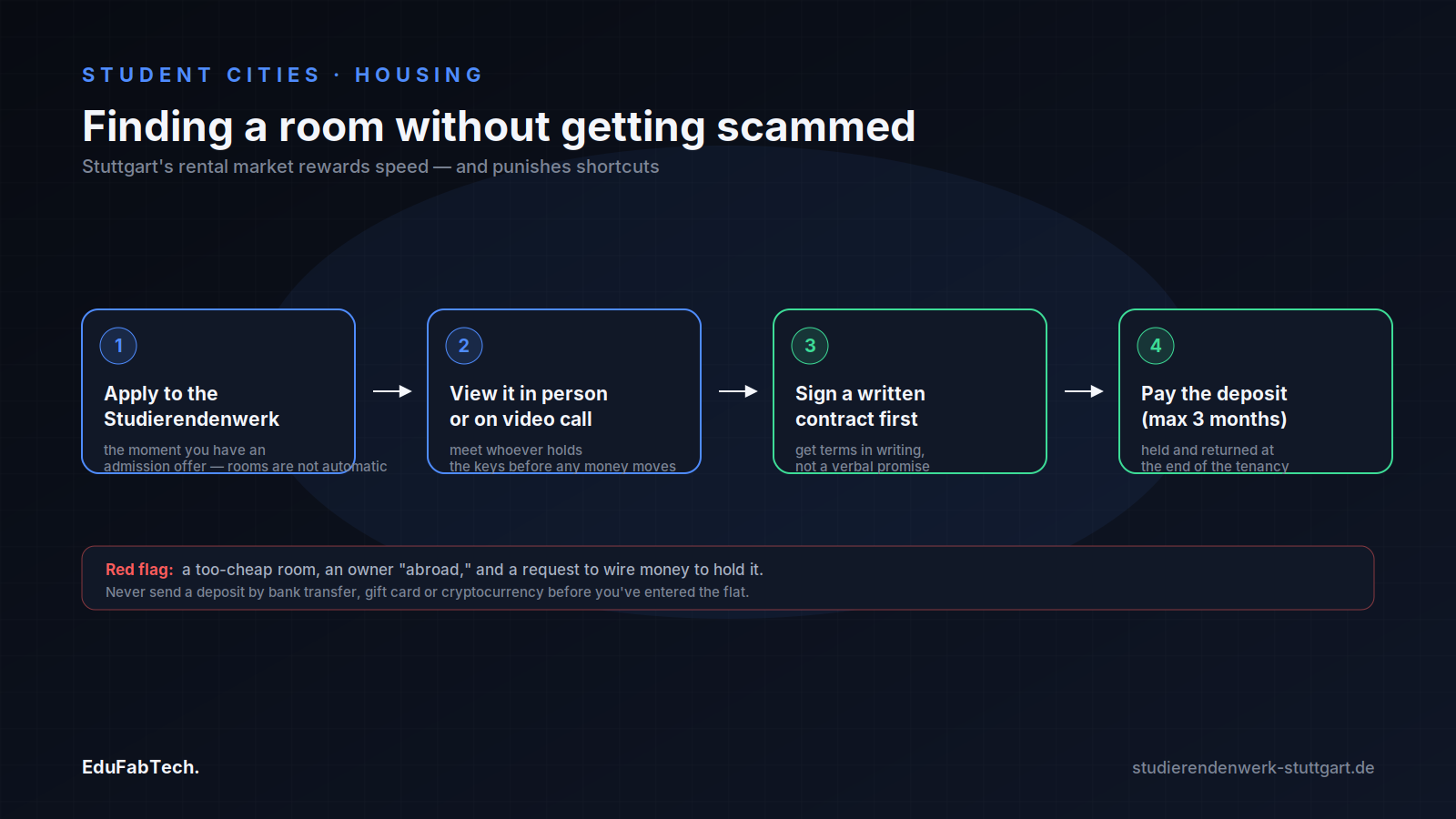
The cheapest reliable housing comes from the Studierendenwerk Stuttgart, the public student-services body. Its accommodation pages say it runs more than 5,800 bed spaces across around 30 halls in Stuttgart, Ludwigsburg, Esslingen and Göppingen, and warn that you are not allocated a room automatically — you must apply, ideally early, with students at the supported universities given preference (studierendenwerk-stuttgart.de). Its dormitory listing shows rents starting at €280 a month, with the rent covering heating, water, electricity, rubbish collection and caretaker service, and a maximum tenancy of 36 months — six semesters (studierendenwerk-stuttgart.de/accommodation/dormitories). Demand runs well ahead of supply; apply the moment you have an admission offer rather than waiting for enrolment.
On the private market, the normal arrangement in Germany is a Kaution (deposit) of up to three months' cold rent, held and returned at the end of the tenancy — nothing you pay to merely "reserve" a viewing. Rental scams in Stuttgart follow the familiar pattern: a too-cheap room in West or Süd, an owner who is conveniently abroad, and a request to wire a deposit or first month before you can see the flat. Do not send money by bank transfer, gift card or cryptocurrency to hold a room you have not entered. See the place in person or on a live video call, meet whoever holds the keys, and sign a written contract before any money moves. Rooms and shared flats collected for the city are at /in/germany/stuttgart/rooms.
Kitting out a room: Karlsplatz on a Saturday
Furnishing cheaply is a Saturday project. The city's best-known flea market, the Flohmarkt Karlsplatz, runs every Saturday except public holidays from 08:00 to 16:00 on Karlsplatz beside the Altes Schloss in the centre, organised by Märkte Stuttgart GmbH (flohmarkt-karlsplatz.de); the same organiser also stages larger spring and autumn flea markets. It is the obvious first stop for lamps, crockery, books and records at bargain prices, and the kind of place where polite haggling is expected.
For food and everyday goods, the Art Nouveau Markthalle in the centre and the weekly produce markets on Marktplatz and Schillerplatz are long-running fixtures, and most districts hold their own weekly market. For furniture and household items that cost nothing or next to nothing, EduFabTech keeps Stuttgart listings for second-hand things at /in/germany/stuttgart/second-hand, larger pieces at /in/germany/stuttgart/furniture, and give-aways at /in/germany/stuttgart/free-stuff — handy at the start and end of each semester, when departing students clear out whole rooms.
Working while you study
Many students take a part-time job, and the rules depend on your nationality. Germany's official Make it in Germany portal, run by the federal government, states that international students may work 140 full days or 280 half days a year alongside their studies, and that these limits do not apply to student assistant jobs at the university (make-it-in-germany.com). EU and EEA students have broadly the same access to the labour market as German students. This is general information, not legal advice: your exact conditions are set by your residence permit and the local foreigners' authority (Ausländerbehörde), so confirm your own case with them before signing a contract. Current openings gathered for the city are at /in/germany/stuttgart/jobs.
Where to actually get work done
Study space is plentiful if you know where to look. The Württembergische Landesbibliothek, the regional research library on the cultural mile in the centre, publishes long opening hours — Monday to Friday 08:00 to 22:00 and Saturday 10:00 to 20:00 — on its own schedule page (wlb-stuttgart.de), which makes it one of the few places open late into the evening. The Stadtbibliothek Stuttgart, the striking white cube on Mailänder Platz in the Europaviertel beside the main station, is a public city library with quiet reading rooms on every floor and is open to anyone. The Universitätsbibliothek Stuttgart keeps branches at both the Stadtmitte and Vaihingen campuses, and Hohenheim has its own library on the palace grounds. Between deadlines, when seats fill up fast, EduFabTech also lists desks and study spaces around the city at /in/germany/stuttgart/study-spaces.
Fares, the VVS and the Deutschlandticket
Public transport here is run under the Verkehrs- und Tarifverbund Stuttgart (VVS), which ties together S-Bahn, the Stadtbahn (U-Bahn) light rail, buses and the funicular and rack railways that handle Stuttgart's hills. For most students the cheapest nationwide option is a flat-rate ticket. The Studierendenwerk Stuttgart's transport page, updated in October 2025, states that students up to and including age 26 can buy the Deutschland-Ticket JugendBW for €39.42 a month on an annual subscription, valid on local transport across Germany, while the standard Deutschlandticket costs €58 a month (studierendenwerk-stuttgart.de). The same page notes that Stuttgart's universities do not offer the discounted compulsory "Studi" version of the ticket, because the student bodies rejected the solidarity-funded model. One ticket covering every bus, train and funicular in the region takes much of the sting out of the city's spread-out geography.
What's good, what's hard
The good: Stuttgart is prosperous and well-equipped, with strong engineering and sciences, generous libraries, a dense and integrated transport network, and real green on the doorstep — vineyards, parks and the hills are never far. The flea-market and second-hand culture makes setting up a room cheap, and a single regional ticket removes most of the friction of getting around.
The hard: housing is the recurring pain. The Studierendenwerk itself flags that rooms are not allocated automatically and that you should apply as early as possible, and the private market is expensive and competitive, especially in West and Süd. The basin traps warm, muggy air in summer and can hold pollution on still days. The topography that gives the city its charm also means stairs, slopes and commutes that look shorter on a map than they feel on foot. And because the universities are scattered across the city and neighbouring towns, where you live can tie you to a particular line for your whole degree.
A checklist for your first fortnight
- Apply to the Studierendenwerk Stuttgart for a dorm place the moment you have an offer; do not wait for enrolment.
- For private rooms, never pay a deposit before viewing in person or on a live call and signing a written contract; a normal deposit is up to three months' cold rent.
- Register your address (Anmeldung) at the city's Bürgerbüro soon after moving in — it is required and other paperwork depends on it.
- Buy a Deutschland-Ticket JugendBW if you are 26 or under, otherwise a Deutschlandticket, and learn which S-Bahn or Stadtbahn line links your district to your campus.
- Non-EU students: confirm your working-hours limit with the Ausländerbehörde before taking a job.
- Furnish from the Karlsplatz flea market on a Saturday and from local give-away listings at the start of term.
- Scout the Landesbibliothek and Stadtbibliothek early so you have a late-opening desk before exam season.
A quick question for readers
Do you work part-time while you study?
Many students work to pay the bills. See how common it is — and how many hours people really do.
Pick an answer, create a free account in a minute, and your vote counts. Already a member? Sign in
Comments 3
Comment-
The housing numbers don't add up once you put them side by side. Studierendenwerk Stuttgart runs just over 5,800 beds across its halls, and…
-
The housing math is the part worth sitting with: 5,800 beds across Stuttgart, Ludwigsburg, Esslingen and Göppingen combined, against roughly…
-
The detail I'd pull students aside for is the Deutschlandticket footnote: Stuttgart's student bodies actually voted down the solidarity-fund…
Join free to read the full comments and reply Comments are between members; an account takes a minute.
Source: Studierendenwerk Stuttgart
Sources (5)
- University of Stuttgart. University — facts and profile. University of Stuttgart, 2026. uni-stuttgart.de ↗ · checked 12 Nov 2026
- University of Hohenheim. The University at a glance (Die Universität auf einen Blick). University of Hohenheim, 2026. uni-hohenheim.de ↗ · checked 12 Nov 2026
- Studierendenwerk Stuttgart. Dormitories and accommodation. Studierendenwerk Stuttgart, 2026. studierendenwerk-stuttgart.de ↗ · checked 12 Nov 2026
- Federal Government of Germany. Studying in Germany: working alongside your studies. Make it in Germany, 2026. make-it-in-germany.com ↗ · checked 12 Nov 2026
- Märkte Stuttgart GmbH. Flohmarkt Karlsplatz. Stuttgarter Flohmärkte, 2026. flohmarkt-karlsplatz.de ↗ · checked 12 Nov 2026