Studying in Syracuse: universities, housing and student life
A practical, sourced guide to Syracuse University, where students live, what a room costs, how to get around a snow city, and the honest trade-offs of studying in Central New York.
Syracuse sits in the middle of New York State, far from the coast and higher up than people expect — a mid-sized city of old brick and salt-grey winters, wrapped around a university that looks down on it from a hill. If you come to study here, most of your life will be lived on or just below that hill, within a short walk of the Quad. This guide covers the university, the neighbourhoods students pick, what a room costs with the figures traced to their source, how to get around in a city that measures snow by the foot, and the parts that are genuinely hard.
Almost everyone who studies in the city proper studies at one institution, so this piece is built around it rather than pretending Syracuse is a multi-campus college town. What follows should be recognisable to anyone who has spent a winter on Comstock Avenue.
Syracuse University on the Hill
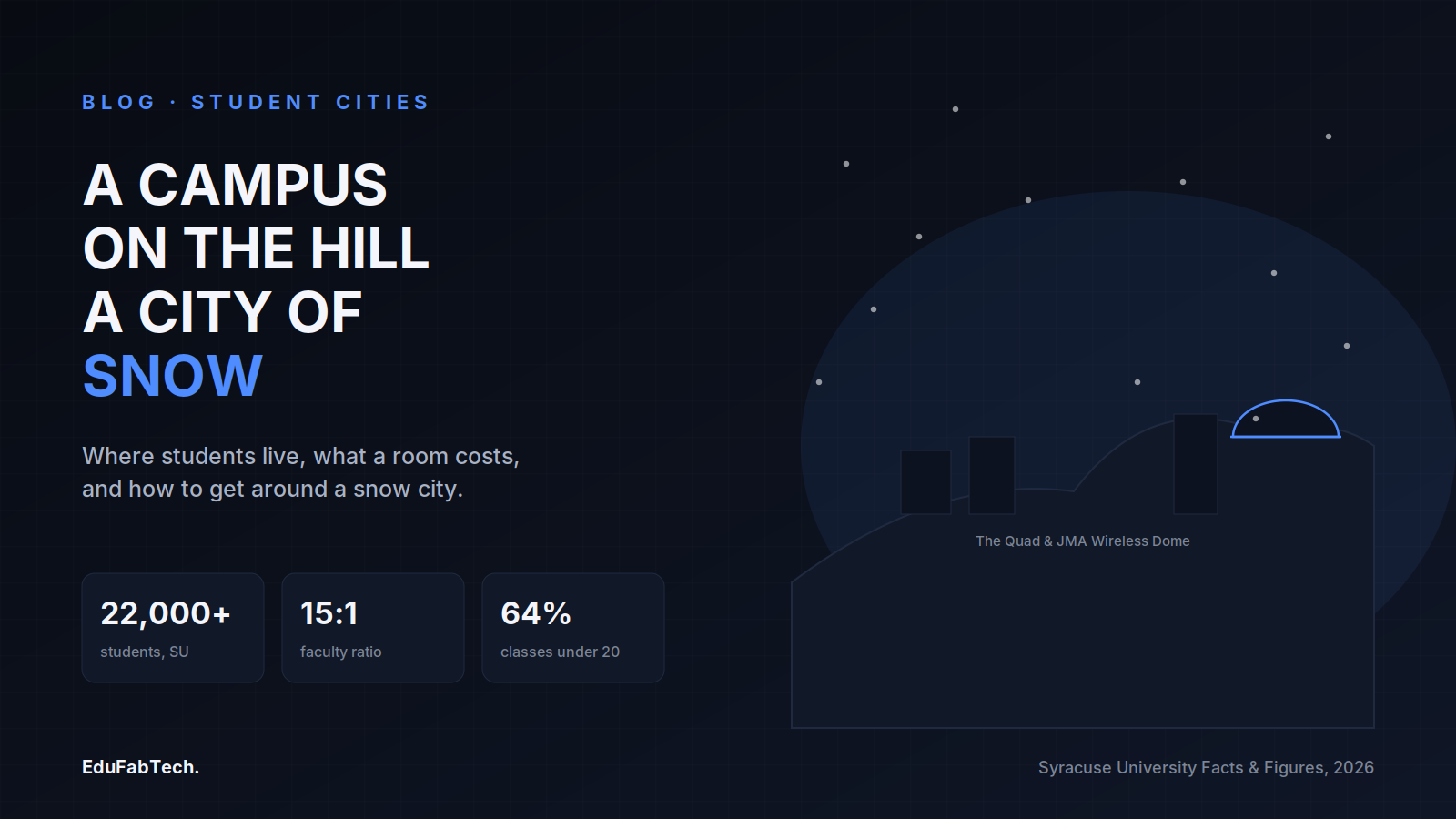
Syracuse University was founded in 1870 and describes itself, on its own Facts and Figures page, as a private R1 research university whose main campus sits atop a hill overlooking the city. The same page lists more than 22,000 students — over 15,000 undergraduates and more than 6,000 graduate students — spread across 13 schools and colleges, with a 15-to-1 student–faculty ratio and 64% of classes holding fewer than 20 students. The campus is compact and walkable: the Quad, Bird Library, the Schine Student Center and the Carrier Dome (now the JMA Wireless Dome) are all within a few minutes of each other.
Among the 13 units, the David B. Falk College of Sport and Human Dynamics is worth knowing by name. Syracuse University announced in 2024 that it would turn Falk into a standalone College of Sport — which the university calls the first standalone college on an R1 campus to focus solely on sport. As Syracuse University reported in August 2025, the former human dynamics programmes then moved elsewhere for the 2025-26 year: public health to the Maxwell School, social work to the School of Education, and human development and family science to the College of Arts and Sciences. If you are applying to a sport analytics, sport management or exercise science programme, that is the college you will deal with. Graduate applicants across all fields work through the Syracuse University Graduate School, which administers admissions, funding and degree requirements centrally rather than leaving everything to departments.
The neighbourhoods below the Hill
Three areas hold most students. The University Neighborhood east of campus — Ackerman, Euclid, Livingston, Sumner and the streets off Comstock — is the classic undergraduate zone: wood-frame houses chopped into student flats, within walking distance of class and the bars on Marshall Street, the short pedestrian strip students call "M Street." Walk a little further east and you reach Westcott, a slightly older, quieter district around Westcott Street with a cinema, cafés and a mix of students, families and long-term residents; locals call it "Westcott Nation." Graduate students and people who want more space often land here or across Thornden Park.
Then there is South Campus, the university's own apartment complex up at Skytop, roughly a mile and a half south of main campus and connected to it by a frequent SU shuttle. These are furnished university apartments rather than dorm rooms, popular with graduate students, families and upperclassmen who want a lease through the university rather than a private landlord. Downtown — Armory Square, the warehouse district — draws a smaller set of students who prefer bars and restaurants to a porch, and who are willing to commute up the hill. The near-west and north sides are cheaper, but farther out and less wired into the student grid.
Finding a room — and not getting scammed
The rhythm here is early and ruthless. Leases in the University Neighborhood for the following August are often signed in the autumn of the year before — some students sign in October or November for a place they will not move into for nine months. That pressure is exactly what rental scams feed on: a "cheap" house near Euclid, photos that look too good, and a landlord who needs a deposit today to "hold" it while you are still abroad or across the country.
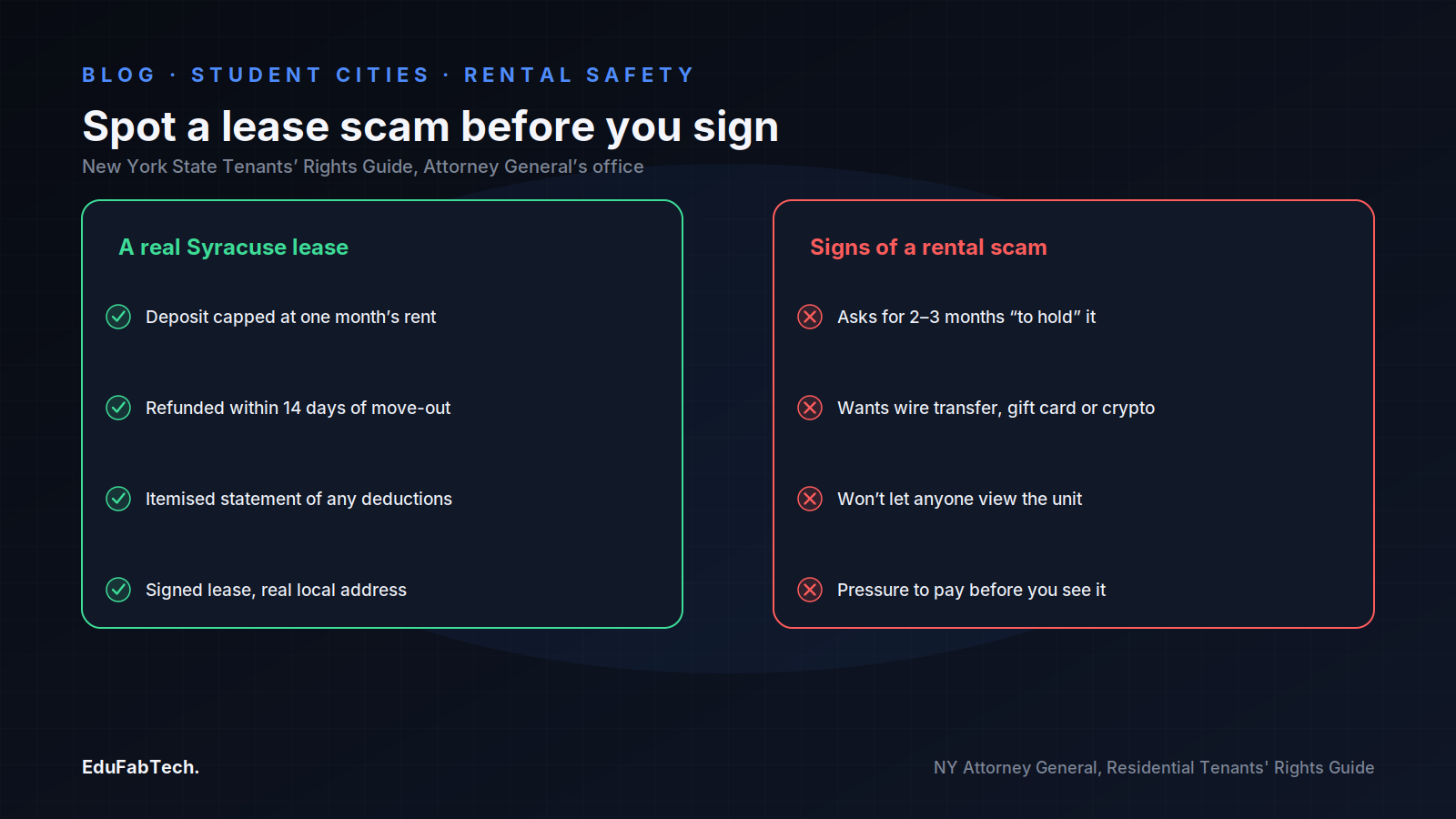
Protect yourself with a few fixed rules. See the actual unit — or have someone you trust see it — before any money changes hands; refuse any request to wire a deposit, pay by gift card, or send cryptocurrency to reserve a room, because legitimate Syracuse landlords do not collect holding money that way. Know what is normal locally: under New York State law, as set out in the Residential Tenants' Rights Guide from the state Attorney General, a security deposit on an unregulated apartment cannot exceed one month's rent, and the landlord must return it within 14 days of you moving out with an itemised statement of any deductions. A "landlord" demanding two or three months up front is either breaking that rule or is not a landlord at all. Get a signed lease with a real local address before you pay anything.
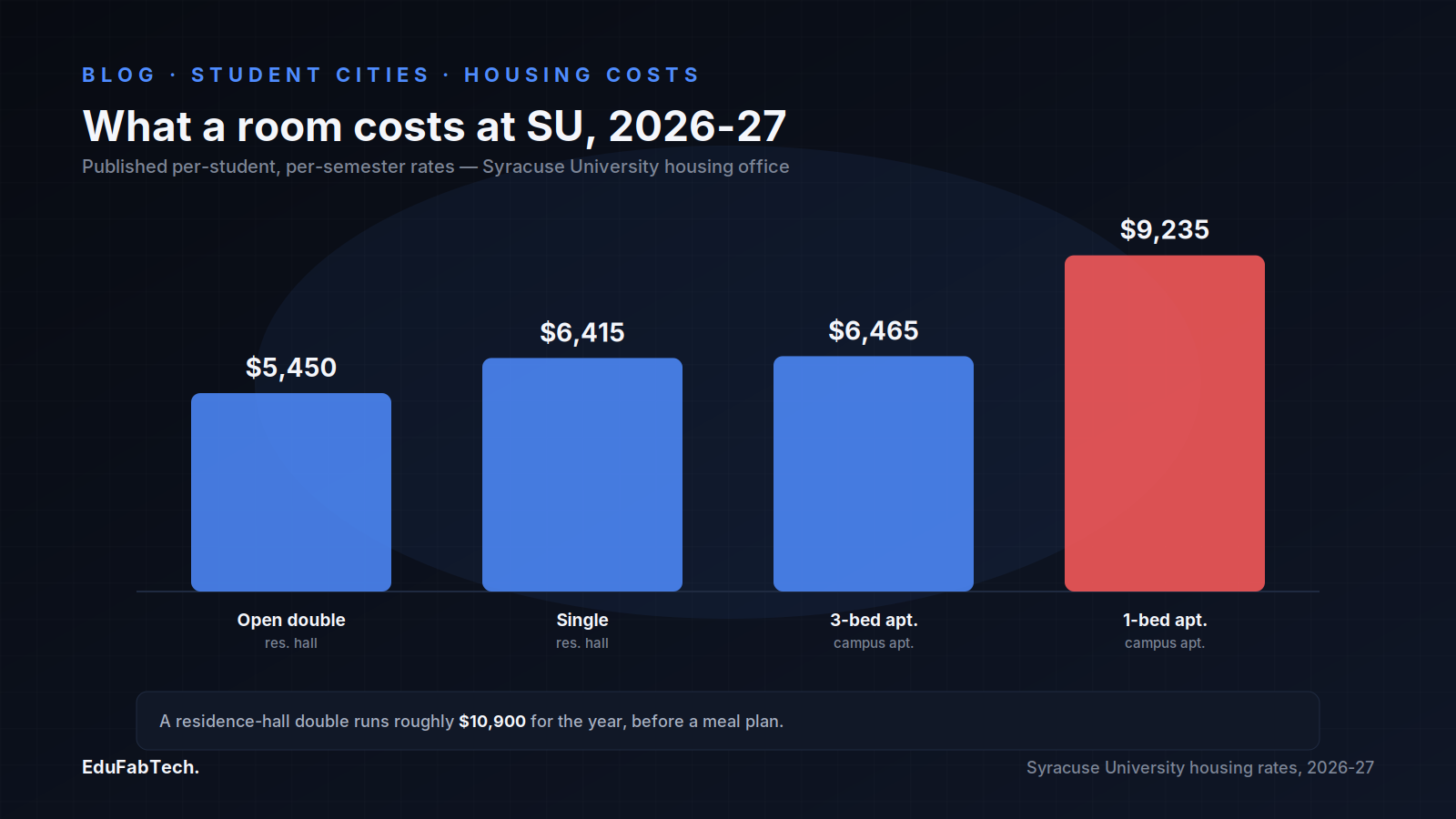
For a dated, verifiable housing figure, the simplest benchmark is the university's own. Syracuse University's housing office lists 2026-27 rates per student per semester: an open double at $5,450, a regular single at $6,415, and campus apartments running from $6,465 for a three-bedroom up to $9,235 for a modern one-bedroom. Because those are per-semester, a double in a residence hall is roughly $10,900 for the academic year before meals. Private off-campus rents vary by house and street, but the university's figures give you an honest floor to measure any off-campus offer against. You can browse what current students are listing on EduFabTech's Syracuse rooms page and the broader city listings.
Furnishing a room for next to nothing
Student housing here mostly comes unfurnished or half-furnished, so most people assemble a room from second-hand pieces. Syracuse's best-known fixture for this is the Central New York Regional Market on the city's north side. Its own site lists the Saturday farmers market at 2100 Park Street, open year-round from 7:00 a.m. to 2:00 p.m., running since 1938; alongside produce you will find household goods, plants and bric-a-brac, and a Sunday flea market heavy on antiques. It is a genuine Syracuse institution, not a tourist stop.
The other great source is other students. Syracuse empties out fast in May, and the curbs of the University Neighborhood fill with furniture, lamps and mini-fridges as leases end — the annual move-out giveaway is a real way to furnish a room for free if you have a car or a strong friend. Online, EduFabTech keeps separate Syracuse pages for second-hand things and items given away free, which is where a lot of end-of-term handovers happen. Whatever the channel, the same caution applies as with rooms: see an item, or arrange collection in person, before paying.
Working while you study
If you are an international student on an F-1 visa, your right to work is defined by U.S. immigration rules and administered on campus through the Center for International Services. Its on-campus employment page states the core rule plainly: on-campus employment must not exceed 20 hours a week while school is in session, though students may work more during authorised breaks up to the university's 40-hour weekly cap, and you must stay enrolled full-time to keep the authorisation. On-campus jobs are posted through 'Cuse Works on Handshake, and the page notes that some roles require a Federal Work-Study award, for which international students are not eligible.
This is not legal advice, and off-campus work (CPT, OPT and the like) carries separate conditions — check with the Center for International Services before accepting anything, because an employment mistake can affect your status. Domestic students face none of these limits; they will find term-time and summer work through the same Handshake system and local employers. General Syracuse openings students are sharing turn up on EduFabTech's jobs page.
Libraries and places to study
Bird Library, the main library on Waverly Avenue, is the centre of study life. The university libraries' own announcement on study-room hours describes a layered system: reservable individual rooms, some bookable for up to six hours a day and most for up to three; first-come, first-served individual rooms; sensory-friendly rooms; private long-term rooms for doctoral candidates; small group rooms for up to three students; and team rooms for up to five, all reservable online. Carnegie Library, the older building near the Quad, serves mathematics and science and also offers bookable team rooms. Between them you can usually find a desk even in December exam week, though the best rooms go fast once reservations open.
Beyond the libraries, the Schine Student Center and various college buildings have informal study space, and the Westcott cafés fill with laptops. EduFabTech also keeps a Syracuse study-spaces page for desks and quiet rooms students are sharing off campus.
Getting around a snow city
The city's bus network is run by Centro — the Central New York Regional Transportation Authority. For Syracuse University students the key benefit is the SU Fare Free Zone: Centro's SU443 page says you ride free, year-round, on routes SY140, SY240 and SY340 within the zone running from Harrison Street and Irving Avenue out to Brighton Avenue and Ainsley Drive, as long as you show a valid SU ID when boarding. That covers the trip between main campus, South Campus and the near neighbourhoods for nothing.
Outside that zone, Centro's fares page lists a one-way local fare of $1.00 in the greater Syracuse area, a Day Pass at $4.00, and reduced fares of $0.50 for seniors, riders with disabilities and children aged 6–9. The university's parking office explains how to buy passes through Centro, listing a $10.00 ten-ride local pass and a $12.00 seven-day unlimited Max Pass. Be clear-eyed about winter, though: SUNY College of Environmental Science and Forestry, next door on the hill, notes on its weather page that Syracuse gets an annual average snowfall of just over 100 inches, much of it lake-effect snow off Lake Ontario. The walk up the hill in February is a real consideration when you choose how far from campus to live.
The honest ledger: cost, climate and size
What is good about studying in Syracuse is tangible. The campus is small enough to cross on foot, the university is a genuine research institution with strong arts, communications, architecture and sport programmes, and the cost of living is lower than in New York City, Boston or the coastal college towns — rents sit well below those markets even as the university's own residence-hall rates above show that on-campus living is not cheap. The city has real character: Westcott's cafés, the Regional Market, a downtown that has slowly refilled, and a sports culture that turns the Dome orange on game days.
What is hard is equally concrete. The winter is long, dark and genuinely snowy — the 100-inch-plus average is not a joke, and it shapes months of the year. Off-campus housing stock is old, and the earliest-lease scramble pressures students into signing for houses they have barely seen. Parts of the city beyond the student core have high poverty, and the university sits noticeably better-off than the neighbourhoods at the bottom of the hill, a contrast you will feel. And because nearly everything student-facing orbits one institution, the city can feel small if you want a life entirely outside the campus bubble. Weigh those honestly against the lower rents and the compact, walkable core.
Your first two weeks: a checklist
- Confirm your room in person. If you signed from abroad, verify the unit matches the lease before unpacking, and photograph its condition the day you move in for your deposit record.
- Get your SU ID and test the free bus. Ride an SY140/240/340 within the Fare Free Zone so you know the benefit works before you ever pay a fare.
- International students: visit the Center for International Services early. Check in, confirm your enrolment is full-time, and ask about on-campus work before accepting any job.
- Furnish from the Regional Market and move-out piles, not a furniture store. A Saturday trip to Park Street plus EduFabTech's second-hand listings will cover most of a room.
- Claim a study spot. Learn Bird Library's reservable-room system in week one, before exam-week demand hits.
- Buy winter boots and a real coat now. Do not wait for the first lake-effect storm; by then the shops near campus are picked over.
- Browse what other students are sharing on the Syracuse city page for rooms, jobs and end-of-term handovers.
A quick question for readers
Do you work part-time while you study?
Many students work to pay the bills. See how common it is — and how many hours people really do.
Pick an answer, create a free account in a minute, and your vote counts. Already a member? Sign in
Comments 0
CommentNo comments yet. Members start the conversation.
Source: Syracuse University
Sources (5)
- Syracuse University. Facts and Figures. Syracuse University, 2026. syracuse.edu ↗ · checked 8 Oct 2026
- Syracuse University Housing and Meal Plans. 2026-27 Housing Rates. Syracuse University, 2026. housingmealplans.syr.edu ↗ · checked 8 Oct 2026
- Centro (Central New York Regional Transportation Authority). SU Fare Free Zone (SU443). Centro, 2026. centro.org ↗ · checked 8 Oct 2026
- New York State Office of the Attorney General. Residential Tenants' Rights Guide. NY State Attorney General, 2025. ag.ny.gov ↗ · checked 8 Oct 2026
- Syracuse University Center for International Services. On-Campus Employment. Syracuse University, 2026. experience.syracuse.edu ↗ · checked 8 Oct 2026