Studying in Tahlequah: Northeastern State University, housing and student life
A practical, sourced guide to studying in Tahlequah, Oklahoma — the Cherokee Nation's capital — covering Northeastern State University, where to live, what a semester costs, work rules and getting around.
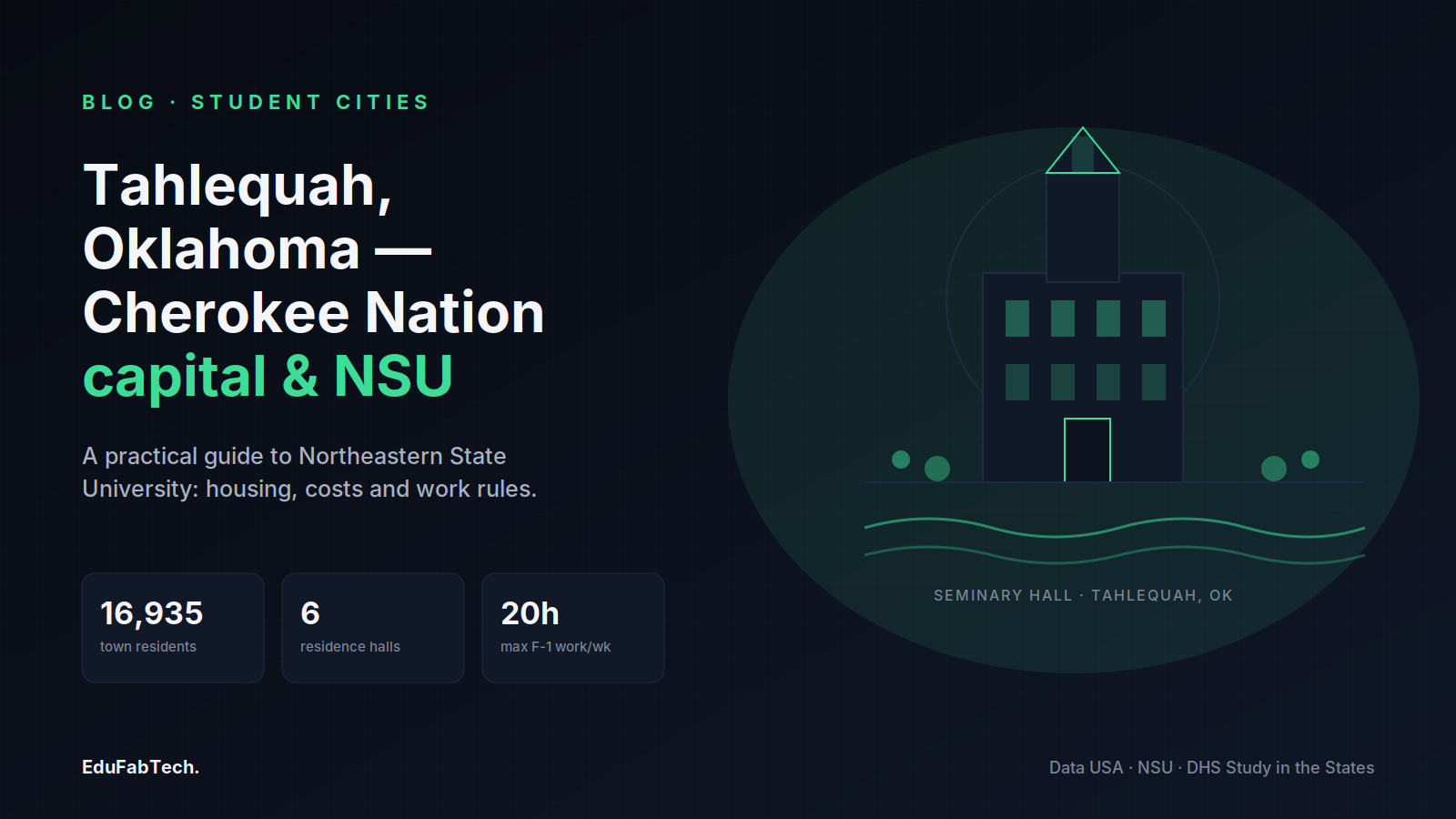
A capital town at the foot of the Ozarks
Tahlequah sits in the northeastern corner of Oklahoma, in the rolling country the state tourism board calls Green Country, and it carries a role almost no other American college town has: it is the seat of the Cherokee Nation government and of the United Keetoowah Band of Cherokee Indians. That history is visible day to day. Street signs appear in the Cherokee syllabary that Sequoyah devised, the Cherokee National Capitol anchors the downtown square, and the university on the north edge of town grew directly out of a Cherokee school.
By the numbers it is small. The U.S. Census Bureau's 2024 American Community Survey, as compiled by Data USA, put Tahlequah at about 16,935 residents with a median household income of $49,581. For a student that scale cuts both ways: you can cross the town in ten minutes and you will recognise faces within a semester, but you should not expect the bus networks, late-night transit or dense rental markets of a big city.
Northeastern State University describes its main campus as sitting "less than an hour southeast of Tulsa, in the heart of Oklahoma's Green Country and nestled at the foot of the Ozark Mountains," with the Illinois River and Lake Tenkiller nearby, per the university's campuses page. Those two waterways shape the social calendar as much as anything: float trips on the Illinois in warm months and weekends at Tenkiller are part of how students here actually spend free time.
Northeastern State University: what studying here is like
The university everyone means when they say "the college" is Northeastern State University (NSU), whose main campus is in Tahlequah on North Grand Avenue, with additional campuses in Broken Arrow and Muskogee. NSU traces itself to the Cherokee National Female Seminary; its own heritage page states that "Northeastern State University was founded as the Cherokee National Female Seminary" and that its "history as a state institution began on March 6, 1909, when the Oklahoma legislature purchased the Female Seminary and created Northeastern State Normal School." The same page calls NSU "the oldest institution of higher learning in Oklahoma." Seminary Hall, the Victorian building near the centre of campus, is the physical survivor of that story and the image most alumni keep.
Academically, NSU is a regional public university organised around colleges including Business and Technology, Education, Liberal Arts, Science and Health Professions, and it is one of the few places in the country with a College of Optometry — the Oklahoma College of Optometry is based in Tahlequah. Teacher education and Cherokee and Indigenous studies are long-standing strengths, and the university runs a Cherokee language degree pathway that reflects its setting. Class sizes are moderate rather than enormous, which suits students who want to be known by name rather than be one of several hundred in a lecture theatre.
For an international student, NSU is the body that issues your Form I-20 and houses the Designated School Official who manages your SEVIS record. Keep that office's contact details from your first week; almost every visa question — a change of address, a work authorisation, a travel signature — runs through them rather than through any outside adviser.
Where students live: on campus and off
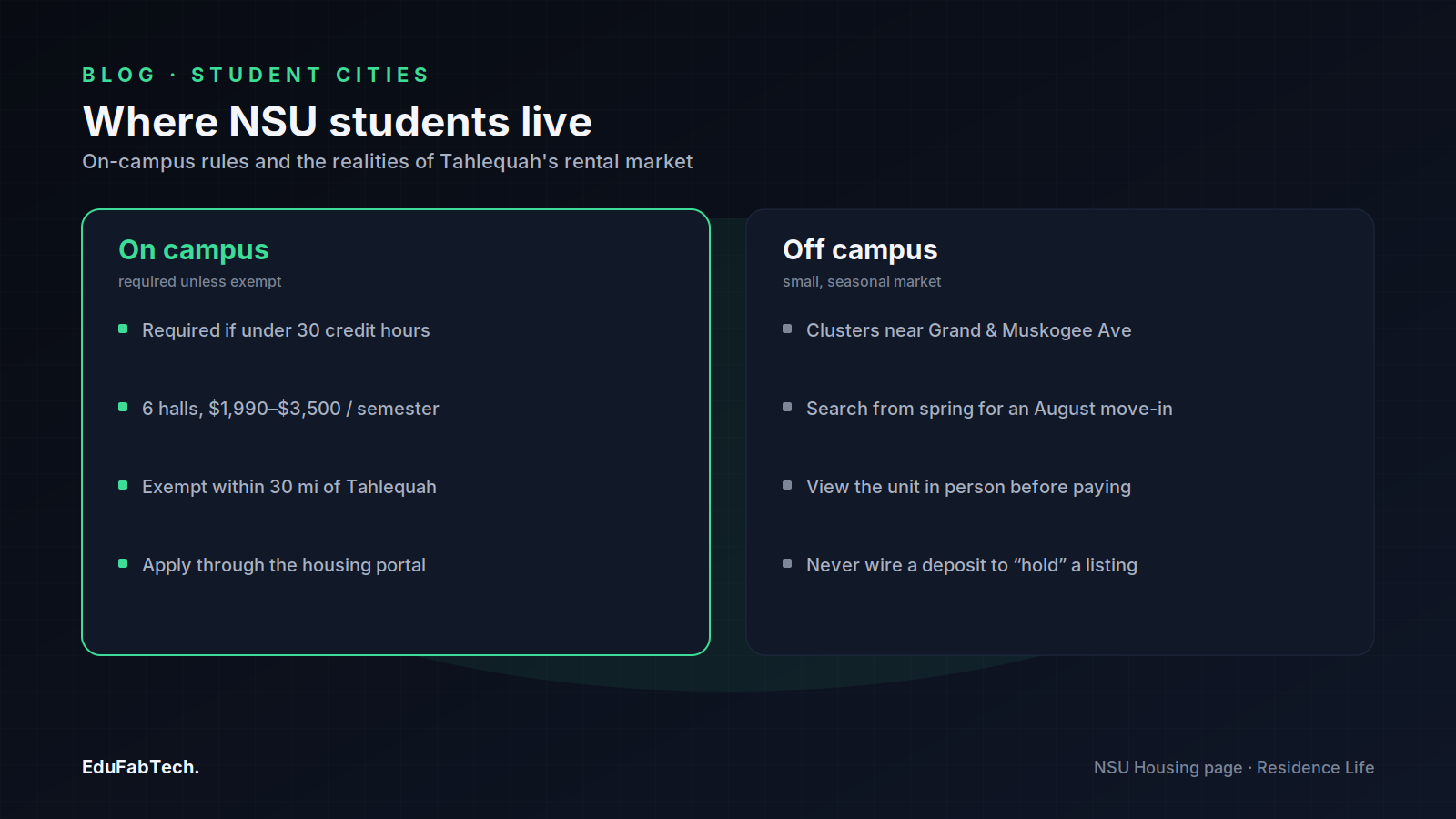
NSU keeps most first-year students on campus by rule, not just by habit. Its housing page states that "incoming students who have not completed 30 hours prior to the beginning of the Fall term will be required to live on campus," with an exemption for students who live with a parent or guardian within a 30-mile radius of Tahlequah. If you want to commute from inside that radius, you request it through the housing portal; students outside it, or appealing on hardship or medical grounds, write to the Director of Residence Life, whose Commuting Distance Exception Committee reviews the case.
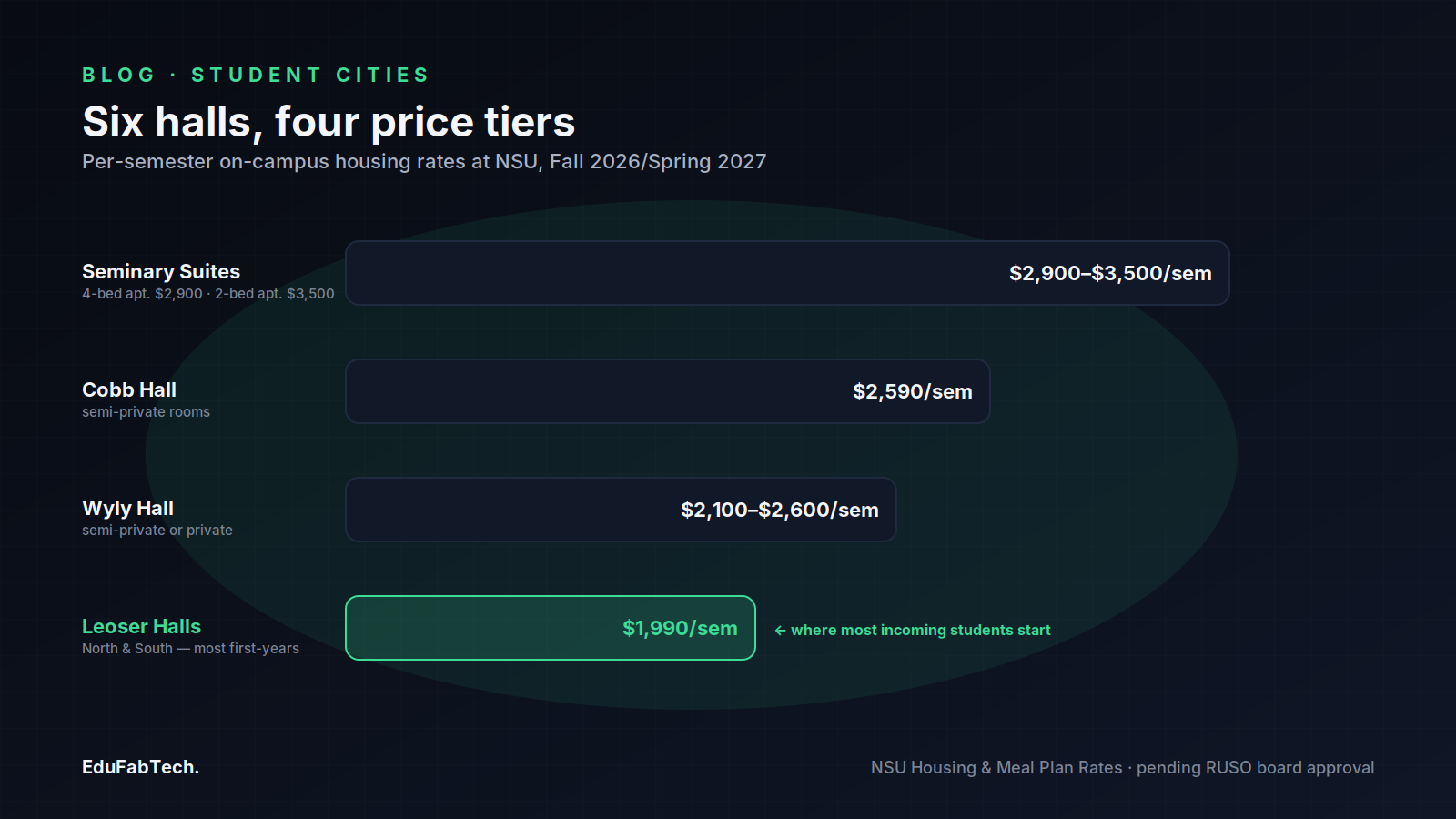
On-campus options run across six residence halls. The university's housing and meal plan rates, which it notes are "pending approval by RUSO board of regents" for Fall 2026/Spring 2027 and subject to change, list North Leoser and South Leoser at $1,990.00 per semester (semi-private), Wyly Hall at $2,100.00 semi-private and $2,600.00 private, Cobb Hall at $2,590.00, and Seminary Suites at $2,900.00 for a four-bedroom unit and $3,500.00 for a two-bedroom unit. The Leoser halls are the budget end; the Seminary Suites apartments are the priced-up, more independent end.
Off campus, most student rentals cluster in the older grid of streets between campus and the downtown square, and in newer complexes along the highways toward the edges of town. Tahlequah's rental market is small and seasonal, so the realistic advice is specific: start looking in late spring for an August move-in, because the best-placed houses near Grand and Muskogee Avenues turn over fast once leases end in July. Before you pay anything, see the unit in person or send someone you trust; confirm who the landlord actually is; and read whether utilities are on you, because many older Tahlequah houses have window units and poor insulation that make summer electricity bills real.
On scams: in a town this size the fraud you are most likely to meet is an online listing — often a photo lifted from a real house — for a place near campus at a suspiciously low rent, from someone who says they are "out of town" and wants a deposit to "hold" it before you can view it. No legitimate Tahlequah landlord needs you to wire money, buy gift cards or send cryptocurrency to reserve a room. A normal deposit here is paid by cheque or card after you have seen the unit and have a signed lease in hand. If a listing cannot be viewed in person and the person pushes for an irreversible payment, walk away.
Furnishing a room for less
Because so many leases turn over in summer, second-hand furniture circulates heavily in July and August, and you can kit out a room cheaply if you know where to look. The Tahlequah Area Habitat for Humanity ReStore, at 17165 West Mud Valley Road, sells "gently used furniture, doors, windows, hardware, tools, housewares, kitchenware" and more, and runs 50% off orange-sticker items on Wednesdays and Saturdays; its own page lists hours of Monday to Friday 9:00 to 5:30 and Saturday 9:00 to 4:00. It is the single most useful stop for a desk, a chair or a bed frame, and the proceeds fund local house-building.
For produce, plants and the social side of shopping, the Tahlequah Farmers' Market runs April to October, Saturdays 8 a.m. to noon, at the pavilion across from Norris Park where Muskogee Avenue meets Morgan Street in the historic downtown — a short walk from campus. The town also has a Goodwill store on the south side for clothing and small goods. Between those and the end-of-lease giveaways that appear around town each August, a frugal student rarely needs to buy much furniture new.
Working part-time while you study
Domestic students work the usual campus and town jobs — dining halls, the library, retail along Muskogee Avenue, and seasonal work tied to the river and lake tourism. For international students the rules are stricter and come from federal law, not the university. The U.S. Department of Homeland Security's Study in the States guidance states that an F-1 student "may not work more than 20 hours per week when school is in session," and that off-campus employment generally requires having completed one academic year plus specific authorisation. Curricular and optional practical training (CPT and OPT) are separate categories with their own paperwork.
This is not legal advice, and the details change: confirm your own situation with NSU's international student office and the official DHS and U.S. Citizenship and Immigration Services pages before you take any job, because working outside the terms of your visa can end your status. The practical point for Tahlequah is that on-campus roles are the straightforward path, and they are limited in number, so apply early in the semester rather than waiting until money is tight.
Libraries and places to study
The academic heart of campus study is the John Vaughan Library at 711 N. Grand Avenue, confirmed on NSU's library help page. It holds individual desks and bookable group study rooms, and it keeps genuinely late hours during the week — open until midnight Sunday through Thursday — useful in a town where options thin out after dark. You reserve group rooms through the library's online booking tool rather than turning up and hoping.
Beyond the main library, the Oklahoma College of Optometry and the various college buildings have their own quiet corners, and the student union offers daytime tables when you want background noise rather than silence. Downtown, the independent coffee shops around the square give you a change of scene within walking distance of campus. If you want to compare desks, opening hours and quiet spots that other students rate, the EduFabTech study spaces listing for Tahlequah collects them in one place.
Getting around Tahlequah
Be honest with yourself about transport before you arrive: Tahlequah has no conventional city bus network of the kind you would find in a larger town. The main public option is Cherokee Nation Transit, whose stated purpose is "to provide safe, reliable, and low-cost transportation for Native Americans to employment, healthcare, places of higher learning, and other vital destinations through commuter-routes and demand response services." It runs commuter routes in the region, including service between Stilwell and Tahlequah, but it is not a general campus shuttle, and eligibility is oriented toward Native American riders.
In practice, the central campus and downtown are walkable — one of the real advantages of a compact town — and many students bike. For trips to Tulsa, a car or a ride-share with classmates is the usual answer; there is no passenger rail. If you are coming from a city with a transit pass in your pocket, plan for walking, a bicycle or access to a car rather than assuming a bus will get you to a late shift or a weekend trip.
What it costs, and the honest trade-offs
Costs are where you should trust dated, named figures over impressions. NSU's 2026-2027 cost of attendance estimates tuition and fees at $9,006 for a full-time in-state undergraduate and $18,964 for a non-resident, with books and supplies at $800 for the nine-month year. The dorm rates above — from $1,990.00 per semester in the Leoser halls to $3,500.00 for a two-bedroom Seminary Suites unit for 2026-2027, pending RUSO board approval — give you the on-campus end directly. For the broader cost of living, the median household income of $49,581 reported in the 2024 American Community Survey via Data USA signals a town where rents and groceries are modest by national standards.
The good side of Tahlequah for a student is real: low cost of living, a walkable core, a university woven into the town's Cherokee history, and outdoor life on the Illinois River, Lake Tenkiller and the Ozark foothills that is hard to match in a flat city. The hard side is equally real. The rental market is small and clusters around the summer turnover, so timing matters. Public transport is minimal, so life is easier with a car. Oklahoma summers are hot and the region sees severe spring storms, which matters for older housing without good cooling. And the social scene is campus-and-outdoors rather than big-city nightlife — a feature for some students, a limitation for others. You can see what is on offer near campus through the EduFabTech page for places near Northeastern State University.
A checklist for your first weeks
- Sort housing status early. If you have fewer than 30 completed hours, confirm whether the on-campus requirement applies to you, or file a commuter request, through NSU's housing process rather than assuming you can live off campus.
- See before you pay. View any off-campus room in person, get a signed lease, and never wire a deposit or pay by gift card or crypto to "hold" a place.
- Furnish second-hand. Hit the Habitat ReStore and the August lease-end giveaways before buying anything new; browse the EduFabTech second-hand and furniture listings.
- Line up work the legal way. If you are on an F-1 visa, read the DHS rules and talk to NSU's international office before accepting any job; start with on-campus roles and the local jobs listings.
- Learn the library's late hours and book a group study room online at John Vaughan Library when you need one.
- Plan transport honestly. Expect to walk, bike or share a car; do not count on a city bus for shifts or trips to Tulsa.
A quick question for readers
Do you work part-time while you study?
Many students work to pay the bills. See how common it is — and how many hours people really do.
Pick an answer, create a free account in a minute, and your vote counts. Already a member? Sign in
Comments 1
Comment-
The cost-of-living case leans entirely on one number: $49,581 median household income from the ACS, used to imply 'rents and groceries are m…
Join free to read the full comments and reply Comments are between members; an account takes a minute.
Source: Northeastern State University
Sources (5)
- Northeastern State University. Housing and Meal Plan Rates. Northeastern State University, 2026. offices.nsuok.edu ↗ · checked 2 Nov 2026
- Northeastern State University. Housing Options for Commuters. Northeastern State University, 2026. offices.nsuok.edu ↗ · checked 2 Nov 2026
- Northeastern State University. Heritage of Northeastern State University. Northeastern State University, 2026. nsuok.edu ↗ · checked 2 Nov 2026
- U.S. Department of Homeland Security. Working in the United States (F-1 students). Study in the States, 2026. studyinthestates.dhs.gov ↗ · checked 2 Nov 2026
- Data USA. Tahlequah, OK (2024 American Community Survey). Data USA, 2024. datausa.io ↗ · checked 2 Nov 2026