Studying in Tallahassee: universities, housing and student life
A practical, honest guide to studying in Florida's capital — Florida State and Florida A&M, where students live, what rooms cost, how to get around, and what the city gets right and wrong.
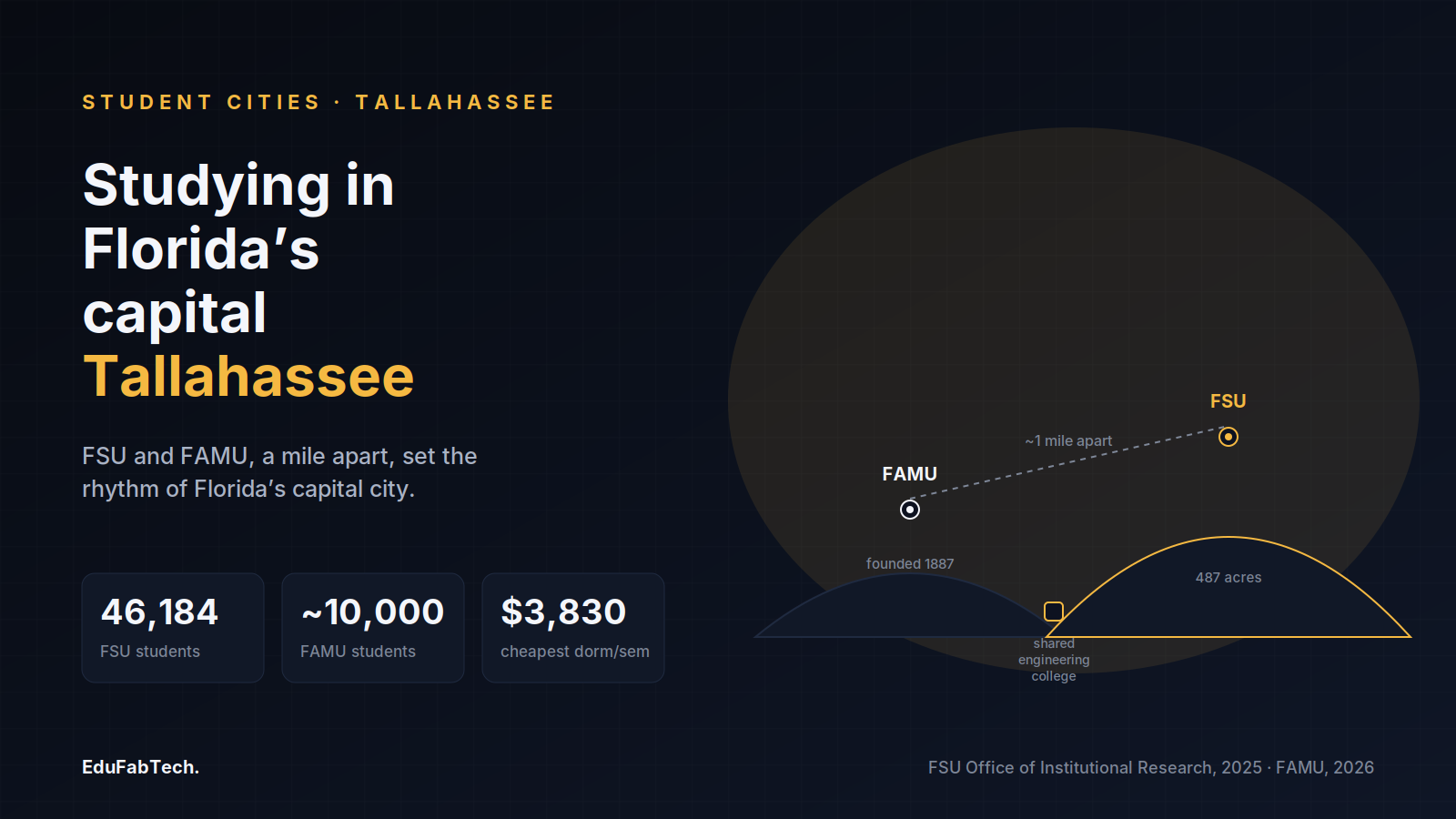
Tallahassee is the capital of Florida, set in the state's Panhandle much closer to the Georgia line than to the beaches most people picture when they hear "Florida." It is a government town and a university town at the same time: the Florida Legislature meets a short walk from two campuses that, between them, set the rhythm of the place. Term-time and legislative session fill the restaurants on Gaines Street and the parking garages downtown; when students leave in May, whole neighbourhoods visibly empty out.
The two campuses are Florida State University and Florida A&M University, and they sit roughly a mile apart on adjacent hills just southwest of downtown. According to its Office of Institutional Research, Florida State enrolled 46,184 students in Fall 2025 — 33,068 undergraduates and 11,022 graduate students — on a main campus of 487.1 acres in Leon County (FSU Office of Institutional Research, 2025). It is a comprehensive research university whose film programme draws national attention: the Florida State University College of Motion Picture, Television and Recording Arts held its place as the country's No. 4 public film school and climbed to No. 13 overall in The Hollywood Reporter's 2026 ranking, as the college itself reported (FSU College of Motion Picture Arts, 2026).
FSU is organised into colleges and schools you apply to by name, and it is worth knowing which is which before you choose a programme. The Florida State University College of Arts and Sciences and the Florida State University College of Social Sciences cover the bulk of the liberal-arts and social-science majors; the Askew School of Public Administration and Policy, which prepares people for government and non-profit careers, sits within the latter — fitting for a capital city. Teacher training runs through the Florida State University College of Education, clinical training through the Florida State University College of Nursing, and nutrition, family and child science through the Florida State University College of Human Sciences. Music, theatre, art and dance belong to the Florida State University College of Fine Arts. The Dedman School of Hospitality trains hotel and restaurant managers, and the Florida State University School of Library & Information Studies runs one of the older library and information programmes in the field.
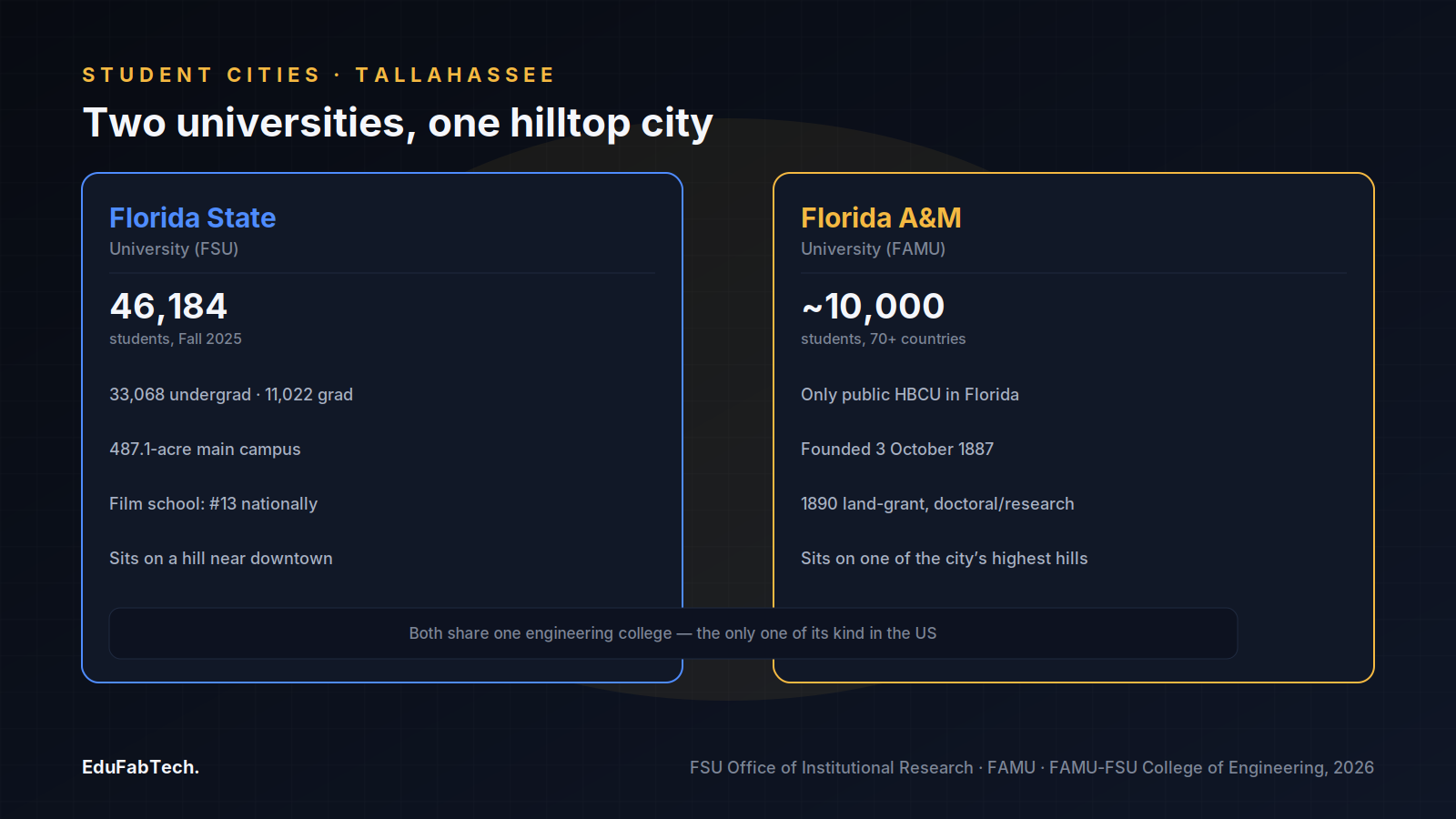
Florida A&M University, founded on 3 October 1887, describes itself as "a public, historically Black university located in Tallahassee, Florida" that "enrolls nearly 10,000 students from across the United States and more than 70 countries" and is an 1890 land-grant, doctoral/research institution (Florida A&M University, 2026). FAMU — universally called FAMU, pronounced "fam-you" — sits on one of the highest hills in the city, its oldest buildings forming the Florida Agricultural and Mechanical College Historic District. It is the only public historically Black university in Florida, and its pharmacy, business and journalism programmes and its marching band are part of the city's identity.
The two universities also share something unusual. The Florida A&M University – Florida State University College of Engineering is, in its own words, "the only shared college of engineering in the nation," on a separate campus at 2525 Pottsdamer Street between the two hills (FAMU-FSU College of Engineering, 2026). A student can register at either university and earn the same engineering degree. Tallahassee State College (the former community college) and other providers add to the mix, but FSU and FAMU are the gravity in this city.
Where students settle, hill by hill
College Town is the obvious first choice if you want to roll out of bed into class at FSU. Built along Madison Street on the east edge of campus and beside Doak Campbell Stadium, it is a dense cluster of mid-rise student apartments over ground-floor bars, coffee and food. You pay for the convenience: this is among the priciest student housing in the city, and on football Saturdays the noise is relentless. It suits someone who wants to live without a car and does not mind a crowd.
Midtown, north of the FSU and downtown area along Thomasville Road and Monroe Street, is a step quieter and more mixed — older houses split into rentals, newer apartments, and a strip of independent restaurants and bars that stays busy with graduate students and young professionals. Commutes to either campus are short by bus or bike.
All Saints and the Gaines Street / Railroad Square corridor, just south-east of FSU near the railway, is the arts district: galleries, breweries, the First Friday art walk at Railroad Square, and warehouse-style apartments. It is walkable to FSU and to the engineering college and tends to attract students who want something less polished than College Town.
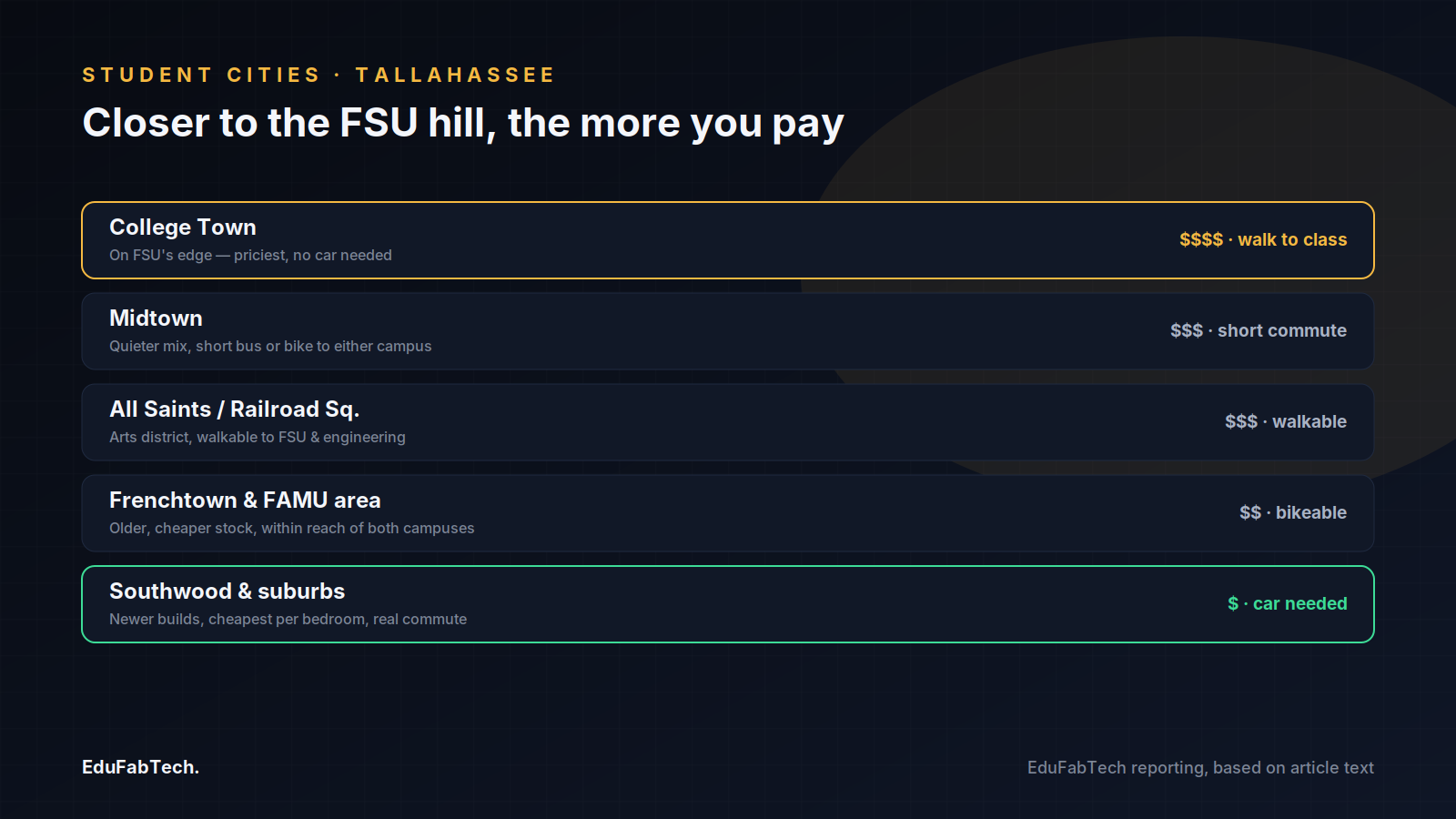
Frenchtown, immediately north-west of downtown, is the oldest historically Black neighbourhood in the area and sits within reach of both campuses; it has older, generally cheaper housing stock and a strong community character, though parts are still mid-regeneration. South and west of FAMU, the streets around the university hold a lot of FAMU students in houses and smaller complexes, with rents below the College Town premium. Further out, Southwood and the south-east suburbs offer quieter, newer rentals aimed at families and staff — cheaper per bedroom, but a real commute that assumes a car or a longer bus ride. As a rule in Tallahassee, the closer you are to the FSU hill, the more you pay and the less you need to drive.
You can browse what is currently listed across the city on EduFabTech's Tallahassee page, and filter to rooms and places to stay, or to listings near Florida State University and near Florida A&M University.
Finding a room, and the traps that appear at move-in
On-campus housing is the simplest starting point, and its prices are published. FSU University Housing lists its 2025–2026 residence-hall rates per person, per semester: a shared suite triple with a shared bath from about US$3,830, a one-bedroom Rogers apartment shared by two at US$3,285, and a private-bath suite single at US$4,795, with furnishings, electricity, water and internet included (FSU University Housing, 2025–2026). Those are useful benchmarks even if you plan to live off campus, because private rents in College Town often run above the dorm rate once utilities are added. I have not found a single authoritative municipal figure for the typical off-campus student rent in Tallahassee, so treat any one number with caution and compare several listings yourself.
For off-campus leases, start early: demand peaks for an August move-in, and the best-value rooms near FSU are often signed many months ahead. Both universities run off-campus housing search services, which are a safer first stop than open marketplaces. The scams that circle Tallahassee at move-in season follow a pattern: a room near College Town or FAMU advertised below the going rate, a "landlord" who is conveniently out of state, and pressure to send a deposit to "hold" it before you can see the place. Do not pay anyone who will not let you view the unit in person or by live video, and never send a deposit or first month's rent by bank wire, gift card or cryptocurrency — those payments are effectively impossible to recover. Normal local practice is a signed lease and a deposit paid once you have seen the unit; insist on both.
Furnishing a room without overpaying
Tallahassee turns over a huge amount of second-hand furniture every May and August as leases end, and students who time it well furnish a room for very little. Goodwill Industries–Big Bend runs several thrift stores across the city, and FAMU's student newspaper, The Famuan, has mapped the local options for clothes and furniture, naming Goodwill alongside independent shops such as Community Thrift (The Famuan, 2020). Watch the end-of-semester weeks especially: departing students give away or cheaply sell desks, chairs and kitchenware they cannot take with them. EduFabTech's second-hand and used-furniture listings, and the free-stuff page, are worth checking in that window before you buy anything new.
Working while you study
Many students take part-time jobs on campus — in dining halls, libraries, labs and offices. If you are an international student, the rules are strict and worth reading from the source rather than from hearsay. For F-1 students, U.S. Citizenship and Immigration Services states that on-campus employment with the approval of a Designated School Official is permitted for up to 20 hours per week when school is in session, with full-time work allowed during official breaks (USCIS Policy Manual, Volume 2, Part F, Chapter 6). Off-campus work for F-1 students generally requires separate authorisation. This is a summary, not legal advice: confirm your own situation with FSU's Center for Global Engagement or FAMU's international office before accepting any job. Current openings in the city are collected on EduFabTech's Tallahassee jobs page.
Libraries and places to study
FSU's main library is Strozier, at the centre of campus, with the Dirac Science Library serving the science and engineering side; both offer bookable group study rooms and long opening hours, and you can check current hours and room availability through the FSU Libraries site (FSU Libraries). FAMU students have the Samuel H. Coleman Memorial Library on their hill. Off campus, the LeRoy Collins Leon County Public Library runs a main branch downtown on West Park Avenue, a quiet, free alternative open to everyone (Leon County Public Library). When those are full in exam season, EduFabTech lists other study spaces and desks around the city.
Getting around: StarMetro and the Seminole Express
Tallahassee's public bus operator is StarMetro, run by the City of Tallahassee, with its hub at the C.K. Steele Plaza downtown. For a standard rider a single trip is US$1.25 and a 31-day pass US$38.00, bought through the Token Transit app or a reloadable Smart Card; the reduced fares of US$0.60 a trip and US$19.00 a month are for riders aged 60 and over, people with disabilities, Medicare customers and K-12 students, not university students (City of Tallahassee StarMetro, 2026). FSU and FAMU students, though, do not pay a cash fare at all: the same StarMetro page tells FSU and FAMU students to swipe a valid student ID to board, and FSU's transportation office states that "all students, faculty, and staff can ride StarMetro buses throughout the City of Tallahassee for free with a valid FSUCard" (FSU Transportation & Parking Services). FSU also runs its own Seminole Express shuttle routes, on which "students, faculty, & staff ride for free with a valid FSUCard" (FSU Transportation & Parking Services). Between the free campus shuttles and free city buses, a student living near campus can manage without a car — but Tallahassee is spread out, and if you settle in the southern suburbs you will feel the lack of one.
The honest ledger: what is good, what is hard
The good: Tallahassee is, by the standards of US university cities, affordable, and the published dorm rates above show it. Two major universities a mile apart give it real intellectual and cultural density, from the film school's screenings to FAMU's concerts to the Railroad Square art walk. It is green and walkable in its core, famous for canopy roads of live oak, and as the state capital it offers unusual access to internships in government, policy and law. The free FSU shuttle and free student bus rides keep daily costs down.
The hard: the summers are long, hot and intensely humid, and hurricane season runs through the autumn term, which can mean genuine disruption and the occasional campus closure — Tallahassee has been struck directly in recent years. Housing demand spikes hard around FSU for an August start, so latecomers pay more or commute further. Beyond the two campuses and downtown, the city is car-oriented and sprawling, and bus coverage thins out in the evenings and suburbs. And because so much of the economy is students and government, the place genuinely quiets down between terms and sessions, which some find peaceful and others find dull.
A checklist for your first weeks
- Set up your student ID — the FSUCard or FAMU ID — early; it is your key to free Seminole Express rides and free StarMetro rides.
- If you are on a visa, visit FSU's Center for Global Engagement or FAMU's international office to confirm your status and what work, if any, you may do.
- Decide car or no car before you sign a lease: it dictates whether College Town, Midtown and All Saints or the cheaper southern suburbs make sense for you.
- View any off-campus room in person or by live video before paying, sign a proper lease, and never wire a deposit to "hold" a place.
- Learn the StarMetro and Seminole Express routes between your neighbourhood and campus — your student ID is your bus fare.
- Furnish from second-hand stores and end-of-semester giveaways rather than buying new; the August and May turnover is when the good pieces appear.
- Find your study base early — a floor in Strozier or Dirac, Coleman Library, or the downtown public library — before finals make seats scarce. Check EduFabTech's Tallahassee events page to meet people in the first fortnight.
A quick question for readers
Do you work part-time while you study?
Many students work to pay the bills. See how common it is — and how many hours people really do.
Pick an answer, create a free account in a minute, and your vote counts. Already a member? Sign in
Source: Florida State University Office of Institutional Research
Sources (5)
- Florida State University Office of Institutional Research. FSU Facts and Figures. Florida State University, 2025. ir.fsu.edu ↗ · checked 5 Oct 2026
- Florida A&M University. About FAMU. Florida A&M University, 2026. famu.edu ↗ · checked 5 Oct 2026
- City of Tallahassee. StarMetro Fares, Passes & Purchase Options. City of Tallahassee, 2026. talgov.com ↗ · checked 5 Oct 2026
- FSU University Housing. Residence Hall Rental Rates 2025-2026. Florida State University, 2026. housing.fsu.edu ↗ · checked 5 Oct 2026
- U.S. Citizenship and Immigration Services. Policy Manual, Volume 2, Part F, Chapter 6: Employment. USCIS, 2026. uscis.gov ↗ · checked 5 Oct 2026