Studying in Tampa: universities, housing and student life
A practical, sourced guide to studying in Tampa, Florida — its universities, the neighbourhoods students actually rent in, dorm costs, getting around on HART, work rules and the honest trade-offs.
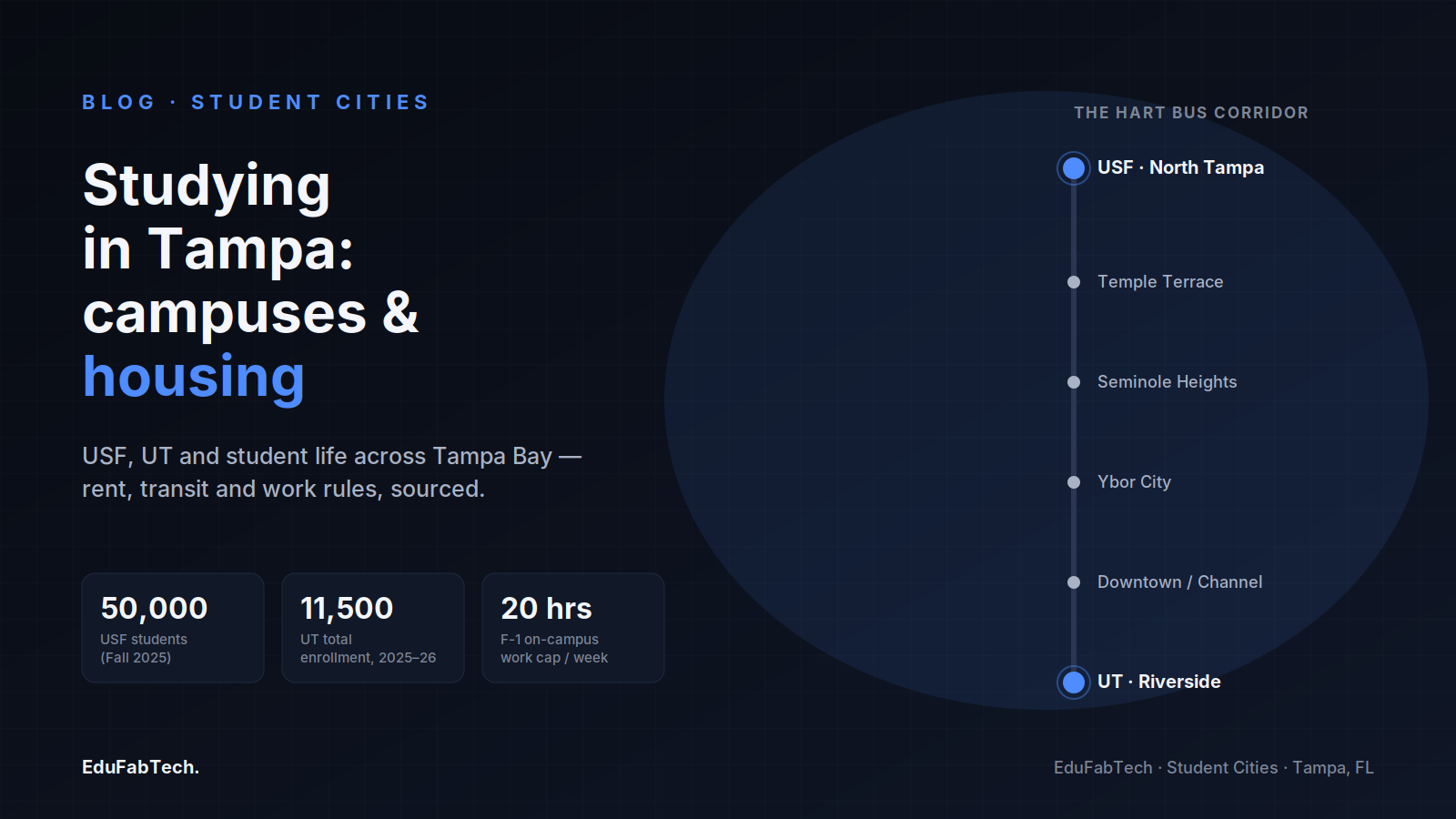
Tampa spreads out along the north-eastern edge of Tampa Bay, a warm, flat, car-shaped city where the student population is split between two very different campuses. To the north, off Fowler Avenue, sits the sprawling research campus of the University of South Florida; near the river downtown, behind a row of silver minarets, sits the far smaller University of Tampa. Between them lie neighbourhoods that range from cigar-era brick streets to 1920s bungalow districts to glassy new downtown towers, connected by a bus network that works well on a few corridors and thinly everywhere else.
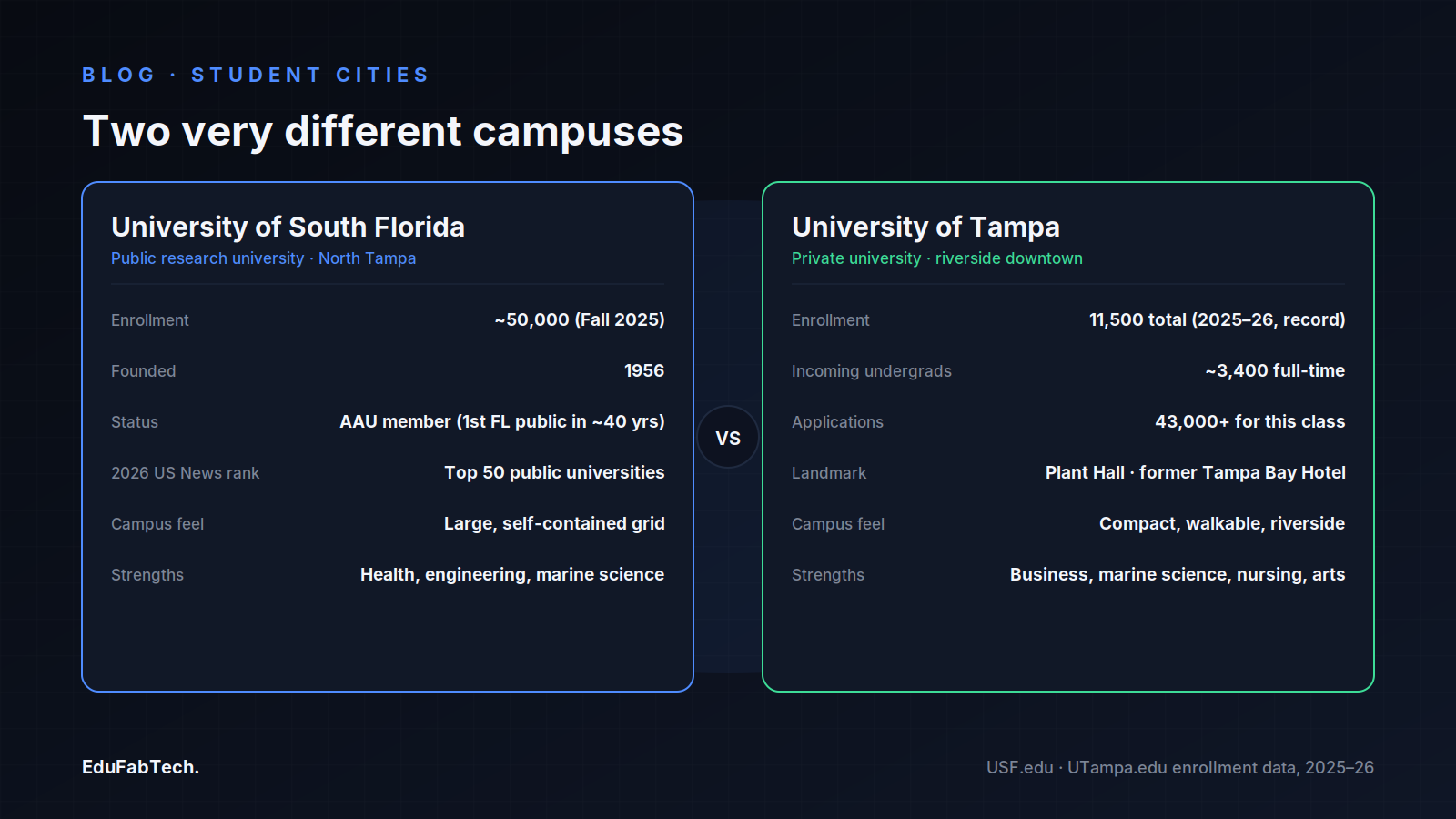
The numbers give a sense of the scale. The University of South Florida says on its own site that it serves nearly 50,000 students across its Tampa main campus and a St. Petersburg branch (Fall 2025), which makes it one of the largest universities in the United States. The University of Tampa reported a record total enrolment of 11,500 for 2025–2026, with about 3,400 incoming full-time undergraduates drawn from more than 43,000 applications. Together with several smaller institutions, that is a sizeable student city layered onto a metropolitan area built mostly for drivers.
What follows is a practical account of living here as a student — local or international: where people rent, what it costs where a figure can be sourced, how to get around, the rules that apply to working, and the parts of the city that are harder than the brochures admit. Every figure below is tied to the page it came from.
The universities, and what studying at each is like
The University of South Florida (USF) is the gravitational centre of student Tampa. Its main campus sits in North Tampa, a self-contained grid of research buildings, residence halls and medical facilities well north of downtown. USF states that it was founded in 1956 and joined the Association of American Universities (AAU) — the first public university in Florida invited in nearly 40 years — and that U.S. News & World Report placed it among the top 50 public universities in its 2026 ranking. It is a classic large public research university: wide subject range, strong in health, engineering and marine science, and big enough that first-year students often describe it as a small town. The Judy Genshaft Honors College runs honours study within USF for students who want smaller classes inside the larger machine.
The University of Tampa (UT) is the opposite in feel: a compact private university on a riverside campus downtown, built around Plant Hall — the former Tampa Bay Hotel, whose silver minarets are the city's most recognisable landmark and which today also houses the Henry B. Plant Museum. UT describes its identity in terms of access, affordability and graduation success, and describes itself as a major intellectual talent importer for Tampa Bay. Business, marine science, nursing and the arts are among its best-known programmes, and the campus's position across the river from downtown means students walk or take the free streetcar into the city rather than driving everywhere.
Schiller International University keeps a Tampa campus downtown, inside the high-rise at 400 North Tampa Street. Schiller says the Tampa campus grants degrees including a BA in international relations and diplomacy, a BS in international business, a BS in computer science, an MS in data science and an MBA, with students able to move between its campuses in different countries — a small, internationally oriented school rather than a traditional residential college. The USF system's University of South Florida St. Petersburg campus, across the bay in St. Petersburg, grants degrees as part of USF and is a realistic option for students who prefer that waterfront city to North Tampa. On the metro's quieter eastern edge, Florida College in Temple Terrace is a small private Christian college granting associate and bachelor's degrees.
If you are comparing programmes and living options in one place, EduFabTech keeps the city's student listings at /in/united-states/tampa, with campus-specific pages for USF, the University of Tampa and Schiller International University.
Where students settle across the city
Tampa's student geography follows the two main campuses, and the neighbourhoods differ sharply in price and character.
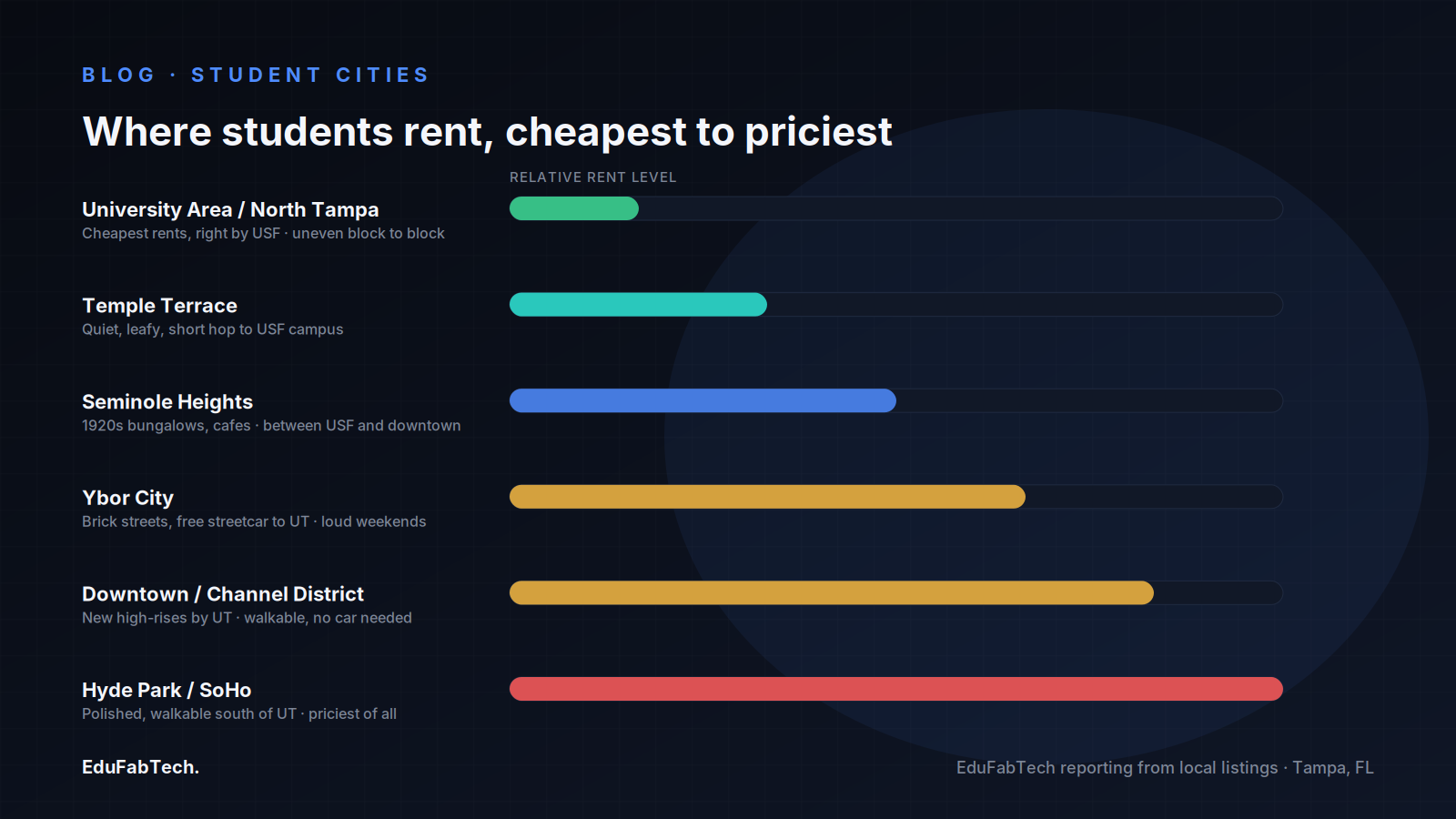
University Area / North Tampa. The blocks around USF along Fowler Avenue hold most of the city's purpose-built student apartments and its cheapest rents close to campus. It is convenient — the University Area Transit Center and the campus Bull Runner shuttle are right there — but it is also uneven street by street, with some blocks much quieter and safer than others, so visit at different times of day before committing.
Temple Terrace. Just east of USF, this is a leafier, calmer residential town built around an old golf course, popular with graduate students and staff who want quiet and a short hop to campus. Florida College is here too.
Seminole Heights. Midway between USF and downtown, a district of 1920s bungalows that has become the city's hub for independent cafés, breweries and small restaurants. Rents are higher than the University Area but it draws students who want character and a short drive or bus ride into town.
Ybor City. The historic cigar-making quarter east of downtown, with brick streets, converted lofts and the region's loudest weekend nightlife. The free TECO Line Streetcar links it to downtown and the University of Tampa, which makes it attractive to UT students who can do without a car — at the cost of noise on weekend nights.
Downtown and the Channel District. New high-rise apartments along the river and the port, within walking distance of UT and Schiller and served by the streetcar. This is the most expensive end of the student market; the trade-off is that you can live without a car here.
Hyde Park and SoHo. Historic, polished neighbourhoods just south of UT, where South Howard Avenue ("SoHo") concentrates bars and restaurants. Pleasant and walkable, but among the priciest places a student can rent.
Finding a room without losing a deposit
Many first- and second-year students at both universities start in the residence halls and move off campus later, which is the safest way to arrive in a city you don't yet know. When you do look privately, the off-campus hunt in Tampa concentrates around the USF/Fowler corridor and the downtown–Ybor–Seminole Heights band, and that is also where rental scams concentrate: listings priced suspiciously below the surrounding blocks, "landlords" who are travelling and cannot show the unit, and pressure to pay before you have seen it.
The rule that protects you is simple: see the actual room in person, or have someone you trust see it, before any money moves. A legitimate complex has a staffed leasing office you can walk into. In Tampa the normal upfront cost is the first month's rent plus a security deposit, typically around one month's rent; be wary of demands far outside that. Never send a deposit by bank wire, gift card or cryptocurrency to "hold" a room — those payments cannot be recovered, and no honest landlord here requires them. EduFabTech's own Tampa listings for rooms are a place to start building a shortlist before you contact anyone.
Furnishing a room without overspending
Because so many students move in and out each August and May, Tampa has a steady second-hand market. The Ybor City Saturday Market runs on Saturdays in the historic district and describes itself as the largest continually operating outdoor market in the Tampa Bay Area, operating since 2000, good for local food and one-off finds. For the bulky, boring essentials — a desk, a lamp, a microwave — the cheapest route is the end-of-semester churn: students leaving their apartments give away or sell furniture in May and December. EduFabTech gathers these locally under second-hand things and free stuff, which is usually faster and closer to campus than any single market.
Working while you study
If you are an international student, the rules on employment are set by federal immigration authorities, not the university, and they are strict. For students on an F-1 visa, the U.S. Department of Homeland Security's Study in the States guidance states that in on-campus employment you may not work more than 20 hours per week when school is in session, that on-campus work is generally permitted, and that off-campus employment requires authorisation arranged through your Designated School Official (DSO) and, where applicable, U.S. Citizenship and Immigration Services. Before accepting any job, check your specific situation with your DSO — USF's and UT's international-student offices exist for exactly this — and read the official page rather than relying on word of mouth. This is a pointer to the source, not legal advice. On-campus roles and locally advertised part-time work appear on EduFabTech's Tampa jobs page.
Libraries and places to study
On the USF campus, the USF Tampa Library is the main study building, open long hours and busy through exam periods. Off campus, the Tampa–Hillsborough County Public Library system offers free library cards to Hillsborough County residents, and its downtown flagship, the John F. Germany Public Library on North Ashley Drive, gives students a large, quiet, air-conditioned space away from campus — useful in a city where summer heat makes outdoor study impractical for much of the year. Seminole Heights and Ybor cafés fill the gap for group work and casual study; EduFabTech lists bookable desks and quieter rooms under study spaces.
Getting around
Public transport in Tampa is run by the Hillsborough Transit Authority (HART), and it pays for a student to understand the fare system before buying anything. HART's published fares put a one-way local trip at $2.00 with a daily cap of $4.00 and a monthly cap of $65.00, and a discounted one-way at $1.00 with a $2.00 daily and $32.50 monthly cap, paid through the regional Flamingo Fares card or app. USF students, though, often pay nothing: under the USF U-Pass programme, HART confirms that University of South Florida students can ride HART Local, Limited Express and Flex routes free with a USF-issued Flamingo Card, while faculty and staff pay 50 cents — though that pass is not valid on Express service, HARTPlus or the streetcar. Downtown, the TECO Line Streetcar is fare-free and runs 2.7 miles linking downtown, the Channel District and Ybor City, which is why UT and downtown students can genuinely live car-free.
Away from these corridors, buses are infrequent and distances are large, so many students who live in North Tampa still keep a car. Tampa is flat and increasingly bike-friendly in its central neighbourhoods, but the summer heat and afternoon storms make cycling a seasonal choice rather than a year-round one.
What it costs, and what is hard
University housing gives the firmest dated figures. For 2026–2027, USF Housing lists Tampa-campus rates per semester of $3,320 for a traditional double, $4,612 for a traditional single, $4,588 for a Village double and $5,314 for an apartment-style single. At the University of Tampa, the posted 2026–2027 residence-hall rates run $3,720 per semester for a standard double and $5,591 for a standard single. Off-campus rents vary too much block to block to quote a single reliable figure, which is why seeing a place and comparing nearby listings matters more than any headline average.
The honest balance sheet: Tampa's attractions are real. Winters are mild, the Gulf beaches are an hour away, and the city is cheaper than Miami while offering two solid universities and, for USF students, free transit. Downtown, Ybor and Hyde Park are genuinely walkable. The hard parts are equally real. Outside the USF and streetcar corridors the city assumes you have a car. Summers are long, hot and humid, and the Atlantic hurricane season — which the U.S. National Oceanic and Atmospheric Administration (NOAA) dates from June 1 to November 30 — brings storm and flood risk to a low-lying coastal metro every year. Rents in the central neighbourhoods have risen sharply, and the cheapest blocks near USF can be uneven on safety. None of this is a reason to stay away; it is a reason to choose a neighbourhood deliberately.
A short checklist for the first weeks
- Collect your student ID and, at USF, your U-Pass Flamingo Card from Parking and Transportation Services before you need to travel.
- See any off-campus room in person — or send someone you trust — before paying; expect first month plus roughly one month's deposit, and never wire money or pay in gift cards or crypto to hold a place.
- If you are on an F-1 visa, meet your DSO about the 20-hour limit and any work authorisation before taking a job.
- Get a free Tampa–Hillsborough County Public Library card and locate your closest branch and campus library.
- Learn the two or three HART routes and, for USF, the Bull Runner shuttle that actually serve your commute.
- Furnish from the May/December student move-out churn and markets like the Ybor City Saturday Market rather than buying everything new.
- Prepare for the climate: plan around the June–November hurricane season and keep a basic storm kit.
Tampa rewards students who pick their patch of the city with care — near a campus, on a transit line, at a rent they have actually verified — and then take advantage of the warm coast around them. The rest of EduFabTech's local pages, from second-hand furniture to city events, are built to help with exactly that.
A quick question for readers
Rate these parts of student life this term
Rate each one from 1 (very poor) to 5 (very good). Together the results show where students struggle most.
Rate 5 things →Source: University of South Florida
Sources (5)
- University of South Florida. About USF. University of South Florida, 2025. usf.edu ↗ · checked 5 Oct 2026
- University of Tampa. UTampa Sets Another Record With 11,500 Students. University of Tampa, 2025. ut.edu ↗ · checked 5 Oct 2026
- Hillsborough Transit Authority (HART). Fares & Cards. Hillsborough Transit Authority, 2026. gohart.org ↗ · checked 5 Oct 2026
- U.S. Department of Homeland Security. Working in the United States (Study in the States). U.S. Department of Homeland Security, 2026. studyinthestates.dhs.gov ↗ · checked 5 Oct 2026
- University of South Florida Housing & Residential Education. Hall Rates 2026–2027. University of South Florida, 2026. usf.edu ↗ · checked 5 Oct 2026