Studying in Thornton: universities, housing and student life
Thornton has no university of its own, so this is a guide to using it as a commuter base for Denver and Boulder campuses — the N Line, rents, thrift stores and the honest trade-offs.
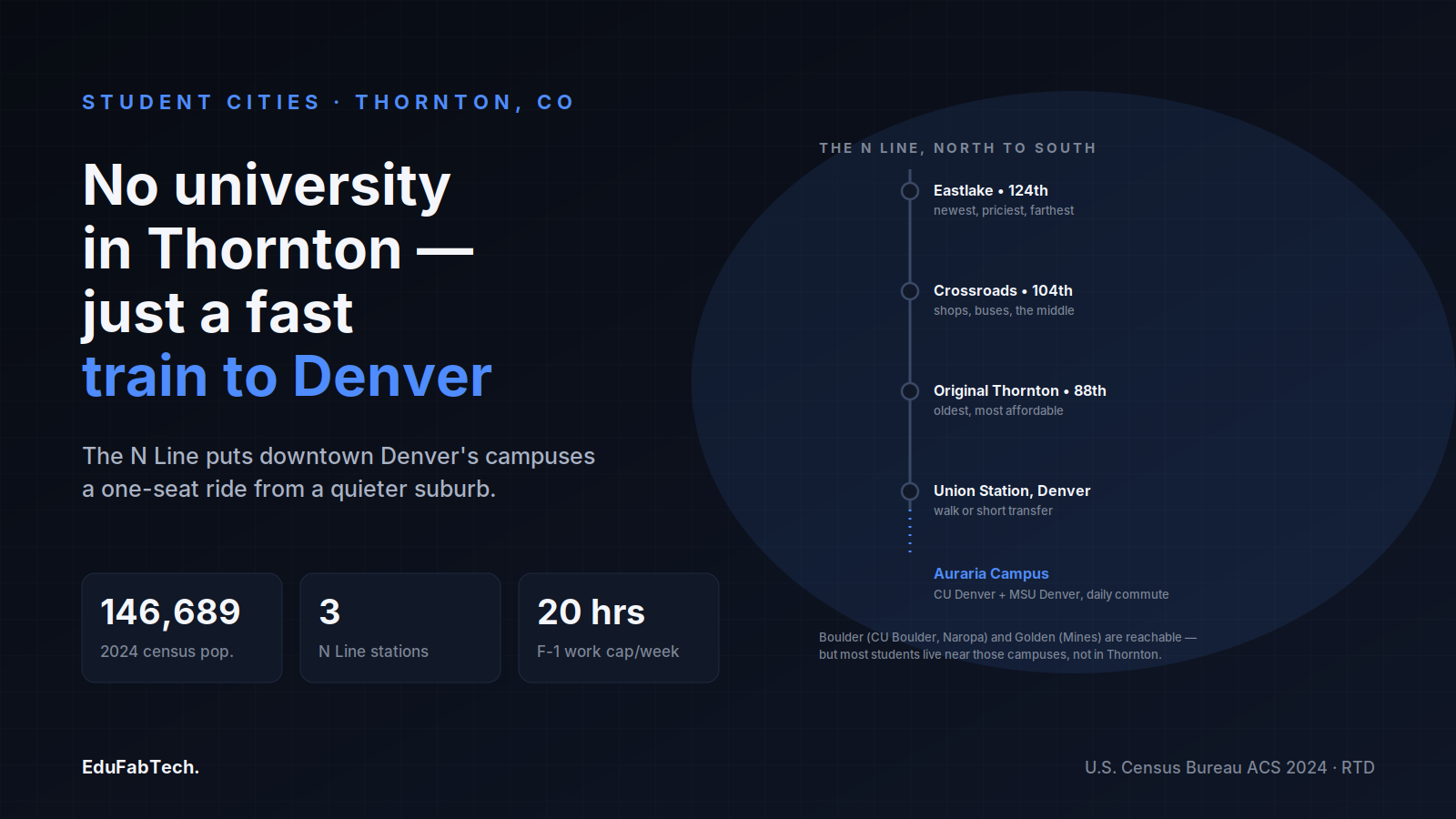
Thornton is not a college town, and it is more honest to say so at the start. It is a large suburb at the northern edge of the Denver metropolitan area, with about 146,689 residents counted by the U.S. Census Bureau's 2024 American Community Survey one-year estimate, as compiled by Census Reporter. No university grants degrees inside the city limits. What makes Thornton worth considering for a student is geography and a train: the region's campuses sit a commute away, and a commuter-rail line now connects the city directly to downtown Denver.
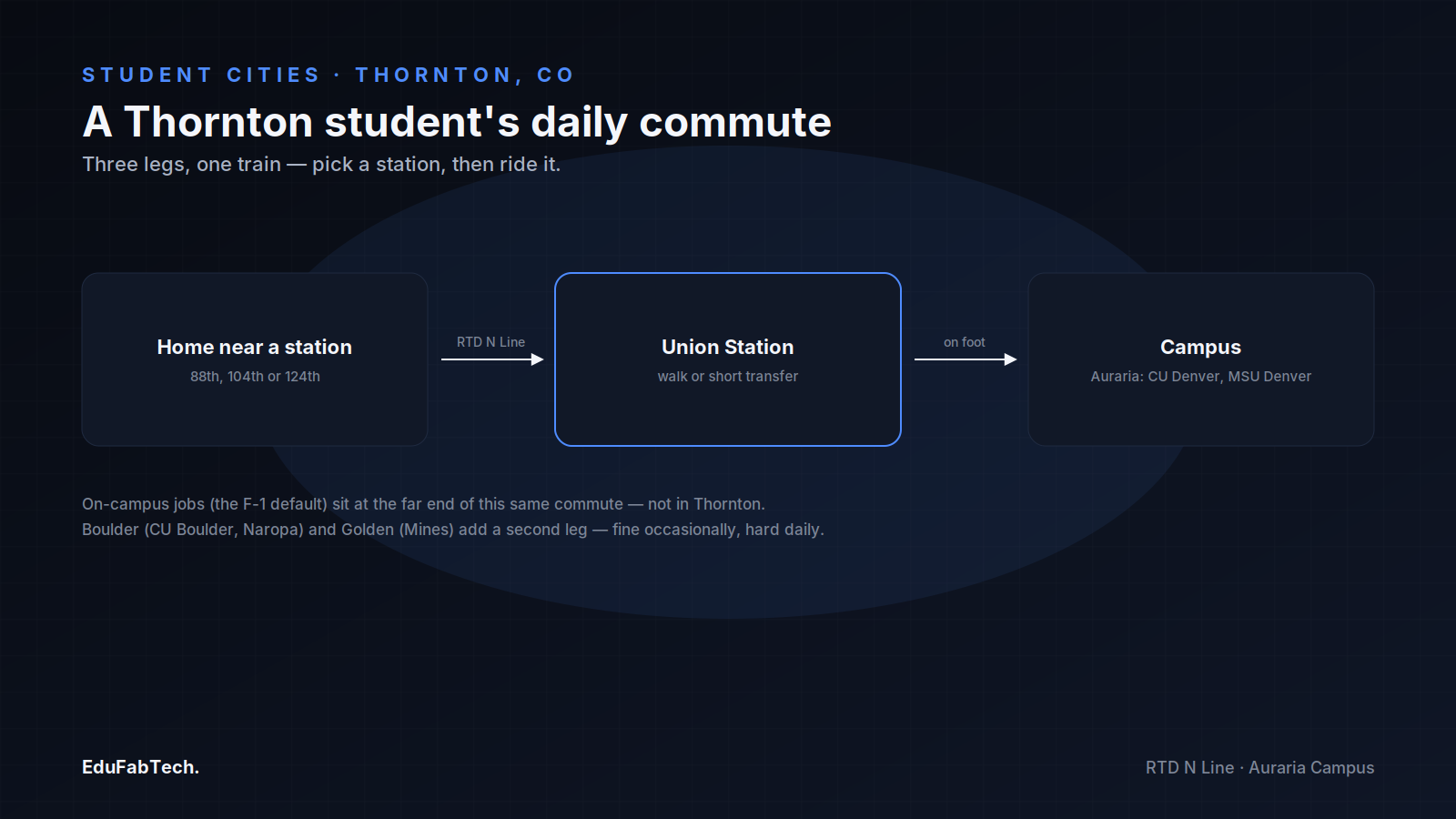
That line is the Regional Transportation District's N Line, which the agency describes as running north from Denver Union Station with three stations in Thornton — Original Thornton•88th, Thornton Crossroads•104th and Eastlake•124th. From Union Station you can reach the downtown campuses on foot or by a short transfer, which is the pivot the rest of this guide turns on. If you want a quieter, more residential place to live than central Denver, with the trade-off of a daily journey, Thornton is a reasonable choice.
The universities you would actually commute to
The closest cluster is the Auraria Campus in downtown Denver, a single site shared by three institutions. The University of Colorado Denver sits at 1201 Larimer Street and offers more than 135 academic programs across seven schools and colleges, from engineering and business to arts and media. It shares Auraria with the Metropolitan State University of Denver, a public university in the heart of downtown where, by its own figures, 57% of undergraduates are the first in their family to attend college. MSU Denver provides no on-campus housing, which is one reason its students fan out across suburbs like Thornton. Of the Auraria trio, these are the two most realistic daily destinations from a Thornton bedroom: ride the N Line to Union Station, then connect across downtown.
Further out are the better-known research universities. The University of Denver is a private institution that calls itself the oldest independent higher-education institution in the Rocky Mountain West and holds the Carnegie R1 "very high research" designation; among its professional schools is the Graduate School of Social Work at the University of Denver. The University of Colorado Boulder is the state's flagship, dating to 1876, one of only 38 U.S. public research institutions in the Association of American Universities, with five Nobel Laureates since 1989 by its own count. And the Colorado School of Mines, founded in 1874 as the Territorial School of Mines and based in Golden, concentrates on engineering and applied science with a focus on the earth sciences and energy. Boulder and Golden are far enough that students who attend them generally live near those campuses rather than commuting from Thornton every day; treat them as reachable for occasional trips, not a daily slog.
Two more belong on the list because they are closer, and one of them actually has a building in Thornton. Regis University — a Jesuit, Catholic university whose main campus is in northwest Denver at 3333 Regis Boulevard — runs an Interprofessional Health Site at 500 E. 84th Avenue in Thornton, housing counseling, occupational therapy and nursing skills labs, and a low-cost community counseling centre. That is the one piece of degree-related higher education physically in the city. Rounding out the picture: Naropa University in Boulder, a private, Buddhist-inspired university rooted in contemplative education and described as the birthplace of the modern mindfulness movement, and the Denver College of Nursing, a private downtown-Denver school that grants the Bachelor of Science in Nursing. CU Denver's health and medical programmes, meanwhile, are taught largely at the Anschutz Medical Campus in neighbouring Aurora, which is worth knowing if you are in a health field.
The parts of Thornton students rent in
Thornton stretches for miles, and where you land should be decided by which train station you will use. The three N Line stops give you three natural anchors.
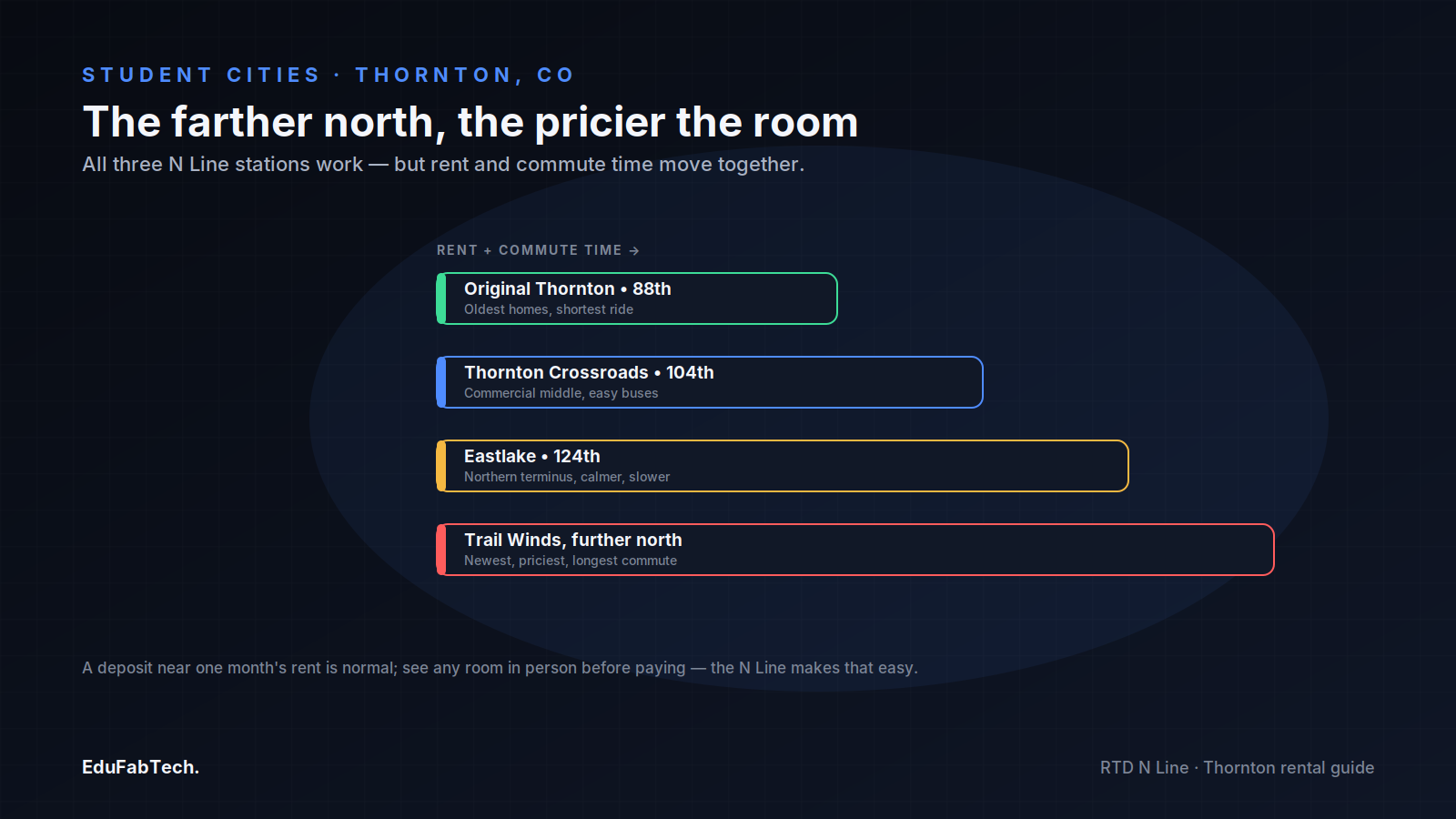
Around Original Thornton•88th and Washington Square is the oldest, most affordable part of the city — modest post-war homes on established streets, close to the southern end of the line and therefore the shortest ride to Union Station. It is the most budget-minded choice and the one most likely to have older, cheaper rentals. Thornton Crossroads•104th sits in the commercial middle of the city, near large shopping centres, so errands are easy and bus connections feed the station. Eastlake•124th, at the current northern terminus, borders the old village of Eastlake and its lake and trails; it is calmer and more spread out, but it adds minutes to every southbound trip. Newer, pricier housing generally lies further north, around the Trail Winds area, where you trade a longer commute for quieter, more recently built streets. As a rule in Thornton, the further north you go the newer and more expensive the housing, and the longer your journey to any campus.
Finding a room without losing a deposit
Because Thornton is spread out and car-shaped, the smartest filter is walking distance to an N Line station or a frequent bus to one. Start looking early — serious searching six to eight weeks before a term is sensible, since suburban leases turn over more slowly than dense student districts and the good, cheap rooms near the stations go first. Browse the rooms listed for Thornton on EduFabTech to get a feel for prices before you commit to anything.
The single rule that prevents most losses: see the place, or have someone you trust see it, before any money changes hands. The N Line makes this easy — ride to the station nearest a listing and walk to it. A deposit of roughly one month's rent is ordinary here; a request for more than that, or for several months up front, is a reason to pause. Scams on the northern Front Range follow the usual pattern: an attractive room, a landlord who is conveniently out of state or "travelling", and pressure to send money to hold it. Never wire a deposit, buy gift cards, or pay in cryptocurrency to reserve a room you have not seen and signed for. Get a written lease with the address and the deposit terms on it, and pay by a method that leaves a record.
Furnishing a room, and the markets worth knowing
Furnishing cheaply is straightforward in Thornton because the city has the big second-hand chains close to the stations. There is an arc Thrift store at 9131 Washington Street, a short distance from the Original Thornton area, with a large furniture department alongside clothing and housewares; it is the kind of place where a desk, a lamp and a set of plates come together in one trip. For produce and the social side of the season, the City of Thornton hosts the People + Produce farmers market at Carpenter Park Fields, 11000 Colorado Boulevard, on select Thursday evenings from 5 to 8 p.m. with free entry and free parking. The city's calendar also includes its Harvest Fest in autumn and a WinterFest, useful fixed points if you are new and want to meet people. For the rest, check what other students are selling or giving away on the furniture and free-stuff pages for Thornton — a room is cheapest to fill at the end of a term, when people are moving out.
Working while you study
Rules for part-time work differ sharply between domestic and international students, and this is general information, not legal advice — confirm your own case with your school's international office. For students on an F-1 visa, the U.S. Department of Homeland Security's Study in the States site states plainly that you may not work more than 20 hours per week when school is in session, that on-campus work is the normal starting point, and that off-campus employment is tightly limited and requires authorisation arranged through your Designated School Official. Curricular and optional practical training (CPT and OPT) are also handled through that office. The practical catch for a Thornton resident is that "on-campus" jobs are at the Denver or Boulder campus, not in your suburb, so the 20 hours come with a commute attached. Local, off-campus roles in Thornton's shops and restaurants are generally open only to those with the right to work off campus; check openings on the Thornton jobs page and verify your eligibility first.
Libraries and quiet places to read
Thornton is well served by its public library district, which matters when your campus is a train ride away and you want somewhere to study near home. Anythink — the Rangeview Library District, the public library for Adams County — runs several Thornton branches, including Anythink Huron Street at 9417 Huron Street, Anythink Wright Farms at 5877 E. 120th Avenue, and the Anythink Thornton Community Center Library at 2211 Eppinger Boulevard, each open Monday to Thursday 9 a.m.–8 p.m. and Friday–Saturday 9 a.m.–5 p.m., closed Sundays as listed at the time of writing. These are free, quiet and genuinely close to where students live. On campus, the Auraria Library serves CU Denver and MSU Denver students together, and each university runs its own libraries and study spaces for enrolled students. For desks, reading rooms and co-working spots around the city, the Thornton study-spaces page collects what is available locally.
Getting to campus
Transport is where living in Thornton is decided. The N Line is the backbone, and all its stations are in RTD's Local fare zone. The RTD fare table lists a Local 3-hour pass at $2.75, a Day Pass at $5.50 and a Monthly Pass at $88; it also notes that youth 19 and under and active-duty U.S. military ride free on all RTD services. For most university students the better deal is the CollegePass, RTD's unlimited pass whose participating institutions include CU Denver, the University of Denver, Colorado School of Mines, CU Boulder, MSU Denver and Naropa; at some schools the cost is folded into student fees, so check with yours rather than buying individual fares. The same network reaches Boulder on the regional Flatiron Flyer buses and the airport on the A Line.
Be realistic about time. From a southern Thornton station the train gets you to Union Station reasonably quickly, but a trip to Auraria means that ride plus a transfer, and Boulder or Golden add a good deal more. Many residents keep a car, which means I-25 traffic and winter driving. Thornton sits high on the plains near a mile above sea level, with cold, snowy winters and strong summer sun — budget for a proper coat and for days when the commute is slower than the timetable promises.
Costs, and the honest trade-offs
Thornton is not a cheap suburb, and the data say as much. Census Reporter's reading of the 2024 American Community Survey one-year estimate puts median household income at $101,096, and Data USA records a 2024 median property value of $517,500 — numbers that signal a housing market priced for working families, not students. There is no single official student-rent figure for Thornton, so the clearest cost anchors come from campus housing you might choose instead of commuting: for 2026–2027, CU Denver's Lynx Crossing lists a triple room at $4,630 per person per semester and a double at $5,999 per person per semester, while the University of Denver's AY 26-27 rates run about $3,746 per quarter for a residence-hall double, with its 175-block meal plan at $2,511 per quarter. Weigh a Thornton room plus transit against those figures for your own term length.
The honest balance: Thornton gives you more space and a calmer residential life than central Denver, a direct train, free public libraries, and easy second-hand shopping. Against that, it has no campus culture of its own, a real daily commute that lengthens the further north you live, a car-oriented layout, a cold and snowy winter at altitude, and housing costs that are high for a student budget. It suits someone who values quiet and a lower rent more than walking to lectures.
A checklist for your first weeks
- Confirm which campus you will actually attend, and pick an N Line station — Original Thornton•88th for the shortest ride, Eastlake•124th for a quieter home — before signing a lease.
- See any room in person (ride the train to the nearest station and walk to it); pay a deposit of about one month's rent only after you have a written lease, and never by wire, gift card or crypto.
- Ask your university whether a CollegePass is included in your fees; if not, compare a monthly pass against your likely trips.
- International students: before taking any job, check the 20-hour on-campus rule and speak to your Designated School Official.
- Get a library card at an Anythink branch for a free place to study near home.
- Furnish from the arc Thrift store on Washington Street and the free-stuff listings, and buy a winter coat before the first snow.
A quick question for readers
Do you work part-time while you study?
Many students work to pay the bills. See how common it is — and how many hours people really do.
Pick an answer, create a free account in a minute, and your vote counts. Already a member? Sign in
Comments 3
Comment-
The pass pricing is where this piece gets vague right when it matters most. They give you exact numbers for the Local fares - $2.75, $5.50,…
-
The cost section sets up a comparison it never actually lets you make. It tells you to weigh "a Thornton room plus transit" against the camp…
-
The part that actually bites is the F-1 work rule interacting with the whole commuter premise. On-campus work is capped at 20 hours and is t…
Join free to read the full comments and reply Comments are between members; an account takes a minute.
Source: Regional Transportation District
Sources (5)
- Regional Transportation District. Fares. RTD, 2026. rtd-denver.com ↗ · checked 1 Nov 2026
- University of Colorado Denver. Lynx Crossing Floor Plans and Rates. CU Denver, 2026. ucdenver.edu ↗ · checked 1 Nov 2026
- University of Denver. Room and Board Rates AY 26-27. University of Denver, 2026. studentaffairs.du.edu ↗ · checked 1 Nov 2026
- U.S. Census Bureau via Census Reporter. Thornton, CO. Census Reporter, 2024. censusreporter.org ↗ · checked 1 Nov 2026
- U.S. Department of Homeland Security. Working in the United States. Study in the States, 2026. studyinthestates.dhs.gov ↗ · checked 1 Nov 2026