Studying in Thousand Oaks: universities, housing and student life
A practical, sourced guide to California Lutheran University, the colleges within commuting reach, and how to find a room, get around and manage costs in the Conejo Valley.
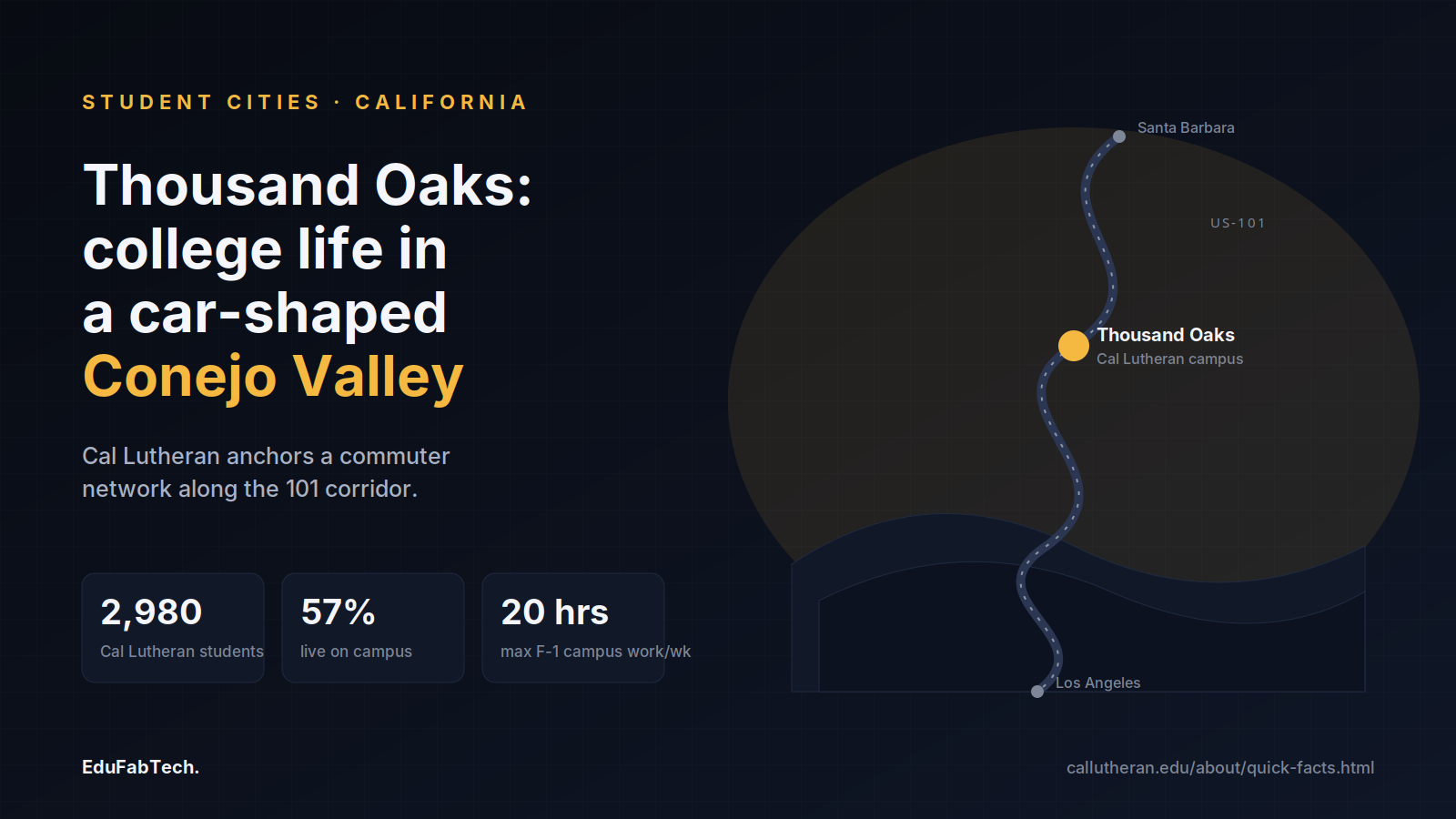
Thousand Oaks is the largest city in the Conejo Valley, a stretch of oak-dotted hills and planned suburbs in eastern Ventura County, California. It sits along U.S. Route 101 roughly halfway between the Los Angeles basin and Santa Barbara; California Lutheran University's own facts page places its Thousand Oaks campus "between Los Angeles and Santa Barbara" (callutheran.edu/about/quick-facts.html). The city borrows its name from the valley oaks that still shade its parks and roadsides, and the Santa Monica Mountains press up against its southern edge, so trailheads at places like Wildwood Regional Park are a short walk from residential streets.
For a student, the first thing to understand is that Thousand Oaks is a quiet, spread-out, car-shaped place rather than a dense college town. It is wealthy and low-rise; its daily rhythm runs through shopping centres, the Thousand Oaks Civic Arts Plaza and the 101 corridor rather than a walkable downtown core. That shapes almost everything below — where you can afford to live, how you get to class, and how much a part-time job and a bus pass matter.
Only one university actually sits inside the city, but several more are within a commute that students here really do make, up and down the 101 and over the hills into the San Fernando Valley and to the coast. This guide treats the city as students experience it: the campuses, the housing, the money, and the parts that are genuinely hard.
California Lutheran and the universities within reach
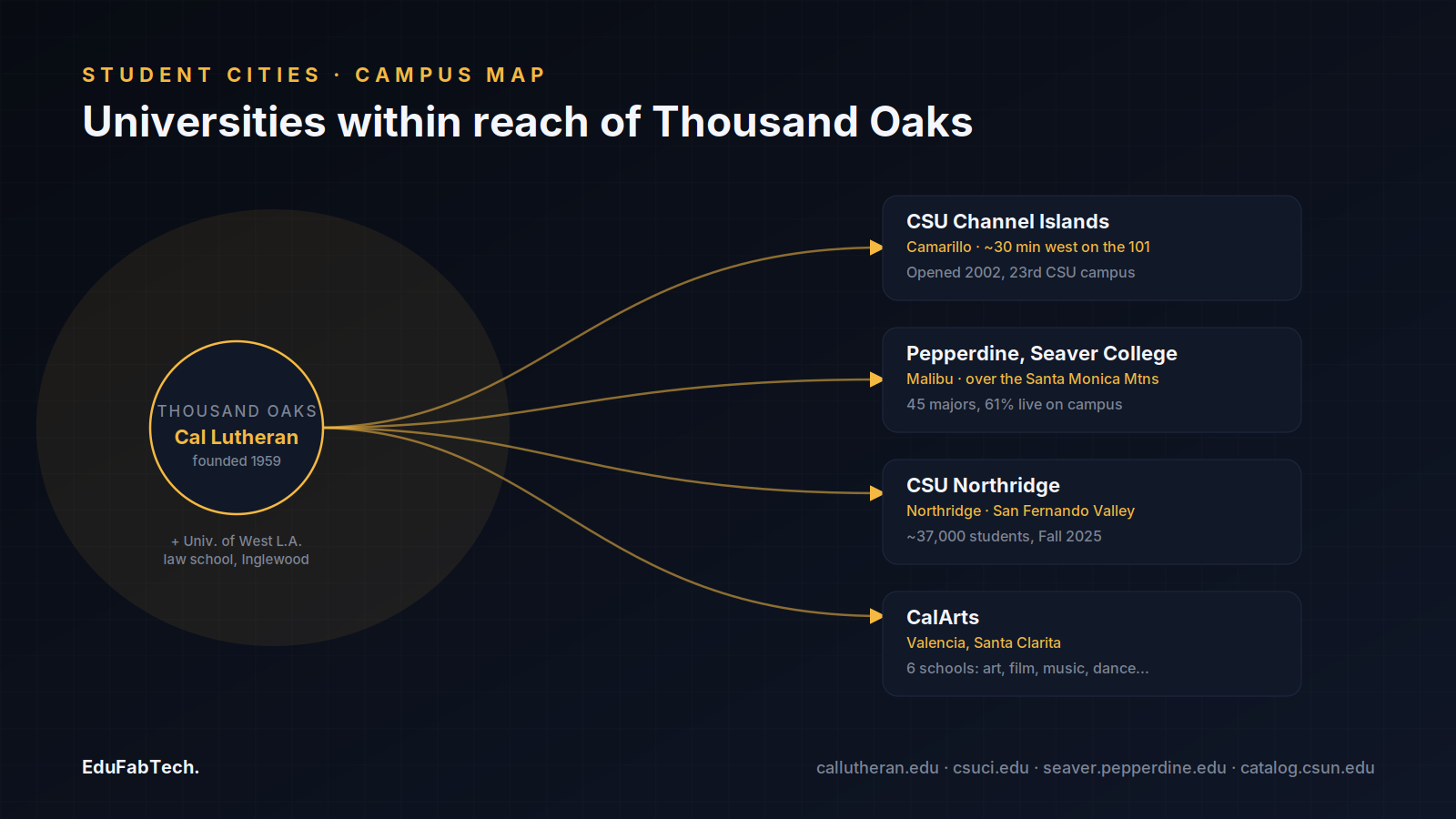
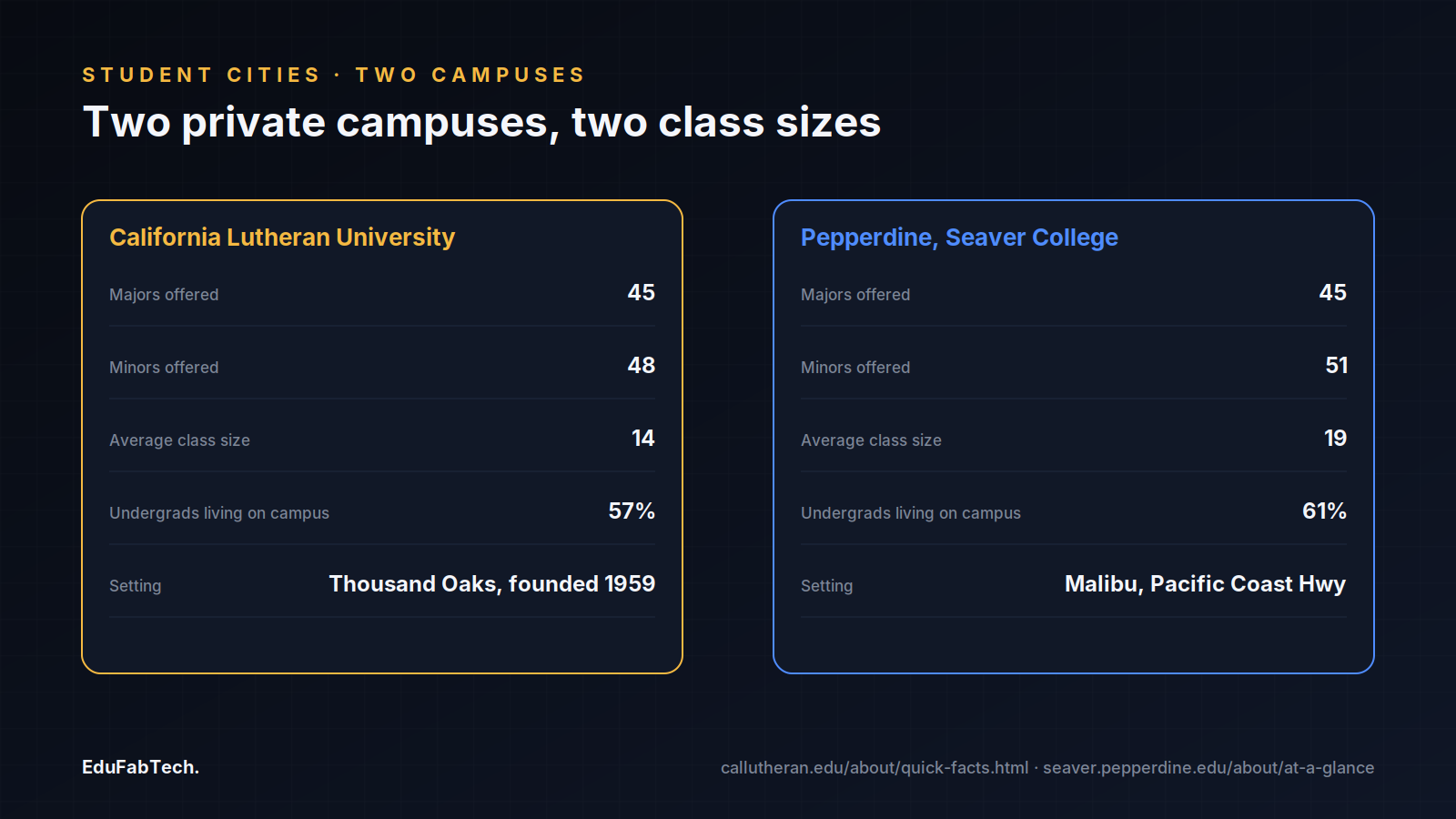
California Lutheran University is the anchor. It is a private institution in Thousand Oaks founded in 1959, and its facts page lists roughly 2,980 students — about 2,003 undergraduate and 977 graduate — with 45 majors and 48 minors in the traditional undergraduate programme and an average class size of 14 (callutheran.edu/about/quick-facts.html). The same page notes the university was designated a Hispanic-Serving Institution by the U.S. Department of Education in 2016, and that 57% of traditional undergraduates live on campus. Cal Lutheran also runs teaching centres beyond the main campus, in Oxnard, Westlake Village, Santa Maria and Berkeley, so some graduate and professional study happens away from Thousand Oaks itself.
The nearest public university is California State University, Channel Islands, in Camarillo, about half an hour west on the 101. Its history page records that it opened for classes in 2002 as the 23rd campus of the California State University system, built on the grounds of the former Camarillo State Hospital (csuci.edu/about/facts-history/history.htm). Over the hills to the south, in Malibu, is Pepperdine University, whose undergraduate Seaver College sits on Pacific Coast Highway and offers 45 majors and 51 minors, with an average class size of 19 and 61% of undergraduates living on campus, according to the college's at-a-glance page (seaver.pepperdine.edu/about/at-a-glance/).
East, in the San Fernando Valley, California State University, Northridge is a very different scale: its catalog states it enrolled nearly 37,000 students in Fall 2025 and is one of the largest universities in the nation, part of the 23-campus CSU system, on Nordhoff Street in Northridge (catalog.csun.edu/about/). For art students, California Institute of the Arts, in the Valencia district of Santa Clarita, grants undergraduate and graduate degrees across six schools — Art, Critical Studies, Dance, Film/Video, Music and Theater (calarts.edu/about). And for law, University of West Los Angeles in Inglewood grants the Juris Doctor and has, in its own words, "been continuously accredited by the Committee of Bar Examiners of the State Bar of California (CBE) since 1978" (uwla.edu).
If you are planning to transfer into one of these from a lower-cost start, the Ventura County Community College District runs the county's community colleges, with Moorpark College the closest to Thousand Oaks; its courses and articulation agreements are the usual on-ramp into Cal State and the University of California. You can browse everything students have listed locally — rooms, jobs, second-hand goods and more — on the EduFabTech city page at /in/united-states/thousand-oaks, and listings gathered around specific campuses at /near/pepperdine-university and /near/california-state-university-northridge.
Where students live, from campus to the Conejo Valley
At Cal Lutheran, the simplest path for a first-year is a residence hall, and because a majority of traditional undergraduates live on campus, the on-campus community is a real one rather than a token. The residence-life pages list several building types, from shared suites to studios, each with its own price (more on those under costs, below). Living on campus removes the single hardest problem in Thousand Oaks — getting around without a car — because classes, dining and the library are all within walking distance.
Off campus, students spread across the Conejo Valley: the neighbourhoods of Thousand Oaks proper, Newbury Park to the west, and the Westlake Village area to the east, with some commuting from Camarillo or Simi Valley where rents can be lower. Because the city is suburban, most off-campus options are rooms in houses or units in apartment complexes rather than purpose-built student blocks. That means your neighbours are often families and professionals, the places are quiet, and a bedroom in a shared house is usually cheaper than a studio of your own. Start looking early — several weeks before term, not after you arrive — because the rental market here is small and turns over slowly.
Before you commit money to anything, use the EduFabTech rooms board at /in/united-states/thousand-oaks/rooms to see what is actually on offer and at what price, and check the commute: a room that looks cheap in a far suburb can cost you an hour each way if you do not drive. Ask what is included (utilities, internet, parking), who else lives there, and whether the lease is in your name or a sublet.
Paying a deposit safely in Thousand Oaks
Rental scams in a place like Thousand Oaks almost always follow the same shape: a listing for a room or apartment at a price that looks a little too good for the Conejo Valley, a "landlord" who says they are out of town — often framed as travelling for work or on the coast — and a request to send a deposit or first month before you can see the unit. The warning sign is the pressure to pay before a viewing.
The rule that protects you costs nothing: see the place in person, or have someone you trust see it, before any money changes hands. Meet whoever holds the keys, confirm the unit exists and matches the photos, and read the lease. Never send a deposit by bank wire transfer, gift card or cryptocurrency to "hold" a room — those methods are chosen precisely because they cannot be reversed, and no legitimate Thousand Oaks landlord needs them. A normal arrangement here is a deposit plus first month's rent paid by cheque or a traceable method once you have signed a written lease and been given keys. If a listing pushes you to skip the viewing or pay instantly, walk away; another will come up. For international students arriving before term, it is worth booking a short temporary stay and finding the permanent room once you are on the ground and can view in person.
Furnishing a room, and the market worth a Thursday
Thousand Oaks is not a flea-market town, so the cheapest way to furnish a room is usually other students and the second-hand economy rather than a dedicated weekend market. The move-out weeks at the end of spring term are the best window: furniture, kettles and desk lamps change hands fast as leases end. On EduFabTech you can watch three boards that matter here — general second-hand things at /in/united-states/thousand-oaks/second-hand, furniture specifically at /in/united-states/thousand-oaks/furniture, and things being given away free at /in/united-states/thousand-oaks/free-stuff.
For food rather than furniture, the Thousand Oaks Certified Farmers' Market runs on Thursdays from 11 a.m. to 4 p.m. in the east-end parking lot of The Oaks shopping centre, where Wilbur Road meets Oaks Mall Drive, selling fruit, vegetables, eggs, honey and prepared food from local growers; it is operated by the Ventura County Certified Farmers' Market Association (vccfm.org/thousand-oaks). It is a cheap, pleasant habit for anyone cooking on a budget, and it is one of the few genuinely communal weekly events in a city that otherwise lives indoors and by car.
Working while you study
If you are an international student, your right to work is set by U.S. immigration rules, not by the employer or the university. The Department of Homeland Security's Study in the States site states plainly that an F-1 student doing on-campus employment "may not work more than 20 hours per week when school is in session" (studyinthestates.dhs.gov). Off-campus work, and training such as CPT or OPT, generally needs authorisation arranged before you start — do not take a job off campus on the assumption it is allowed. This is not legal advice; confirm your own situation with your university's international-student office and the official DHS guidance, which is the authority that matters. Jobs that students list locally, on and off campus, appear at /in/united-states/thousand-oaks/jobs. For domestic students the hours are not capped the same way, but the same practical limit applies: Thousand Oaks commutes eat time, so a job on or near campus is worth more than a better-paid one across the valley.
Libraries and quiet desks
Beyond the university's own library, the city runs a strong public system. The main branch is the Grant R. Brimhall Library at 1401 E. Janss Road, open Monday to Thursday 10 a.m. to 8 p.m., Friday 10 a.m. to 6 p.m., Saturday 10 a.m. to 5 p.m. and Sunday noon to 5 p.m., according to the library's hours page (tolibrary.org/hours). The Newbury Park Library at 2331 Borchard Road keeps the same weekday and Saturday hours but is closed on Sundays. Both have study seating and are free to use, which makes them a reliable fallback when campus spaces are full or closed. Students posting about desks and quiet study spots keep a board at /in/united-states/thousand-oaks/study-spaces, and local events worth a study break are at /in/united-states/thousand-oaks/events.
Buses, the College Ride and the car problem
Local buses are run as Thousand Oaks Transit, with a handful of fixed routes across the Conejo Valley. The single most useful fact for students is the regional College Ride programme operated by the Ventura County Transportation Commission: its FAQ states that "the College Ride Program is a program that is continuing until June 2027," and that students at participating colleges — California Lutheran among them — ride any participating Ventura County bus free by showing a valid student ID bearing the current academic year (goventura.org/college-ride-faq). If you are at Cal Lutheran, that turns the local network into free transport for the length of your degree, which is a real saving and a real reason to keep your student ID current.
Be honest with yourself about the limits, though. Service is suburban: routes are not frequent, and evenings and Sundays are thin. Many students here end up relying on a car, and the Conejo Valley's geography — strung along the 101, with campuses in Camarillo, Malibu, Northridge and Santa Clarita all reached by freeway — makes driving the default rather than the exception. Factor that into your budget and your choice of neighbourhood: a room on a bus route you will actually use is worth more than a cheaper one that leaves you stranded after dark.
What costs, and what's hard
The clearest housing figures come from Cal Lutheran's own residence-life costs page for the 2026–2027 academic year. A standard space in a four-student suite is listed at $9,580 for the year; a standard single in a two-student suite at $11,780; and a Trinity Hall studio at the top end at $16,370 (callutheran.edu/students/residence-life/living-on-campus/costs.html). Those are among the steeper on-campus rates you will see in this series, and they reflect the broader truth of the area: the Conejo Valley is an expensive, high-income part of California, and off-campus rents are not cheap either. A reliable, current municipal rent figure for the city is harder to cite confidently, so treat the campus numbers as your anchor and budget on the assumption that Thousand Oaks sits well above the U.S. average.
What is good about studying here is real. It is safe, green and calm; the campuses are small enough to feel personal, especially Cal Lutheran with its class size of 14; the weather is mild; and the coast, the mountains and Los Angeles are all within reach. The free College Ride programme genuinely helps. What is hard is also real. The cost of living is high. The city is built for cars, so without one you lean on bus timetables that thin out at night. There is no dense, walkable student quarter, and the social life is more dispersed than in a classic college town. For many students the trade is worth it; just go in knowing which side of the ledger each item falls on.
First-weeks checklist
- Sort a place to sleep before term, viewing any room in person before you pay; never wire a deposit to hold an unseen unit.
- If you are on an F-1 visa, confirm your work limits with your international-student office and the DHS Study in the States guidance before taking any job.
- Get your student ID issued with the current academic year on it, then use it for free travel under the VCTC College Ride programme.
- Work out one bus route you will actually use, and test it once before you depend on it for class.
- Get a Thousand Oaks Library card for free study space at the Grant R. Brimhall and Newbury Park branches.
- Furnish from the second-hand and free boards, and watch end-of-term move-outs for furniture.
- Plan your week around commutes: in this valley, distance is measured in freeway minutes, not miles.
A quick question for readers
Do you work part-time while you study?
Many students work to pay the bills. See how common it is — and how many hours people really do.
Pick an answer, create a free account in a minute, and your vote counts. Already a member? Sign in
Comments 0
CommentNo comments yet. Members start the conversation.
Source: California Lutheran University
Sources (5)
- California Lutheran University. Facts at a Glance. California Lutheran University, 2026. callutheran.edu ↗ · checked 18 Oct 2026
- California Lutheran University. Housing and Meal Plan Costs. California Lutheran University, 2026. callutheran.edu ↗ · checked 18 Oct 2026
- Ventura County Transportation Commission. College Ride FAQ. VCTC, 2026. goventura.org ↗ · checked 18 Oct 2026
- Thousand Oaks Library. Hours and Locations. City of Thousand Oaks, 2026. tolibrary.org ↗ · checked 18 Oct 2026
- U.S. Department of Homeland Security. Working in the United States. Study in the States (SEVP), 2025. studyinthestates.dhs.gov ↗ · checked 18 Oct 2026