Studying in Topeka: Washburn University, housing and student life
A practical, sourced guide to studying in Kansas's capital — Washburn University, where students live, what a room costs, how to get around, and the honest trade-offs.
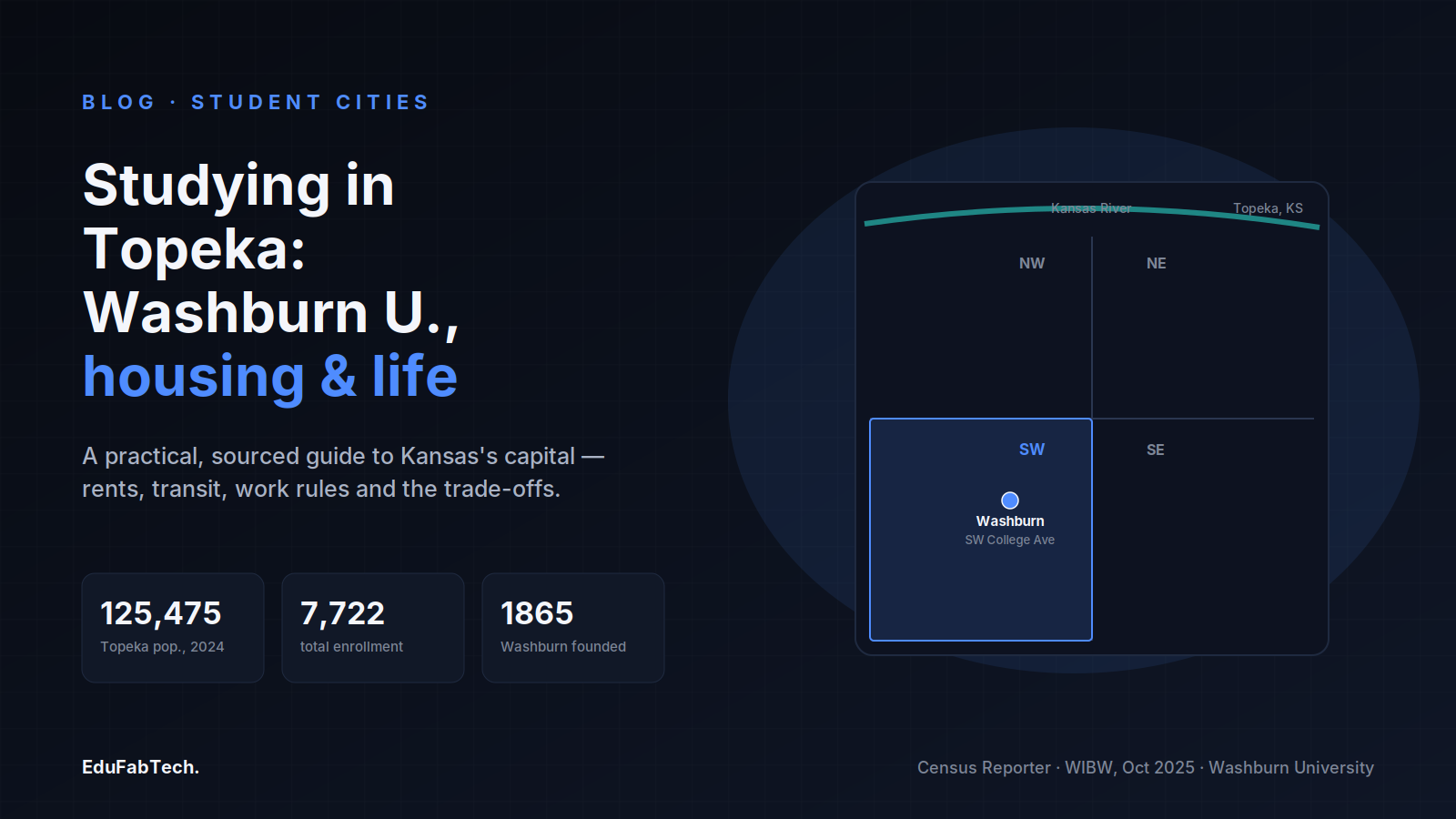
Topeka is the capital of Kansas and the seat of Shawnee County, laid out on a grid beside the Kansas River in the north-east of the state. Its streets are numbered and tagged by quadrant — SW, NW, SE, NE — which makes the city easy to read from a map but also means an address like "SW 17th" tells you immediately which part of town you are in. For students, almost everything of interest sits in the south-west quadrant, because that is where Washburn University is.
This is a mid-sized government and healthcare town rather than a college town built around its university. Census Reporter puts Topeka's population at 125,475 for the 2024 American Community Survey one-year estimate, with a median household income of $61,030 over the same period. The state government, the courts, the hospitals and the schools are the big employers; the student population is a slice of the city, not the whole of it. That shapes the experience: housing is relatively cheap, the pace is calm, and the social life you build will be the one you make rather than one handed to you by a dense student quarter.
Topeka also carries real history for anyone studying law, education or civil rights — the 1954 Supreme Court case Brown v. Board of Education began at a Topeka elementary school, now a national park site. That context matters at Washburn, where the School of Law is one of the better-known parts of the university. The guide below sticks to what you can verify, names the places and rules you will actually need, and is honest about what is hard here as well as what is easy.
Washburn University, and the Tech campus across town
Washburn University is a public university founded in 1865, on a roughly 160-acre campus along SW College Avenue in central Topeka (Washburn's own facts pages describe the campus and its history). It is organised into the College of Arts and Sciences, the School of Applied Studies, the School of Business, the School of Nursing and the School of Law, with the separate Washburn Institute of Technology — Washburn Tech — on its own campus elsewhere in the city. The athletic teams are the Ichabods, competing in NCAA Division II and the Mid-America Intercollegiate Athletics Association.
It is not a giant. As reported by WIBW in October 2025, Washburn's autumn 2025 enrolment was a combined headcount of 7,722 across the university and Washburn Tech, with 6,170 at the university and 1,552 at Tech. For an international or out-of-town student that scale is a feature: classes are smaller than at a flagship state university, the campus is walkable in a few minutes end to end, and the law and nursing schools give the place a professional, grown-up feel rather than a sprawling undergraduate one.
Washburn Tech, the technical campus, grants certificates and associate-level technical credentials in trades such as welding, automotive, health occupations and building construction. It shares the Washburn name and the same student iCard, but if your plan is a four-year degree or a postgraduate or law qualification, the main College Avenue campus is where you will be. Kansas's two large research universities — the University of Kansas in Lawrence and Kansas State University in Manhattan — are each less than an hour and a half away by road, which is worth knowing if you want library access or events beyond what Topeka offers, but neither is in the city.
Where students settle: halls on campus and the quadrant around them
Washburn houses undergraduates in a small set of residence buildings clustered on the north edge of campus. Lincoln Hall, the newest, opened in 2016 and is built around suites shared by up to six students; Kuehne Hall and West Hall use single-gender, eight-person suites of four bedrooms; the Living Learning Center and the apartment-style Washburn Village round out the options for students who want a kitchen rather than a meal plan. Because the campus is compact, every one of these is within a short walk of classrooms, the library and the Memorial Union.
Off campus, the practical search area is the south-west quadrant: the blocks immediately around the university between roughly SW 10th and SW 21st, and the older residential streets of the College Hill and Westboro areas nearby. These are quiet, tree-lined neighbourhoods of single-family houses and small apartment buildings, and rents reflect a city where most people own their homes rather than rent. Further out, the newer apartment complexes along Wanamaker Road on the west side are cheaper per square foot but assume you have a car. The listings near Washburn University and the wider rooms in Topeka on EduFabTech are a reasonable place to see what is currently on offer.
A note on timing: because Topeka is not a tight student market, you do not face the same frantic autumn scramble as in a big university city. On-campus housing does fill, so apply for a hall place as early as the university opens applications for the year; for a private room, starting one to two months before term is usually enough, and you will often find mid-year vacancies because leases here are not all synchronised to the academic calendar.
Renting without losing a deposit
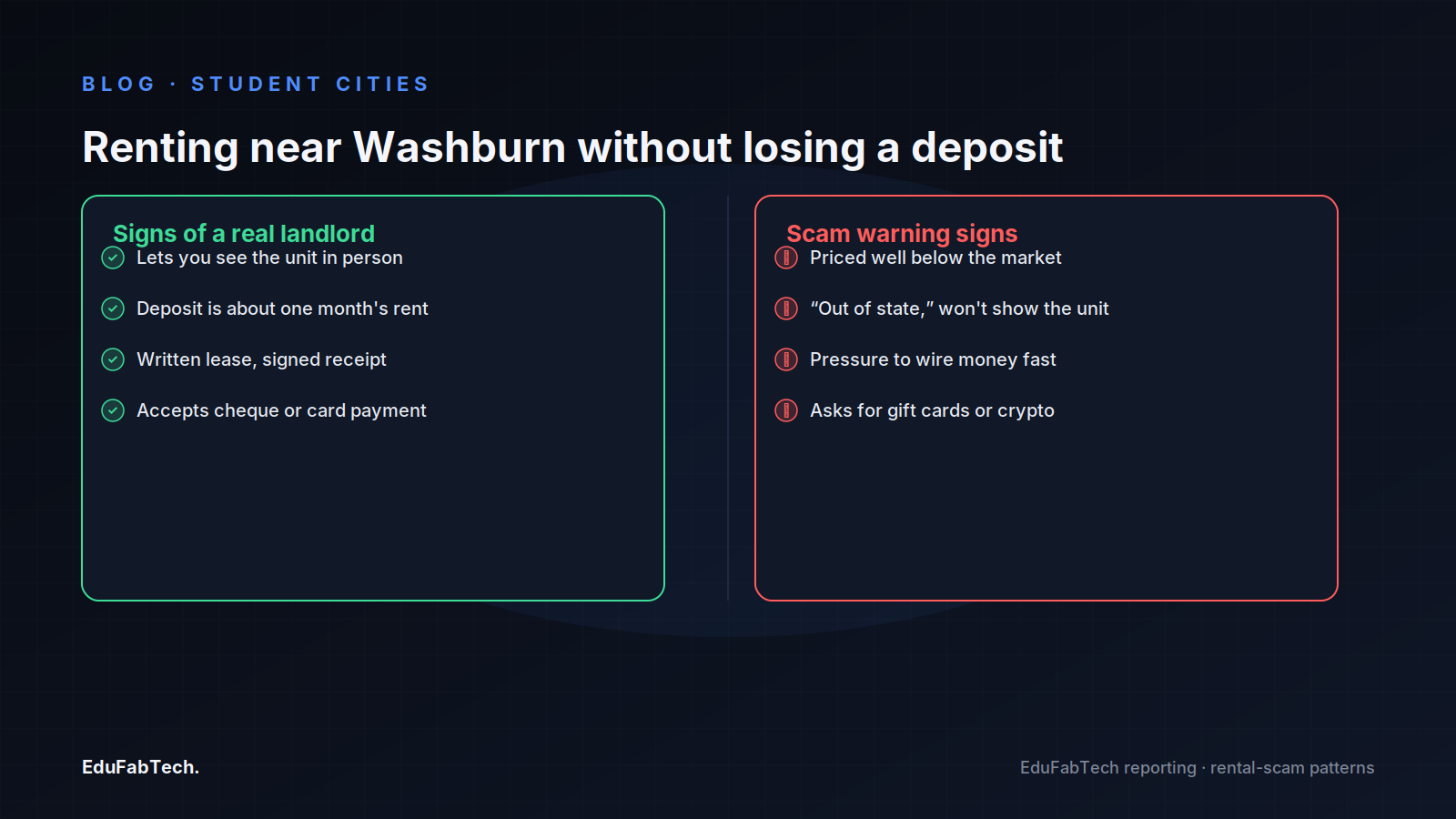
Topeka's rental scams look much like those reported in other US cities, and they cluster in the same places: listings on free classified sites and social-media marketplace groups for houses near Washburn that are priced noticeably below the going rate, posted by someone who says they are out of state and cannot show you the unit in person. The warning signs are consistent — pressure to "hold" a place with money before you have seen inside, a landlord who will only communicate by message, and a request to pay by a method that cannot be reversed.
Protect yourself with a few local habits. See the actual unit in person, or have someone you trust see it, before any money changes hands; a real Topeka landlord will let you walk through a house in College Hill or off Wanamaker. Expect a normal deposit to be roughly one month's rent, paid by cheque or card with a written receipt and a signed lease, not in cash. Never send a deposit by bank wire transfer, gift card or cryptocurrency to reserve a room — no legitimate landlord in this city asks for that, and money sent that way is gone. If you are arriving from abroad before you can view anything, use university-managed housing for your first term and search for a private place once you are on the ground.
Furnishing a room on the cheap: antique malls and flea markets
Topeka is well supplied with second-hand and antique trade for its size, which helps when you are furnishing an empty room. The Owls Nest Topeka Antique Mall and Flea Market is the largest of these, running two booth-style showrooms in the city — one at 3411 SW Topeka Boulevard and a second at 2901 SE Adams Street — with the mix of furniture, housewares and oddments you want for a first apartment. Opening hours at privately run markets change, so confirm a place is open before you drive across town.
Before you buy anything, it is worth checking what students are already giving away or selling cheaply. EduFabTech's second-hand listings for Topeka are built for exactly this, and the end-of-semester move-out weeks in May and December are when furniture, lamps and kitchen kit appear for little or nothing as graduating students clear out.
Part-time work and the rules international students must check
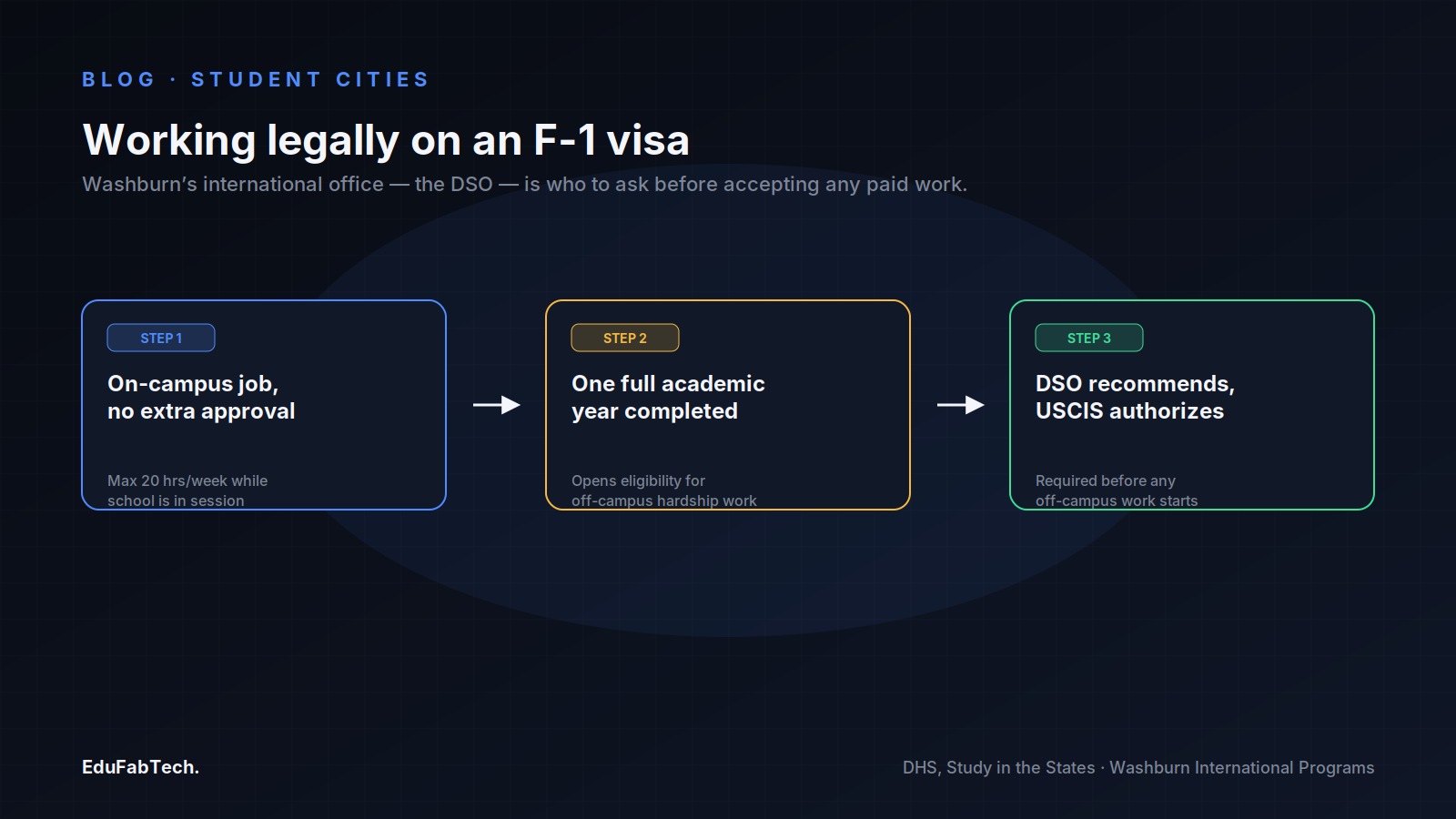
If you are on an F-1 student visa, the rules on work are set by the US federal government, not the university, and you should read them from the official source rather than from word of mouth. The Department of Homeland Security's Study in the States guidance, on its Working in the United States page, states that a student in on-campus employment "may not work more than 20 hours per week when school is in session." On-campus jobs — in the union, the library, dining services or an academic department — are the normal starting point, because on-campus employment is generally open to F-1 students without separate work authorisation.
Off-campus work carries extra conditions. The same federal guidance explains that off-campus employment based on economic hardship is generally open only to students who have completed at least one full academic year, and that it must be recommended by your Designated School Official and authorised by US Citizenship and Immigration Services before you start. That Designated School Official sits in Washburn's international office, and that office — not a website, not a fellow student — is who you should ask before accepting any paid work. This points you to the official source rather than giving legal advice, and your own circumstances may differ. For the kinds of roles students actually take locally, EduFabTech lists part-time jobs in Topeka.
Libraries and places to study
On campus, the Mabee Library on SW College Avenue is the main study building, with the usual mix of quiet floors, group rooms and research help; its term-time hours run from the morning into the evening on weekdays with shorter weekend hours, so check the current library hours before a late session rather than assuming it stays open all night.
Off campus, Topeka's strongest study asset is the Topeka and Shawnee County Public Library at 1515 SW 10th Avenue, a large and well-regarded central library a short distance from Washburn. Its published hours and locations page lists a schedule that runs Monday to Friday from 9am to 9pm, Saturday 9am to 6pm and Sunday from noon to 9pm, giving you long evening and weekend study time that a university library alone does not. A public library card is free to local residents and opens up computers, meeting rooms and quiet space. EduFabTech also collects study spaces in Topeka if you want a café or co-working desk instead.
Getting around: Topeka Metro and the free Washburn ride
Public transport in the city is run by the Topeka Metropolitan Transit Authority, branded Topeka Metro, which operates fixed bus routes radiating from a downtown station. The single most useful fact for a Washburn student is on Topeka Metro's own fares page: Washburn University and Washburn Tech students, faculty and staff ride the fixed routes free by swiping their university iCard at the farebox. That turns the bus into a genuinely free way to reach downtown, the library and the shops without a car.
For everyone else, the same page lists a one-way adult cash fare of $2.00 and a 31-day full-fare pass at $50.00, under a fare structure the page gives as effective 1 December 2019, with reduced fares for seniors, riders with disabilities and income-qualifying passengers. A cash fare is paid on board, while passes are sold online, at the downtown Quincy Street Station, and at Topeka Dillons and Hy-Vee stores. Be realistic, though: Topeka is a car-oriented, spread-out city, bus frequencies are modest and evening and Sunday service is limited, so students who live near campus mostly walk, and those further out tend to rely on a car or on lifts.
What it costs, as far as the figures go
On-campus halls at Washburn bundle a room with a meal plan and are billed by the semester, so the rate you are quoted covers roughly half the academic year. The university sets its current per-semester room-and-board rates each year through its Residential Living office, and those are the figures to confirm directly before you commit — along with the cost of staying somewhere over the summer if you do not go home.
For renting in the wider city, the US Census Bureau's QuickFacts for Topeka reports a median gross rent of $979 a month for the 2020-2024 American Community Survey five-year period (census.gov QuickFacts). That figure covers all households, not student rooms specifically, and a shared house near Washburn typically comes in below it per person; read it as a rough gauge of what ordinary rentals cost here rather than a student quote. Set against the median household income of $61,030 that Census Reporter records for the 2024 American Community Survey one-year estimate, Topeka reads as an affordable place to live by US standards — one of the real reasons to study here.
The honest trade-offs
What is good about Topeka for a student is straightforward: it is cheap by American standards, the Washburn campus is small and walkable, the free bus ride with an iCard removes a real cost, and a strong public library sits minutes from campus. The city is calm and low-pressure, and a smaller university means you are a name rather than a number.
What is hard is the flip side of the same facts. This is not a buzzing college town; nightlife and a dense student scene are limited, and much of social life happens in houses and at campus events rather than in a walkable student quarter. The city is spread out and built around cars, so without one you will lean on modest bus service and your own two feet. And the climate is demanding: Topeka's weather swings from hot, humid summers to cold winters, and the region sees severe spring storms, so budget for both ends of the thermometer. For an international student used to frequent public transport and a compact city, the adjustment to distances here is the thing most people underestimate.
A checklist for the first few weeks
- Collect your Washburn iCard early — it is your identity card, library card and free bus pass in one.
- If you are on an F-1 visa, visit the international office in person and confirm the work rules with your Designated School Official before taking any job.
- Get a free Topeka and Shawnee County Public Library card for evening and weekend study space beyond Mabee Library's hours.
- If you are renting privately, see the unit in person, sign a written lease, and pay a deposit of about one month's rent by cheque or card — never by wire, gift card or crypto.
- Furnish from the flea markets and from move-out giveaways in December and May rather than buying new.
- Work out your transport reality: if you will live off campus and away from a bus route, plan for a car; if near campus, you can manage on foot and the free bus.
- Browse the local Topeka student listings on EduFabTech for rooms, jobs and second-hand goods before you arrive.
A quick question for readers
Do you work part-time while you study?
Many students work to pay the bills. See how common it is — and how many hours people really do.
Pick an answer, create a free account in a minute, and your vote counts. Already a member? Sign in
Comments 3
Comment-
The number worth sitting with is $979 median gross rent against $61,030 median household income, right under the checklist telling you to bu…
-
The $979 median gross rent next to the $61,030 median household income is the only cost comparison in here that actually has matching denomi…
-
The transit nugget buried near the end is the one worth highlighting: free fixed-route rides for Washburn students and staff just by swiping…
Join free to read the full comments and reply Comments are between members; an account takes a minute.
Source: Topeka Metropolitan Transit Authority
Sources (5)
- Topeka Metropolitan Transit Authority. Fixed Route Fares. Topeka Metro, 2019. topekametro.org ↗ · checked 1 Nov 2026
- U.S. Department of Homeland Security. Working in the United States. Study in the States, 2024. studyinthestates.dhs.gov ↗ · checked 1 Nov 2026
- U.S. Census Bureau. QuickFacts: Topeka city, Kansas. U.S. Census Bureau, 2024. census.gov ↗ · checked 1 Nov 2026
- WIBW. Washburn reports growing enrollment for third straight year. WIBW-TV, 2025. wibw.com ↗ · checked 1 Nov 2026
- Topeka & Shawnee County Public Library. Hours and Locations. TSCPL, 2025. tscpl.org ↗ · checked 1 Nov 2026