Studying in Tucson: universities, housing and student life
A practical, sourced guide to the University of Arizona, where students find rooms, how to avoid a rental scam, getting around a fare-free transit city, and what desert living costs.
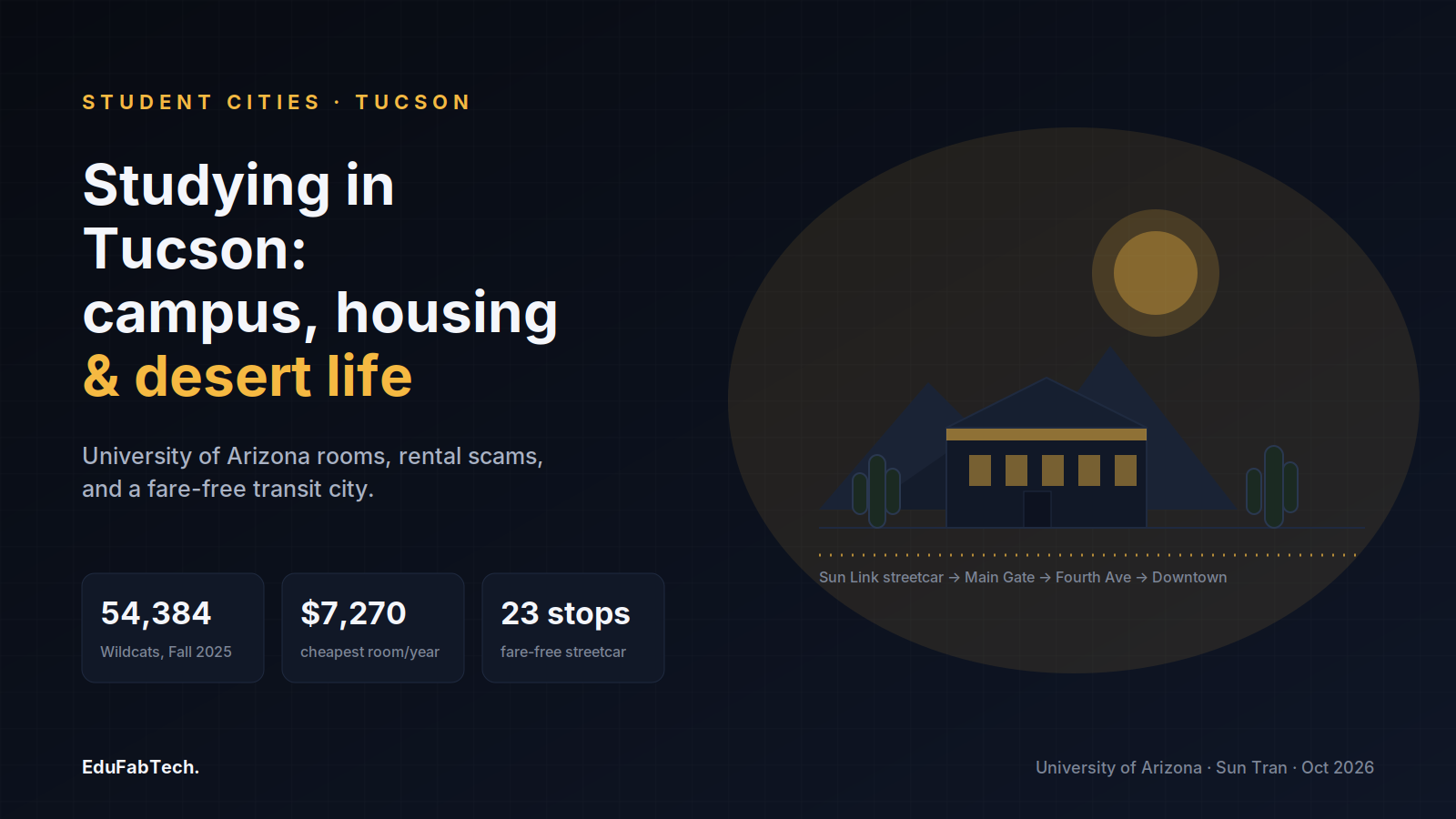
Tucson sits in a broad valley in southern Arizona, ringed by mountain ranges and the saguaro forests of the Sonoran Desert, roughly an hour's drive north of the border with Mexico. For students, the city is organised around one institution more completely than most American college towns are: the University of Arizona, whose campus fills a large block of midtown and whose red-and-blue colours, game-day traffic and academic calendar set the rhythm of the surrounding neighbourhoods. This guide covers what studying and living here actually involves — the universities, where students find rooms, how to avoid losing a deposit, what it costs, and the parts of desert-city life that take adjustment.
By its own account the University of Arizona was established in 1885 as the state's land-grant university, and its main campus runs along East University Boulevard in central Tucson. The university's facts page states that it enrolled "54,384 Current Wildcats" in Fall 2025 and awarded 13,217 degrees in 2025, and that it holds the combined distinction of Research 1 status, Association of American Universities membership and Hispanic-Serving Institution designation, advancing more than $1 billion in annual research activity. It is especially known for space and planetary science — the same page notes the university's part in helping NASA map the Moon before the Apollo missions — alongside medicine, optics and the environmental sciences.
Two specialist colleges are worth naming. The University of Arizona College of Pharmacy, now the R. Ken Coit College of Pharmacy, runs a four-year PharmD programme on the Tucson health-sciences campus together with a branch campus in Phoenix, according to its accreditation record with the Accreditation Council for Pharmacy Education. The James C. Wyant College of Optical Sciences, at 1630 E. University Blvd., grants degrees in optical sciences — one reason Tucson is sometimes called "Optics Valley." Both sit within the University of Arizona Campus Historic District, the older core of campus around Old Main that gives the university much of its character.
From campus halls to the midtown barrios
Most first-year students start in university housing, which the Housing & Residential Life office publishes rates for each year. For 2026–2027 a shared (double) room runs from $7,270 for the academic year in the most basic halls, such as Coconino and Navajo-Pinal, up to $10,760 in the newest halls, such as Árbol de la Vida and Arizona-Sonora; single rooms over the same year start at $10,910 and reach $16,140. Those are per-person figures for the full year. You can browse what is listed around campus on EduFabTech's near University of Arizona and Tucson rooms pages.
After the first year, students spread into the midtown neighbourhoods that surround campus, and the geography is worth learning. West University, the historic bungalow district immediately northwest of campus, and Sam Hughes, east of the stadium, are the classic walk-to-class neighbourhoods. Rincon Heights and the blocks around Fourth Avenue lie just south and west, within reach of the streetcar. Main Gate Square, at the western edge of campus, is where the purpose-built student towers cluster. Further out, downtown and the westside Mercado District are a streetcar ride away. Rents fall as you move away from the Main Gate, but so does the ability to walk home after a late shift in the library.
Renting safely: what is normal here, and what is not
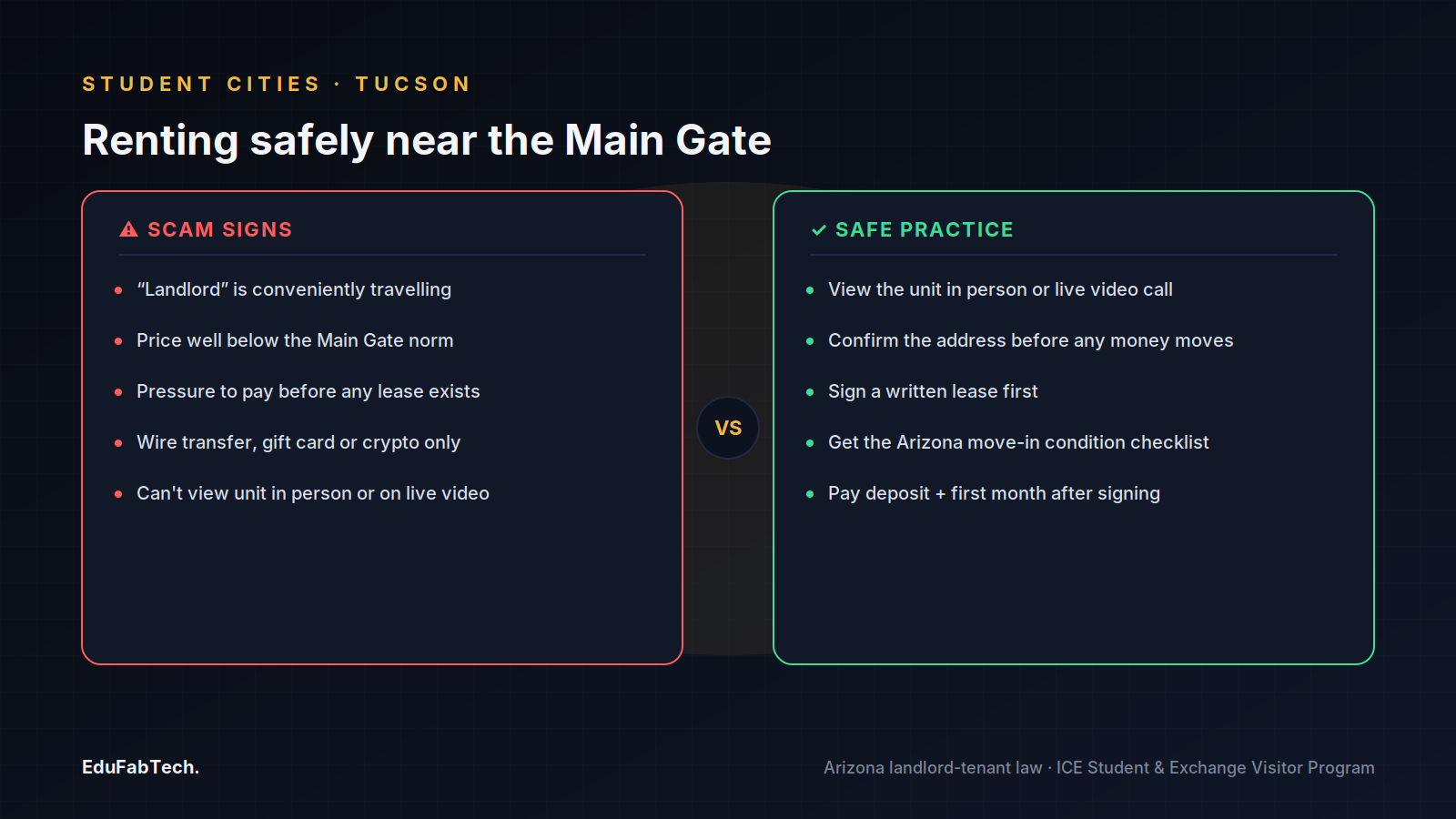
Tucson's private rental market turns over sharply each August, and the scams follow the calendar. The common ones target students searching online over the summer from out of state or abroad: a "landlord" who is conveniently travelling, a too-cheap apartment near the Main Gate, and a request to wire a deposit to hold it. Treat any of those as a warning. Normal practice in Tucson is a security deposit plus first month's rent paid after you have signed a written lease and, under Arizona law, received a move-in condition checklist — not a payment to "reserve" a place you have never entered.
If you are abroad and cannot visit, ask a current student or the university's housing office to view the unit in person or on a live video call, and confirm the building exists at the address given before any money moves. Never send a deposit by bank wire, gift card or cryptocurrency — none of those can be reversed, and no legitimate Tucson landlord requires them to hold a room. If something feels off — a price well below the Main Gate norm, or pressure to pay before you have seen a lease — walk away; there is always another room in a city that turns over this many each August.
Furnishing a room, and the markets worth knowing
Tucson rewards second-hand shopping, partly because thousands of students cycle through leases each August and leave furniture behind. Fourth Avenue, which the Fourth Avenue Merchants Association calls "the heartbeat of Tucson", is the walkable strip of independent, vintage and resale shops just south of the Main Gate, linked to campus by the streetcar. For produce and makers' stalls, the Heirloom Farmers Markets run year-round, including Sundays at Rillito Park and Fridays at Udall Park in Tucson, with summer hours of 8am–noon shifting to 9am–1pm from October. On the west side, the Mercado San Agustín on S. Avenida del Convento — the streetcar's western terminus — hosts markets and a periodic flea alongside its cafés and shops. For furnishing a room on a budget, EduFabTech's second-hand and free-stuff pages are the places to watch in the weeks around move-out.
Working while you study
International students need to understand the rules before taking any job. According to the U.S. Immigration and Customs Enforcement Student and Exchange Visitor Program, an F-1 student "may work up to 20 hours per week while school is in session" in on-campus employment, and full-time during official breaks; the same page explains that off-campus work generally requires authorised Curricular Practical Training (CPT) or Optional Practical Training (OPT). The University of Arizona's international-student office is the authority to consult before you accept anything — this guide is not legal advice, and your visa status depends on getting the paperwork right. Campus jobs (dining, libraries, research labs, recreation) are the usual starting point; listings in the wider city are collected on EduFabTech's Tucson jobs page.
Libraries and places to study
The Main Library at 1510 E. University Blvd. is the central study hub, spread over five floors with the upper two set aside as quiet floors. Its second floor houses CATalyst Studios, a makerspace with laser and vinyl cutters, CNC routers, 3D printers and sewing machines, plus a technology-lending desk. Students can reserve group and quiet study rooms for up to four hours at a time. The university runs other branch libraries — including the Science-Engineering Library and the Health Sciences Library near the medical campus — and quieter corners turn up across campus during exam weeks. Cafés along Fourth Avenue and Main Gate Square fill the gaps; EduFabTech's study-spaces page tracks desks and rooms around the city.
Getting around a flat, spread-out city
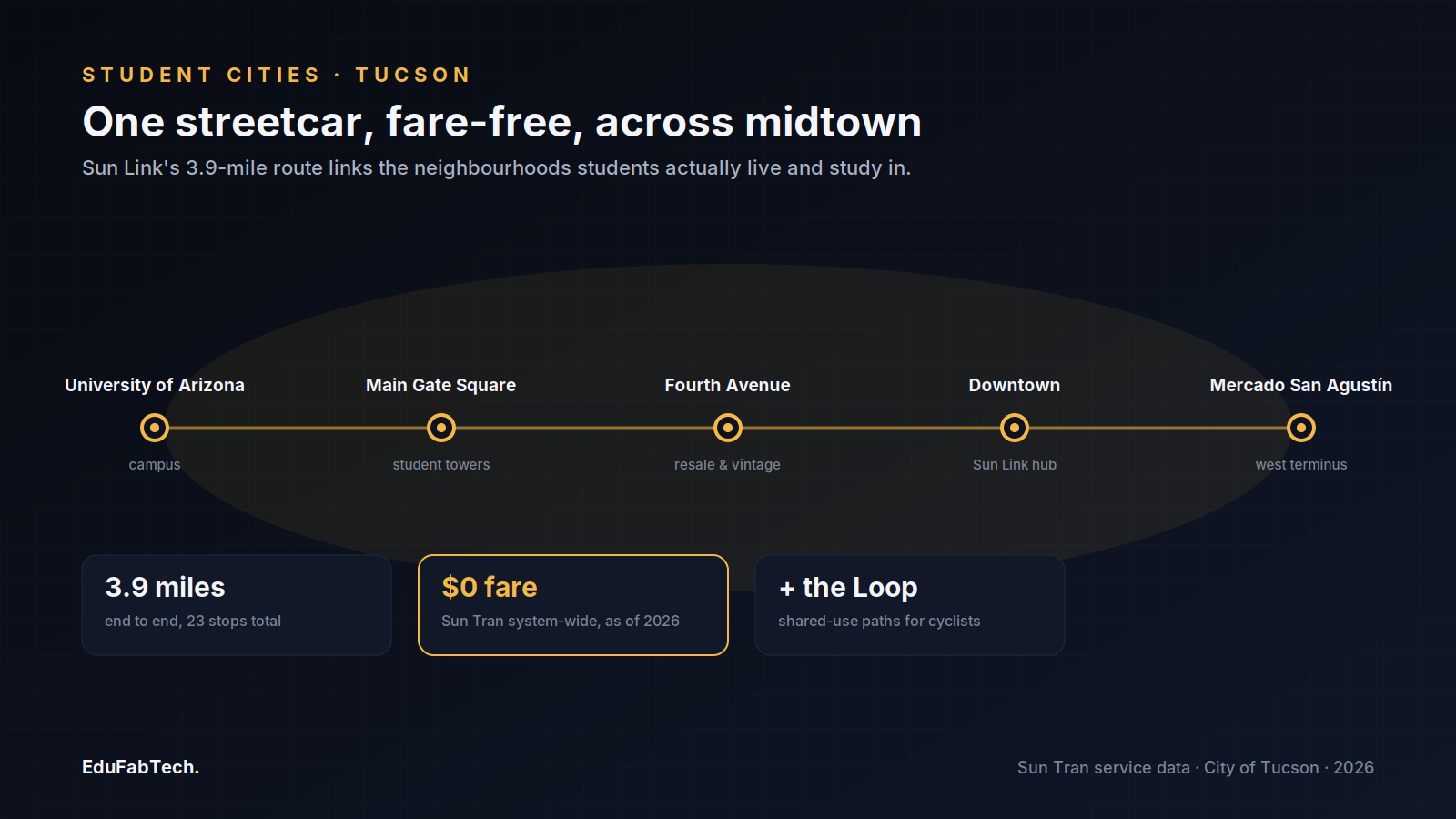
Tucson is wide, flat and laid out on a grid, which makes cycling realistic for much of the year and makes transit matter for everyone else. The city's shared-use path network, known locally as the Loop, and the wide bike lanes along the midtown arterials make a bicycle the quickest way across the flat grid for many students. As of 2026 the city's transit operator, Sun Tran, reports that all of its services — buses, the Sun Link streetcar, Sun Van and the on-demand options — remain fare free at the direction of the Mayor and Council. The Sun Link streetcar is the line students use most: its 3.9-mile route with 23 stops connects the University of Arizona, Main Gate Square, Fourth Avenue, downtown and the westside Mercado San Agustín, tying together the neighbourhoods where students actually live, study and eat. Because fares are currently free, there is no fare to pay for now — but confirm the current status with Sun Tran before you rely on it, since the fare-free policy depends on continued Mayor and Council support.
What it costs, and the honest trade-offs
Housing is the figure that varies most. Beyond the university halls above, the broad market gives a sense of scale: the U.S. Census Bureau's QuickFacts for Tucson city reports a median gross rent of $1,145 and a median household income of $57,073 over 2020–2024. Student rooms near the Main Gate typically run well above a citywide median because of demand and location; rooms a few streets out, or a shared house further east, are where the savings are. Tucson is, by regional standards, cheaper than Phoenix or the California coast, and that is part of its appeal.
The honest trade-offs are mostly about climate and sprawl. Summer is long and genuinely hot — the academic year opens in August heat, and the July-to-September monsoon brings sudden storms — while winters are mild and sunny, which is why so many choose to study here. The city is spread out, so without a bike or the streetcar some errands become a project, and the single-institution economy means much of social life orbits the university. On the other hand, the desert setting, the Santa Catalina Mountains on the skyline, a strong Mexican-American food culture and a genuinely walkable campus core make Tucson distinctive in a way a generic "college town" is not. A reader who has lived here will recognise the trade: cheap rent and sunshine, paid for in August afternoons.
A checklist for the first weeks
- Confirm your housing in writing before you arrive — a signed lease or a university hall assignment — and never wire money to hold a room you have not seen.
- If you are an international student, meet the university's international-student office early and confirm your work limits before taking any job, following the ICE/SEVP rules.
- Get your CatCard (student ID) and set up library and study-room bookings through the Main Library.
- Learn the Sun Link streetcar route early; while fares are free it is the simplest way to reach downtown, Fourth Avenue and the Mercado.
- Plan for the heat: sun protection, water and an understanding of the monsoon season matter from day one.
- Furnish second-hand around move-in and move-out, when Fourth Avenue shops, the markets and local free-and-cheap listings are busiest.
A quick question for readers
Do you work part-time while you study?
Many students work to pay the bills. See how common it is — and how many hours people really do.
Pick an answer, create a free account in a minute, and your vote counts. Already a member? Sign in
Source: University of Arizona
Sources (5)
- University of Arizona. About the University of Arizona. University of Arizona, 2026. arizona.edu ↗ · checked 7 Oct 2026
- University of Arizona Housing & Residential Life. Housing Rates 2026–2027. University of Arizona, 2026. housing.arizona.edu ↗ · checked 7 Oct 2026
- Sun Tran. Sun Link Streetcar. City of Tucson / Sun Tran, 2026. suntran.com ↗ · checked 7 Oct 2026
- U.S. Immigration and Customs Enforcement. Employment — Students and Exchange Visitor Program. ICE, 2026. ice.gov ↗ · checked 7 Oct 2026
- U.S. Census Bureau. QuickFacts: Tucson city, Arizona. U.S. Census Bureau, 2024. census.gov ↗ · checked 7 Oct 2026