Studying in Tuscaloosa: universities, housing and student life
A practical, sourced guide to studying at the University of Alabama and living in Tuscaloosa — campus, housing, second-hand furniture, part-time work rules, study spaces, transport and real costs.
A campus city on the Black Warrior River
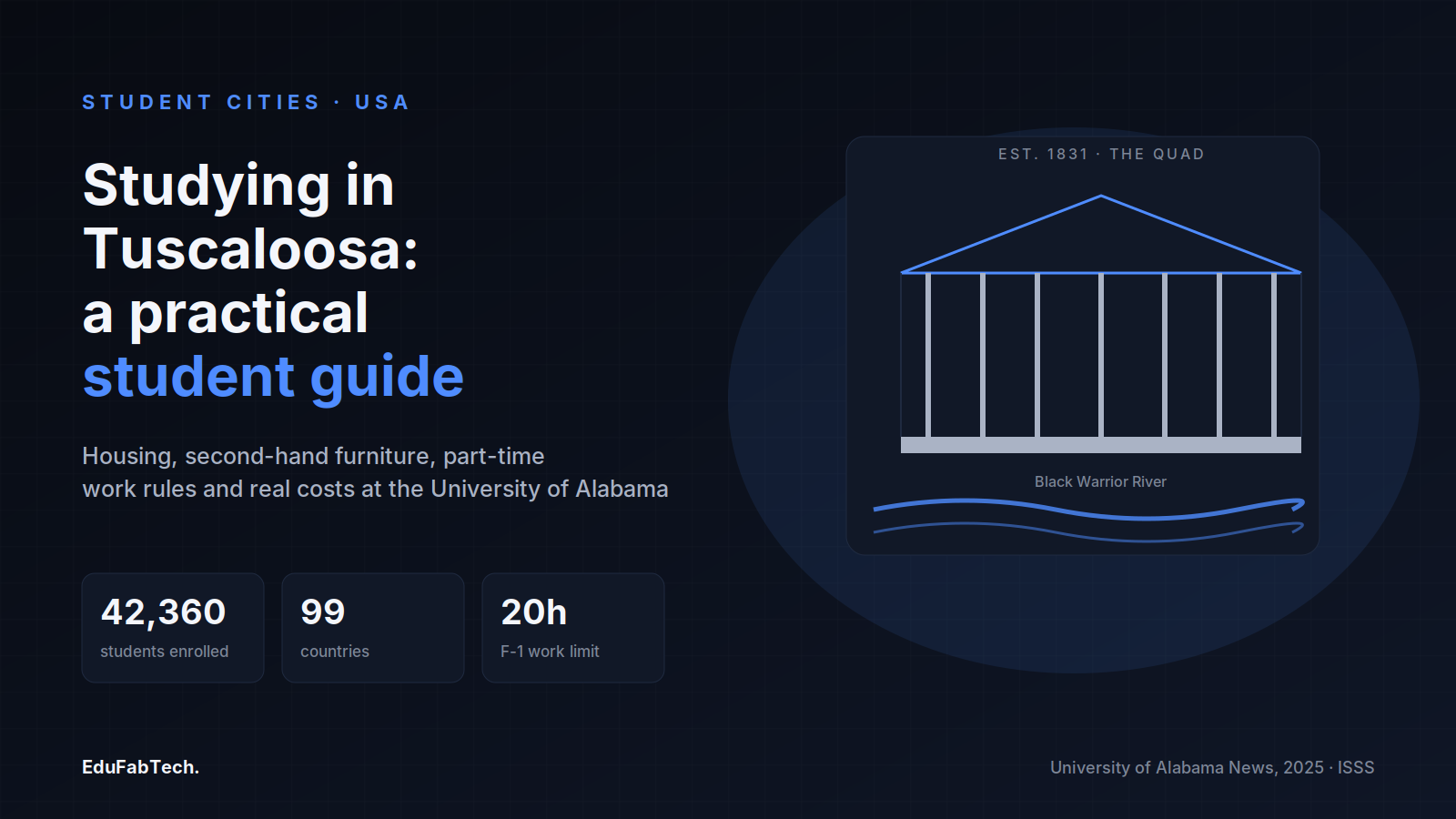
Tuscaloosa sits on the fall line of the Black Warrior River in west-central Alabama, the county seat of Tuscaloosa County and roughly an hour's drive southwest of Birmingham. For most students the city and its university are hard to separate: the University of Alabama's Quad, the stadium and the student bars along University Boulevard — the stretch everyone calls the Strip — all sit within a short walk of one another, and the river marks the northern edge of the main campus before the city of Northport picks up on the far bank.
That proximity shapes everything about student life here. Term time fills the neighbourhoods east and south of campus with renters; football Saturdays at Bryant-Denny Stadium turn the same streets into a crowd of tens of thousands. If you are arriving from abroad or from another US state, the single most useful thing to understand early is that Tuscaloosa is a university town with a large commuter edge, not a dense city with a university tucked inside it. Where you choose to live decides whether you walk to class or depend on a shuttle.
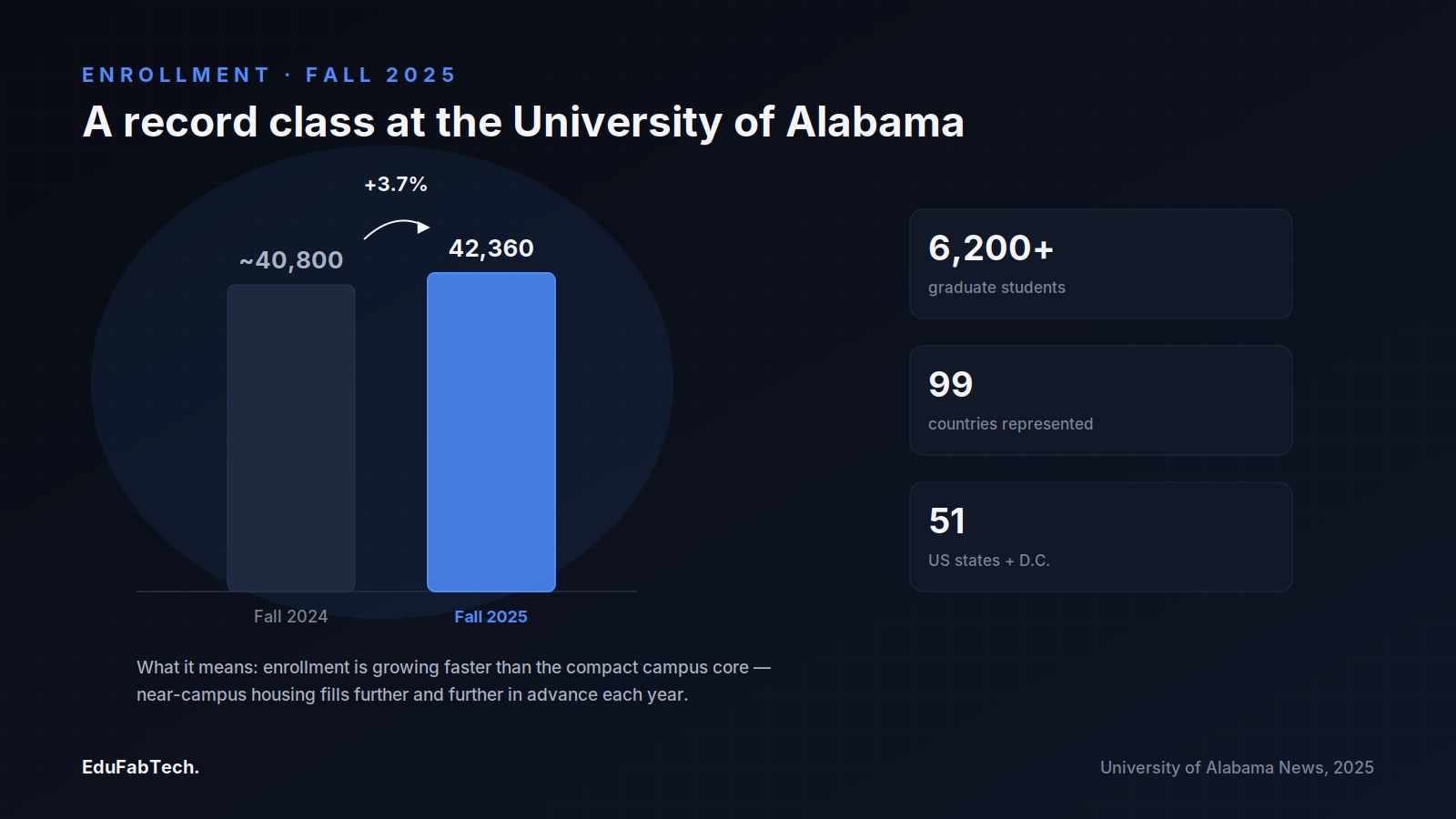
The University of Alabama reported record enrolment of 42,360 students for fall 2025, a 3.7% increase on the previous year, with a graduate school that surpassed 6,200 and students drawn from all 50 states, the District of Columbia and 99 countries, according to University of Alabama News (2025). A student body that size, in a city this scale, is why housing near campus is competitive and why planning ahead matters.
The University of Alabama and what studying here is like
The University of Alabama (Tuscaloosa) is the state's oldest public university, opened to students in 1831, and remains the flagship campus of the University of Alabama System. Its historic core is the Quad, framed by buildings including the Gorgas House — part of the Gorgas-Manly Historic District — which predates the Civil War burning of the campus and is among the few original structures left standing. Academically the university is broad, with large programmes in business, engineering, communication, nursing and the sciences; athletics under the Crimson Tide banner are a genuine part of campus identity rather than a sideline.
One route worth knowing about is New College, University of Alabama. Rather than a fixed major, New College lets undergraduates design an individual interdisciplinary "depth study" leading to a BA or BS, combining coursework from across the university with research, study abroad and independent work, as its own degree-program page describes. For students whose interests cross departmental lines, it is a structured alternative to picking a single conventional degree.
Studying here, practically, means large introductory classes in your first year and smaller, more specialised courses later, a semester calendar (fall, spring and a shorter summer), and a campus built to be self-contained — dining, gyms, health services and libraries all on or beside the Quad. International students will deal throughout with the Capstone International Center's International Student & Scholar Services (ISSS), the office that handles the I-20, status questions and work authorisation.
Where students actually settle in Tuscaloosa
Housing falls into three broad camps. First-year and many second-year students tend to live in university residence halls, which range from traditional corridor-style halls such as Burke, Parham and Paty to suite-style buildings (Riverside, Lakeside, Ridgecrest, Presidential Village, Bryant) and apartment-style options (Highlands, Bryce Lawn, East Edge). Beyond that, most upper-year and graduate students move into the dense band of purpose-built private apartment complexes east and south of campus and along the river, many marketed by the bedroom with shared common space. Finally, a smaller number rent houses and flats in older neighbourhoods such as those near downtown and toward Northport across the river.
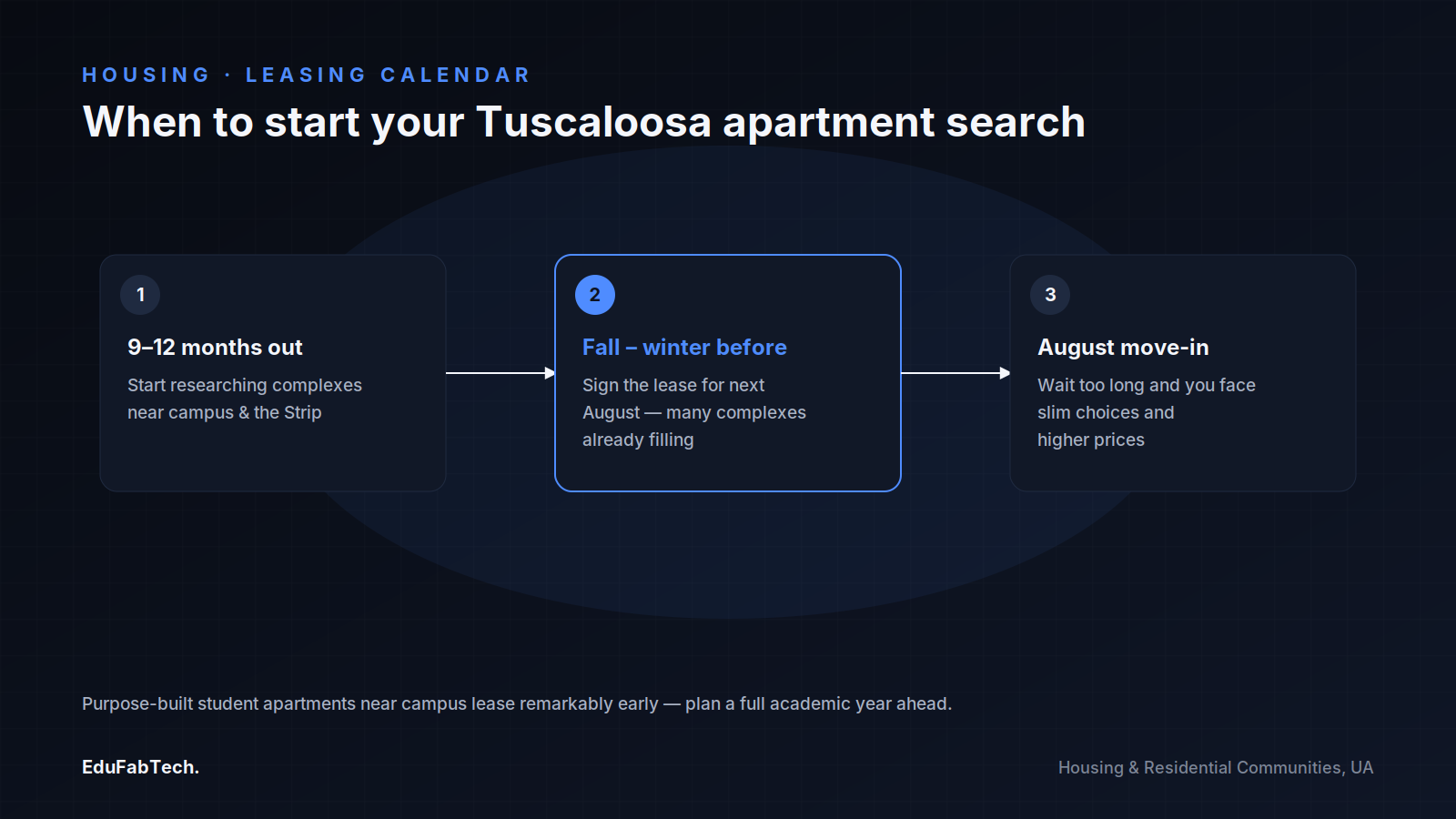
The rhythm of the leasing market is the thing that catches newcomers out. Purpose-built student apartments here lease remarkably early — many sign tenants for the following August during the preceding autumn and winter, long before you would in most cities. If you want to live close to campus, start looking roughly nine to twelve months ahead; if you arrive in August hoping to find something that week, expect slim choices and higher prices. University housing has its own application timeline through Housing and Residential Communities, so check that calendar the moment you are admitted. You can also browse current rooms and sublets on EduFabTech's Tuscaloosa rooms listings.
Renting without being cheated here
Tuscaloosa's rental scams cluster where demand is highest: the per-bedroom apartment market near campus and the summer sublet scramble, where students leaving for the break try to hand off a lease fast. The classic trap is a "listing" for a room near the Strip or the river at a price that looks too good, posted by someone who claims to be out of town and asks you to send a holding deposit before you can view it. Treat that as a scam every time.
A few habits protect you. See the actual unit in person, or have someone you trust see it, before paying anything — a real local landlord or leasing office can show you the specific apartment, not just a show model. Confirm the person collecting money controls the property. Never send a deposit, "application fee" or first month by bank wire, gift card or cryptocurrency to hold a place; those payments cannot be reversed and are the hallmark of fraud. Get the lease, the fees and the move-in date in writing, and keep records of every payment. For subletting, make sure the original tenant's lease actually allows it. If you are still abroad and cannot view a room, lean on the university's housing office and recognised complexes rather than private cash deals.
Furnishing a room for very little
Because so many students arrive and leave each August, Tuscaloosa has a steady churn of cheap second-hand furniture. The most reliable fixed shop is the Habitat for Humanity ReStore at 504 14th Street, a registered 501(c)(3) nonprofit that sells gently used furniture, appliances and building materials with inventory that changes often, open Monday to Friday 10:00–17:00 and Saturday 10:00–13:00, according to Habitat for Humanity Tuscaloosa. Buying there also funds local home-building rather than a private reseller.
Beyond the ReStore, the end-of-semester move-out weeks are the real bargain season: desks, chairs, mini-fridges and lamps are given away or sold cheaply as leases end in late spring and summer. EduFabTech keeps Tuscaloosa-specific pages for used furniture and items offered free, which are worth checking repeatedly in May, July and August rather than once. If you are furnishing a whole room, split a single car or van trip between the ReStore and a move-out giveaway and you can kit out a bedroom for a fraction of retail.
Part-time work and the rules for international students
Many students work part-time on campus — dining, the libraries, recreation, research and administrative jobs. For anyone on an F-1 visa, the rules are strict and worth reading from the source rather than from word of mouth. The university's ISSS states that F-1 students under its sponsorship do not need separate authorisation for on-campus work, but "may not work more than 20 hours per week" during the fall and spring semesters, counting all on-campus jobs combined, as set out on the Student Employment page. More hours are allowed during official breaks of a week or longer.
Off-campus work is a different matter: the same page says students who wish to work off campus "must do so through special authorization," generally via Curricular Practical Training (CPT) or Optional Practical Training (OPT), and OPT requires approval from US Citizenship and Immigration Services (USCIS) and an Employment Authorization Document before you start. This is not legal advice — immigration rules change and individual cases differ, so confirm your own situation with an ISSS adviser before accepting any job. Campus and local openings students actually use are collected on EduFabTech's Tuscaloosa jobs page.
Libraries and places to study
The University Libraries run several facilities, and two matter most day to day: Gorgas Library on the Quad, the main humanities and social-sciences building, and Rodgers Library for Science and Engineering. Gorgas houses a first-floor Learning Commons with computers running over 100 software programs and room to work alone or in groups, plus group study spaces on the second floor, as described by University Libraries. During deadline weeks the upper floors fill up fastest.
If you prefer not to compete for a seat during exam crunch, the apartment complexes near campus usually have their own study lounges, and downtown cafés give you a change of scene within walking distance of the Strip. Students also trade and advertise desk space and quiet rooms on EduFabTech's Tuscaloosa study-spaces page. A practical tip: at Gorgas and Rodgers, claim a spot early during deadline weeks rather than hoping one is free.
Getting around campus and the city
The university runs its own transit system, Crimson Ride, through the UA Transportation Hub. It covers campus routes, apartment shuttles to off-campus student complexes and a seasonal shopping shuttle, and includes a partnership with the city's Tuscaloosa Trolley "at no charge" connecting campus to downtown, according to Crimson Ride. Nights and weekends the campus service runs on a reduced schedule, so check the current hours before relying on it, as Crimson Ride's FAQ notes. For most students living in a complex on a shuttle route, a car is optional rather than essential.
City buses are run by the Tuscaloosa Transit Authority. A single fixed-route ride costs $1.00, with seniors aged 60 and over paying $0.50, transfers free and children aged three and under free; the University Shuttle is free to anyone with a valid UA ID, but only on school days during the morning and afternoon windows of 6:30–8:00 and 14:30–16:00, according to Tuscaloosa Transit Authority. If you live off a Crimson Ride route and need to move around the city outside those shuttle hours, factor those fares and limited evening service into your plans.
What it costs
University housing is billed per semester on a nine-month contract. For 2026-2027, Housing and Residential Communities lists traditional double rooms in Burke and Parham at $3,375 per semester, suite-style rooms in Riverside, Lakeside, Ridgecrest and Presidential Village at $5,000–$5,400, and apartment-style East Edge three- and four-bedroom units at $6,100 with a studio at $6,500, per the 2026-2027 rate sheet. Those are the published figures to budget against; they are per student, per semester, not per year.
For a fuller picture, the university's own 2026-2027 Cost of Attendance estimates in-state tuition and fees at $12,718 and out-of-state at $36,724, with a housing allowance of $10,000 for students living on campus and $11,242 for those off campus, plus $5,478 for food in both cases, according to UA's Cost of Attendance page (2026-2027). These are estimates the university uses to build financial-aid budgets, not quotes from a landlord, so an individual lease near campus may run above or below the off-campus figure depending on the complex and how many bedrooms share the rent.
The honest trade-offs
The good: by the standards of large US flagship towns, Tuscaloosa is comparatively affordable, the campus is walkable and self-contained, and the free University Shuttle plus Crimson Ride make a car less essential than in many Southern cities. The student community is large and the university pours resources into housing, libraries and services.
The hard parts are real too. The leasing market moves early and can feel pressured, so leaving your search until summer limits you to whatever is left. Summers are long, hot and humid, which shapes how and when you move and study. Football Saturdays bring heavy crowds and traffic to the exact streets students live on. And because the city sprawls, choosing a place off a shuttle route can leave you dependent on a car or on limited city bus hours. Weigh a slightly higher rent close to campus against the time and cost of commuting before you sign.
A checklist for your first weeks
- Confirm your university housing timeline, or start an off-campus search early — ideally many months before an August move-in.
- View any room in person (or via someone you trust) before paying; never wire a deposit or pay by gift card or crypto to "hold" a place.
- International students: meet an ISSS adviser about the 20-hour on-campus limit and any work authorisation before accepting a job.
- Get a UA ID early — it unlocks the free University Shuttle windows and library access.
- Learn which Crimson Ride or apartment-shuttle route serves your address, and check its reduced night and weekend hours.
- Furnish from the Habitat ReStore and end-of-semester giveaways rather than buying new.
- Claim a seat or group space at Gorgas or Rodgers early during deadline weeks, when study space fills up fast.
- Browse EduFabTech's listings near the University of Alabama to settle in.
A quick question for readers
Do you work part-time while you study?
Many students work to pay the bills. See how common it is — and how many hours people really do.
Pick an answer, create a free account in a minute, and your vote counts. Already a member? Sign in
Comments 0
CommentNo comments yet. Members start the conversation.
Source: The University of Alabama
Sources (5)
- The University of Alabama, Housing and Residential Communities. 2026-2027 Residence Hall Rates. University of Alabama, 2026. housing.sl.ua.edu ↗ · checked 10 Oct 2026
- The University of Alabama. Cost of Attendance 2026-2027. University of Alabama, 2026. afford.ua.edu ↗ · checked 10 Oct 2026
- The University of Alabama News. UA's Record Enrollment Growth Reinforces In-State Investment, Academic Excellence. University of Alabama, 2025. news.ua.edu ↗ · checked 10 Oct 2026
- The University of Alabama, Capstone International Center. Student Employment (International Student & Scholar Services). University of Alabama, 2026. international.ua.edu ↗ · checked 10 Oct 2026
- Habitat for Humanity Tuscaloosa. Tuscaloosa ReStore. Habitat for Humanity Tuscaloosa, 2026. tuscaloosarestore.org ↗ · checked 10 Oct 2026