Studying in Ulm: universities, housing and student life
A practical guide to Ulm, the Danube science city split between Baden-Württemberg and Bavaria — its universities, dorm rents, markets, part-time work rules and the honest trade-offs.
A science city on one bank, a business school on the other
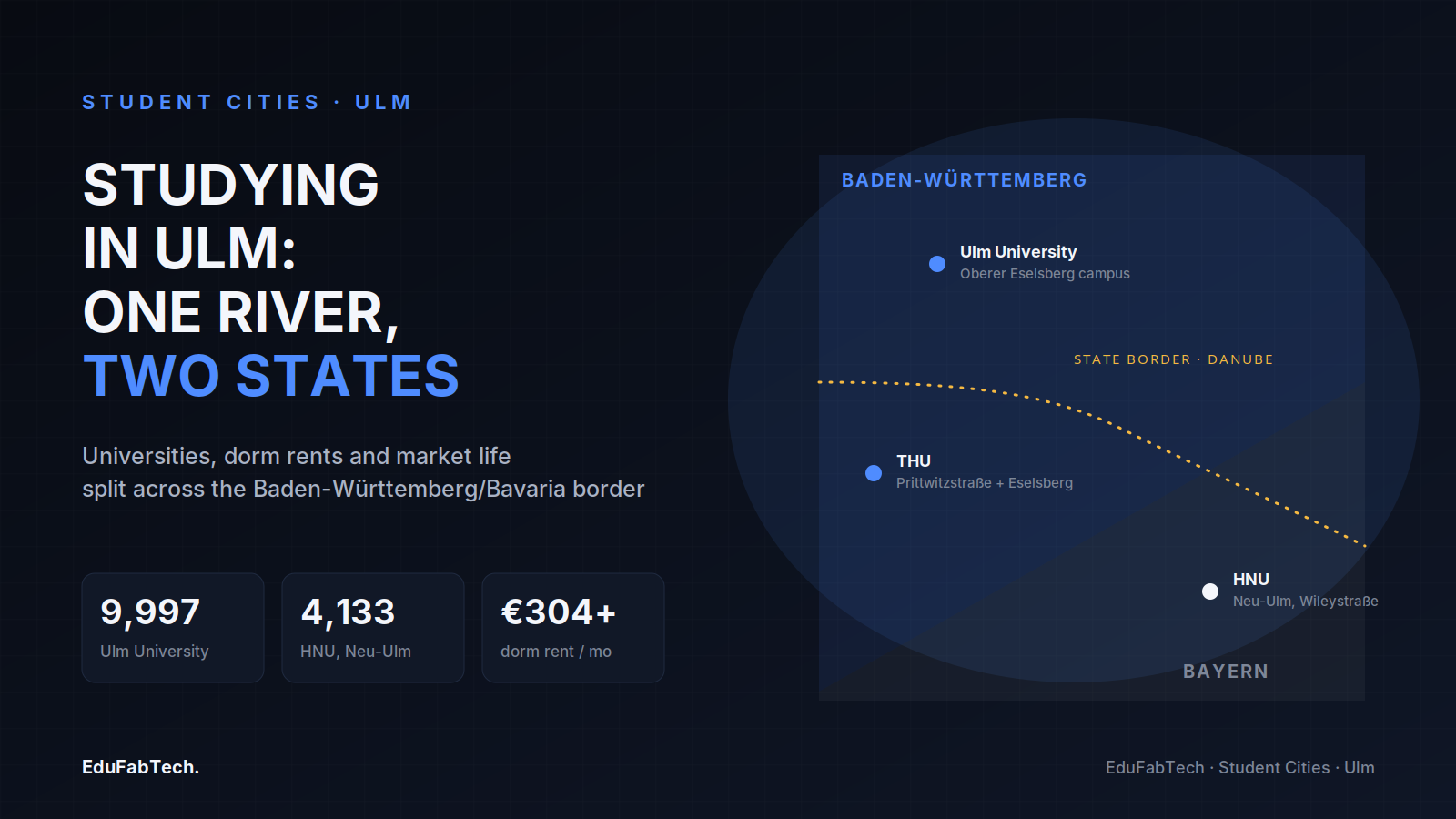
Ulm is two cities with one skyline. The Danube runs through the middle of it, and the river is also a state border: the old town, the Minster and the main station sit in Baden-Württemberg, while Neu-Ulm — closer than many Ulm suburbs — lies in the Free State of Bavaria. For a student this is not trivia. It decides which transport ticket you can buy, sometimes which authority handles your paperwork, and it quietly doubles the number of markets, dorms and part-time jobs within cycling distance of the centre.
Most of the academic weight sits north of the river, on a hill called the Oberer Eselsberg. Ulm University describes this hilltop campus as the highest-lying university campus in Germany, and it shares the plateau with the university hospital, the Helmholtz Institute for electrochemical energy storage and a cluster of technology firms that the city brands its Wissenschaftsstadt (science city). The result is a campus that feels separate from the medieval town below — a bus or tram ride up the Eselsberg, not a stroll across a historic quad.
It is a mid-sized place rather than a metropolis, which shapes student life more than any ranking. You will keep running into the same people at the same handful of libraries, bakeries and Wednesday markets; rooms near the university are genuinely scarce in October; and the city is walkable and bike-friendly in a way that bigger German student cities are not. If you want listings, events and rooms gathered in one place for the city, EduFabTech's Ulm page is a reasonable starting point.
The universities, named
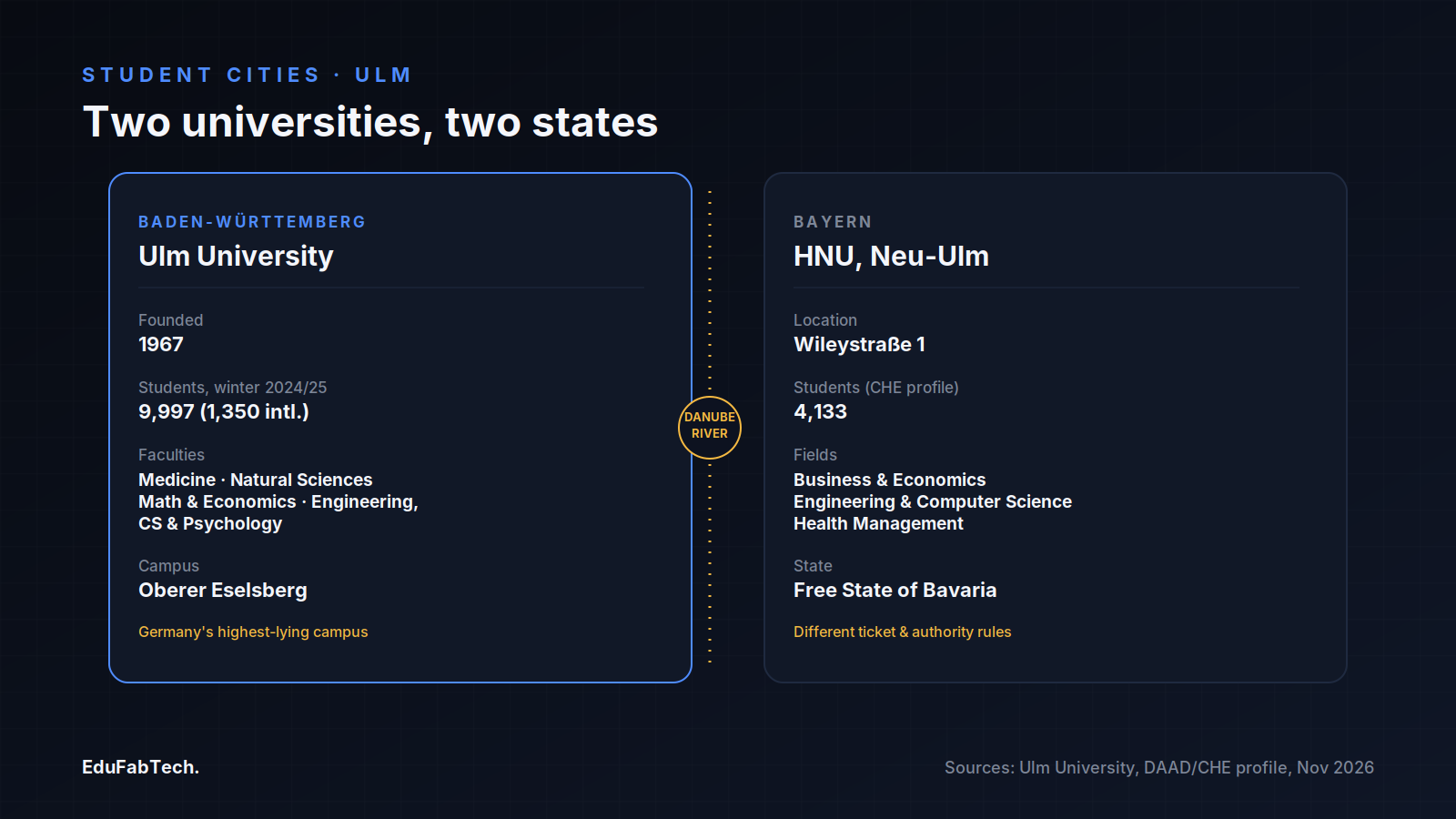
Ulm University (Universität Ulm) is the big research institution and the reason the Eselsberg exists as it does. Founded in 1967, it is the youngest university in Baden-Württemberg, according to its own profile, and it specialises in STEM subjects and medicine rather than the full breadth of a classical university. Its facts-and-data page records 9,997 students in winter semester 2024/25, of whom 1,350 were international, spread across four faculties — Medicine; Natural Sciences; Mathematics and Economics; and Engineering, Computer Science and Psychology. If you are looking for rooms or study spaces near this campus specifically, see listings near Ulm University.
Ulm University of Applied Sciences — the Technische Hochschule Ulm (THU) — is the practice-oriented engineering school, with a different feel: smaller cohorts, applied projects and theses done with regional companies. Its own site lists two campuses, a central one at Prittwitzstraße 10 near the old town and one at Albert-Einstein-Allee in the science city beside the university, so THU students move between the riverside and the Eselsberg depending on their subject. Rooms and desks close to it are collected under listings near Ulm University of Applied Sciences.
Neu-Ulm University of Applied Sciences (Hochschule Neu-Ulm, HNU) sits across the Danube on the Bavarian bank at Wileystraße 1. The DAAD's CHE university profile records 4,133 students across business and economics, engineering and computer science, and a health-management strand. Being in Bavaria rather than Baden-Württemberg is what HNU students notice most when they buy a transport ticket, as explained below.
Finding a room on the Eselsberg — and not being cheated
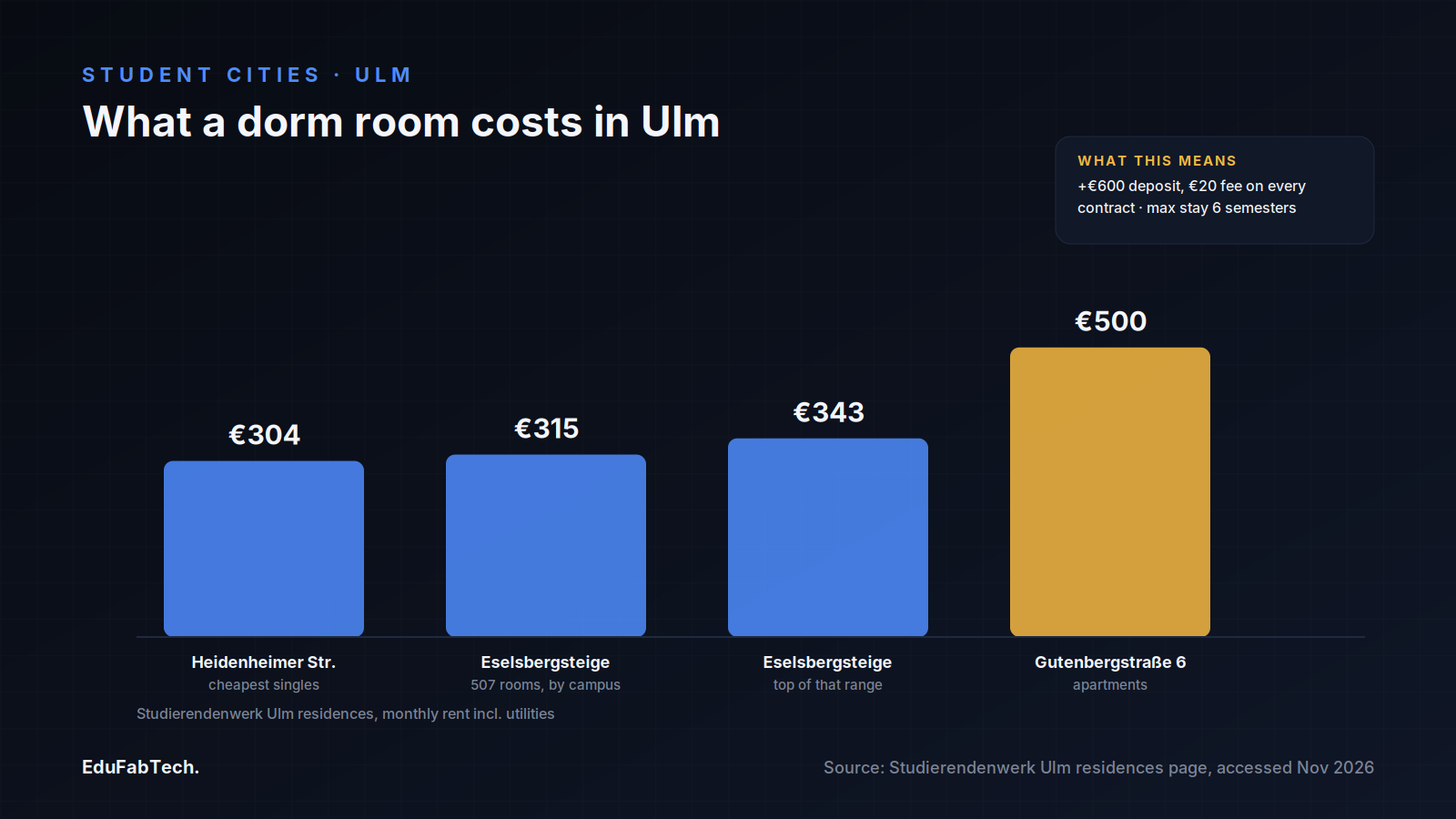
Student housing in Ulm comes in three broad kinds: a place in a hall run by Studierendenwerk Ulm, a room in a shared private flat (a WG, or Wohngemeinschaft), or a studio rented alone. The halls are the cheapest and the most sought-after. The flagship cluster, Studierendenwohnanlage Eselsbergsteige, has 507 rooms right by the university; several other houses sit nearer the river in the town. Across the city, Studierendenwerk Ulm's residences page (figures accessed November 2026) lists monthly rents with utilities included that run from €304 for the cheapest single rooms at Heidenheimer Straße to around €500 for apartments at Gutenbergstraße 6, with Eselsbergsteige rooms at €315–€343. Every contract carries a €600 deposit and a one-off €20 processing fee, and the standard maximum stay is six semesters.
Start early. Because the halls are limited and the private market tightens sharply when thousands of students return in October, the safe move is to apply to Studierendenwerk Ulm months ahead and to treat a hall place, if you get one, as the stable option while you look for a WG. EduFabTech's rooms listings for Ulm are another channel, and smaller towns on the regional trains — Neu-Ulm, Blaustein, Senden — sometimes have space when the Eselsberg does not.
The scams in Ulm look the way they do everywhere the market is tight: a too-cheap room advertised in a social-media housing group or a classifieds site, a "landlord" who is conveniently abroad, and a request to wire a deposit to "hold" the room before you can see it. Do not. In Ulm a legitimate deposit is paid after you sign — the Studierendenwerk's €600 goes to the Studierendenwerk, not to a stranger — and German law caps a private deposit at three months' cold rent. See the room in person if you are already in the city; the Eselsberg halls and the WGs in the old town and Fischerviertel can be viewed before you commit. If you are still abroad, insist on a live video walk-through and a proper contract, and never pay by bank transfer, gift card or cryptocurrency to reserve a place you have not seen.
Furnishing a room for very little
An empty dorm room is an opportunity to buy second-hand. The social enterprise Neue Arbeit Ulm runs a combined "Secondhand & Sozialkaufhaus" at Büchsengasse 25 in central Ulm and a second shop at Memminger Straße 52 in Neu-Ulm; both open, per the organisation's hours page, Monday to Friday 09:30–18:00 and Saturday 10:00–18:00. These social department stores sell donated furniture, household goods and clothes at low prices, which is exactly what a bare room needs.
Ulm also keeps two proper weekly markets. According to Ulm/Neu-Ulm Tourismus, the Wednesday and Saturday market on the Münsterplatz, in the shadow of the Minster, runs with around 80 stalls from 6am to 1pm, and a smaller market with around 35 stalls fills the Petrusplatz across the river in Neu-Ulm on the same days. Those are food markets — bread, cheese, regional fruit and vegetables straight from farms — rather than furniture, but they are where cheap, good eating in Ulm actually happens. For the household end of things, EduFabTech gathers local second-hand, furniture and free listings for the city.
Working alongside your degree
A part-time job is normal here, but the rules depend on your nationality, and this is a place to read the official source rather than a forum. For students from outside the EU, the DAAD's guidance on side jobs states that you may work 140 full days or 280 half days per year without further permission, and it warns that breaking the labour rules can have serious immigration consequences. Jobs as an academic or student assistant at the university are treated differently and should be cleared with the authorities. Whether a specific job counts, and how your residence permit is worded, is a question for the Ausländerbehörde (the foreigners' authority) and your university's International Office — none of this is legal advice, and the categories matter. Local openings aimed at students are listed on EduFabTech's Ulm jobs page.
Libraries and places to study
The main study hub is Ulm University's kiz (Kommunikations- und Informationszentrum), which runs the library. Its central-library learning-environment page describes 380 reading and working places, 21 work cabins that are free to use, and five group study rooms holding 55 workstations, allocated on a rolling basis through the week. During the term the building keeps long hours, which matters in a small city where the alternatives thin out in the evening. THU and HNU run their own libraries for their students, and the town's cafés fill the gaps, but a desk in a quiet reading room is the thing most students compete for in exam season. EduFabTech also lists bookable study spaces in Ulm.
Getting around: one region, two states, two tickets
Local transport is run by SWU (Stadtwerke Ulm), whose buses and two tram lines climb the Eselsberg and thread the old town, all within the DING tariff network (Donau-Iller-Nahverkehrsverbund). Ulm University's transport page for newcomers explains the zone-based fares and notes a fine of at least €60 for riding without a valid ticket.
There is no longer a single flat "semester ticket" here — that changed, and the replacement reflects the state border. Studierendenwerk Ulm's mobility page sets out the two main options: the nationwide Deutschlandticket at €63 per month in 2026, and the discounted D-Ticket JugendBW at €540 per year, which is available to students under 27 studying in Baden-Württemberg. That last condition is the catch: students at Ulm University and THU are in Baden-Württemberg and can take the JugendBW, while HNU students in Neu-Ulm are in Bavaria and look instead to Bavarian discounted options within DING. Either ticket includes DING travel, so day to day the border is invisible on the tram — it only appears when you choose which subsidised pass you are entitled to.
What it costs, honestly
The figures worth anchoring to are the ones with a named source. Rent in a Studierendenwerk Ulm hall, utilities included, runs from €304 to roughly €500 a month depending on the house, per the residences page, with a €600 deposit and a €20 fee on top. Transport is a known quantity — €63 a month for the Deutschlandticket, or €540 a year on the JugendBW for eligible Baden-Württemberg students, from the Studierendenwerk's mobility page. Beyond rent and transport, a reliable, dated, Ulm-specific total for monthly living costs is not something a single authoritative source puts a clean number on, so this guide does not invent one; the food markets and second-hand shops above are the practical levers you actually control.
The good and the hard
What is good about Ulm is its scale and its science. The university and its hospital, research institutes and companies sit together on one hill, so the walk from a lecture to a lab to an internship is short, and a city of this size is cheap to cross by bike and quiet to live in. The two-market, two-state geography means more choice than a town of Ulm's population would normally offer, and the Minster, the river and the crooked lanes of the Fischerviertel are genuinely pleasant places to be a student.
What is hard is mostly housing and distance. Hall places are limited and the private market is tight each autumn, so a late search is a stressful one. The Eselsberg campus is a commute above the town rather than part of it, which can feel isolating in winter, and the nightlife of a mid-sized city is modest next to Munich or Stuttgart, both of which are close enough to tempt you away at weekends. And the state border, charming on paper, is a small bureaucratic seam — tickets, sometimes authorities — that larger single-state cities do not have.
A checklist for the first weeks
- Apply to Studierendenwerk Ulm for a hall place as early as you can, and keep a WG search running in parallel through local rooms listings.
- Register your address (Anmeldung) at the Bürgerdienste soon after you arrive — on the correct side of the river, Ulm or Neu-Ulm, for where you actually live.
- Buy the right transport pass: the JugendBW if you are under 27 and study in Baden-Württemberg, otherwise the Deutschlandticket.
- Get your kiz library account set up and learn how the work cabins and group rooms are allocated before exam season.
- Furnish the room from Neue Arbeit Ulm and the Münsterplatz market rather than new, and check EduFabTech's free-stuff listings first.
- If you are a non-EU student planning to work, confirm the day limit and your permit wording with the Ausländerbehörde and the International Office before you sign anything.
A quick question for readers
Do you work part-time while you study?
Many students work to pay the bills. See how common it is — and how many hours people really do.
Pick an answer, create a free account in a minute, and your vote counts. Already a member? Sign in
Comments 2
Comment-
The 'honest costs' section is the tell here: rent and transport both get named sources, down to the euro, then the guide shrugs at everythin…
-
The transport section is precise right up until it isn't. €63 a month for the Deutschlandticket, €540 a year for the JugendBW, a €60 fine fo…
Join free to read the full comments and reply Comments are between members; an account takes a minute.
Source: Studierendenwerk Ulm
Sources (5)
- Universität Ulm. Facts and data (winter semester 2024/25). Universität Ulm, 2025. uni-ulm.de ↗ · checked 15 Nov 2026
- Studierendenwerk Ulm. Student Residences. Studierendenwerk Ulm, 2026. studierendenwerk-ulm.de ↗ · checked 15 Nov 2026
- Studierendenwerk Ulm. Mobility (Semesterticket). Studierendenwerk Ulm, 2026. studierendenwerk-ulm.de ↗ · checked 15 Nov 2026
- DAAD. Side jobs. Deutscher Akademischer Austauschdienst, 2026. daad.de ↗ · checked 15 Nov 2026
- Stadt Ulm (Ulm/Neu-Ulm Tourismus). Weekly markets Ulm/Neu-Ulm. Stadt Ulm, 2026. tourismus.ulm.de ↗ · checked 15 Nov 2026