Studying in Washington: universities, housing and student life
A practical, sourced guide to the universities of the Washington region, where students actually live, and what it costs to study in a city that spans three jurisdictions.
A capital that is also a campus
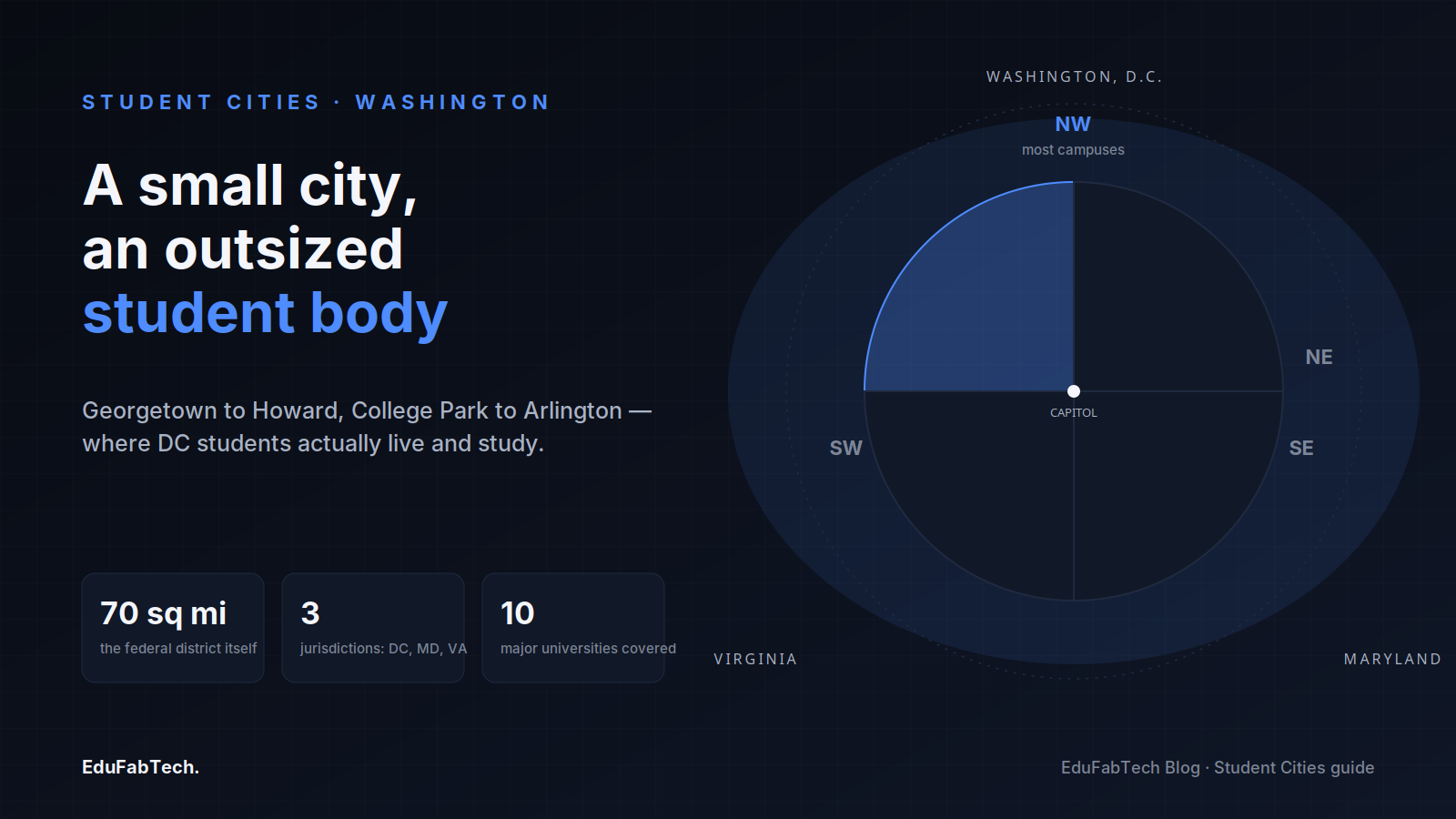
Washington is a small city with an outsized population of students, researchers and early-career professionals. The federal district itself is only about seventy square miles, but the place students mean when they say "DC" spills across the state lines into Maryland and Virginia — the region locals call the DMV. A degree here is rarely confined to one campus: a politics seminar might meet a short walk from the National Mall, an archive sits inside a federal library, and an internship is often the point of being in town at all. The city's character is institutional and transient in roughly equal measure, which is good news for a newcomer, because almost everyone arrived from somewhere else.
Geography shapes student life more than most people expect. The district is divided into four quadrants radiating from the Capitol, and the university campuses are scattered across the north-west of the city and out along the transit lines into the suburbs. Because the region crosses three jurisdictions, the rules that matter to you — tenancy, local taxes, even transit cards — can change depending on which side of a river or a state line your room is on. It pays to know not just your campus but your quadrant.
The climate is humid subtropical: summers are hot and heavy, winters are cold but rarely severe, and the brief, mild spring that brings the cherry blossoms along the Tidal Basin is genuinely the nicest time to be a student here. Autumn, when most academic years begin, is long and pleasant. None of this requires special equipment, but a city built on reclaimed marshland in August is a real thing, and air conditioning is not a luxury.
The universities, and what studying here is like
Georgetown University is the oldest of the city's major institutions, its hilltop campus sitting above the Potomac in the leafy Georgetown neighbourhood in the north-west. It is best known for its programmes in international affairs, law, government and the humanities, and two of its most cited units — the Walsh School of Foreign Service and the McCourt School of Public Policy — pull students toward the diplomatic and policy worlds the city runs on. George Washington University sits a few blocks from the White House, its main campus woven into the Foggy Bottom neighbourhood and spilling toward the Golden Triangle business district. GW is large and professionally minded; its Elliott School of International Affairs, its Corcoran School of the Arts & Design, its Columbian College of Arts and Sciences and its George Washington University School of Nursing give some sense of its range.
Howard University, chartered in 1867 and based in the Pleasant Plains neighbourhood, is one of the most influential historically Black universities in the country, with a storied law school and medical school and a campus anchored by its Founders Library. American University, up in Tenleytown in the far north-west, is known for communications, public affairs and international service. University of the District of Columbia, with its main campus at Van Ness, describes itself as "the only public institution of higher learning in the District of Columbia" and "the nation's only exclusively urban land-grant university" — meaning it carries the public, access-focused mission the private institutions do not.
Gallaudet University, near Union Market in the north-east, is a bilingual institution where, in its own words, education is delivered "through American Sign Language (ASL) and English"; it has been the world's leading university for deaf and hard-of-hearing students since the nineteenth century. The Catholic University of America, in Brookland, hosts the School of Nursing at The Catholic University of America and the continuing-education Metropolitan School of Professional Studies, and shares its corner of the north-east with the small St. John Paul II Seminary in Park View. Across the Potomac, George Mason University is a large public research university based in the City of Fairfax, Virginia, with programmes that reach into the capital, while Marymount University sits closer in, in Arlington. Out in Maryland, the University of Maryland flagship campus at College Park is the region's biggest public research university and an easy Metro ride from the centre.
Other universities and campuses around Washington
The region holds many more institutions, specialist and general, public and private:
- University of Maryland Global Campus (College Park/Adelphi) — a distance-focused public university serving working adults and service members worldwide.
- Bowie State University (near Crofton, Maryland) — one of Maryland's historically Black public universities.
- Trinity Washington University (near Bloomingdale) — a small institution with roots as a Catholic women's college.
- Washington Adventist University (Takoma Park) — a faith-based liberal-arts university just over the Maryland line.
- Uniformed Services University of the Health Sciences (toward Chevy Chase/Bethesda) — the federal medical and health-sciences school for military and public-health careers.
- Capitol Technology University (South Laurel, Maryland) — engineering, cybersecurity and aviation programmes.
- University of Management and Technology (Rosslyn, Arlington) and University of the Potomac (Washington) — small private institutions focused on business and professional degrees.
- Strayer University (Rose Hill area) — a career-oriented university offering flexible and online study.
- Graduate School USA (Downtown DC) — a long-running provider of professional and continuing education.
- Nexford University (NoMa) — an online university headquartered in the city.
- Maxwell in Washington (Golden Triangle) — Syracuse University's Washington-based programme for public-affairs students.
- Human Resources University — not a degree-granting university at all, but a federal online training resource, worth knowing so you are not confused by the name.
- University of Northern Virginia (Annandale) and Stratford University (Pimmit Hills/Falls Church) — both have since closed, so you will see them in old listings but cannot enrol.
Research students also orbit campuses that are not universities in their own right: the Paul H. Nitze School of Advanced International Studies in the Golden Triangle (part of Johns Hopkins), the vast National Institutes of Health campus in Bethesda, and teaching sites such as Montgomery College's Rockville Campus and The Universities at Shady Grove, where several Maryland institutions share one suburban location.
Where students live
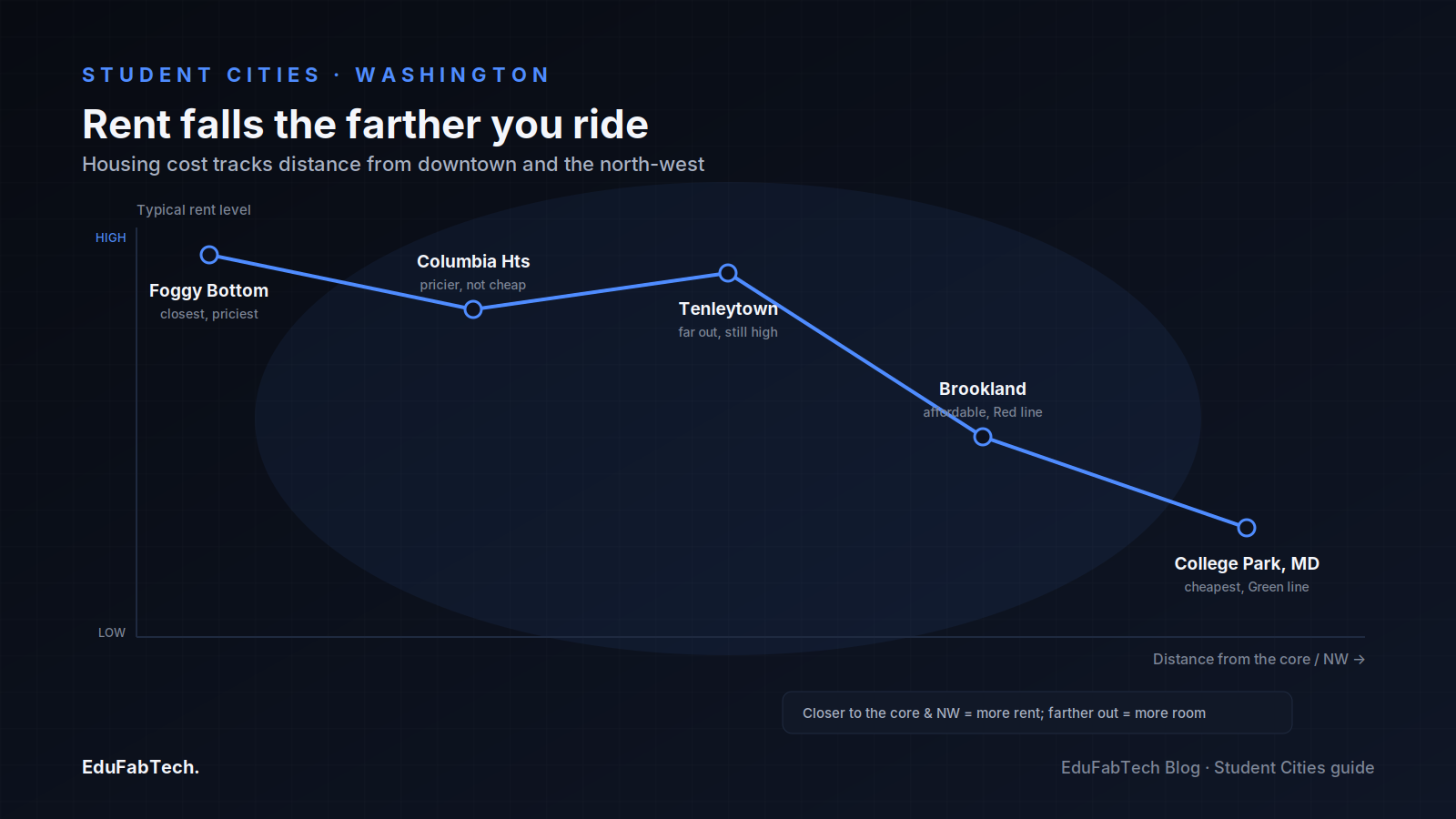
Foggy Bottom and the West End put you at the centre of things, next to George Washington University and a short walk from Georgetown and the National Mall. It is convenient and expensive, dominated by university buildings and older apartment blocks, with very little that is quiet. Columbia Heights, up the hill on the Green and Yellow lines, is one of the most popular student areas: diverse, lively, full of food, with a mix of rowhouses and newer apartments and a commute of fifteen to twenty minutes to most central campuses. It is more affordable than the north-west but far from cheap.
Tenleytown and the AU Park area, in the upper north-west around American University, are residential, green and relatively calm, with the trade-off that you are further out and prices stay high. Brookland, in the north-east near the Catholic University campus, is sometimes called "Little Rome" for its religious institutions; it is comparatively affordable, sits on the Red line, and has a genuine neighbourhood feel. Petworth and Park View, a little north, remain among the more reasonable close-in options and are convenient for Howard.
NoMa and the Mount Vernon Triangle, just east of downtown, are full of newer purpose-built apartments and are handy for Gallaudet and for anyone who wants to live centrally in a modern building; you pay for the newness. Over the lines, College Park, Maryland is the natural choice for University of Maryland students — cheaper, student-dominated, and directly on the Green line into the city. Arlington and Rosslyn, Virginia, across the Potomac, suit students at Marymount University or the Virginia campuses; rents vary block by block, and the Orange, Silver and Blue lines make the crossing quick.
A general rule holds across the region: the closer you are to the core and the north-west, the more you pay, and the further out along a Metro line you are willing to live, the more room you get for the money. You can browse what is currently available across the city — rooms included — at EduFabTech's Washington rooms.
Finding a room without being scammed
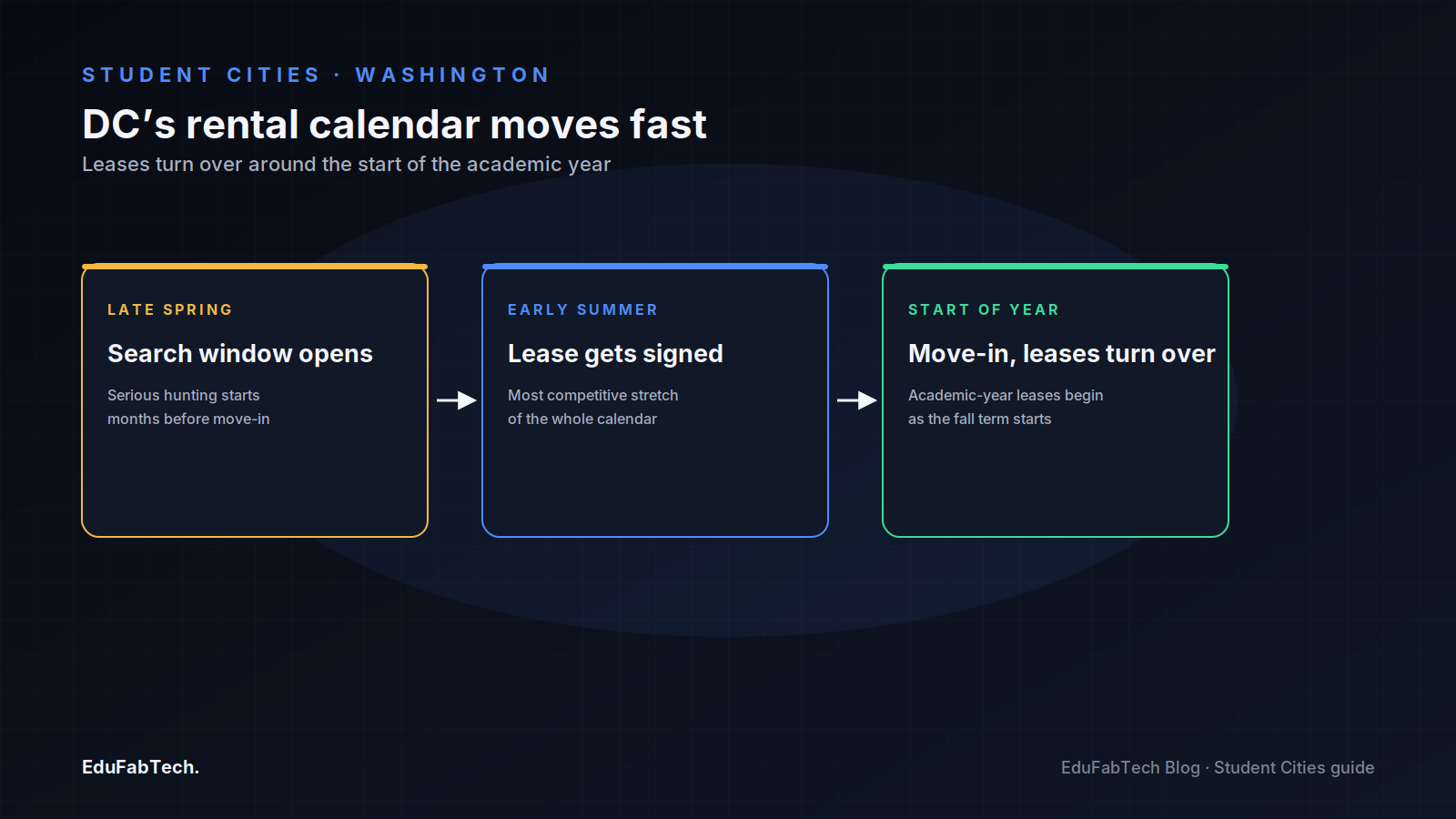
Most students either take university housing for a first year or share a rowhouse or apartment with others. The rental calendar is competitive: many leases turn over around the start of the academic year, so the practical window to search seriously is the late spring and early summer before you arrive, with the understanding that the best-value shared rooms go quickly. Before you commit to anything, confirm who actually holds the lease, what the monthly figure includes (heat, cooling, water and internet are often separate), how the security deposit is handled, and whether the lease term matches your study dates. Ask to see the room, the actual room, not a show flat.
The single most important piece of safety advice is about money. See the place in person, or on a live video call if you are still abroad, before you pay anything at all. A genuine landlord will not need you to wire a deposit, buy gift cards, or send cryptocurrency to "hold" a room, and a listing that pressures you to pay instantly to someone you have never met is the classic shape of a rental scam. Never transfer a deposit by bank wire, gift card or crypto to secure a place you have not verified; use a method that leaves a trace and a receipt, and treat a refusal to let you view the property as the end of the conversation. Do not name or trust a platform over your own eyes.
Furnishing a room for next to nothing
Washington is kind to the second-hand furnisher, largely because so many people cycle through it every year. The end of each academic term produces a reliable tide of abandoned desks, lamps and bookshelves, and in the rowhouse neighbourhoods stoop giveaways — usable things left on the front steps with a "free" sign — are a real local institution. Among markets worth knowing, Eastern Market on Capitol Hill is the city's historic public market, busiest at weekends with a flea section of household goods and curiosities; Union Market in the north-east is more food-and-maker than furniture but good for the texture of the neighbourhood near Gallaudet; and the long-running Georgetown Flea Market is a weekend fixture for used and vintage finds.
Beyond the markets, the cheapest furnishing route is almost always other students. Keep an eye on second-hand furniture and free things being given away near campus, especially in the weeks when leases end. A city this transient means today's graduating tenant is tomorrow's source of a perfectly good mattress frame.
Part-time work and the rules that apply
Local students work in the usual places — cafés, campus jobs, shops, tutoring, and the city's enormous research and non-profit sector. For international students the rules are stricter and should be read from the source, not from hearsay. Under the main academic student visa category, the federal immigration authority's policy manual states that a student may work on campus for up to 20 hours per week while school is in session, with full-time on-campus work permitted during official breaks, and off-campus work generally requiring separate authorisation tied to your programme. The exact conditions depend on your status and your school's designated officials, so treat your university's international-student office as the authority on your own case; this guide is not legal advice. When you are ready to look, local openings are collected at Washington jobs.
Libraries, study spaces and getting around
Few cities offer students this many places to read. The Library of Congress — the world's largest library — issues free reader cards to those doing research and opens its reading rooms to the public; it is an extraordinary resource sitting a short walk from the Capitol. The central branch of the city's public library system, the Martin Luther King Jr. Memorial Library downtown, is a modern, well-equipped place to study for free. On campus, Georgetown's Lauinger Library, GW's Gelman Library, Howard's Founders Library and the University of Maryland's McKeldin Library anchor their respective communities; many university libraries admit visiting researchers for reference use, though borrowing is usually restricted to enrolled students. For quieter, bookable desks and shared study rooms, see Washington study spaces.
Getting around is built on Metro, the region's rail and bus network. According to the regional transit authority, the Metrorail base fare is $2.25 with a maximum of $6.75 on weekday peak trips, fares being distance-based, while regular Metrobus trips are a flat $2.25 (figures current in 2025). The more important fact for students is the U-Pass programme: Metro describes it as giving full-time students at participating schools "unlimited rides on Metro Rail and Metro Bus throughout the semester," included in tuition at a cost equivalent to $1 per day. Not every institution participates, so check with yours — but where it exists, it transforms the economics of commuting across the DMV. Between Metro, a genuinely useful network of protected bike lanes, and the walkability of the central neighbourhoods, many students never need a car.
Costs, trade-offs and a first-weeks checklist
Housing is the hard part. The U.S. Census Bureau's QuickFacts put the District's median gross rent at US$1,954 for 2020–2024 — a figure that reflects whole homes rather than a student's shared room, but which tells you plainly that this is one of the most expensive housing markets in the country. Students bring the cost down by sharing, living a few Metro stops out, and treating the U-Pass as part of the deal. Day-to-day, the saving graces are the ones that are free: the Smithsonian museums, the Mall, the libraries, and a public realm designed to be used.
What is genuinely good about studying here is the density of opportunity — internships, lectures, archives and employers all within a transit ride — and the fact that the student population is large, international and used to newcomers. What is hard is equally real: rent at the top of the national range, a housing search that rewards planning months ahead, summers that are heavy and humid, and a region split across three jurisdictions whose rules do not always line up. Commutes can be long if you trade cost for distance, and the most central neighbourhoods can feel more institutional than homely. None of it is a reason to stay away; all of it is a reason to arrive prepared.
- Confirm your enrolment and, if you are an international student, meet your university's international-student office early — ask them directly about work rules and documents.
- Decide your quadrant and your campus, then shortlist two or three neighbourhoods on the right Metro line before you look at a single room.
- Line up a room only after seeing it in person or on live video; never send a deposit by wire, gift card or crypto to hold a place.
- Get a transit card and check whether your school offers U-Pass; if it does, you have already paid for it.
- Register for a free reader card at a public or research library in your first week — it is the cheapest study space you will find.
- Furnish from the end-of-term giveaways and the city's markets rather than buying new, and keep an eye on local listings as leases turn over.
- Browse what is near your campus — for example, listings near George Washington University — to get a feel for prices before you commit.
A quick question for readers
Do you work part-time while you study?
Many students work to pay the bills. See how common it is — and how many hours people really do.
Pick an answer, create a free account in a minute, and your vote counts. Already a member? Sign in
- U.S. Census Bureau. QuickFacts: District of Columbia. U.S. Census Bureau, 2025. link
- Washington Metropolitan Area Transit Authority. Metro Fares: Basic Fare Information. WMATA, 2025. link
- Washington Metropolitan Area Transit Authority. Student Fare Programs (U-Pass). WMATA, 2025. link
- U.S. Citizenship and Immigration Services. Policy Manual, Volume 2, Part F, Chapter 6: Employment. USCIS, 2025. link
- University of the District of Columbia. Know Your UDC. University of the District of Columbia, 2025. link
- Gallaudet University. About Gallaudet. Gallaudet University, 2025. link