Studying in Wilmington, United States: universities, housing and student life
A practical guide to UNC Wilmington, the Cape Fear housing crunch, second-hand shops, Wave Transit and the real costs of being a student in coastal North Carolina.
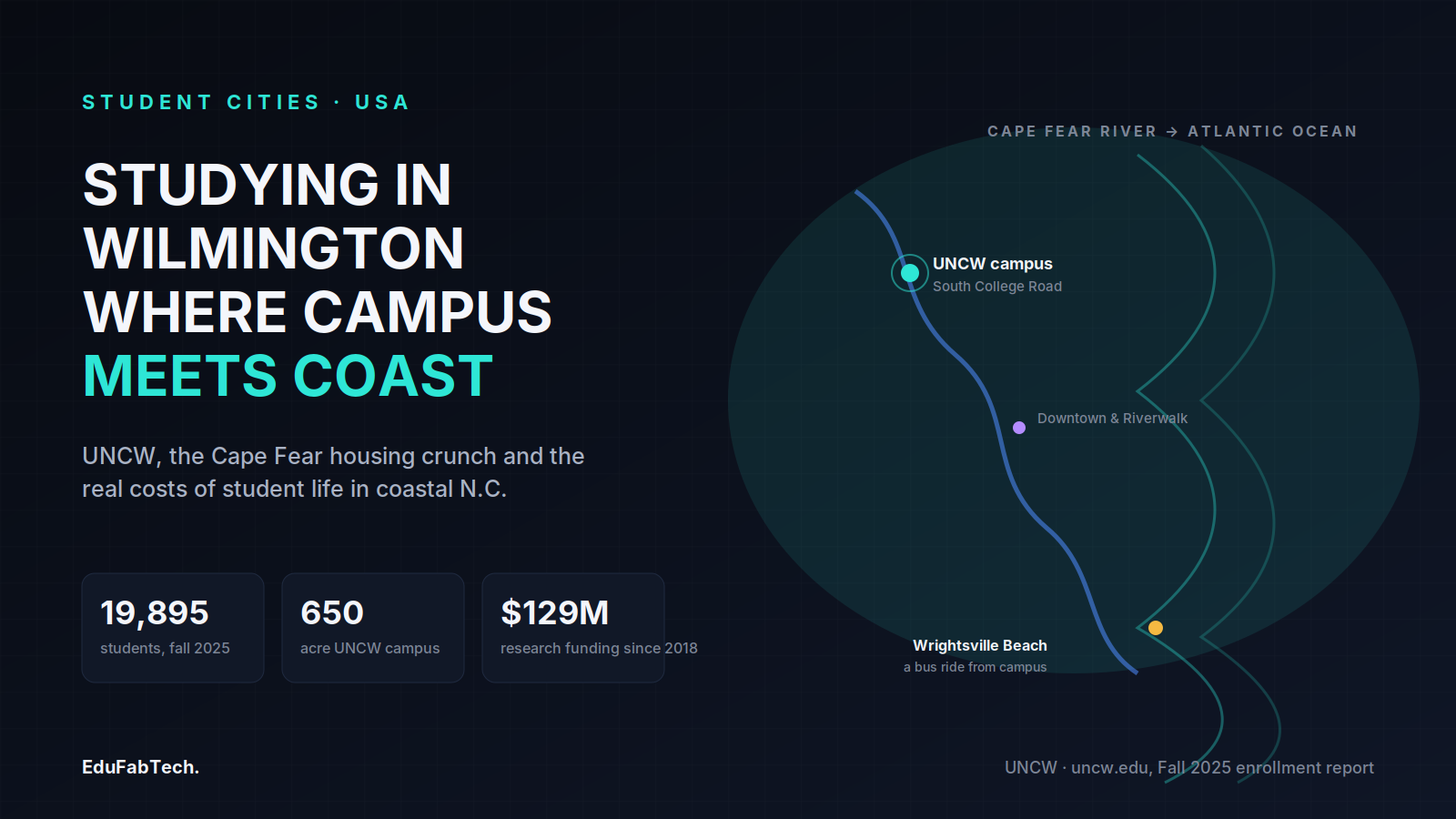
Wilmington sits where the Cape Fear River meets the Atlantic, in the southeastern corner of North Carolina, close enough to Wrightsville Beach and Carolina Beach that students measure distances in minutes-to-the-sand as often as minutes-to-class. It is a mid-sized city with a historic riverfront downtown and a long commercial spine, South College Road, that runs past the university and out toward the suburbs. For a student, that geography shapes almost everything: where rooms are, how long the bus takes, and why demand for beds near the water keeps outrunning supply.
The city's academic centre of gravity is the University of North Carolina Wilmington (UNCW). On its own overview page the university describes itself as "the state's coastal university" and as "a large public institution with a private feel," founded in 1947 as Wilmington College and joining the University of North Carolina System to become UNCW in 1969, on a campus of about 650 acres (uncw.edu/about/know-us). It is not the only place students enrol — Cape Fear Community College, a two-year college granting associate degrees, has campuses downtown and north of the city — but UNCW is the degree-granting university the city is built around, and this guide is mainly about studying there.
UNCW is large and getting larger. The university reported that it welcomed 19,895 students in fall 2025, a 5.6% rise on the previous year, with undergraduate enrolment at 16,131 and graduate enrolment at 3,764, and said it admitted its largest-ever first-year class of 3,109 students, up 12.9% on the year before (uncw.edu news, September 2025). Those numbers matter well beyond bragging rights, because the same growth that fills lecture halls is what makes finding a bed hard.
Studying at UNC Wilmington: marine science and a campus near the beach
UNCW's academic identity leans on its coast. Its own overview page says the university offers "the nation's first" undergraduate degree in coastal engineering, describes itself as a doctoral university with high research activity, and reports more than $129 million in sponsored research funding since 2018 (uncw.edu/about/know-us). Marine biology and the work tied to the Center for Marine Science — reached from main campus by a dedicated on-demand shuttle — are a large part of why students come here, alongside business, nursing, education and film studies. The teams are the Seahawks, the colours teal, gold and navy, and much of undergraduate social life revolves around the short ride east to Wrightsville Beach.
The campus sits a few miles inland on South College Road, which is the practical fact that governs student housing: you are not living on the water, you are living along a busy arterial road and its side streets, and the beach is a bus or bike ride away. That distinction is worth keeping in mind when a listing promises a "coastal" location; most student housing is in the inland corridor around the university, not on the shore.
Where students live, and why beds are tight
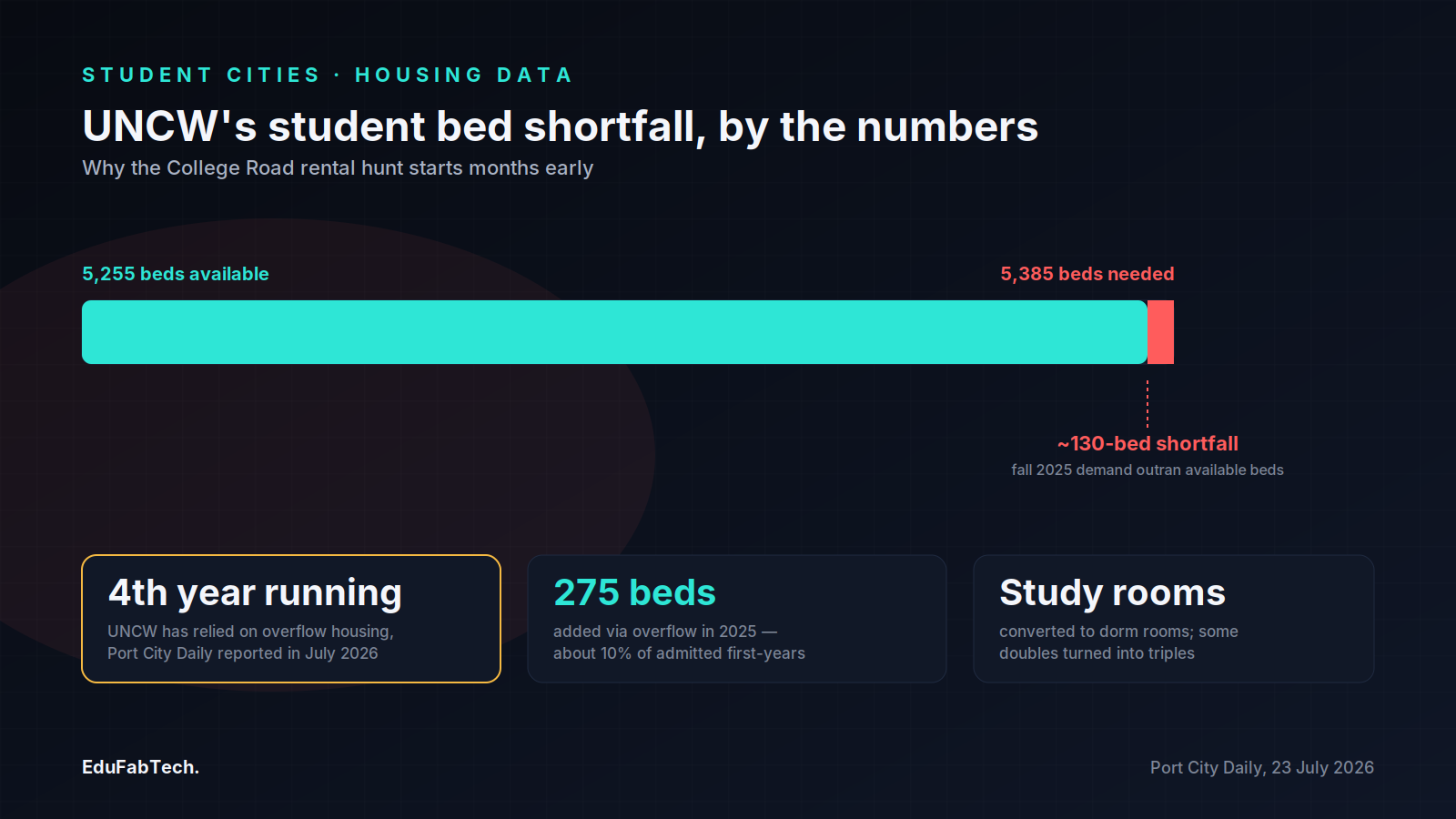
UNCW guarantees housing to many first-year students, and a large share live on campus in traditional residence halls — Belk, Graham, Hewlett and Schwartz among the older ones, with suite-style and apartment options such as Seahawk Crossing, Landing and Village, and leased properties including the Cottages at College Acres. But the university has run short of beds for several years. Port City Daily reported in July 2026 that UNCW had 5,255 available beds against demand of roughly 5,385, a shortfall of about 130 students, and that it was managing the gap by converting study and common rooms into dorm rooms and turning some double rooms into triples; the outlet described it as the fourth year in a row the university relied on overflow housing, and reported that overflow housing in 2025 accounted for about 10% of admitted first-years, needing 275 extra beds (portcitydaily.com, 23 July 2026).
What that means in practice: upper-year, transfer and international students often look off campus, and they look early. The residential belt is the grid of streets and apartment complexes along and off South College Road, stretching south toward the area locals call Monkey Junction, where newer complexes cluster. Downtown and the Riverwalk are livelier and more walkable but further from campus and oriented more to Cape Fear Community College students. If you want to be within a short bus ride of UNCW, you are competing for the College Road corridor, and in a city where enrolment keeps rising, that competition starts months ahead. EduFabTech keeps a running list of what is currently available across the city at rooms in Wilmington.
Finding a room without losing a deposit
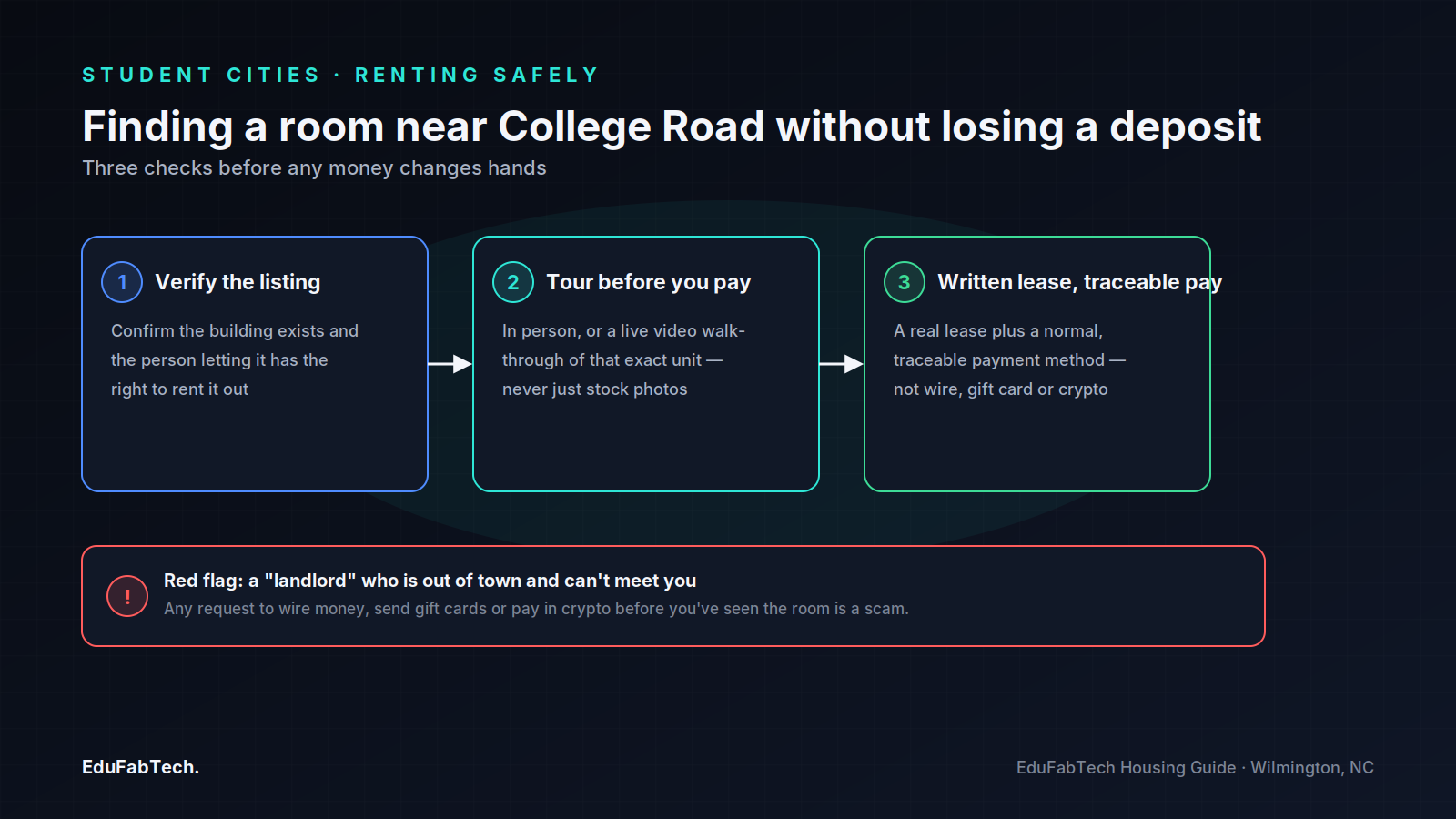
Wilmington's tight market is exactly the condition rental scams exploit: when beds are scarce and students are anxious, a too-good listing near College Road gets quick replies. The pattern to watch for is a room advertised below the going rate by someone who cannot meet you, is "out of town," and wants money to "hold" the place before you have seen it. Treat any request to send a deposit by bank wire, gift card or cryptocurrency as a scam — those are the methods fraudsters use precisely because the money cannot be recovered. A legitimate local landlord or complex will let you tour the unit (or arrange a video walk-through of that exact unit, not stock photos) and will use a normal lease and traceable payment.
Before paying anything, confirm the building exists and the person letting it has the right to: see the actual room, get the lease in writing, and check who pays for what. On campus, UNCW states that its room rates include rent, utilities, internet, housekeeping and security (uncw.edu housing costs); off campus, a cheap-looking rent may exclude electricity, water and internet, which in a humid coastal summer with the air-conditioning running is not a trivial line. If you are new to the city and cannot visit in person, ask the university's housing office or international office about legitimate options rather than wiring a deposit to secure a room you have only seen in photographs.
Furnishing a room cheaply: thrift shops and move-out season
Once you have a room, furnishing it second-hand is both cheaper and easier than shipping or buying new. WILMA magazine's 2022 round-up of local thrift shops names several that take furniture and household goods: Vintage Values, which operates resale shops at 609 Castle Street and on South College Road and is run by the nonprofit Domestic Violence Shelter and Services; the Assistance League of Greater Wilmington at 420 Eastwood Road; Bargain Box of Wilmington at 4213 Princess Place Drive; and Goodwill Industries, with several Wilmington stores including South Kerr Avenue and Sir Tyler Drive (wilmamag.com, 2022). Because shop details change, phone ahead or check current hours before a trip; the WILMA list was accurate when published in 2022.
Move-out season is its own resource: between the end of one semester and the start of the next, the College Road complexes fill with usable furniture left behind by departing tenants. EduFabTech aggregates local second-hand listings at second-hand things in Wilmington and items being given away at free stuff in Wilmington, which are often the cheapest way to kit out a room in the first fortnight.
Part-time work, and the rules for international students
Part-time work is common, but the rules are strict for anyone on a student visa, and this is general information rather than legal advice — always confirm your own case with the university. UNCW's Office of International Students and Scholars states that F-1 students may do casual, part-time on-campus work not exceeding 20 hours per week while school is in session, and do not need separate written authorization from the office for on-campus jobs; on-campus work can be full-time during summer for students who plan to enrol in the fall (uncw.edu international employment overview). The same page is explicit that off-campus employment — including Curricular Practical Training (CPT) and Optional Practical Training (OPT) — must be approved by the office or by U.S. Citizenship and Immigration Services (USCIS) before you begin, and must relate directly to your field of study. Do not start an off-campus job on the assumption it can be authorised later.
On-campus roles — dining, the library, labs, the recreation centre — are the realistic starting point, and the university's Handshake portal is where they are posted, though that portal also carries off-campus listings that F-1 students cannot take without prior authorisation. Local part-time listings students post and look for are also collected at jobs in Wilmington.
Libraries and places to study
The main study building is William Madison Randall Library. UNCW lists Randall Hall's term hours as 7:00 a.m. to midnight Monday to Thursday, 7:00 a.m. to 6:00 p.m. Friday, closed Saturday and noon to midnight Sunday, with access after midnight restricted to UNCW students, faculty and staff (library.uncw.edu/hours). A recent expansion added a long list of named spaces to work in: a Visualization and Analysis Lab with a 30-foot video wall, a MakerStudio with 3D printing and laser cutting, a third-floor grand reading room for deep quiet study with semi-private carrels, a "Lookout" facing the outdoors, a sensory-friendly study space, a Living Room gathering area and many reservable group study rooms (library.uncw.edu new spaces). Group rooms can be booked online.
Beyond the library, the beach-town rhythm means plenty of students study in cafés downtown and along the water, and the New Hanover County Public Library runs branches across the city for those living off campus who want a quiet desk closer to home. EduFabTech lists desks and quiet rooms students share at study spaces in Wilmington.
Getting around: Wave Transit and the One Card
Public transport in Wilmington is run by Wave Transit, operated by the Cape Fear Public Transportation Authority. The arrangement that matters most to students is simple: Wave Transit states that students and employees of UNCW may ride all Wave Transit buses, as well as the Seahawk Shuttle, for free by showing a valid UNCW card (wavetransit.com). UNCW's own transportation page puts it plainly, saying the Seahawk Shuttles and Wilmington Wave Transit buses "are free to ride just by showing your UNCW One Card" (uncw.edu campus shuttles). The Seahawk Shuttle network includes an on-campus loop and several off-campus routes serving the residential complexes, plus an evening point-to-point safety service, and shuttles can be tracked in the Wave Transit app.
That free pass changes the housing maths: a complex on a Seahawk Shuttle route can be worth more than a slightly closer one that is not, because the ride costs you nothing and runs on a schedule. Many students still keep a bike — the terrain is flat and the ride to Wrightsville Beach is a rite of passage — but a car is less essential than the sprawl of College Road first suggests, provided you live on a served route.
What it costs
The most concrete, dated housing figures are UNCW's own. For 2026-2027 the university lists traditional double rooms in Belk, Graham, Hewlett and Schwartz halls at $3,845.00 per semester ($7,690.00 for the year), the lowest rate on the published rate sheet, rising to $5,661.00 per semester ($11,322.00 yearly) for a single in Terrapin and Loggerhead; the Seahawk apartments (Crossing, Landing and Village) are $5,301.00 per semester, and leased units at Plato's Lofts and the Cottages at College Acres are $5,820.00 per semester (uncw.edu housing costs). Those rates bundle utilities, internet, housekeeping and security, which off-campus rents generally do not. (Students placed in overflow housing pay a lower starting rate of $3,097.00 per semester, Port City Daily reported.)
For off-campus rent, reliable, current public figures specific to student units are harder to pin down, so it is more honest to say the on-campus rates above are the firmest number available and to budget off-campus carefully, factoring in the separate utility bills a coastal summer adds. Set against housing, transport is the rare cost that is effectively zero while you hold a valid One Card. When you plan a budget, treat the semester dorm rate as the anchor and add food, course materials and the electricity bill that air-conditioning drives up from roughly late spring through early autumn.
The honest trade-offs
What is good about studying in Wilmington is not hard to see: a real coastline minutes from campus, a walkable historic downtown on the river, a flat and bike-friendly city, free transit on the UNCW card, and a university that is growing and investing in research and facilities. The marine and coastal programmes are a genuine draw, and the climate is mild for much of the year.
What is hard is mostly a consequence of that popularity. The bed shortage is real and documented, triples and converted study rooms are a live possibility for first-years, and the pressure pushes upper-year students into an off-campus market along a car-dominated commercial road. Summers are hot and humid, and the coast carries hurricane-season risk from roughly summer into autumn, which is worth understanding before you arrive. The city is spread out, so where you live relative to a shuttle route matters a great deal. None of this should deter you — but it should make you start the housing search early and read every lease closely.
A checklist for your first weeks
- Pick up your UNCW One Card as soon as you can — it is your free pass on Wave Transit buses and the Seahawk Shuttle (wavetransit.com).
- If you are still searching for a room, do not wire, gift-card or crypto-pay a deposit to "hold" anything you have not seen; tour the exact unit or arrange a live video walk-through first.
- Confirm what your rent includes — on campus, utilities and internet are bundled (uncw.edu housing costs); off campus, budget for them separately.
- International students: check the employment rules with UNCW's Office of International Students and Scholars before taking any job, and remember off-campus work needs authorisation first (uncw.edu employment overview).
- Furnish second-hand: Vintage Values, Goodwill and the Assistance League all take household goods (wilmamag.com), and move-out season is the cheapest time to collect furniture.
- Find your study spot early — reserve a Randall Library group room online and learn the quiet floors (library.uncw.edu/hours).
- Browse what other students are offering locally for rooms, second-hand furniture and part-time work on EduFabTech's Wilmington pages, and see what is listed near UNC Wilmington.
A quick question for readers
Do you work part-time while you study?
Many students work to pay the bills. See how common it is — and how many hours people really do.
Pick an answer, create a free account in a minute, and your vote counts. Already a member? Sign in
Comments 0
CommentNo comments yet. Members start the conversation.
Source: University of North Carolina Wilmington
Sources (5)
- University of North Carolina Wilmington. 2026-2027 Housing Rates. UNC Wilmington, 2026. uncw.edu ↗ · checked 24 Oct 2026
- University of North Carolina Wilmington. UNCW Student Enrollment Surges Near 19,900. UNC Wilmington, 2025. uncw.edu ↗ · checked 24 Oct 2026
- Port City Daily. UNCW to exceed housing capacity fourth year in a row. Port City Daily, 2026. portcitydaily.com ↗ · checked 24 Oct 2026
- Cape Fear Public Transportation Authority. Seahawk Shuttle. Wave Transit, 2026. wavetransit.com ↗ · checked 24 Oct 2026
- WILMA magazine. Thrifting Spots. WILMA magazine, 2022. wilmamag.com ↗ · checked 24 Oct 2026