Studying in Wilmington, United States: universities, housing and student life
A practical, sourced guide to studying in and around Wilmington, Delaware — the universities within reach, the neighbourhoods students choose, what housing and transport cost, and the honest trade-offs of a small corporate city on the Northeast Corridor.
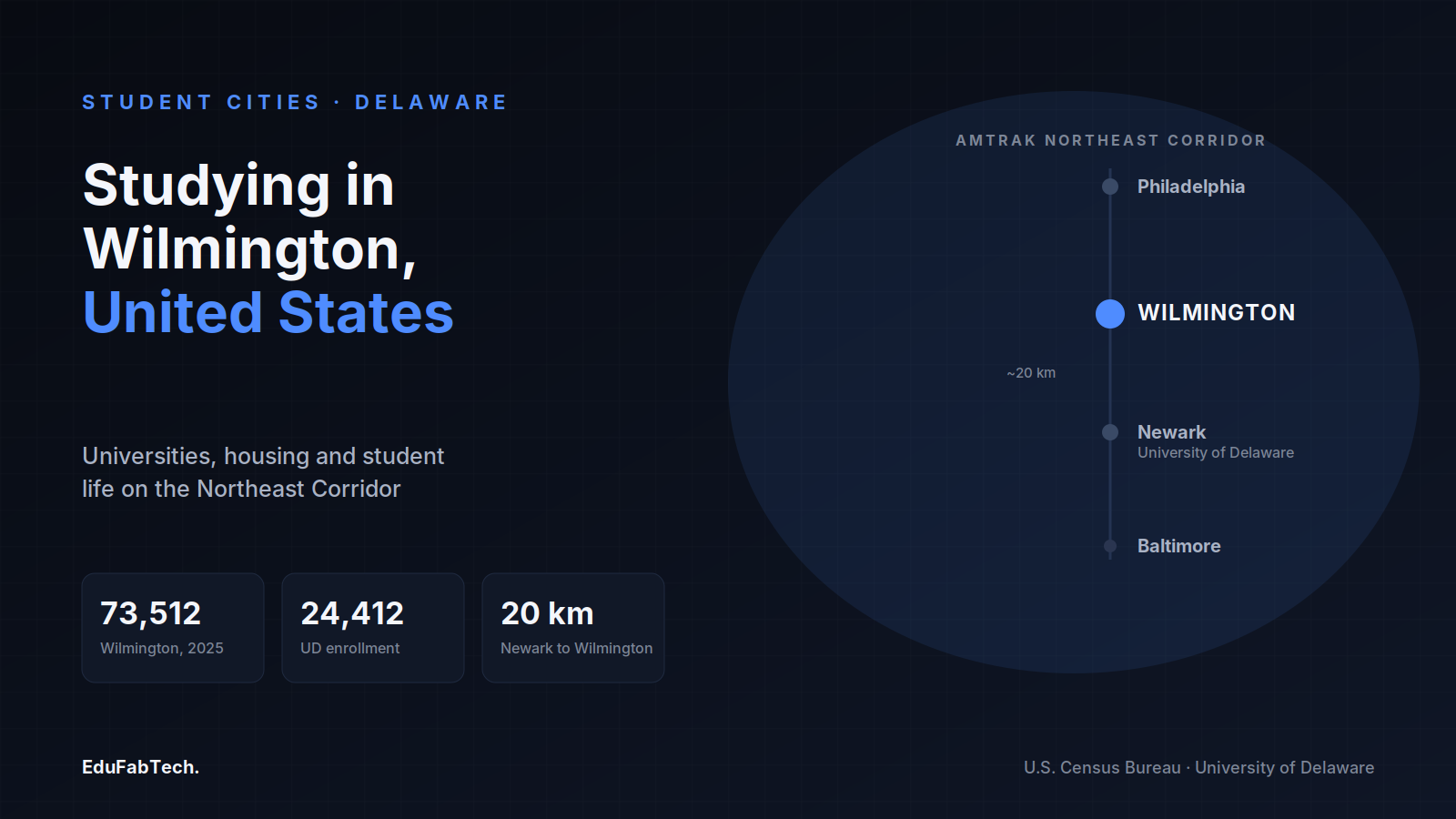
Wilmington sits where the Christina and Brandywine rivers meet, halfway between Philadelphia and Baltimore on the busy Amtrak Northeast Corridor. It is a compact banking and chemicals city rather than a classic campus town: the U.S. Census Bureau's QuickFacts put its population at an estimated 73,512 as of 1 July 2025, which makes it Delaware's largest city but still a mid-sized one by American standards. Its downtown fills with office workers on weekdays and empties in the evening, and much of the region's student population actually lives a short train ride away.
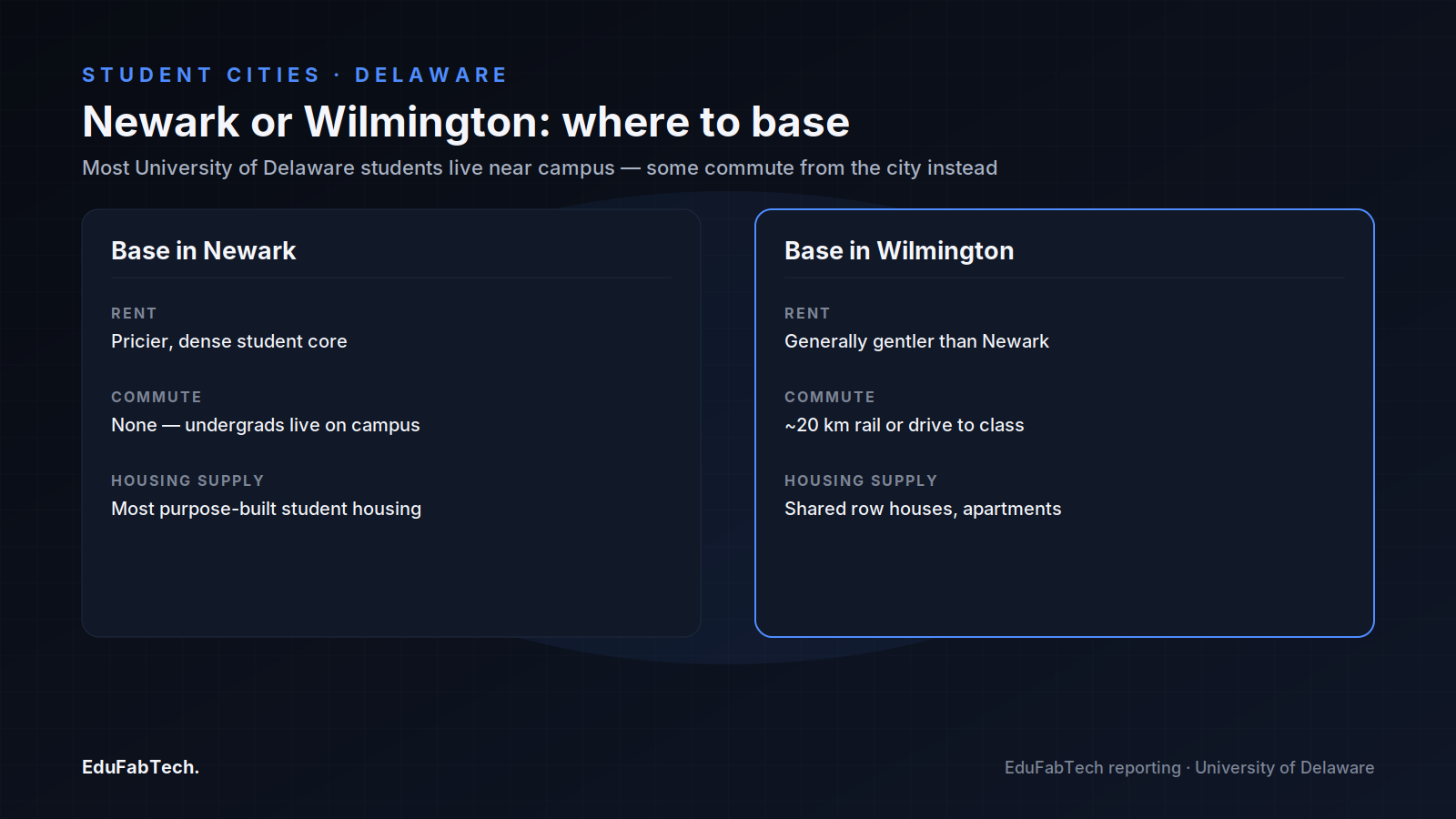
That geography shapes everything for a student here. The biggest university within reach, the University of Delaware, is in Newark about 20 kilometres to the southwest, so many undergraduates base themselves there and treat Wilmington as the nearest real city. Others do the reverse: they live in Wilmington for cheaper rent, the Riverfront and the rail links, and commute out to class. Knowing which group you are in is the first decision that affects your rent, your commute and your budget. You can see what is currently listed across the city on EduFabTech's Wilmington page.
The universities within reach of Wilmington
The University of Delaware is the anchor of the region. Its main campus is in Newark, and the university's own Facts & Figures page states that it enrols 24,412 students across 10 colleges and traces its founding to 1743. It is a research university with strong programmes in engineering, chemistry, business and marine science, and the SEPTA regional-rail stop at Newark puts it on the same line that runs through Wilmington. If you are hunting for a room near campus, the listings clustered near the University of Delaware are the most relevant starting point.
Inside the Wilmington orbit, Goldey–Beacom College is the most convenient four-year option. It sits on a 24-acre campus in Pike Creek Valley just west of the city, and the college reports more than 1,300 students from 22 states and over 60 countries, with programmes concentrated in business, financial technology, economics, psychology and criminal justice, according to its Fast Facts page. Its small size and residential halls make it a different experience from a large public university.
A cluster of Pennsylvania institutions lies within commuting distance across the state line, most of them reachable by rail toward Philadelphia. The Wharton School, the business school of the University of Pennsylvania, is in Philadelphia; Saint Joseph's University is a Jesuit university in the city's western neighbourhoods; and Haverford College is a selective liberal-arts college on the Main Line at Haverford, near Bryn Mawr. The public sector is represented by West Chester University of Pennsylvania in West Chester and by Cheyney University of Pennsylvania, the country's oldest historically Black university, at Chester Heights. For associate degrees and transfer routes there is Delaware County Community College in Broomall, and the Catholic, Franciscan Neumann University in the Village Green-Green Ridge area; students drawn to the kitchen can also look at The Restaurant School at Walnut Hill College in Havertown.
Where students settle in and around the city
Because the student body is split between Newark and the city itself, there is no single "student quarter" in Wilmington. Instead there are a handful of walkable neighbourhoods on the hills northwest of downtown, plus the two campus bases. Rents in the city are generally gentler than in Newark's student core, but the character varies sharply street by street, so it is worth visiting before you commit.
Trolley Square is the neighbourhood most students gravitate to: a dense grid of bars, restaurants and small shops around Delaware Avenue, walkable and lively in the evening, close to the Delaware Art Museum and the seasonal Delaware Avenue Farmers' Market. It is the easiest place in the city to live without a car, which is why rooms there go quickly.
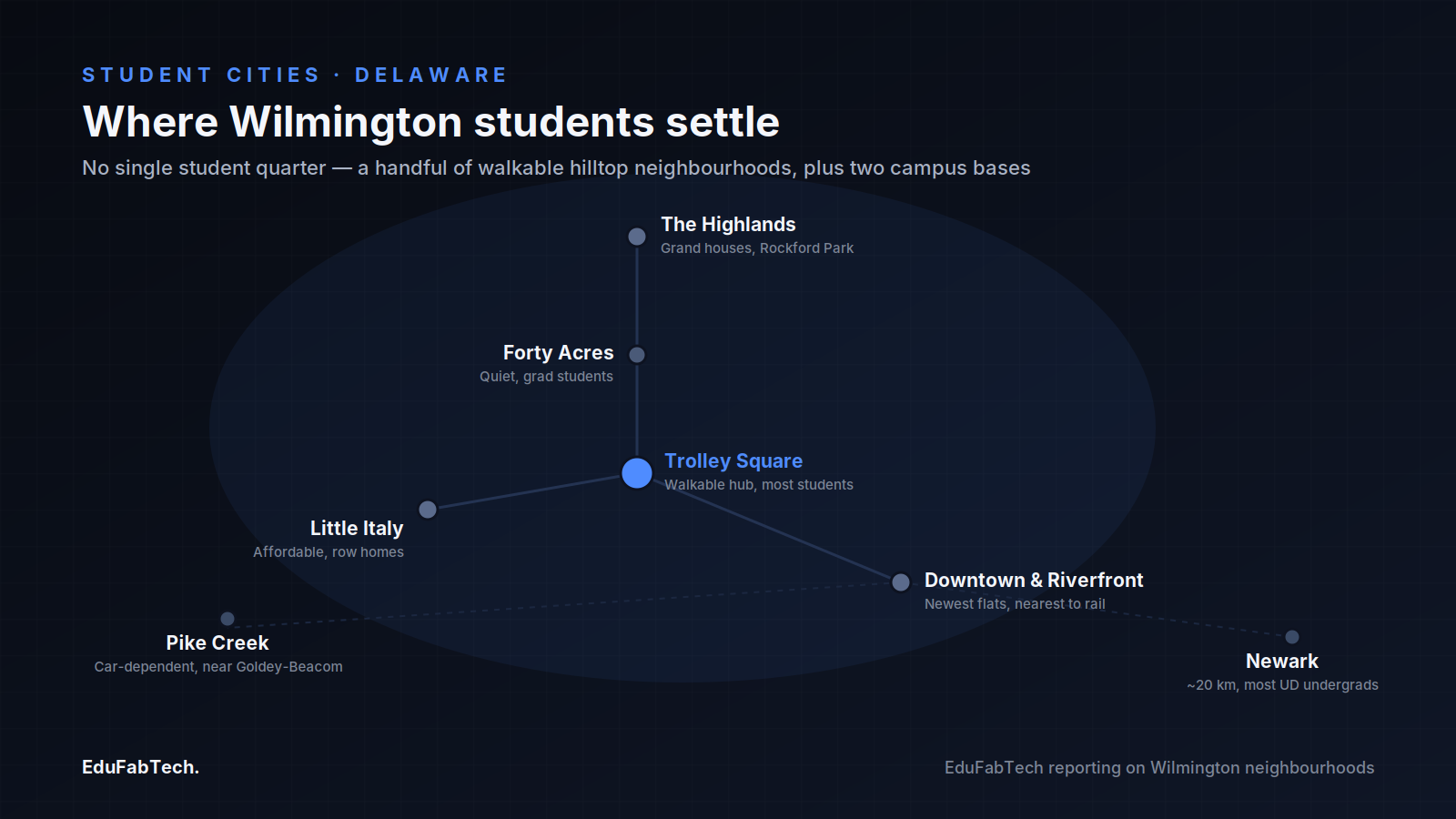
Little Italy, south of Pennsylvania Avenue on the west side of the hill, is the historically Italian-American quarter and still home to family-run restaurants and bakeries; its row homes and apartments are among the more affordable in central Wilmington and sit within walking distance of Trolley Square. Forty Acres, the pocket of streets between Trolley Square and the Highlands, is quiet and residential, popular with graduate students and young professionals who want to stay near the action without paying for it directly.
The Highlands is the grand old residential district further up Pennsylvania Avenue, with larger Colonial and Craftsman houses and Rockford Park on its doorstep; shared houses here can be good value if you split with others. Downtown and the Riverfront suit students who want newer apartments and the shortest walk to the train: the Riverfront along the Christina River has been redeveloped with a public market, a cinema and a riverwalk, while the downtown office core around Market Street is cheapest but much quieter after dark. Finally, Pike Creek is the suburban western edge near Goldey–Beacom, car-dependent but calm, and Newark itself is where most University of Delaware undergraduates live, with the densest supply of purpose-built student housing.
Finding a room without losing your deposit
Most student renting in Wilmington happens the ordinary way: a lease on an apartment or a room in a shared row house, usually with a security deposit of around one month's rent plus the first month up front. Delaware law limits how large a deposit a landlord can require on most year-long residential leases, so be wary of anyone demanding several months at once. Start looking six to eight weeks before term if you want the walkable neighbourhoods; the Newark student market moves earlier, often in late winter for the following autumn.
The scams that appear in Wilmington follow a national pattern but cluster in predictable places: listings for Riverfront apartments or Trolley Square rooms that are priced suspiciously low, posted by someone who claims to be "out of state" and cannot show you the unit in person. The protection is simple and local. See the actual room before you pay anything — an in-person viewing, or at minimum a live video walk-through of that specific address. Confirm the person collecting rent controls the property. And never send money by bank wire, gift card or cryptocurrency to "hold" a place; no legitimate Wilmington landlord needs a deposit in that form. Rooms posted through EduFabTech's Wilmington rooms page are a reasonable place to begin, but the same in-person rule applies to every listing.
Furnishing a room and shopping second-hand
Delaware charges no state sales tax, which quietly helps when you are kitting out an empty room. For furniture and household basics, Wilmington has a good second-hand supply. Goodwill of Delaware runs a dedicated Home Store and donation centre on East Lea Boulevard that carries furniture, alongside a general store on Kirkwood Highway; the Habitat for Humanity ReStore at Prices Corner sells donated furniture and building materials with proceeds funding local home-building. For food and everyday browsing, the Riverfront Market in the converted warehouse at the foot of Market Street and the Tuesday Delaware Avenue Farmers' Market near Trolley Square are the two the city is known for. EduFabTech also aggregates local offers for second-hand furniture, which is worth a look around move-out season when students clear out their rooms.
Part-time work and the rules that apply
If you are an international student, your right to work is set by your visa, not by your employer, so read the official guidance before you apply for anything. On an F-1 visa the governing framework is the U.S. Student and Exchange Visitor Program; your Designated School Official is the person who can confirm what you may do. As a concrete example of how this plays out, the University of Delaware's international student services office states that F-1 students may work on campus up to 20 hours per week during the fall and spring semesters, with full-time hours allowed during the summer and winter breaks. Off-campus work and any paid training usually require separate authorisation. None of this is legal advice — check your own institution's international office and the federal rules that apply to your status. Local openings are listed on EduFabTech's Wilmington jobs page.
Libraries, desks and places to study
The Wilmington Public Library's main branch is downtown on Rodney Square, at 10 East 10th Street — a free, central place to read and work, and a New Castle County library card gives access to branches across the county (Wilmington Public Library). Students at the University of Delaware have the Morris Library in Newark, the region's largest academic library, while Goldey–Beacom students use the Hirons Library on campus. When you want a change of scene, the cafés of Trolley Square and the Riverfront fill the gap. More desks and quiet rooms as they come up are collected on the study spaces page.
Getting around
Local public transport is run by DART First State, the Delaware Transit Corporation, whose buses converge on downtown Wilmington and run out to Newark, Pike Creek and the suburbs; you pay in cash or through the DART Pass mobile app. DART's published fare schedule lists a one-zone cash fare of $2.00 and a reduced student fare of $1.00, with a student ID required for riders aged 17 and older (DART First State, fares effective 2021); if you commute daily, the 30-day pass is the cheaper route. For regional travel, Wilmington's station — the Joseph R. Biden, Jr. Railroad Station at 100 South French Street — sits on the Amtrak Northeast Corridor and is the southern end of the SEPTA Wilmington/Newark regional-rail line, which links the city to Newark and north into Philadelphia. One thing to plan around: on weekends the regional-rail service toward Newark is thinner than on weekdays, so a car-free weekend commute to the University of Delaware takes more planning — check the SEPTA timetable before you rely on it.
Costs, and the honest trade-offs
The clearest dated housing figure comes from the University of Delaware's own numbers. For the 2026-2027 academic year its cost-of-attendance estimate puts standard on-campus housing at $9,286 and a standard dining plan at $7,328 for the year (University of Delaware, 2026-2027 Newark campus rates). Private-market rents inside Wilmington are generally lower than in Newark's purpose-built student blocks, but there is no single official "student rent" figure for the city, so treat any flat number you see online with caution and compare several real listings before you budget.
The good side of Wilmington is concrete. There is no sales tax, rooms are cheaper than in a true college town, the Riverfront and parks like Rockford and Brandywine are genuinely pleasant, and the Northeast Corridor puts Philadelphia within a short, cheap train ride and New York and Washington within reach for a day. The hard side is just as real. This is not a city built around students, so the social life of a big campus is in Newark, not here; the downtown is quiet at night; some neighbourhoods carry higher crime than others and reward local knowledge; the weekend rail service is thinner; and the climate runs to humid summers and cold, grey winters. For a student who wants city living on a budget and does not mind commuting to class, it works well; for one who wants to walk out of a dorm into a dense campus scene, Newark is the better base.
A short checklist for your first weeks
- Decide your base — Wilmington city for cheaper rent and rail, Newark or Pike Creek to be on campus — before you sign anything.
- View any room in person or by live video of that exact address, and never pay a deposit by wire, gift card or crypto.
- Get a New Castle County library card and visit the Wilmington Public Library and your campus library in week one.
- Set up the DART Pass app and, if you commute daily, compare the 30-day pass against single fares.
- Check weekend SEPTA times if you will travel between Wilmington and Newark on Saturdays or Sundays.
- International students: meet your Designated School Official and read the official work rules before applying for any job.
- Furnish from the Goodwill Home Store, the Habitat ReStore at Prices Corner and local second-hand listings rather than buying new.
A quick question for readers
Do you work part-time while you study?
Many students work to pay the bills. See how common it is — and how many hours people really do.
Pick an answer, create a free account in a minute, and your vote counts. Already a member? Sign in
Source: University of Delaware
Sources (5)
- University of Delaware. Facts & Figures. University of Delaware, 2026. udel.edu ↗ · checked 6 Oct 2026
- University of Delaware. Cost of Attendance, Newark campus 2026-2027. University of Delaware, 2026. udel.edu ↗ · checked 6 Oct 2026
- Delaware Transit Corporation. DART First State Fares. DART First State, 2021. dartfirststate.com ↗ · checked 6 Oct 2026
- U.S. Census Bureau. QuickFacts: Wilmington city, Delaware. U.S. Census Bureau, 2025. census.gov ↗ · checked 6 Oct 2026
- Goldey-Beacom College. Fast Facts. Goldey-Beacom College, 2026. gbc.edu ↗ · checked 6 Oct 2026