Studying in Winona: universities, housing and student life
A practical, sourced guide to Winona State University, Saint Mary's University of Minnesota, where students live along the Mississippi, and what a year in the Island City actually costs.
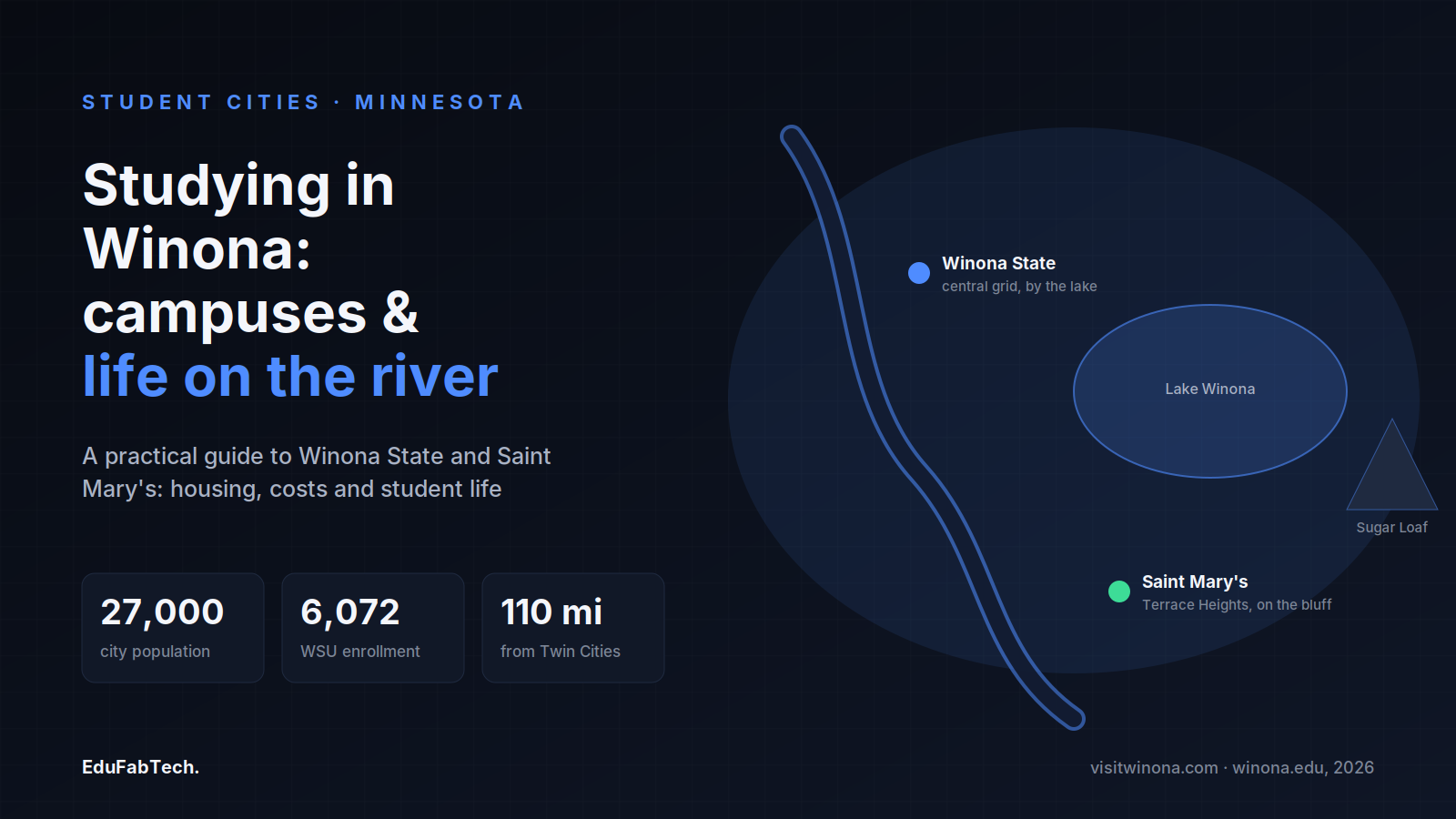
Winona lies on a narrow sandbar of the Mississippi in the southeastern corner of Minnesota, pinned between the river on one side and Lake Winona on the other. The city's tourism office explains the nickname this way: it is called "The Island City" because much of it sits on that sandbar, and it describes Winona as home to about 27,000 people, roughly 110 miles southeast of the Twin Cities, ringed by the steep river bluffs of the Driftless Area (visitwinona.com/quick-facts). The rock pinnacle of Sugar Loaf above Lake Winona is the landmark most students learn to navigate by.
For a town this size, it carries an unusual amount of higher education. The same page names three institutions in the city: Winona State University, Saint Mary's University of Minnesota, and Minnesota State College Southeast. The first two grant the bulk of bachelor's and graduate degrees and are the focus of this guide. During term the student population is a visible share of the whole city, which shapes everything from where rooms are to how the single bus system runs.
The practical geography matters more than it does in a bigger city. Winona State's main campus sits in the flat central grid near Lake Winona, within walking distance of downtown; Saint Mary's is up and east on Terrace Heights, set back against the bluff. Where you study decides, to a large degree, how you live — on foot in the grid, or on a quieter hillside campus a short drive out.
The two universities, and what it is like to study there
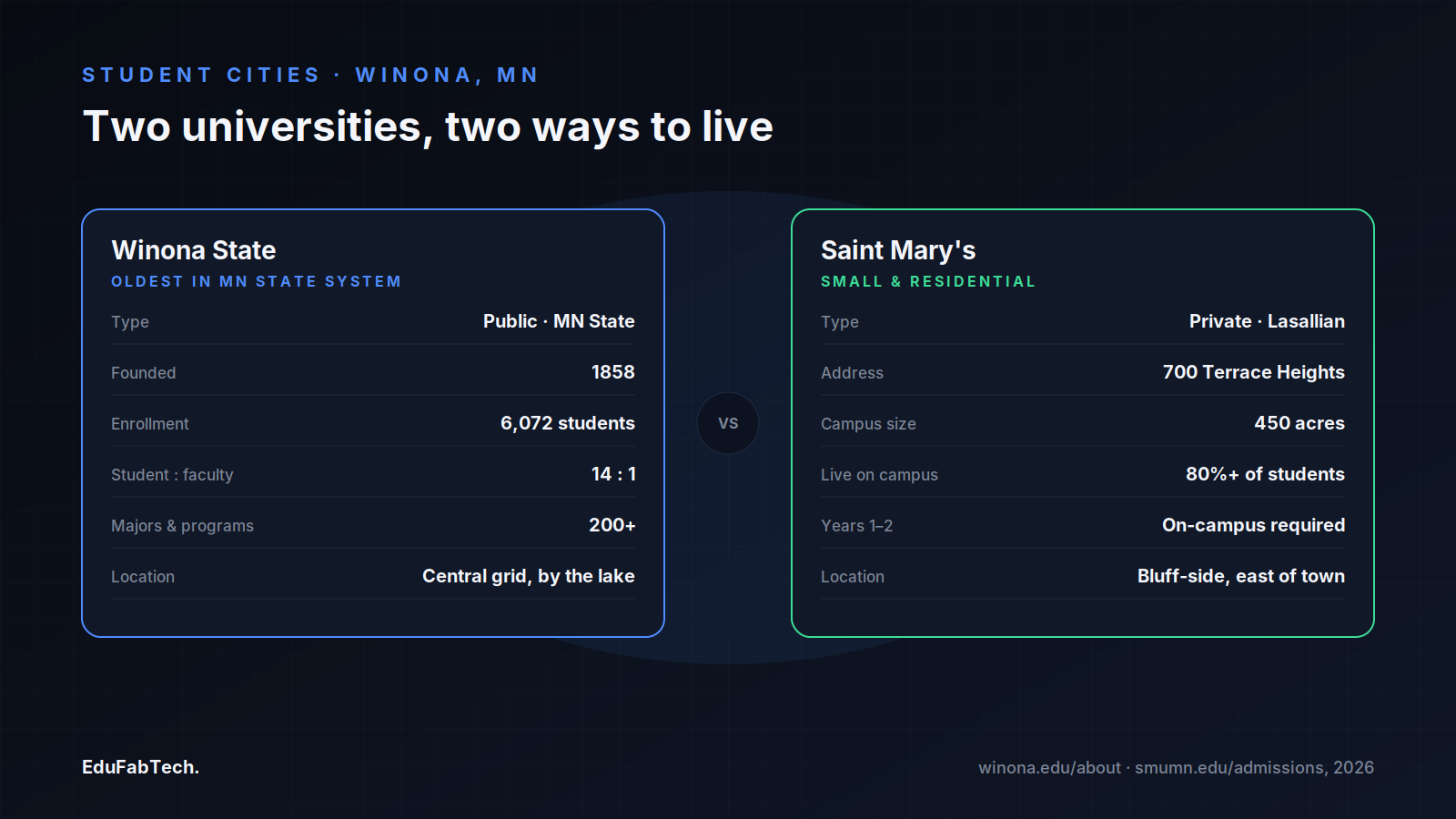
Winona State University is the larger of the two and the older. The university's own site describes it as a regional public university founded in 1858 and the oldest member of the Minnesota State system, with its main campus in Winona between the bluffs and the Mississippi and a second campus in Rochester (winona.edu/about). The same page reports 6,072 enrolled students, a 14:1 student-to-faculty ratio, and more than 200 majors and programs across its campuses. Nursing and the health sciences, business, education and the liberal arts are all substantial; the feel is that of a mid-sized public campus where you can walk from a residence hall to class in a few minutes.
Saint Mary's University of Minnesota is a private institution on the other side of town. Its admissions pages give the Winona campus address as 700 Terrace Heights and describe a 450-acre campus grounded in Lasallian Catholic values (smumn.edu/admissions/undergraduate). It is residential and small: the same source states that more than 80% of students live on campus and that living on campus is required for first- and second-year students, with juniors and seniors free to move off. Its undergraduate schools span arts and humanities, business and technology, education, health and human services, and sciences, and the university also runs large graduate and professional programs with campuses beyond Winona.
The difference in character is worth weighing before you apply. Winona State puts you in the middle of the town's daily life; Saint Mary's puts you on a bluff-side campus that is more self-contained and a walk or short drive from the centre. Minnesota State College Southeast, the city's third institution named by the tourism office above, adds technical and career programmes to the mix if a two-year or trades route fits better.
Where students live, on the island and up the hill
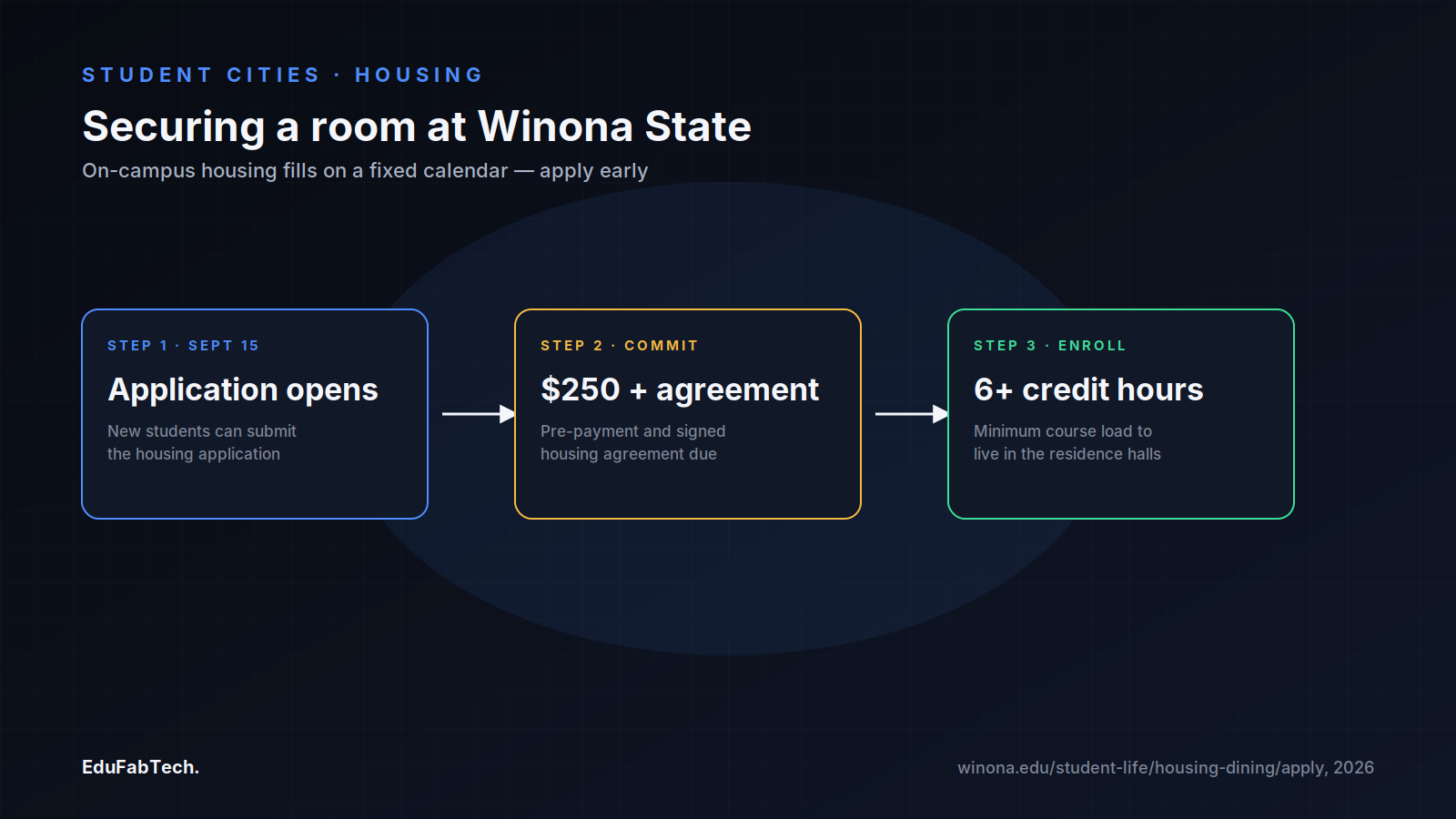
At Winona State, most first-year students start in the residence halls clustered on and around the central campus — traditional halls such as Richards, Conway, Morey-Shepard and Sheehan, suite-style Haake and Kirkland, and the East Lake Apartments beside the lake. The housing office states that everyone living in the residence halls must be enrolled in at least six credit hours per semester (winona.edu/student-life/housing-dining/apply). At Saint Mary's the on-campus question is largely settled for you: as noted above, the first two years are required on campus.
Off campus, the stock around Winona State is mostly older houses in the grid — many subdivided into student rentals — on the blocks west, east and south of campus toward downtown and the lake. Because the centre is flat and compact, a great deal of student life happens on foot or by bicycle. Juniors and seniors at both universities tend to move into these houses; the Terrace Heights area near Saint Mary's is quieter and more spread out, so students there more often rely on a car.
Start looking early. For on-campus housing, Winona State opens its new-student application on 15 September and asks new students to submit a $250 pre-payment and sign the housing agreement to take part in room selection (winona.edu/student-life/housing-dining/apply). For a private house share, the best listings near campus move in late winter and spring for the following autumn, so a search that begins after summer leaves slim pickings. You can browse rooms and shares that other students in the city have posted on EduFabTech's Winona rooms page, including spots near Winona State University or near Saint Mary's.
Renting safely in a small town
Winona's size is an advantage against rental fraud: almost any genuine student rental is close enough to view in person, and you should. The scams that appear here are the ordinary ones — a "landlord" who is conveniently out of town, a house photographed from a listing that is not really for rent, pressure to pay a deposit to "hold" a place before you have seen it. Treat any of those as a stop sign.
- See the actual room before you pay anything. Walk or cycle to it; in the central grid that is usually a few minutes. If you are still abroad, ask a current student or the university's housing staff to look, and do a live video walkthrough of the specific unit.
- Never send money by bank wire, gift card or cryptocurrency to reserve a room. These payments cannot be reversed, and no legitimate Winona landlord needs them to "hold" a place.
- Get a written lease with the address, the rent, the deposit and the dates on it, and keep a record of what you paid and to whom.
- Be wary of a deposit far above one month's rent, or of a price well below everything else near campus — in a market this small, a bargain that looks too good usually is.
If you are unsure whether an off-campus arrangement is sound, Winona State's housing and residence-life office is a reasonable first place to ask before you commit.
Furnishing a room without overspending
Second-hand is the sensible way to kit out a student room here, and the city has a genuine cluster of thrift shops rather than one chain store. The Clothes Shop, run by the non-profit Winona Volunteer Services at 402 E 2nd St, sells second-hand men's, women's and children's clothing and accessories and lists shopping hours of Monday to Friday 11:00am–4:30pm and Saturday 10:00am–12:30pm (winonavs.org/clothes-shop). For furniture, appliances and household basics, the Winona County Habitat for Humanity ReStore at 900 W 3rd St resells donated furniture and building materials; there is also a Goodwill on Gilmore Avenue. Prices and opening times at these shops change, so confirm before a trip.
For fresh food and a weekly ritual, the Winona Farmers Market runs outdoors at Levee Park (2nd and Main St) from the first Saturday of May to the last Saturday of October, 7:30am–12:00pm, and moves indoors to the Morrison Annex Event Center (363 E. 2nd St) on alternating Saturdays through the colder months, 9:00am–12:00pm (winonafarmersmarket.org/about). EduFabTech also carries local listings for used furniture in the city, worth checking at the start and end of each term when students move.
Working while you study
If you are an international student on an F-1 visa, the rules on work are strict and federal, not local. Winona State's international-services office states that on-campus employment is limited to up to 20 hours per week while school is in session, with full-time work allowed during holidays and vacation periods if you are registered for the next semester, and it points to Curricular Practical Training (CPT) and Optional Practical Training (OPT) as the routes to off-campus work tied to your field of study (winona.edu/student-life/support/international-services/employment-information). That page refers to USCIS and the SEVIS record for authorisation, which is where the binding rules live. This is general information, not legal advice: confirm your own situation with the university's international-services staff and the official USCIS guidance before you take any job.
Domestic students face no such cap and commonly take campus jobs, retail and hospitality work downtown, or roles tied to the two universities. EduFabTech's Winona jobs page collects part-time and casual postings students have shared locally.
Libraries and places to study
Each university has its own library at the heart of its campus, open to its students for long hours during term. Beyond them, the Winona Public Library downtown at 151 W 5th St is open to all residents, with weekday daytime hours and a Saturday morning opening posted for its September–May schedule (winona.lib.mn.us/contact-hours). A public library card is useful beyond a quiet desk — for borrowing, printing and a change of scene from campus during exam weeks. Independent cafés downtown fill in the gaps, and in warmer months the lakeside and riverfront paths are where a lot of reading actually gets done. You can also see study spaces and desks other students have flagged on EduFabTech's Winona study-spaces page.
Getting around
Winona Transit Service runs the city's buses. The City of Winona lists a single adult ride (ages 18–64) at $2.00 in cash or tokens and a monthly pass at $68.00; senior, youth and veteran riders pay $1.60 per token with a $56.00 monthly pass, and children aged 0–3 ride free with a paying adult (winonamn.gov/175/Winona-Transit-Service). The same page gives the hours as Monday to Friday 6am to 6:15pm and Saturday 9am to 5pm, with no Sunday service listed and none on the major holidays the page names. The page does not list a dedicated university fare or campus route, so do not assume a student discount beyond what is published there.
In practice, the flat central grid means many Winona State students rarely need the bus day to day; the campus, downtown and the lake are walkable or a short cycle apart, and winter is the main reason to take shelter on a bus. Saint Mary's students, further out on Terrace Heights, lean more on cars. Intercity trains and buses connect Winona to the Twin Cities and beyond, which matters for getting in and out at the start and end of term.
What it costs
The clearest, dated housing figure for a student is Winona State's own residence-hall pricing. For 2026-2027 the university lists a standard double room at $6,500 for the academic year ($3,250 per semester) and a single at $7,300, while the furnished East Lake Apartments range from $6,200 to $7,900 for the year; the page states that those apartment rates include utilities (winona.edu/financial-aid/cost/housing-meals). Residential meal plans of 14 or 21 meals a week are listed at $1,920–$2,060 per semester on the same page. These are the figures to budget against if you live on campus.
For private off-campus rent there is no single authoritative, current Winona figure cited here, so treat any number you are quoted as a starting point and compare several houses rather than relying on one estimate. What you can count on is the shape of the budget: a room, utilities (unless bundled), food, a bus pass only if you need one, and books. Winona's compactness keeps transport costs low for most students, which is one of the real financial advantages of studying here.
The honest trade-offs
What is good: Winona is small, walkable and set in genuinely beautiful bluff-and-river country, with two universities giving the town more cultural and academic life than its size suggests. Housing near Winona State is close enough to campus to view in person and often to reach on foot, and the East Lake apartments include utilities in their rate. The farmers' market, the thrift shops and the public library give a student a real local life without much spending.
What is hard: it is a small Minnesota town, and that cuts both ways. The bus runs limited hours and not at all on Sundays, so without a bicycle or a car you plan around it. Winters on the river are long and cold, which reshapes months of the year. Nightlife and the sheer range of a big city are not here, and students wanting those travel to the Twin Cities. Off-campus rental stock is largely older housing, so inspect condition — heating, insulation, damp — before you sign, especially with winter in mind.
A short checklist for your first weeks
- Sort housing early: for on-campus, apply through Winona State's housing portal and pay the pre-payment by the stated deadline; for off-campus, view the actual room before paying anything.
- Never wire a deposit, buy gift cards or send cryptocurrency to "hold" a place you have not seen.
- If you are on an F-1 visa, meet international-services staff in your first week and confirm the on-campus work limit and CPT/OPT rules before taking any job.
- Get a Winona Public Library card and find your two or three default study spots — a campus library plus one backup for exam weeks.
- Decide early whether you need a monthly bus pass or a bicycle, given where you live and the limited Saturday and no-Sunday service.
- Furnish from the ReStore, Goodwill and The Clothes Shop, and watch the move-in and move-out weeks for free and cheap second-hand furniture.
- Make the Saturday farmers' market at Levee Park a habit while the outdoor season lasts.
A quick question for readers
Do you work part-time while you study?
Many students work to pay the bills. See how common it is — and how many hours people really do.
Pick an answer, create a free account in a minute, and your vote counts. Already a member? Sign in
Comments 2
Comment-
The on-campus numbers are precise to the dollar: $6,500 double, $7,300 single, East Lake at $6,200-$7,900 with utilities included. Then the…
-
The number worth circling is the East Lake range: $6,200 a year with utilities included versus $6,500 for a plain double where utilities are…
Join free to read the full comments and reply Comments are between members; an account takes a minute.
Source: Winona State University
Sources (5)
- Winona State University. About Winona State. Winona State University, 2026. winona.edu ↗ · checked 22 Oct 2026
- Winona State University. Housing & Meal Plan Rates. Winona State University, 2026. winona.edu ↗ · checked 22 Oct 2026
- Saint Mary's University of Minnesota. Undergraduate Admissions. Saint Mary's University of Minnesota, 2026. smumn.edu ↗ · checked 22 Oct 2026
- City of Winona. Winona Transit Service. City of Winona, Minnesota, 2026. winonamn.gov ↗ · checked 22 Oct 2026
- Winona Farmers Market. About. Winona Farmers Market, 2026. winonafarmersmarket.org ↗ · checked 22 Oct 2026