Studying in Wolfsburg: universities, housing and student life
A practical guide to living and studying in Germany's Volkswagen town — Ostfalia's city campus, the bigger universities 30 km west in Braunschweig, dormitory rents, markets, part-time work and transport.
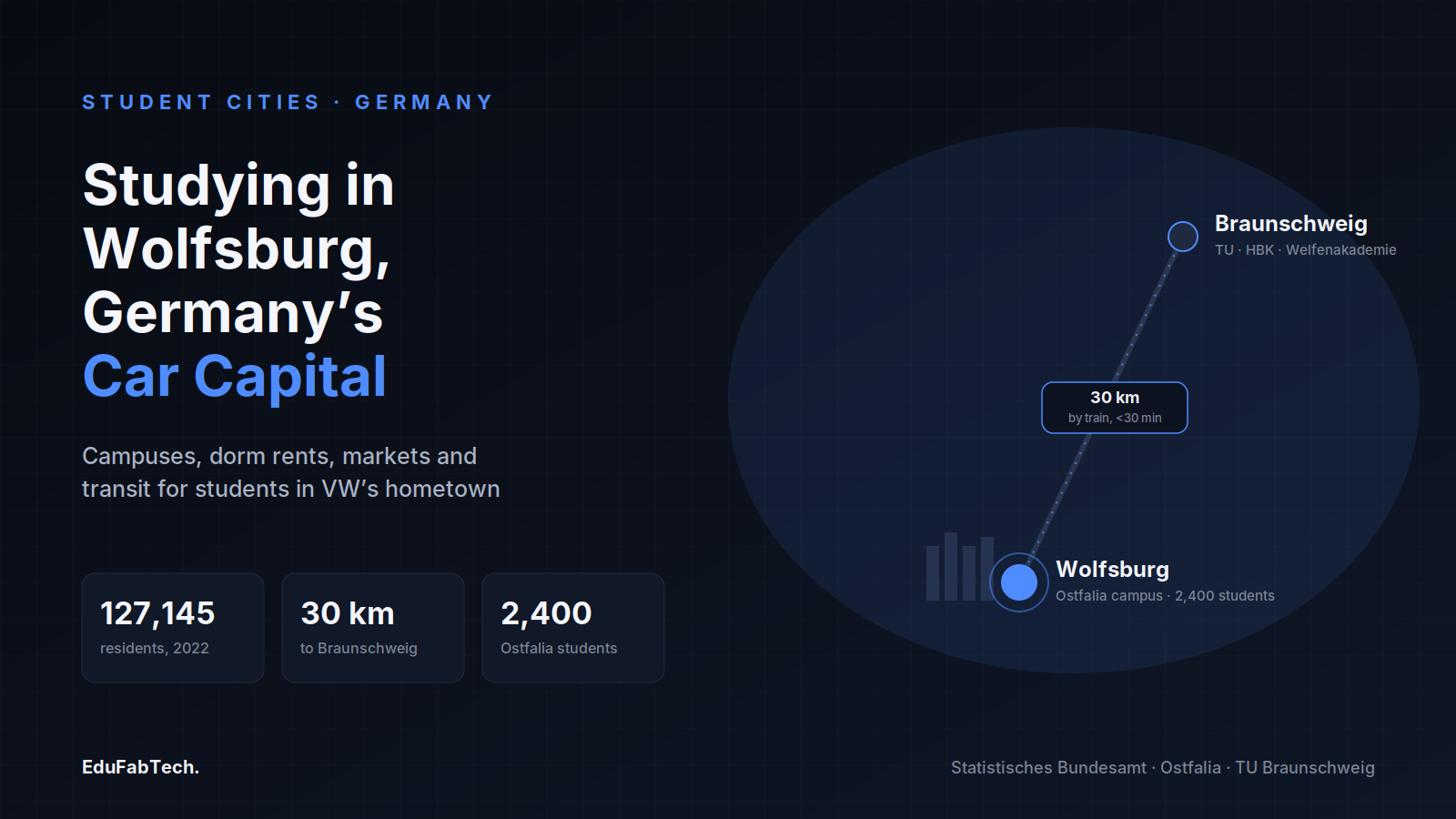
Wolfsburg is unusual among German cities because it was planned, from the ground up, around a factory. The town was founded in 1938 as the site of the Volkswagen works, and much of it still follows that logic: the wide avenues, the grid of company-built estates, the main shopping street named Porschestraße. Germany's 2022 census counted 127,145 residents (Statistisches Bundesamt), which makes Wolfsburg mid-sized, but the skyline belongs to the four chimneys of the VW plant across the Mittellandkanal, and the city's rhythm still bends around shift changes at that one employer.
For a student, that shapes daily life in concrete ways. Wolfsburg is prosperous and orderly, with the Autostadt, the phæno science centre and the Allersee lake all within cycling distance, but it is not a classic university town with a dense, cheap student quarter. The number of students is small next to the number of people who commute in to build cars. That brings advantages — the place runs, the buses are reliable, there is money behind the museums — and real drawbacks, which this guide tries to set out plainly.
The city lies in eastern Lower Saxony, close to the former inner-German border, on the main east–west railway between Hannover and Berlin. Braunschweig, the regional university hub, is about 30 km west and under half an hour away by regional train — which matters a great deal if you want more than one campus within reach.
The campus inside the city, and the bigger names to the west
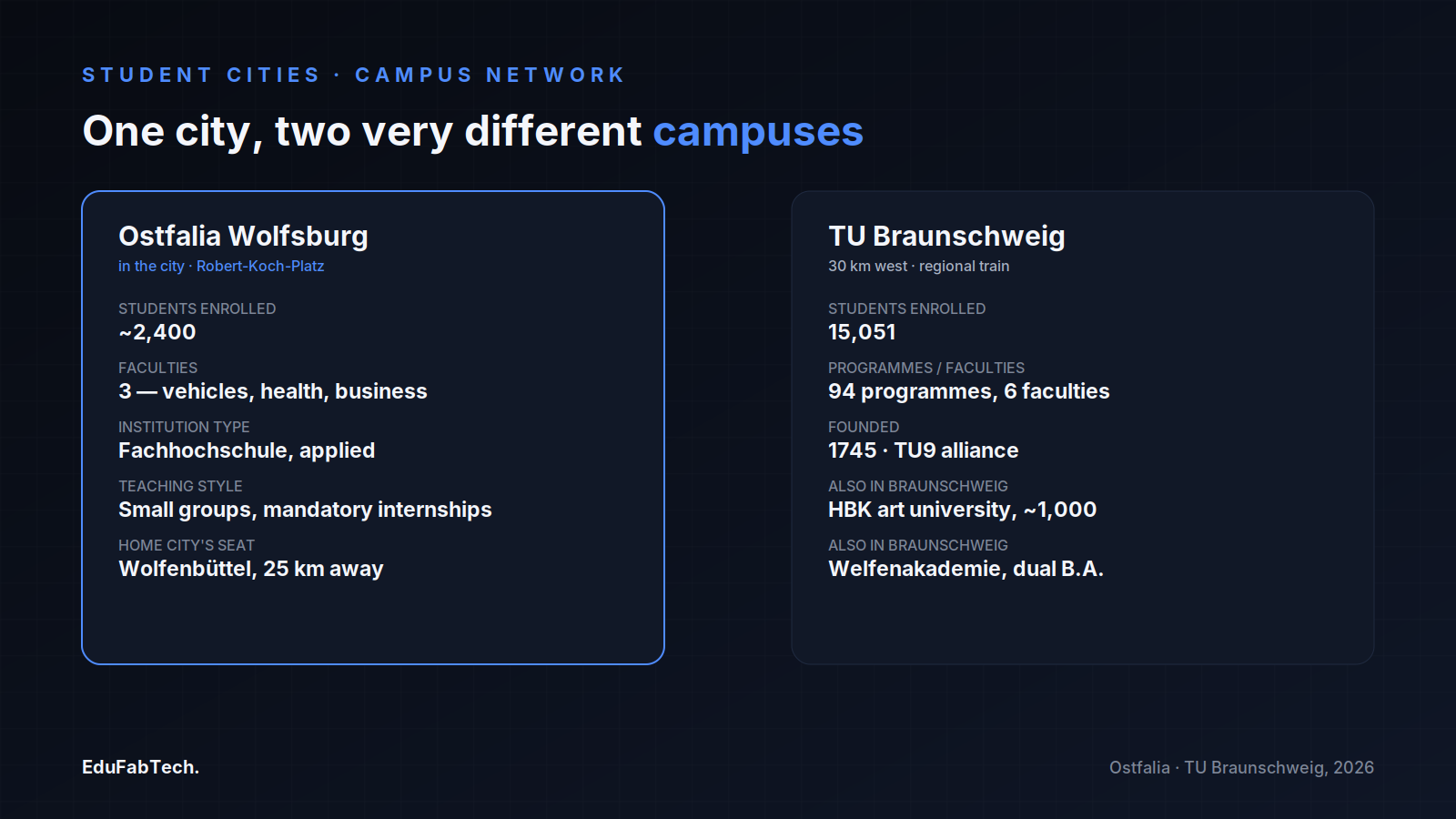
The university you can actually attend within Wolfsburg is Ostfalia University of Applied Sciences. Its Wolfsburg campus sits at Robert-Koch-Platz 10–14, and Ostfalia states that around 2,400 students are enrolled there across three faculties — Fahrzeugtechnik (vehicle technology), Gesundheitswesen (health services) and Wirtschaft (business). The subject mix is no accident: an automotive town supports a faculty teaching vehicle and automotive systems engineering, while the health and business faculties feed the region's clinics and firms. Ostfalia is a Fachhochschule, so the teaching is applied, in smaller groups, with mandatory internships and close ties to local employers.
Ostfalia's institutional seat is not in Wolfsburg but in Wolfenbüttel, about 25 km south-west, where it runs two larger campuses (Am Exer and Salzdahlumer Straße). Students who want the full Ostfalia catalogue — more engineering, computing, law and social work — often look there as well, commuting by train.
The heavier research universities are in Braunschweig, and the regional train makes them a genuine option from a Wolfsburg room. TU Braunschweig reports 15,051 students in 94 degree programmes across six faculties; it was founded in 1745 as the Collegium Carolinum, belongs to the TU9 alliance, and describes itself as the largest technical university in northern Germany. Braunschweig University of Art (Hochschule für Bildende Künste, HBK Braunschweig) is, in the city of Braunschweig's description, the only art university in Lower Saxony, with around 1,000 students and the right to award doctorates, teaching fine art, design, art education and media studies. The Welfenakademie Braunschweig is a smaller, private Berufsakademie offering a dual Bachelor of Arts in business administration, alternating study blocks with work at partner companies. Listings near the Braunschweig campuses are gathered on EduFabTech's page for TU Braunschweig.
Rooms in a town that also houses a carmaker's workforce
The honest starting point for housing is that you are competing with Volkswagen. The company and its suppliers recruit continuously, and the same compact, central flats that students want are also chased by new hires on full salaries. That thins the supply at the cheap end and firms up the rents, so begin early — ideally two to three months before the semester starts.
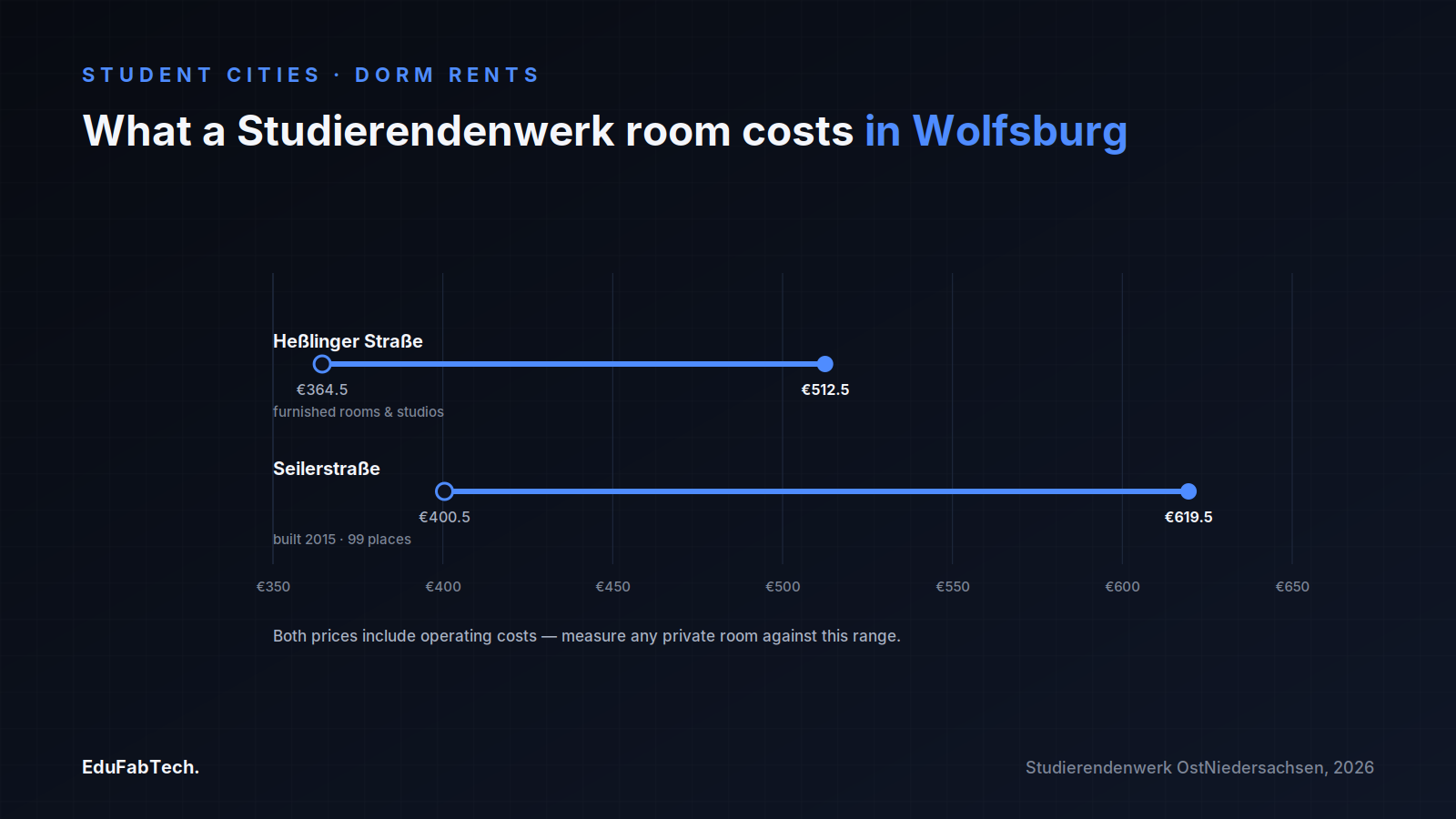
The cheapest dependable rooms belong to the Studierendenwerk OstNiedersachsen, which runs two halls in the city. At the Heßlinger Straße hall (Heßlinger Straße 14–20), furnished rooms in shared flats and studios range from about €364.50 to €512.50 a month, operating costs included. The Seilerstraße hall (Seilerstraße 21), completed in 2015 with 99 places, lists furnished single apartments and shared-flat rooms from roughly €400.50 to €619.50, again including operating costs. Those are the figures to measure any private offer against. Apply through the Studierendenwerk's own portal, and register as soon as you have an admission letter rather than waiting for enrolment, because demand outstrips the places. EduFabTech also keeps a running list of rooms and places to stay in Wolfsburg.
On the private market the usual German building blocks apply: a cold rent (Kaltmiete) plus Nebenkosten, a deposit (Kaution) of up to three months' cold rent, and a written contract. A room in a WG (shared flat) is normally the cheapest private option. It is worth looking beyond the centre — the older cores of Fallersleben and Vorsfelde, the Nordstadt, and the planned 1960s estates of Detmerode and Westhagen, where larger blocks sometimes hold cheaper rooms in exchange for a longer bus ride to Robert-Koch-Platz.
Paying for a room you have not seen
Rental fraud in a town like Wolfsburg almost always targets the newcomer arriving from abroad who cannot view a place first. The pattern repeats: an unusually cheap, well-photographed flat near the campus or the Hauptbahnhof, a "landlord" conveniently out of the country, and a demand to wire a deposit or buy vouchers to "reserve" it before you can see it. Do not send money by bank transfer, gift card or cryptocurrency to hold a room sight-unseen. View the place in person or send someone you trust; insist on a written contract carrying a real street address; and pay a deposit only into a named account set out in that contract. The Studierendenwerk halls are the safest first move precisely because they take this risk off the table.
Furnishing a room without spending much
Furnishing is where a small city helps. Students leave each semester, and a steady trickle of desks, lamps and bikes changes hands cheaply or free; EduFabTech lists second-hand things sold or given away in the city. For food on a budget, Wolfsburg runs so-called Grüne Märkte — produce-only weekly markets. The city states that the Rathausplatz market is held on Wednesdays and Saturdays from 08:00 to 13:00, with further markets through the week in Fallersleben, on Hansaplatz, in Westhagen, Vorsfelde and Detmerode. They sell fruit, vegetables, bread, cheese, eggs and fish rather than furniture, but a Saturday shop at the Rathausplatz is one of the few genuinely communal things in the city centre.
Working where one employer sets the pace
Before taking a job, international students should check what their status allows. The DAAD states that students from outside the EU may work 140 full days or 280 half days per year without additional permission, with work as an academic assistant treated separately. Treat that as general information rather than legal advice: your residence permit can carry its own conditions, and the authority that issues and enforces them in Wolfsburg is the city's Ausländerbehörde. Register your address at the Bürgeramt within two weeks of moving in — the Anmeldung — because almost everything else depends on it. In a Volkswagen town the realistic student jobs are in retail, hospitality and logistics, with working-student roles at manufacturers and suppliers for those with the right background. Current openings are collected on EduFabTech's Wolfsburg jobs page.
Libraries and places to study
On campus, the Ostfalia library in Wolfsburg (Siegfried-Ehlers-Straße 1) is the obvious working space during the week, with its own loan desk and reading room; its opening hours differ between semester and lecture-free periods, so check before relying on a late evening. Off campus, the Stadtbibliothek Wolfsburg sits inside one of the city's landmarks, the Alvar-Aalto-Kulturhaus on Porschestraße, designed by the Finnish architect Alvar Aalto; the central library offers study places that can require advance booking. Between the two you have quiet desks near the campus and in the city centre. EduFabTech also maps out study spaces in Wolfsburg for the exam weeks when both fill up.
Getting around: the WVG, the Deutschlandticket and the trains
Wolfsburg has no tram or U-Bahn; the city's public transport is a bus network run by the Wolfsburger Verkehrs-GmbH (WVG), within the Verkehrsverbund Region Braunschweig (VRB). The nationwide Deutschlandticket costs €63 a month through the WVG. Students, though, usually get their transport through the compulsory semester fee instead: Ostfalia's own figures put the semester fee for the summer semester 2027 at €471.80, of which €226.80 is the Deutschlandsemesterticket — a pass covering local and regional transport across Germany. For a flat, compact city, a second-hand bike is often faster than the bus, and the Allersee loop is a pleasant ride. Wolfsburg Hauptbahnhof sits on the Hannover–Berlin line, so fast trains reach both cities, and frequent regional trains run to Braunschweig for the universities there.
What is good, and what is hard
The good: Wolfsburg is well-run, safe and unusually well-funded for its size, with the phæno, the Kunstmuseum, the Autostadt and the Allerpark all close at hand, flat terrain for cycling, strong engineering and automotive job links, and Braunschweig's larger student scene a short train ride away. The hard: the rental market is tightened by a single dominant employer, the student population is small and spread thin, and the nightlife and informal student culture are thinner than in Braunschweig, Hannover or Leipzig. Winters are grey and damp, as across northern Germany, and much of the city's social life sits in the estates rather than one walkable old town. For students in vehicle technology, health or business who value proximity to industry and a quiet, orderly base, the trade is a fair one; for those wanting a big, cheap, round-the-clock campus city, it is not that.
A checklist for the first weeks
- Accept your admission, then apply to the Studierendenwerk OstNiedersachsen halls immediately — do not wait for enrolment.
- If renting privately, view the room in person or through someone you trust, get a written contract with a real address, and pay a deposit only into a named account.
- Register your address (Anmeldung) at the Bürgeramt within two weeks of moving in.
- Enrol, pay the semester fee and activate your Deutschlandsemesterticket.
- Open a German bank account and sort out your health insurance.
- Non-EU students: confirm the work conditions on your residence permit with the Ausländerbehörde before taking any job.
- Get a card at the Ostfalia library and the Stadtbibliothek for desk space.
- Buy a second-hand bike — the city is flat and distances are short.
Browse everything EduFabTech has gathered for the city on the Wolfsburg listings page.
A quick question for readers
Do you work part-time while you study?
Many students work to pay the bills. See how common it is — and how many hours people really do.
Pick an answer, create a free account in a minute, and your vote counts. Already a member? Sign in
Comments 3
Comment-
The transport math is the bit that undersells itself. €226.80 of the €471.80 semester fee buys a Deutschlandsemesterticket, so once you annu…
-
The housing math is the part that lands hardest: you're not just competing with students, you're competing with Volkswagen's new hires on fu…
-
The number that tells you what kind of place this actually is: 2,400 students at Ostfalia's Wolfsburg campus against 15,051 at TU Braunschwe…
Join free to read the full comments and reply Comments are between members; an account takes a minute.
Source: Ostfalia University of Applied Sciences
Sources (5)
- Ostfalia University of Applied Sciences. Studieren in Wolfsburg – Standort Wolfsburg. Ostfalia Hochschule für angewandte Wissenschaften, 2026. ostfalia.de ↗ · checked 28 Nov 2026
- Studierendenwerk OstNiedersachsen. Wohnheim Heßlinger Straße, Wolfsburg. Studierendenwerk OstNiedersachsen, 2026. stw-on.de ↗ · checked 28 Nov 2026
- Wolfsburger Verkehrs-GmbH. Deutschlandticket. WVG, 2026. wvg.de ↗ · checked 28 Nov 2026
- Stadt Wolfsburg. Wochenmärkte. Stadt Wolfsburg, 2026. wolfsburg.de ↗ · checked 28 Nov 2026
- DAAD. Side jobs. Deutscher Akademischer Austauschdienst, 2026. daad.de ↗ · checked 28 Nov 2026