Studying in Worcester: universities, housing and student life
A practical guide to Worcester, Massachusetts for students — its colleges on the hills, its three-decker rentals, fare-free buses, and what a room actually costs.
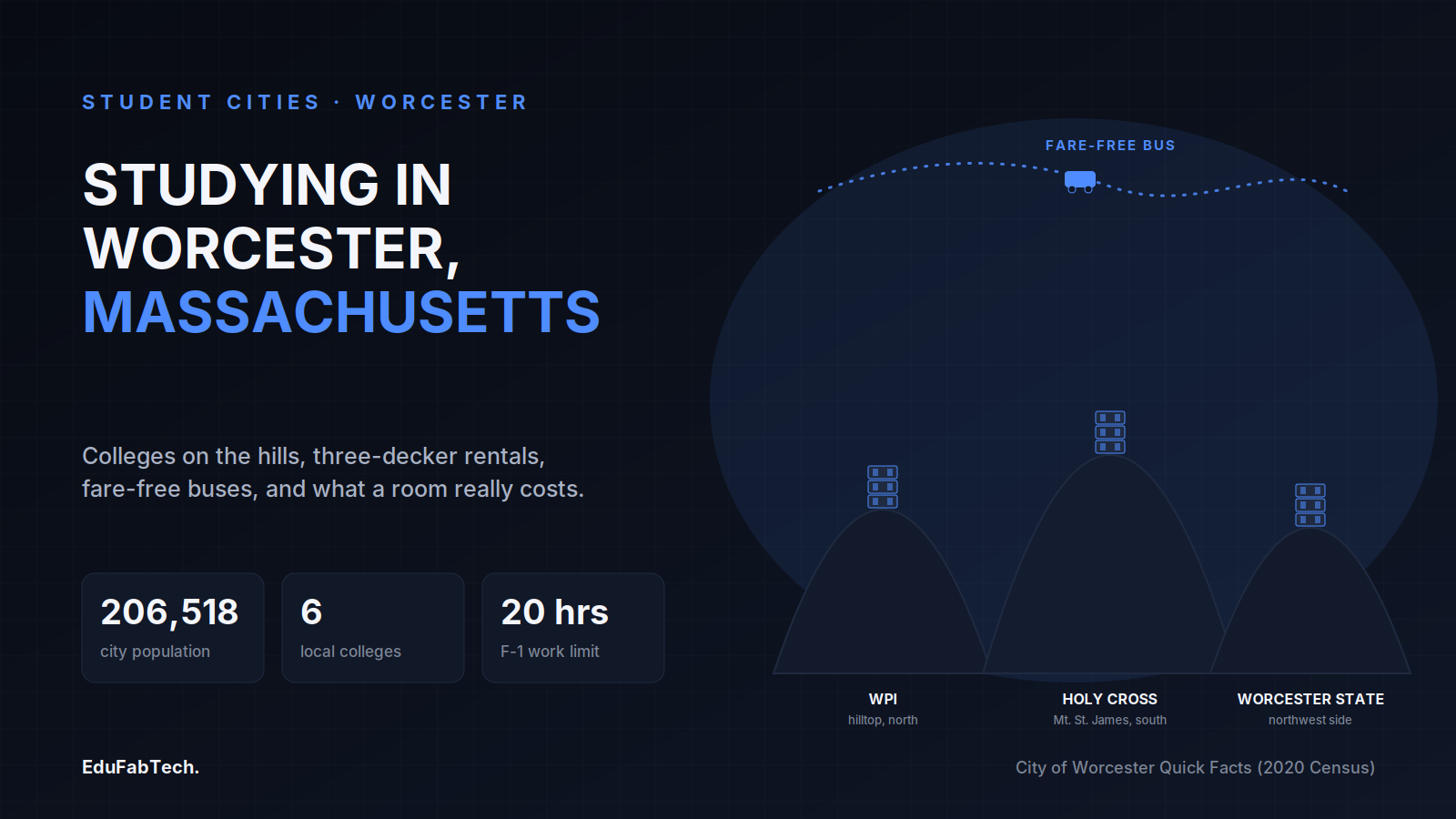
Worcester sits in the middle of Massachusetts, almost exactly between Boston and the Connecticut border, built across a cluster of hills that still shape how students get to class and how much a flat of stairs costs you in winter. It is the second-largest city in New England after Boston, and the City of Worcester's Quick Facts page records a 2020 Census population of 206,518. For a city that size it is unusually dense with colleges, and the campuses are scattered — on a hilltop to the north, in a wooded residential enclave to the south, on the west side, and downtown — so where you study largely decides where you should look for a room.
The character is post-industrial New England: brick mill buildings along the old Blackstone Canal line, triple-decker wooden houses stacked up the slopes, and a downtown that has been rebuilt around Union Station, a convention centre and, since 2021, the Polar Park ballpark. It is a working city rather than a tourist one, which is part of why rents undercut Boston's and why a student budget stretches further here than an hour east.
This guide names the institutions, the neighbourhoods students actually rent in, what dormitories cost for the 2026-2027 year according to the universities' own pages, how to avoid the rental traps that recur here, and the parts of Worcester that are genuinely hard — the hills, the winters, and a tight housing market shared with thousands of other students.
The colleges on the hills
Worcester's best-known campus is Worcester Polytechnic Institute (WPI), a private research university on a 95-acre hilltop campus just north of downtown. According to WPI's own About page, it was founded in 1865 as one of the United States' earliest engineering and technology schools, and it is built around project-based learning — the "WPI Plan" — in which undergraduates complete substantial real-world projects, often at off-campus project centres. If you are coming for engineering, robotics, data science or the sciences, this is the Worcester name you already know.
The College of the Holy Cross is a very different place: a Jesuit liberal-arts college on the wooded slopes of Mount Saint James in the city's south. Its college catalog describes a 174-acre campus and dates the founding to 1843, calling it the oldest Catholic college in New England. It is residential and undergraduate-focused, strong in the humanities, pre-medicine and the sciences, with a close, small-college feel rather than a research-university sprawl.
Worcester State University is the public option, and the most affordable of the three for Massachusetts residents. The university's About page records a founding in 1874 and a 58-acre campus on the northwest side of the city, with programmes in nursing, education, business and the liberal arts. It draws a large share of commuter and in-state students, which gives it a different rhythm from the residential colleges.
Several other degree-granting institutions sit inside the city and are worth knowing. Clark University, founded in 1887, occupies a 72-acre campus in the Main South neighbourhood and is long known for psychology, geography and international development. The Massachusetts College of Pharmacy and Health Sciences runs a downtown Worcester campus with accelerated nursing and health-sciences programmes, and UMass Chan Medical School — the state's public medical school, home of the T.H. Chan School of Medicine — trains physicians and biomedical scientists on the city's east side. If you are a graduate or professional student, those two matter as much as the undergraduate names.
Neighbourhoods students actually rent in
Worcester is a city of distinct neighbourhoods, and the right one depends on your campus and your tolerance for stairs and noise. These are the ones students cluster in.
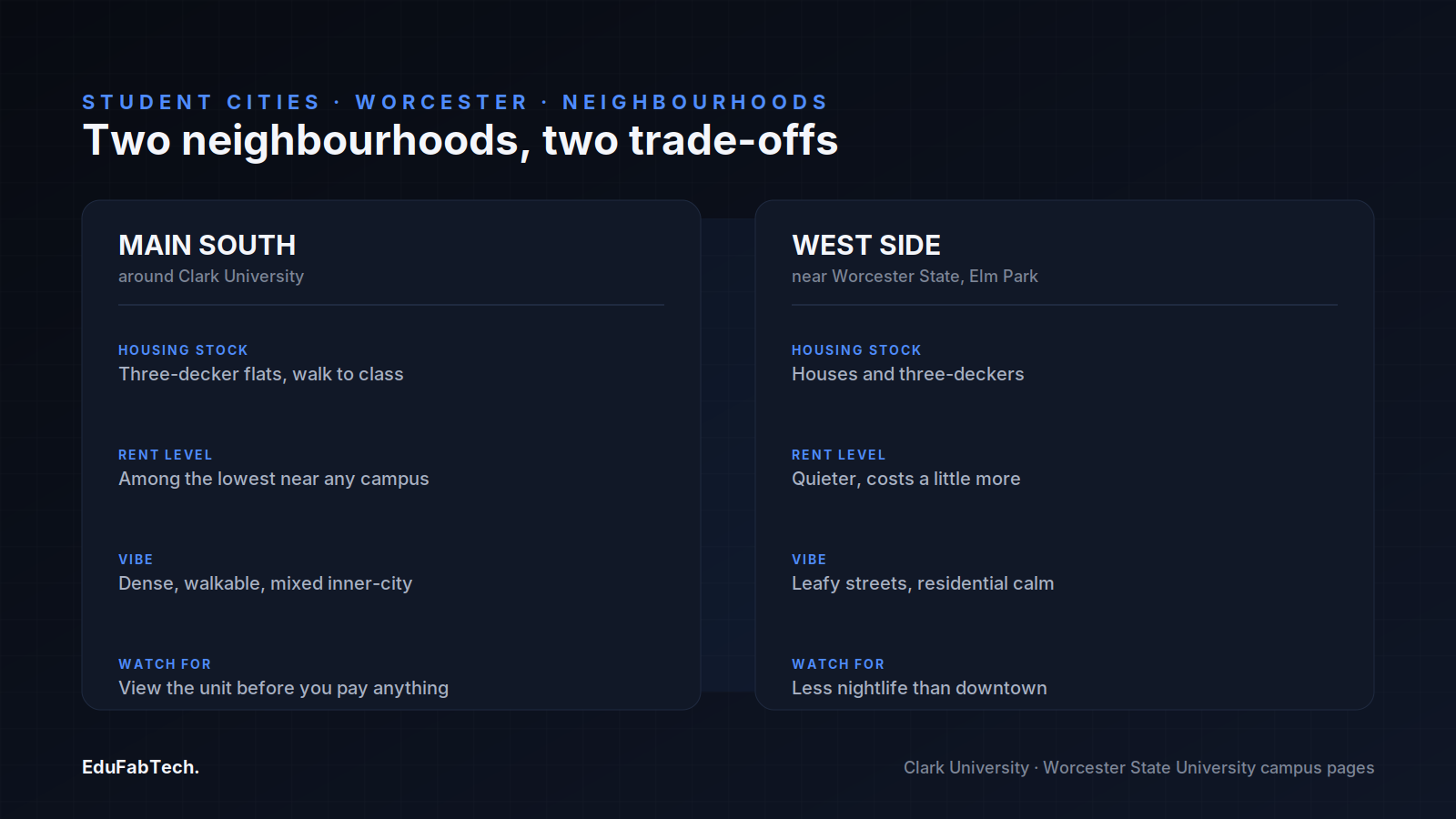
Main South wraps around Clark University and the University Park area — the neighbourhood immediately surrounding the campus, as Clark's Worcester page describes it, and it is where many Clark undergraduates and some Worcester State and Holy Cross students rent. Rents here are among the lowest near any campus, the housing stock is mostly three-decker flats, and you can walk to class — but it is a dense, mixed inner-city area, so this is the part of town where you most want to see a place in person before committing.
The Canal District, around Kelley Square and Green Street, is the city's nightlife and ballpark quarter. The Worcester Public Market anchors it, and converted-mill apartments and newer buildings have gone up near Polar Park. It is lively, walkable and close to Union Station, which suits students who want to be in the thick of things; the trade-off is weekend-evening noise and higher rents in the newer conversions.
Shrewsbury Street, known locally as Restaurant Row, runs north-east of downtown and is lined with three-deckers above dozens of restaurants. It is popular with graduate students and young professionals, within reach of downtown and the east-side medical campuses, and quieter than the Canal District while still walkable.
The West Side, near Worcester State and around Elm Park and June Street, is the calmer residential option: leafier streets, single-family and two-family houses alongside three-deckers, and an easy approach to the Worcester State campus. It costs a little more and has less nightlife, which is exactly why older students and those who value quiet choose it.
Downtown itself, around the Common and Union Station, now has apartment buildings aimed partly at students at MCPHS and the downtown campuses. You pay for the location and the transit access rather than for space.
Whichever neighbourhood you land in, the city's own student listings are collected on EduFabTech at the Worcester hub, with campus-specific pages near WPI, Holy Cross and Worcester State.
Renting a three-decker without losing a deposit
Most off-campus student housing in Worcester is a flat in a three-decker — the three-storey wooden houses that fill the residential streets, usually rented as a whole unit of three to five bedrooms shared between friends. Leases on the busiest streets near Clark, WPI and Worcester State turn over fast, and many landlords align to the local September cycle, so the practical window to look is from roughly January to April for a lease starting in late summer. Leaving it to August means slim pickings.
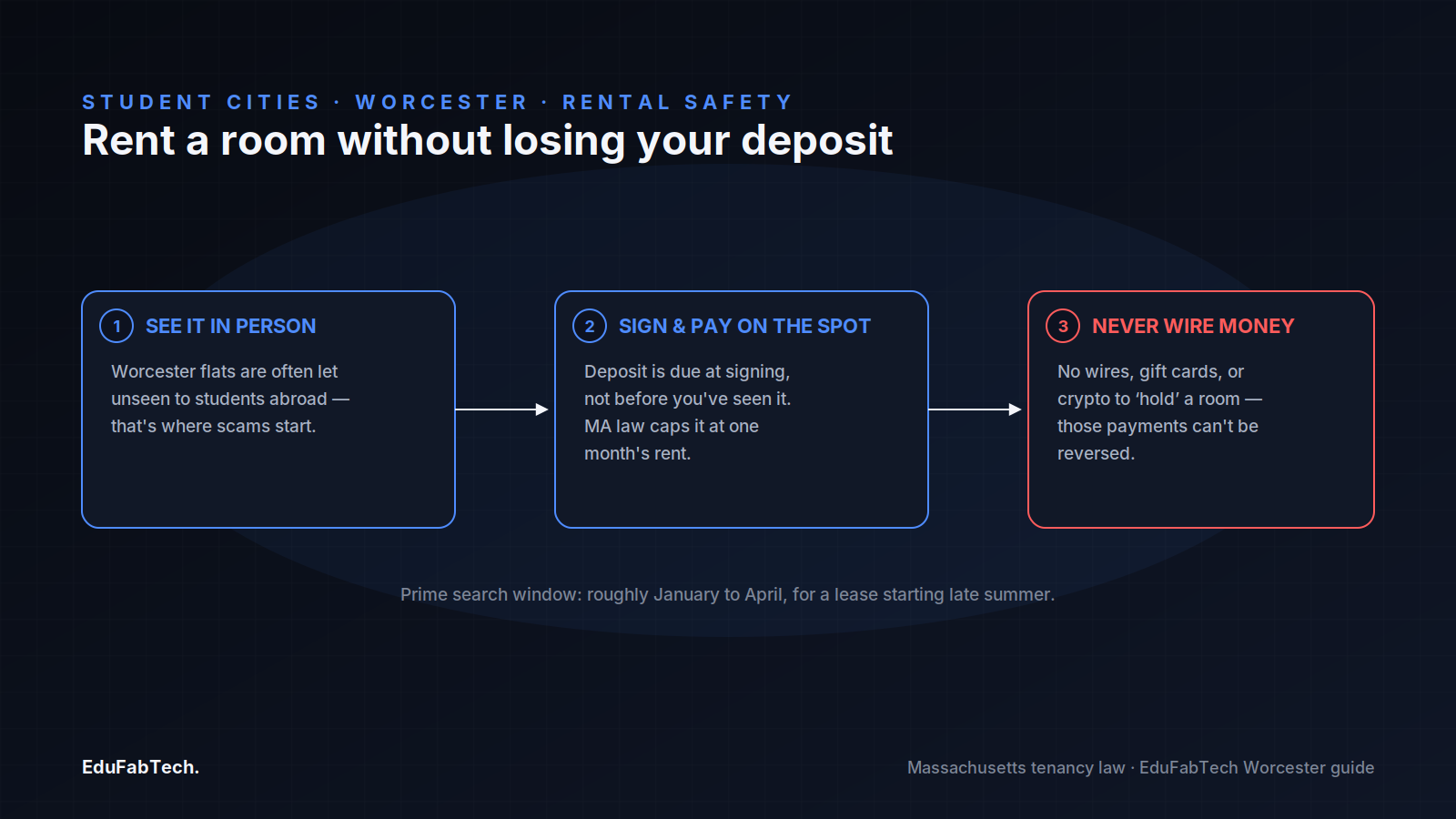
Before you pay anything, see the unit in person or have someone you trust view it for you. Worcester rentals are often let unseen to incoming international and out-of-town students, and that is exactly where trouble starts: a listing with a too-low rent, a landlord who is "travelling" and cannot show the flat, and a request to wire a deposit to "hold" it. A normal Worcester tenancy involves a signed written lease and, typically, first month's rent plus a security deposit paid once you have keys or at lease signing — not before you have seen the place. Massachusetts law caps a security deposit at one month's rent, so a demand for several months up front is a warning sign. Never send money by bank wire, gift card or cryptocurrency to reserve a room; those payments cannot be reversed, and no legitimate Worcester landlord needs them to hold a flat. Ask for the landlord's name and the property address, and check it is a real, rentable unit before any money changes hands.
For shared-room and sublet listings, EduFabTech's Worcester rooms page is a safer starting point than cold-messaging an unverified listing.
Furnishing a room on the cheap
A three-decker flat usually comes unfurnished, so the first week often means finding a bed, a desk and kitchen basics fast. Worcester has large second-hand stores that make this easy. There is a Savers thrift store at 490 Lincoln Street on the north side, which takes and resells clothing, housewares, books and small furniture, and a Goodwill store at 25 Park Avenue; both are reachable by bus. Students leaving at the end of term also give away furniture and appliances, and that cycle peaks in May and late August when leases end.
For food and everyday shopping, the Worcester Public Market in the Canal District gathers independent food vendors — produce, a deli pantry, bakers, coffee — under one roof, a short walk from Union Station. Departing students give away or resell furniture and household goods each May and late August as leases turn over, which is the cheapest way to kit out a flat.
Working while you study
If you are an international student on an F-1 visa, the rules on working are set by the United States government, not by your university, and they are strict. The U.S. Department of Homeland Security's Study in the States guidance states that an F-1 student doing on-campus employment "may not work more than 20 hours per week when school is in session," and that you must consult your Designated School Official (DSO) before taking any job — the DSO issues the approval you need. The same page warns that unauthorised work is reported through SEVIS and can end your student status. Treat your college's international-student office as the first and final word on what you are allowed to do; this guide is not legal advice.
On-campus jobs — libraries, dining halls, labs, residence life — are the straightforward route and fit around the 20-hour rule. Domestic students have more options off campus. Local part-time listings for Worcester are gathered on EduFabTech's jobs page.
Libraries and places to study
The Worcester Public Library's Main Library sits downtown at 3 Salem Square, a short walk from the Common and Union Station, and is open to everyone with free study space, Wi-Fi and extended evening hours midweek. It is the natural neutral ground when you want to study off campus or do not have a quiet flat.
Each university adds its own. WPI's George C. Gordon Library, Holy Cross's Dinand Library, Clark's Goddard Library and the Worcester State library all offer long hours in term and quiet floors, though access to some is restricted to enrolled students outside opening events. During exam weeks the busiest desks fill early, and students spread out to the Canal District and Shrewsbury Street cafés.
Getting around a hilly city
Worcester's local buses are run by the Worcester Regional Transit Authority (WRTA), and right now they are free. The WRTA's fare page states that it "has extended the suspension of fares on all fixed route, paratransit services until June 30, 2027" — so there is no fare card to buy and no student discount to apply for, because nobody is charged. Most routes radiate from the downtown hub near Union Station, which puts the WRTA within reach of all the main campuses, though evening and Sunday frequencies thin out.
For trips to Boston, Worcester is the western terminus of the MBTA Framingham/Worcester commuter-rail line, which runs from Worcester Union Station to Boston's South Station; the MBTA's commuter-rail fares page puts a one-way ticket from Worcester (Zone 8) to Boston at $12.25. Union Station is also an Amtrak and intercity bus stop. Within Worcester itself, a lot of student life is walkable, but the "hills" in the city's nickname are literal — a flat near campus saves you a steep daily climb, and that matters more once snow and ice arrive.
What it costs
Living on campus gives you the clearest, most reliable numbers. For 2026-2027, WPI's cost-of-attendance page lists housing at $10,660 and food at $9,072 for a student living on campus, within a total estimated cost of attendance of $87,570 for a first-year undergraduate. Worcester State is markedly cheaper: its cost-of-attendance page for 2026-2027 puts resident housing at $9,624 and food at $5,848, inside a total student-expense budget of $31,363 for an in-state resident living on campus. The gap between the two is largely the gap between a private research university and a public one.
Off-campus rents are harder to pin to a dated figure. The City of Worcester's Quick Facts page lists median asking rents of about $1,564 for a studio, $1,800 for a one-bedroom and $2,075 for a two-bedroom, but it does not state the year those cover, so treat them as current and indicative rather than as a dated statistic — and remember that a three-decker flat split between housemates usually works out well below the per-person cost of living alone. Food, transport and second-hand furniture are where a careful Worcester budget is won, helped by the free buses and the thrift stores above.
The honest trade-offs
What is good about Worcester for students is real. Rents sit well below Boston's while Boston is a cheap train ride away; the local buses are free through mid-2027; the city is small enough to feel knowable and large enough to have a genuine food and music scene; and the concentration of colleges means a built-in student population and plenty of campus jobs. For engineering and the health sciences in particular, the cluster of WPI, UMass Chan and MCPHS is a serious draw.
What is hard is also real. The housing market near the popular campuses is tight and turns over early, so a late search leaves you with the worst stock. Much of the cheap housing is in dense inner-city neighbourhoods where seeing a place in person matters. The winters are long, cold and snowy, and the hills that give the city its name turn an easy walk into a daily climb on ice. Bus service thins in the evenings and on Sundays, which pushes many students toward sharing a car. And while Boston is close, the commuter-rail trip is long enough that "just popping into the city" is a planned outing, not a casual one.
A checklist for the first weeks
- Start the housing search early — January to April for a late-summer lease — and never pay a deposit before you or someone you trust has seen the flat.
- Pay deposits and rent only by traceable means after signing a written lease; refuse any request to wire money or send gift cards or cryptocurrency to "hold" a room.
- If you are on an F-1 visa, meet your Designated School Official before taking any job and keep within the 20-hour on-campus limit set by the U.S. government.
- Get your campus library and ID access sorted, and scout the Worcester Public Library downtown as a backup study spot.
- Learn the WRTA routes from the downtown hub to your campus while the buses are still free, and keep the MBTA Worcester-line schedule for Boston trips.
- Furnish from Savers on Lincoln Street, Goodwill on Park Avenue and end-of-term giveaways from departing students.
Worcester rewards students who arrive organised: pick the neighbourhood that matches your campus, lock in housing before the spring rush, and let the free buses and second-hand economy do the rest.
A quick question for readers
Do you work part-time while you study?
Many students work to pay the bills. See how common it is — and how many hours people really do.
Pick an answer, create a free account in a minute, and your vote counts. Already a member? Sign in
Source: Worcester Polytechnic Institute
Sources (5)
- Worcester Polytechnic Institute. Cost of Attendance 2026-2027. Worcester Polytechnic Institute, 2026. wpi.edu ↗ · checked 4 Oct 2026
- Worcester State University. Cost of Attendance. Worcester State University, 2026. worcester.edu ↗ · checked 4 Oct 2026
- U.S. Department of Homeland Security. Working in the United States (F-1 students). Study in the States, 2026. studyinthestates.dhs.gov ↗ · checked 4 Oct 2026
- Worcester Regional Transit Authority. Purchase Fares / Fare Information. WRTA, 2026. therta.com ↗ · checked 4 Oct 2026
- City of Worcester. Quick Facts. City of Worcester, 2026. worcesterma.gov ↗ · checked 4 Oct 2026