ctDNA Clearance Before Surgery Tracks Outcomes in Phase 2 NeoCOAST-2 Lung Cancer Trial
A Nature paper published 25 October 2026 reports that clearing tumour DNA from the blood before surgery predicted which NeoCOAST-2 patients stayed cancer-free longer, in a phase 2 trial not designed to prove one drug combination best.
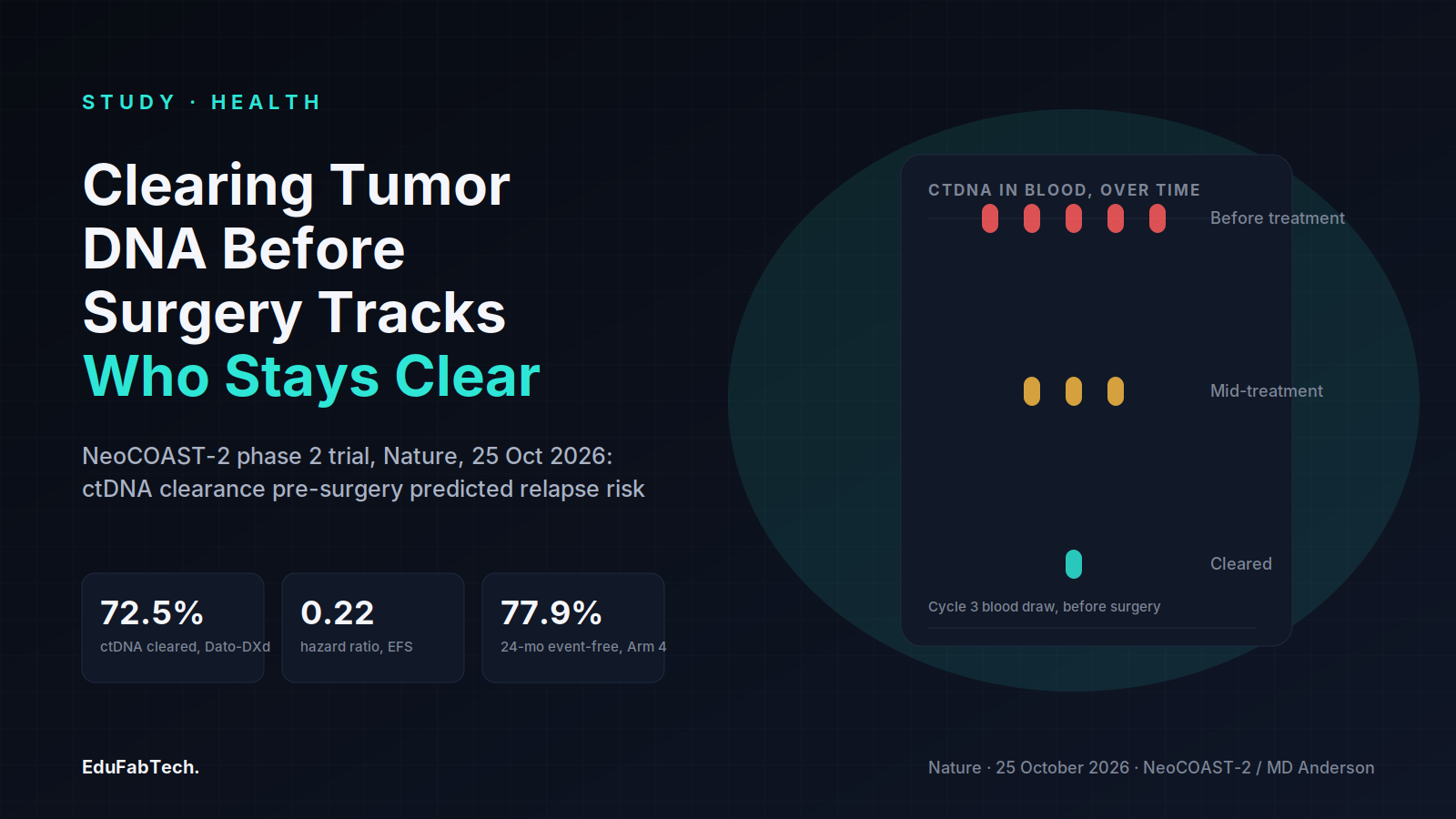
A paper published in Nature on 25 October 2026 reports that patients in a lung cancer surgery trial whose tumour DNA disappeared from their blood before the operation went on to live far longer without their cancer returning than patients whose tumour DNA persisted. The study, titled "ctDNA clearance and outcomes for resectable lung cancer from NeoCOAST-2" and led by Lara McGrath and Tina Cascone, a professor of thoracic/head and neck medical oncology at the University of Texas MD Anderson Cancer Center, draws on the NeoCOAST-2 platform trial, a phase 2, randomised, open-label study testing new drug combinations given before and after surgery for resectable non-small-cell lung cancer (NSCLC).
What NeoCOAST-2 tested
NeoCOAST-2 enrolled patients with untreated, resectable stage IIA–IIIB NSCLC and randomised them to one of several neoadjuvant regimens built around the checkpoint inhibitor durvalumab. Three of those arms are the focus of the new analysis: durvalumab plus chemotherapy with oleclumab, a CD73 inhibitor (Arm 1, 76 patients); durvalumab plus chemotherapy with monalizumab, an NKG2A inhibitor (Arm 2, 72 patients); and durvalumab plus single-agent chemotherapy with datopotamab deruxtecan, a TROP2-targeted antibody-drug conjugate known as Dato-DXd (Arm 4, 54 patients). Patients then had surgery followed by adjuvant durvalumab, as described in the earlier primary analysis of the trial published in Nature Medicine in 2025, which reported pathologic complete response (pCR) rates of 20.3% in Arm 1, 25.7% in Arm 2 and 35.2% in Arm 4 in that paper's modified intention-to-treat population.
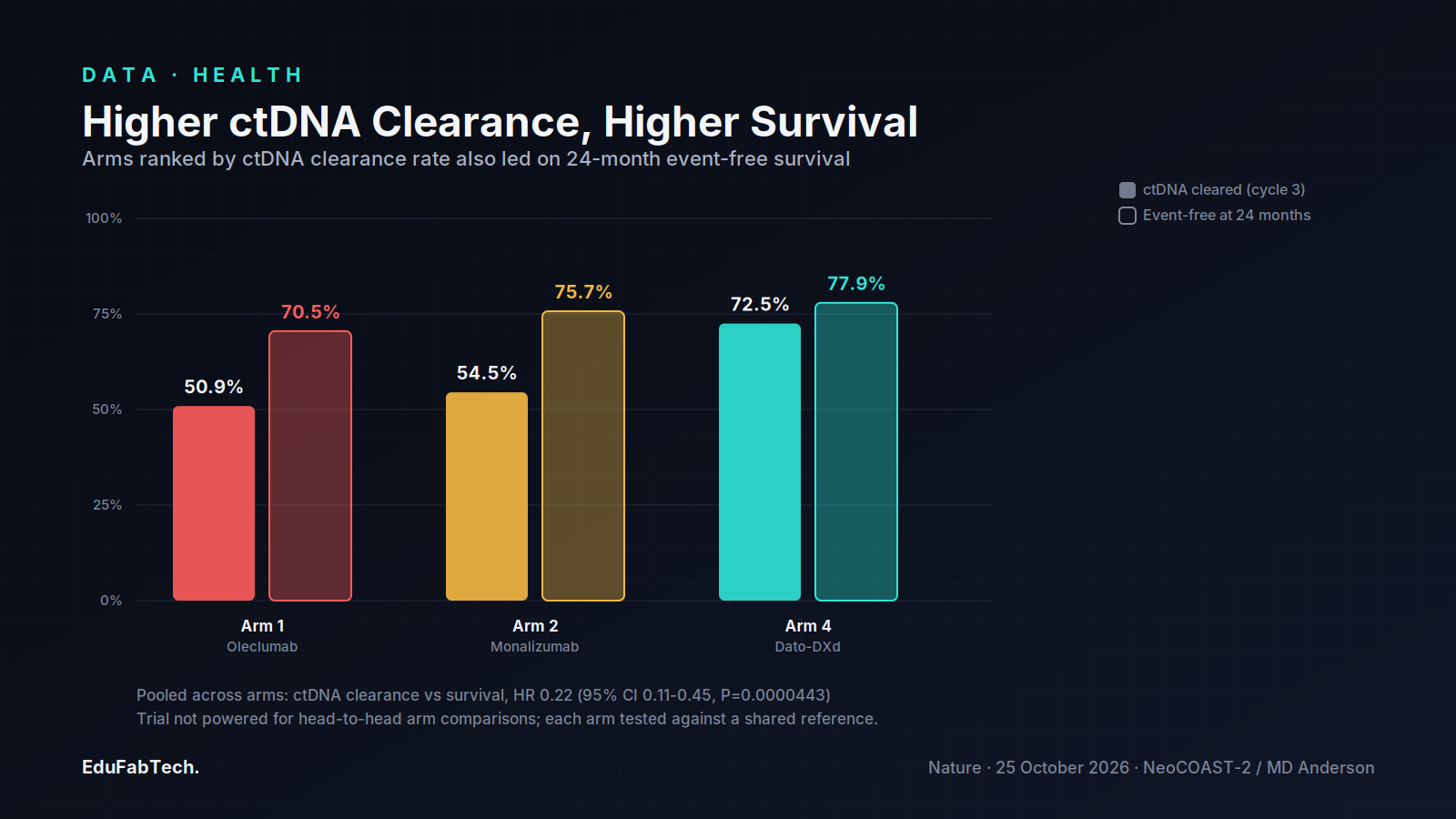
The new Nature paper layers a blood-based measurement onto that design. Researchers tracked circulating tumour DNA (ctDNA), fragments of tumour genetic material that leak into the bloodstream, using a tumour-agnostic assay taken at the start of the third treatment cycle, before surgery. Clearance of detectable ctDNA at that point was highest in the Dato-DXd arm: 50.9% in Arm 1, 54.5% in Arm 2 and 72.5% in Arm 4, according to the study.
Why clearance tracked survival
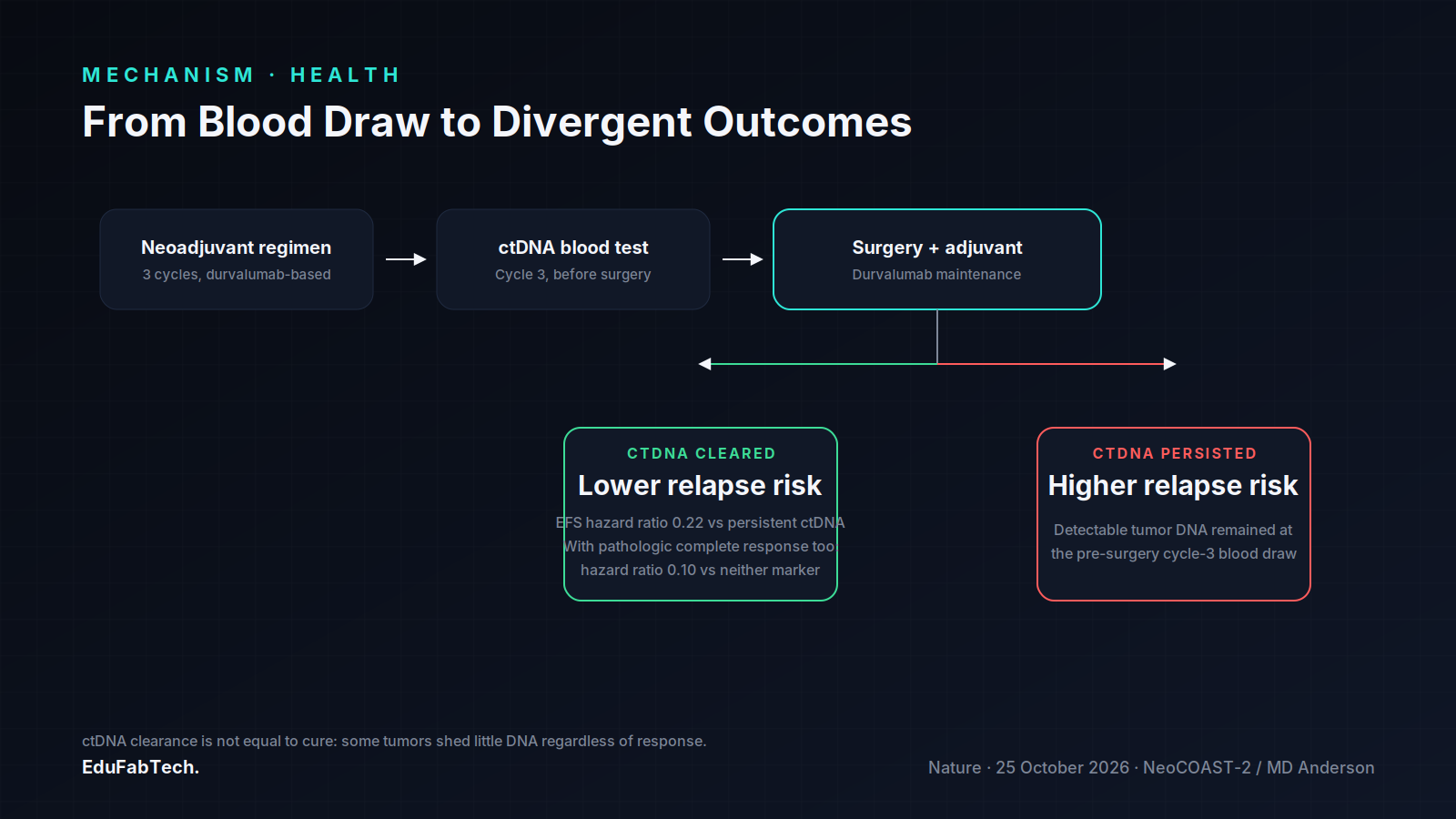
The paper's central finding is that this early blood signal corresponded with how long patients went without their cancer recurring or progressing. Across the trial, patients who cleared ctDNA before surgery had substantially longer event-free survival (EFS) than those who did not, with a pooled hazard ratio of 0.22 (95% CI 0.11–0.45, P = 0.0000443), according to the Nature paper. Patients who achieved both ctDNA clearance and a pathologic complete response fared best of all, with an EFS hazard ratio of 0.10 (95% CI 0.02–0.42, P = 0.002) compared with patients who had neither. At 24 months, event-free survival stood at 70.5% in Arm 1, 75.7% in Arm 2 and 77.9% in Arm 4.
Cascone described the appeal of the measurement in comments carried by a UT MD Anderson Cancer Center release tied to the findings' presentation at the ESMO Congress 2026: ctDNA "can provide an earlier view of how a patient's cancer is responding" and, she said, "could play an important role in guiding future perioperative treatment strategies." The release lists the presentation under ESMO abstract number 4244RO.
What it means for students and researchers
For anyone studying oncology trial design, the result is a case study in how a blood test can supplement, not replace, pathology. pCR, the resection-based measurement where no viable tumour is found in surgical tissue, has been the standard way to gauge whether neoadjuvant treatment worked. The NeoCOAST-2 ctDNA analysis argues that combining ctDNA status with pCR separates patients into finer risk groups than pCR alone, since some patients who achieve pCR still carry detectable ctDNA, and vice versa. That distinction matters for trial design: a blood draw taken mid-treatment, before a tumour is ever removed, could in principle flag which patients are responding weeks before a surgical pathology report is possible.
The underlying trial also illustrates how adjunct drugs mechanistically differ. Oleclumab blocks CD73, an enzyme tumours use to generate immunosuppressive adenosine; monalizumab blocks NKG2A, a receptor that dampens natural killer and T cell activity; and datopotamab deruxtecan delivers a topoisomerase inhibitor directly into TROP2-expressing tumour cells. The new analysis found the Dato-DXd arm numerically ahead on both ctDNA clearance and EFS, which the authors say "warrant further evaluation" rather than establishes superiority.
What the trial does not show
NeoCOAST-2 is a phase 2 platform study, and the researchers are explicit that it was not powered to make direct statistical comparisons between arms; each arm was tested against a shared reference rather than head-to-head. ctDNA clearance is also not the same as cure, since some tumours shed little DNA into the bloodstream regardless of how they respond to treatment, a limitation noted in reporting on the findings. The safety profile reported in the 2025 Nature Medicine primary analysis showed grade 3 or higher treatment-related adverse events in 36.5% of Arm 1 patients, 40.8% of Arm 2 patients and 20.4% of Arm 4 patients, figures that any larger confirmatory trial would need to weigh against the survival signal.
The authors frame their conclusion carefully: combined ctDNA and pCR assessment "may improve risk stratification," and the Dato-DXd arm's numerical lead in both markers is a hypothesis for larger trials of antibody-drug conjugates paired with checkpoint inhibition before surgery, not a finished verdict on which regimen belongs in standard care.
A quick question for readers
Which study habit do you think is most overrated?
Some popular habits have little evidence behind them. Which one do you think gets too much credit?
Pick an answer, create a free account in a minute, and your vote counts. Already a member? Sign in
Comments 3
Comment-
The number that actually matters here is 24-month EFS, and the arms are nowhere near as far apart as the clearance rates suggest: 70.5%, 75.…
-
The P = 0.0000443 on the pooled hazard ratio looks impressively precise until you remember the arms it's pooled from are 76, 72 and 54 patie…
-
The number that actually matters here is the combined-marker hazard ratio: 0.10 for clearance plus pCR together versus 0.22 for clearance al…
Join free to read the full comments and reply Comments are between members; an account takes a minute.
Source: Nature
Sources (3)
- Lara McGrath, Tina Cascone, et al.. ctDNA clearance and outcomes for resectable lung cancer from NeoCOAST-2. Nature, 2026. nature.com ↗ · checked 27 Oct 2026
- Tina Cascone, et al.. Perioperative durvalumab plus chemotherapy plus new agents for resectable non-small-cell lung cancer: the platform phase 2 NeoCOAST-2 trial. Nature Medicine, 2025. ncbi.nlm.nih.gov ↗ · checked 27 Oct 2026
- UT MD Anderson Cancer Center (via Newswise). ESMO 2026: UT MD Anderson highlights innovative approaches to monitor, prevent and treat cancer. Newswise, 2026. newswise.com ↗ · checked 27 Oct 2026