Boston University Study Estimates CTE in 74.5% of NFL Players Who Died From 2008 to 2023
Correcting for who chooses to donate their brain, researchers put chronic traumatic encephalopathy prevalence well below the 93.5% seen in raw donor data, but still far above community rates.
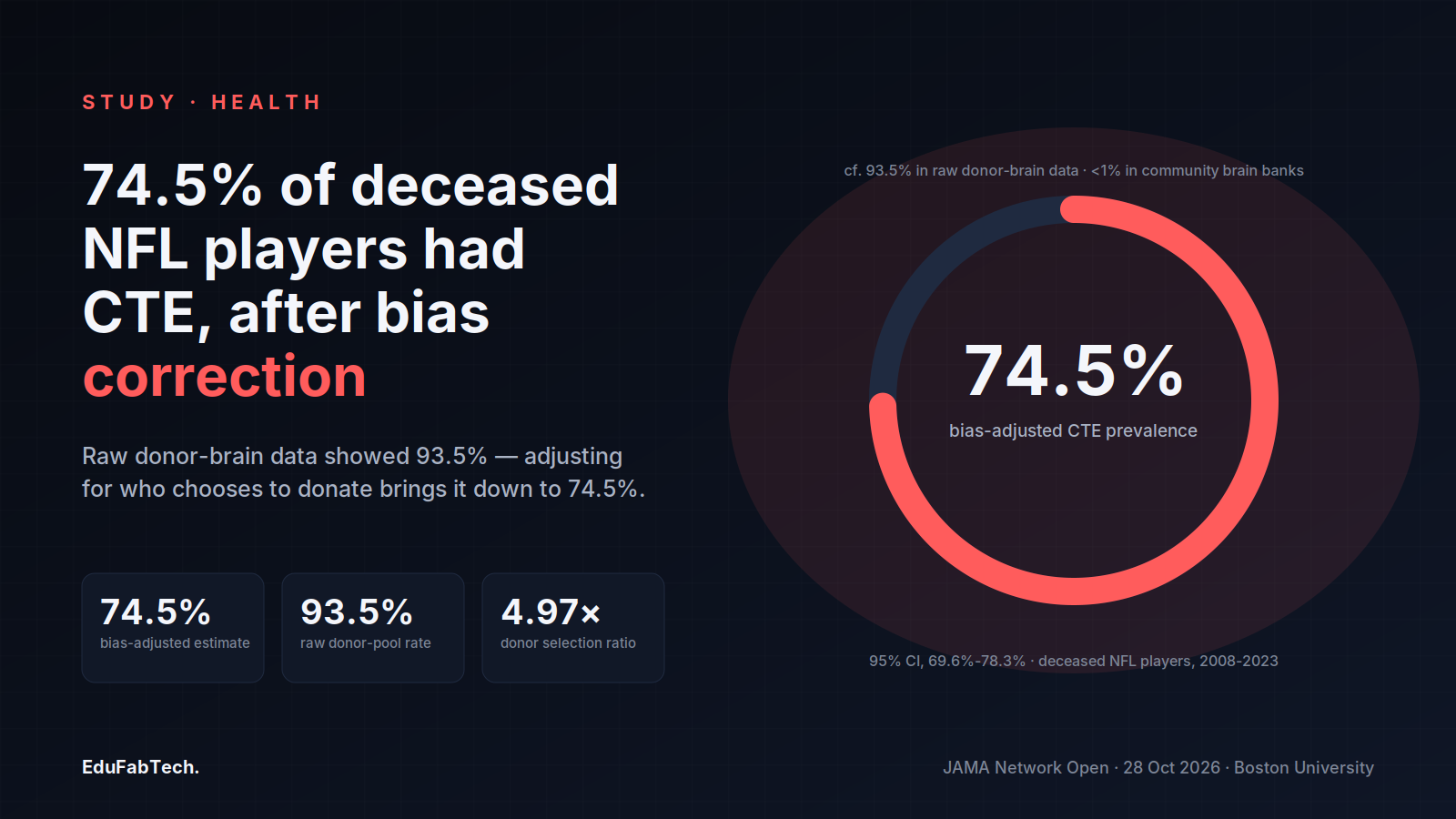
A study published in JAMA Network Open on 28 October 2026 estimates that 74.5% (95% CI, 69.6%-78.3%) of former National Football League players who died between 2008 and 2023 had chronic traumatic encephalopathy (CTE) neuropathology, after statistically correcting for the fact that people who donate brains for CTE research are not a random sample of all players who die. The study was led by Julia Gallini, a biostatistics PhD candidate at the Boston University School of Public Health, with senior author Yorghos Tripodis and co-authors from Boston University's Chobanian & Avedisian School of Medicine, the Boston University CTE Center, Spaulding Rehabilitation Hospital and the Concussion & CTE Foundation.
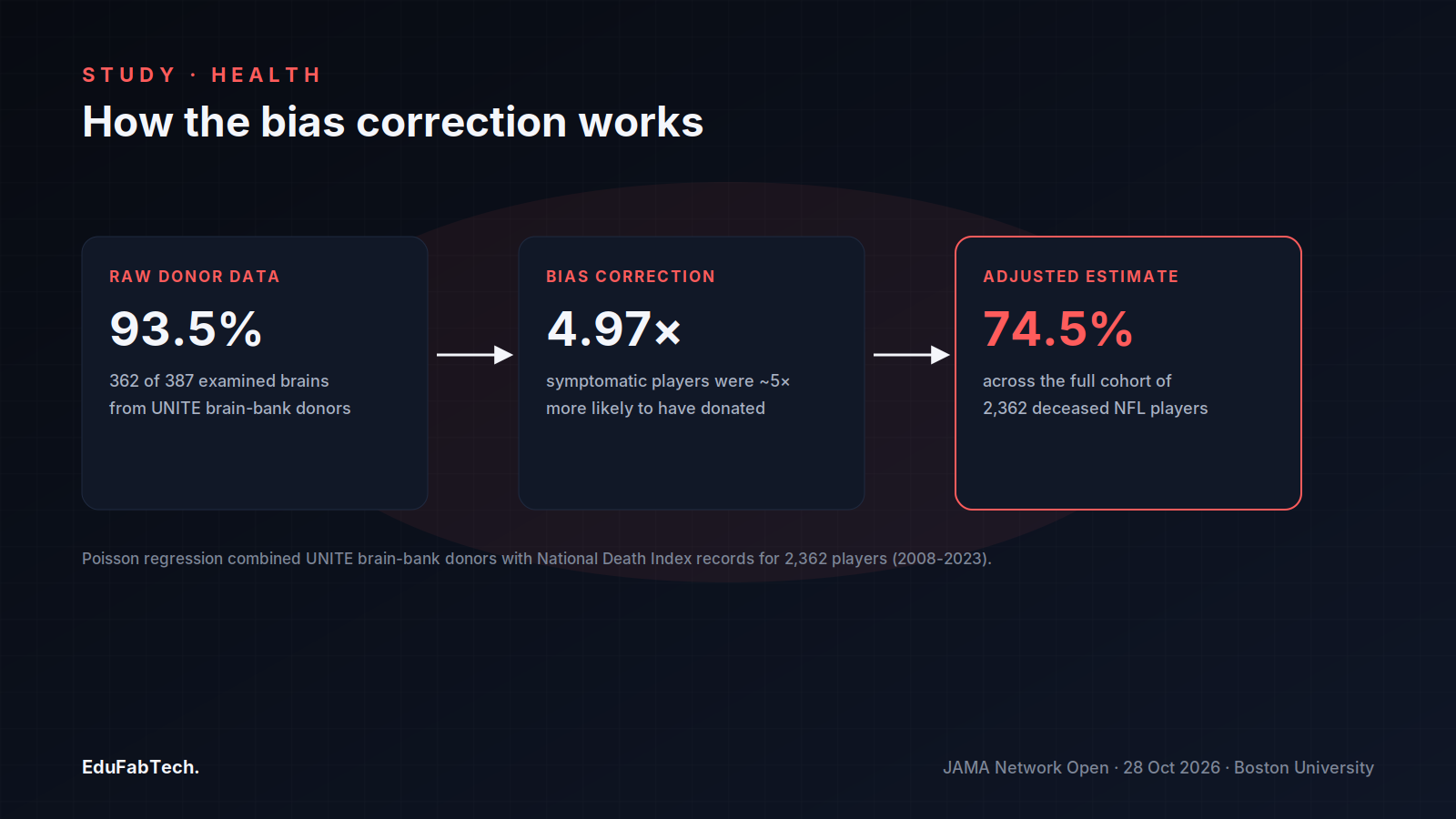
CTE is a neurodegenerative disease linked to repetitive head impacts and can currently only be diagnosed after death, by examining brain tissue for a specific pattern of the protein tau. Most of what is known about CTE in American football comes from the Boston University-based UNITE brain bank, where families who suspect a loved one had the disease can donate a brain for study. In that donor pool, the JAMA Network Open paper reports that 362 of 387 examined brains (93.5%) showed neuropathologic CTE. Because donation is voluntary and motivated by suspected symptoms, the authors set out to ask how that number should be adjusted to describe all NFL players who died, not just those whose families chose to donate.
To do this, the researchers combined the UNITE brain bank data with National Death Index mortality records covering 2,362 deceased former NFL players from the 2008-2023 period. Of that cohort, 396 had donated a brain (387 with a determinable CTE status) and 1,966 had not. Donors died younger on average (mean 67.0 years) than nondonors (mean 74.7 years) and had played in the NFL longer (mean 7.1 years versus 4.7 years), and a larger share of donors had a dementia-related cause of death (19.3% versus 11.2%), according to the paper.
Correcting for who chooses to donate
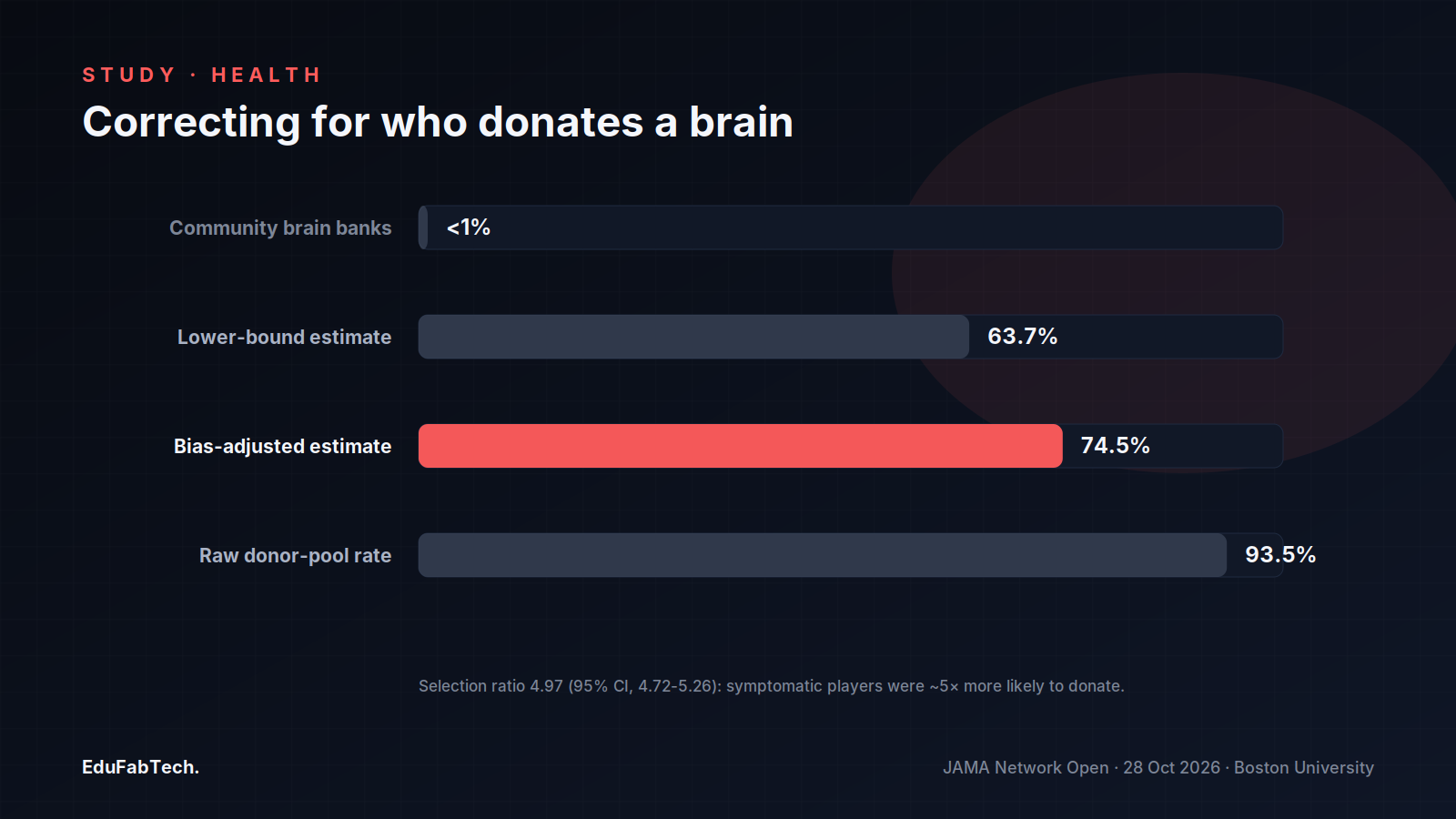
The authors used Poisson regression to estimate a "selection ratio" — how much more likely a player with cognitive symptoms was to have a brain donated, compared with a player without such symptoms. They used dementia-related cause of death as a proxy for cognitive symptoms in the mortality records, and supplemented it with population-level mild cognitive impairment prevalence figures from the NFL-LONG study to broaden that definition, since death certificates do not capture cognitive status directly. The resulting median selection ratio was 4.97 (95% CI, 4.72-5.26), meaning players with cognitive symptoms were estimated to be about five times more likely to have donated a brain than those without symptoms, the study reports.
Applying that correction to the full cohort produced the headline estimate of 74.5% bias-adjusted CTE prevalence among deceased NFL players over the 16-year period. The authors also reported a more conservative lower-bound estimate of 63.7% (95% CI, 57.2%-68.9%), and sensitivity analyses that varied the assumptions behind the correction produced a range of 70.3% to 86.1%, according to the paper. As a secondary outcome, the bias-adjusted estimate of all-cause dementia history during life among this cohort was 27.2% (95% CI, 22.6%-31.6%).
For comparison, the paper notes that CTE is found in less than 1% of donors to community brain banks that are not selected for football exposure or suspected symptoms — a figure the authors use to underline how unusual even the adjusted NFL estimate is relative to the general population.
What the correction does and does not show
The paper also found that donation itself was not random with respect to other factors: white race was independently associated with a higher likelihood of brain donation (risk ratio 1.47, P=.005), and each additional year of NFL play was associated with a higher likelihood of donation (risk ratio 1.13, P<.001). The authors list several limitations explicitly. Classifying "clear cognitive symptoms" relied on dementia-related cause of death rather than direct clinical assessment of nondonors, a method the paper acknowledges is affected by underreporting of dementia on death certificates. The correction also assumes that population-level ratios between mild cognitive impairment and dementia prevalence, drawn from the NFL-LONG study, apply equally to donors and nondonors — an assumption the authors flag rather than verify directly. They write that unmeasured factors linked to both symptoms and the decision to donate could still bias the estimate in either direction.
Why the method matters beyond football
The authors are careful to state what the study cannot show: the estimate applies only to NFL players who had already died during the study window, not to living former players or those still playing, and the paper notes a limited understanding of how CTE pathology progresses during life, since it can only be assessed after death. The study does not establish whether CTE independently raises mortality risk, nor can it be used to infer symptom burden in players who are still alive.
For researchers and students, the methodological contribution is arguably as significant as the football-specific number: the paper is an applied example of correcting prevalence estimates for self-selection into a tissue-donor registry, a problem that recurs across brain banks, cancer registries and other voluntary-donation research cohorts. Gallini noted in the Boston University announcement that "with CTE consistently found in less than 1 percent of donors to community brain banks, an estimated 75 percent prevalence among NFL players who died over a 16-year period is concerning," a framing that keeps the attention on the disease's unusual concentration in this population rather than on symptom burden is concerning," a framing that keeps the attention on the disease's unusual concentration in this population rather than on precision beyond what the confidence intervals support.
A quick question for readers
Which study habit do you think is most overrated?
Some popular habits have little evidence behind them. Which one do you think gets too much credit?
Pick an answer, create a free account in a minute, and your vote counts. Already a member? Sign in
Comments 2
Comment-
The number that actually matters here is the lower-bound: 63.7%, not 74.5%. The headline figure depends on treating dementia-related cause o…
-
What I like here is that they didn't just report the 93.5% raw donor figure and call it a day — they built a selection model and knocked it…
Join free to read the full comments and reply Comments are between members; an account takes a minute.
Source: JAMA Network Open
Sources (3)
- Julia Gallini, Michael L. Alosco, Yorghos Tripodis, et al.. Bias-Adjusted Prevalence of Chronic Traumatic Encephalopathy Among Deceased National Football League Players. JAMA Network Open, 2026. jamanetwork.com ↗ · checked 1 Nov 2026
- Boston University School of Public Health. Nearly 75 Percent of Former NFL Players Had Brain Disease CTE, According to New Boston University–Led Study. Boston University, 2026. bu.edu ↗ · checked 1 Nov 2026
- Boston University Chobanian & Avedisian School of Medicine. Boston University-Led Study Estimates that 75% of Former NFL Players Who Died Between 2008-2023 Had CTE. Boston University Chobanian & Avedisian School of Medicine, 2026. bumc.bu.edu ↗ · checked 1 Nov 2026