Danish Study of 2.1 Million Children Finds ADHD and Autism Diagnoses Increasingly Resemble the General Population
A JAMA Psychiatry study of Danish registry data links a decade of rising ADHD and autism diagnoses to a narrowing gap in birth and socioeconomic risk factors, not to worsening severity.
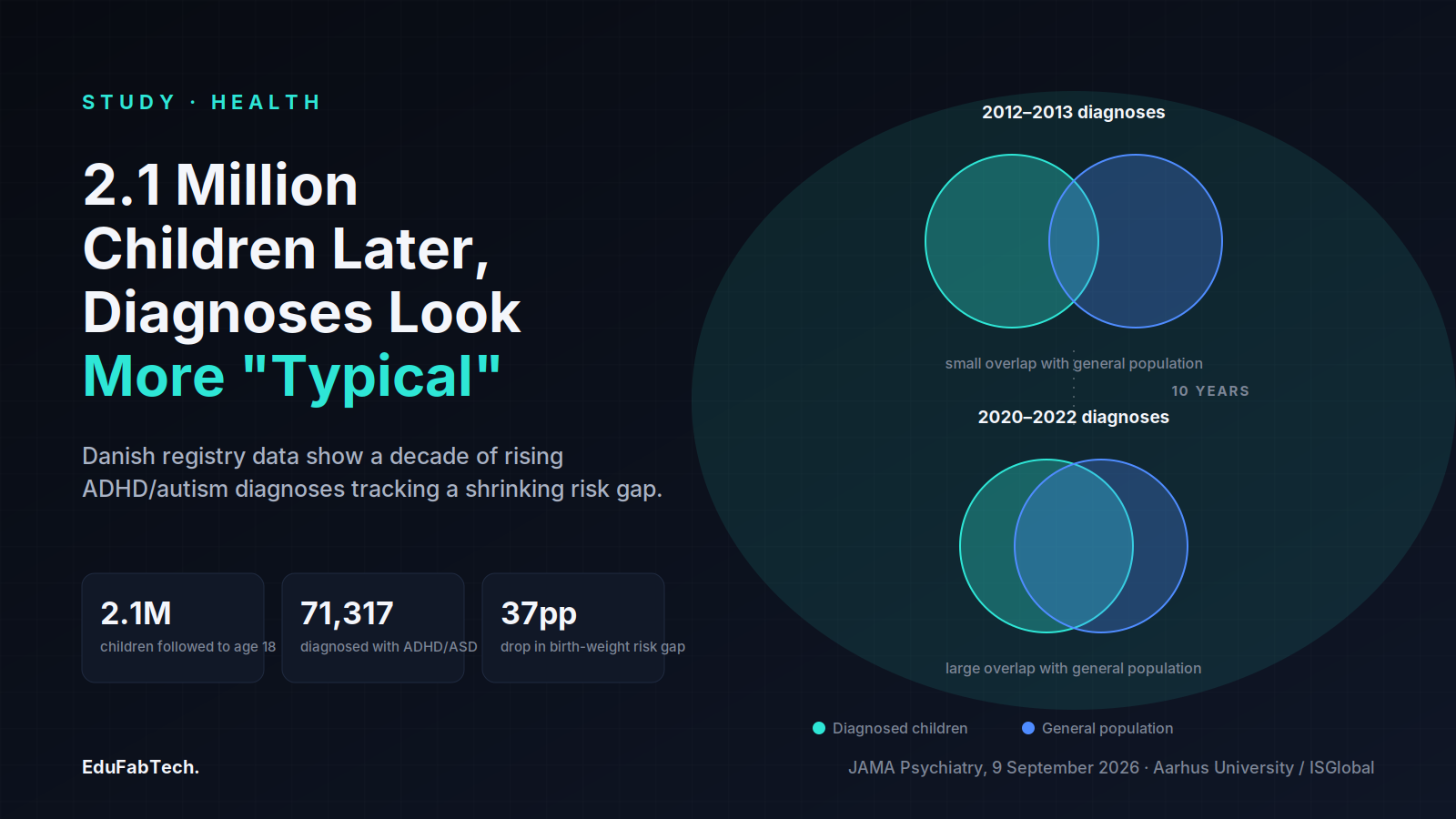
A study published in JAMA Psychiatry on September 9, 2026, reports that children and adolescents diagnosed with ADHD or autism spectrum disorder (ASD) in Denmark now look, on paper, much more like their undiagnosed peers than children diagnosed with the same conditions a decade earlier. The research, led by Magnus Elias Tarp of Aarhus University with senior author Oleguer Plana-Ripoll of the Barcelona Institute for Global Health (ISGlobal) and Aarhus University, is one of the largest single-country efforts to date to track how the population behind a diagnostic trend has itself changed over time.
What the registries show
The team drew on Danish national health and civil registries covering 2,194,951 children and adolescents born between 1994 and 2022 and followed to age 18. Within that population, 71,317 individuals were diagnosed with ADHD or ASD between 2012 and 2022 (26,452 female, or 37.1%), each matched ten-to-one by sex, birth year, municipality and country of birth against 713,170 undiagnosed peers, for a matched comparison group of the same size class as the case group multiplied out. Median age at diagnosis was 11.4 years (interquartile range 8.1–14.9).
The researchers then tracked, year by year, how strongly a set of prediagnostic characteristics — low birth weight, preterm birth and household socioeconomic disadvantage — predicted who went on to receive a diagnosis.
A shrinking gap
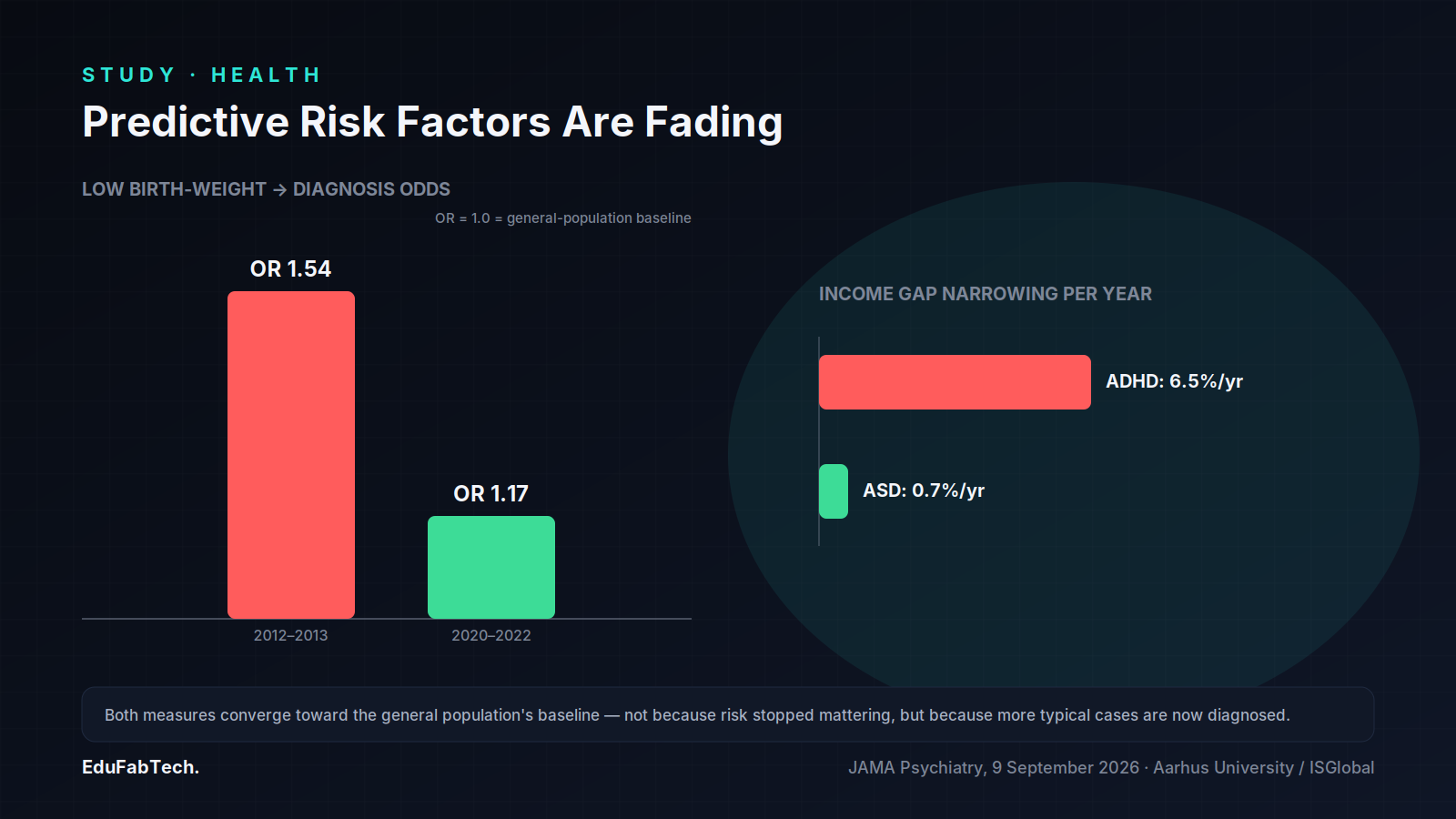
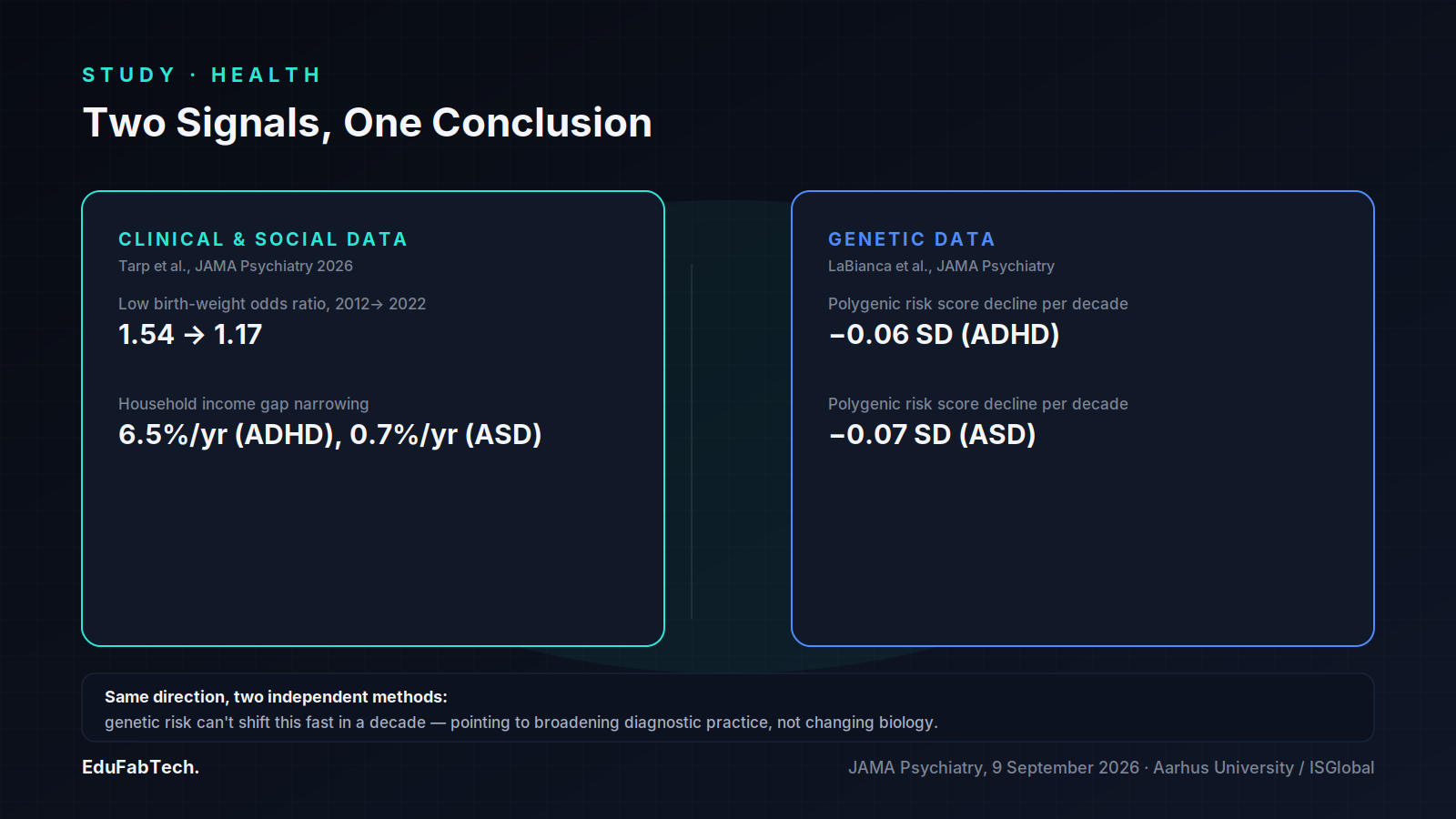
The gap narrowed sharply. Low birth weight was associated with 54% higher odds of a later ADHD or ASD diagnosis among children diagnosed in 2012–2013 (odds ratio 1.54, 95% CI 1.41–1.68); by 2020–2022 that excess had fallen to 17% (odds ratio 1.17, 95% CI 1.10–1.24). The study also found the income gap between diagnosed children's households and the general population narrowing over time — by a mean of 6.5% per year for ADHD (95% CI 5.7–7.3%) and 0.7% per year for ASD (95% CI −0.1 to 1.5%), with comparable attenuation for preterm birth. The effect was more pronounced for ADHD than for ASD, and larger among children diagnosed at older ages.
The authors' interpretation is specific and, they stress, limited: the pattern is consistent with rising diagnosis rates reflecting broader identification — wider diagnostic criteria, greater clinical awareness, more accessible services — rather than a growing underlying burden of severe cases with the biological and social risk profiles historically associated with these conditions. "The key message is not that these risk factors are no longer important," lead author Magnus Elias Tarp said in a statement accompanying the study, since diagnosed children still carry measurably higher risk than undiagnosed peers on every measure tracked; the change is in how much of the diagnosed population now falls outside that older, higher-risk profile.
What the study does not claim
The authors are explicit that a shrinking statistical gap is not evidence that ADHD or ASD have become less impairing for the people who have them, nor that the conditions are being overdiagnosed. A case-control design comparing prediagnostic characteristics cannot separate how much of the shift comes from changed clinical thresholds, expanded service capacity, greater parental and teacher awareness, or a genuine change in incidence — the paper describes its findings as consistent with several of these explanations operating together, not as proof of any single one. The authors also flag that the analysis is confined to Danish registry data, covering a country with universal, tax-funded child psychiatric services, and call for replication in health systems organized differently.
A genetic corroboration
The finding lines up with an earlier JAMA Psychiatry study from an overlapping Aarhus University group, led by Sonja LaBianca, which used polygenic risk scores rather than clinical or socioeconomic markers. In cohorts of 17,071 people diagnosed with ASD and 20,111 diagnosed with ADHD between 1994 and 2016, average genetic risk scores for both conditions declined with each successive diagnostic decade (ADHD: β = −0.06 standard deviations per 10 years, 95% CI −0.09 to −0.03, P = .001; ASD: β = −0.07 SD per 10 years, 95% CI −0.10 to −0.04, P < .001), while remaining above general-population levels throughout. Genetic risk cannot shift that fast in a real population over a decade, which points toward changing diagnostic practice as the more likely driver — a conclusion the newer study's social and clinical data now reinforce from a different angle.
Why it matters beyond Denmark
ADHD and autism diagnosis rates have climbed across many high-income health systems over the past two decades, often fueling public debate about whether children are being over-treated or under-served. Denmark's registries, which link near-complete birth, health and socioeconomic records for the whole population, make it possible to test that question with a precision most countries cannot match. The result does not resolve the debate outright, but it shifts the terms of it: rather than asking whether more children have ADHD or autism than before, the data invite asking who is now able to access a diagnosis that a decade ago might have gone unrecognized — and what that means for how services, schools and families plan for a more heterogeneous diagnosed population.
The study's authors note that untangling exactly which mechanism — criteria, awareness, capacity or true incidence — carries the most weight will require further work, including comparable analyses in countries with different diagnostic and referral systems.
- Magnus Elias Tarp, Mette Lise Lousdal, Charlotte Ulrikka Rask, Kathrine M. Keyes, Tomáš Formánek, Isabell Brikell, Xiaoqin Liu, Genona T. Maseras, Oleguer Plana-Ripoll. Changes in Characteristics Associated With ADHD and ASD Diagnoses Over Time. JAMA Psychiatry, 2026. doi:10.1001/jamapsychiatry.2026.2722
- Barcelona Institute for Global Health (ISGlobal). Study suggests the profile of people diagnosed with ADHD and autism has changed over the past decade. ISGlobal, 2026. link
- Sonja LaBianca, Mette Lise Lousdal, Morten Dybdahl Krebs, et al.. Changes in Genetic Contributions to ASD and ADHD by Year of Diagnosis. JAMA Psychiatry, 2026. doi:10.1001/jamapsychiatry.2026.2244
- ScienceDaily. ADHD and autism diagnoses have surged. A massive study may help explain why. ScienceDaily, 2026. link