Engineered Protein "Glue" Restores Chromosome Stability in Aged Mouse Eggs
A Science paper published 26 November 2026 by Max Planck researchers shows TALhesin raising intact-chromosome rates in aged mouse eggs from 46.7% to 74.1%, with early tests on donated human eggs.
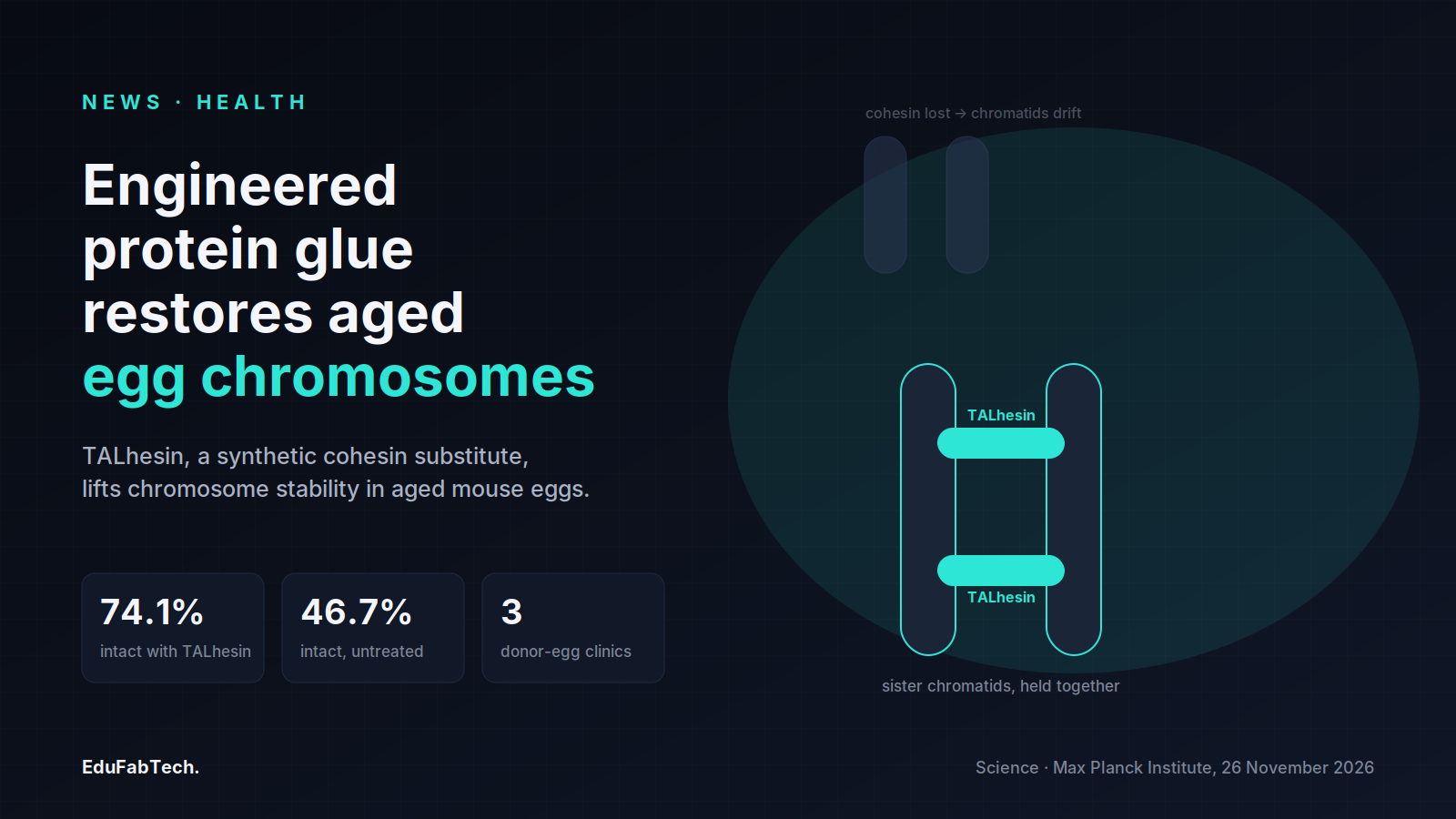
A team led by biochemist Melina Schuh at the Max Planck Institute for Multidisciplinary Sciences in Göttingen, Germany, has engineered a synthetic substitute for a protein that normally holds chromosomes together in egg cells, and used it to restore chromosome stability in aged mouse eggs. The work, carried out with co-authors including Alexandre Webster, Halima Yusuf and Nina Schweizer, appeared in Science on 26 November 2026.
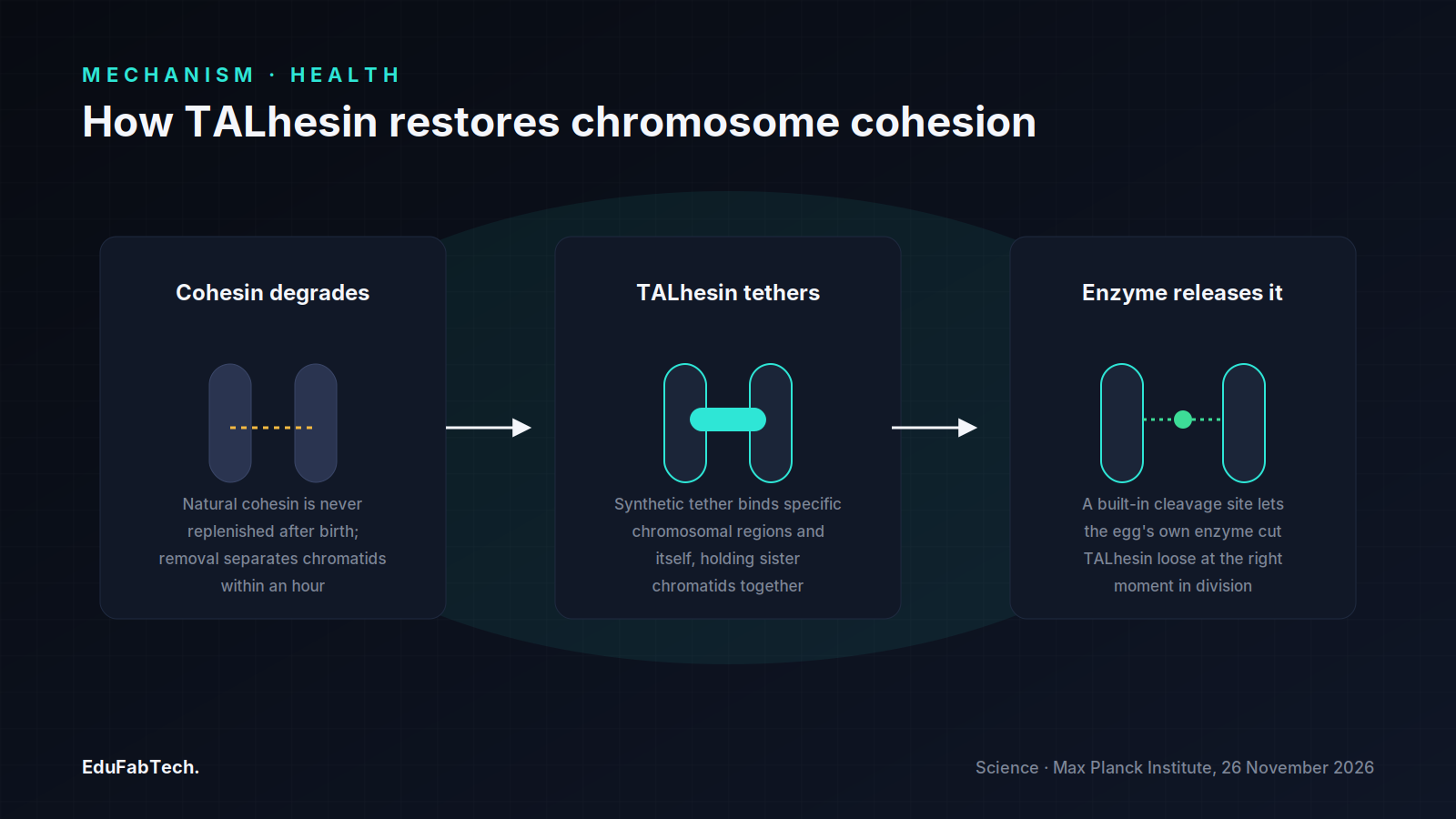
The target is cohesin, the protein complex that keeps sister chromatids paired until the right moment in meiosis. Eggs are formed before birth and then stay arrested for decades, during which natural cohesin is not replenished and gradually degrades. The Science paper reports that in experiments removing natural cohesin from young mouse eggs, chromatids that should stay bound separated within an hour, illustrating how directly the protein's loss drives chromosome errors as eggs age.
To compensate for that loss, the team built an artificial tether called TALhesin, short for transcription activator–like cohesin, which attaches to specific chromosomal regions and binds to itself, mimicking cohesin's function without relying on the degraded natural protein.
What changed in aged mouse eggs
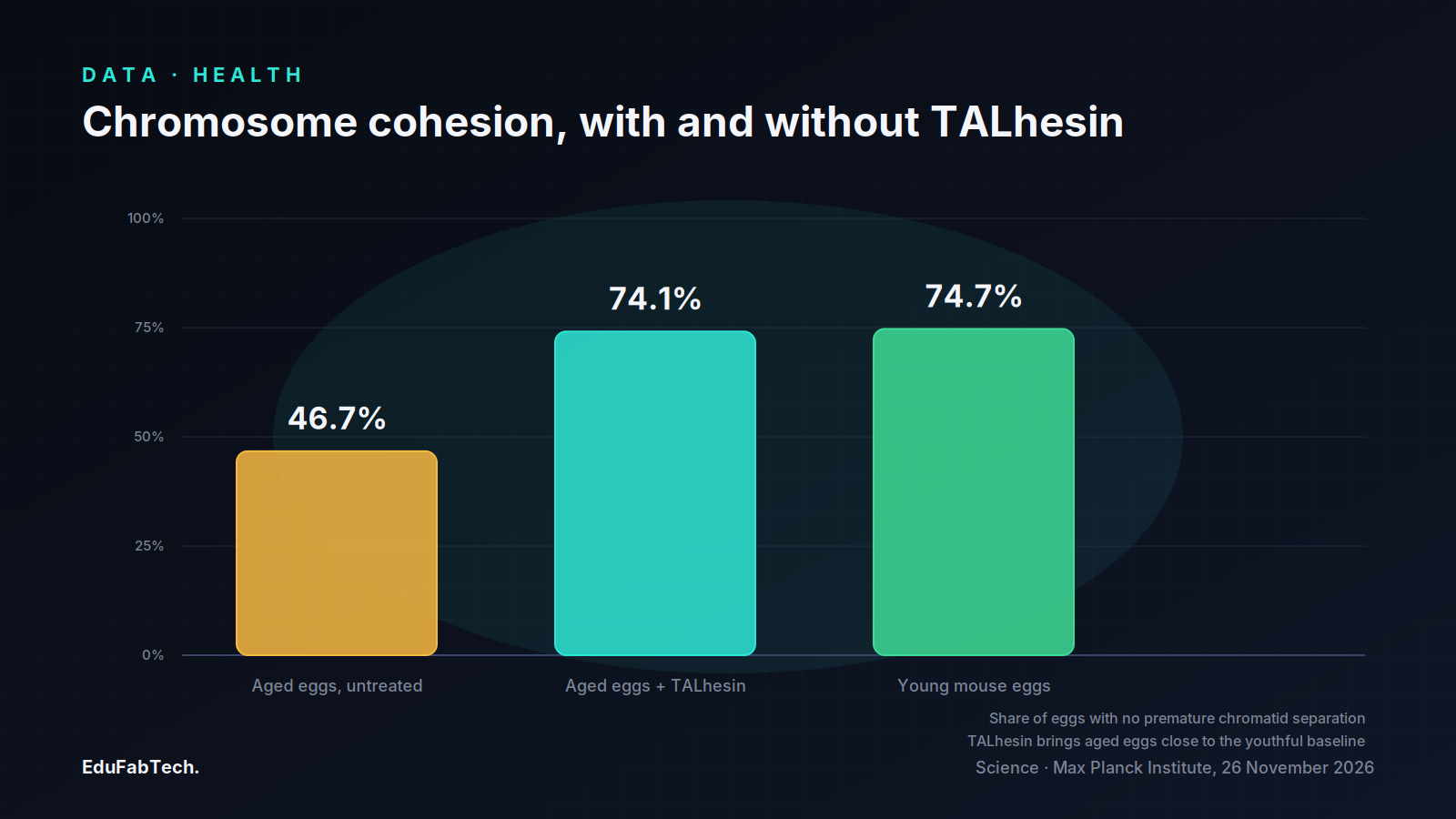
The researchers tested TALhesin in eggs from aged mice, at the stage when cohesin loss and chromosome-segregation errors become common. According to the Max Planck Institute press release, the proportion of aged mouse eggs with no premature chromatid separation rose from 46.7% without treatment to 74.1% with TALhesin — close to the 74.7% seen in eggs from young mice.
Schuh described the result in the institute's release: "With TALhesin, we can replace lost chromatid cohesion for the first time." The release frames the work as "a first step towards developing a safe method" rather than a finished intervention, and Schuh is quoted saying "further research and safety testing will be needed before clinical use."
Early tests in donated human eggs
The team also tested TALhesin in unfertilized human eggs donated through three fertility centers: the Göttingen Fertility Center, Bourn Hall Fertility Clinic in Cambridgeshire, and the Fertility Center Berlin, according to the Max Planck Institute. TALhesin bound to its intended chromosomal regions without visibly disrupting the first meiotic division, and eggs carrying more TALhesin showed smaller distances between sister chromatids than those carrying little, consistent with the system holding them together. A built-in cleavage site also allowed one of the egg's own enzymes to release TALhesin at the right time during division.
An early-stage result, not a treatment
Reporting on the study, Nature's news coverage quotes reproductive biologist Bettina Mihalas of the University of New South Wales, Sydney, who was not involved in the research, calling the approach "very creative, well-engineered and well-thought-out" and noting it is "the first approach to replace the protein's function" with an engineered system rather than merely study its loss. The same report stresses that human testing so far involved only donated eggs in the laboratory, not embryos or pregnancies, and that clinical application remains speculative at this stage.
For researchers and students following reproductive biology, the result is notable less as a ready IVF treatment than as a demonstration that a lost structural protein inside a cell can be functionally replaced by a designed substitute — a strategy that, if it clears safety testing, the authors suggest could eventually be explored as a way to reduce chromosome-segregation errors linked to age-related infertility.
A quick question for readers
Which study habit do you think is most overrated?
Some popular habits have little evidence behind them. Which one do you think gets too much credit?
Pick an answer, create a free account in a minute, and your vote counts. Already a member? Sign in
Comments 3
Comment-
The jump from 46.7% to 74.1% is real progress but it's still short of the 74.7% young-egg baseline, and the piece doesn't say how much varia…
-
What stands out is how close 74.1% gets to the 74.7% baseline from young eggs — that's not a marginal nudge, that's TALhesin erasing most of…
-
The number that actually matters here is the gap to baseline, not the headline jump: 74.1% with TALhesin versus 74.7% in young eggs is basic…
Join free to read the full comments and reply Comments are between members; an account takes a minute.
Source: Science (AAAS)
Sources (3)
- Alexandre Webster, Halima Yusuf, Nina Schweizer, Melina Schuh, et al.. An engineered cohesion system reduces errors in aged mammalian eggs. Science, 2026. science.org ↗ · checked 27 Nov 2026
- Max Planck Institute for Multidisciplinary Sciences / Max-Planck-Gesellschaft. An engineered "glue" for aged eggs. EurekAlert!, 2026. eurekalert.org ↗ · checked 27 Nov 2026
- Nature News. Chromosome 'glue' could boost fertility by stabilizing ageing eggs. Nature, 2026. nature.com ↗ · checked 27 Nov 2026