FDA's Accelerated Approval for First DNA Immunotherapy Targets a Rare HPV Airway Disease
On 30 October 2026 the FDA approved Inovio's Voceryq for recurrent respiratory papillomatosis after 7 of 26 adults with frequent prior surgery went a year without needing another operation; a confirmatory trial is still required.
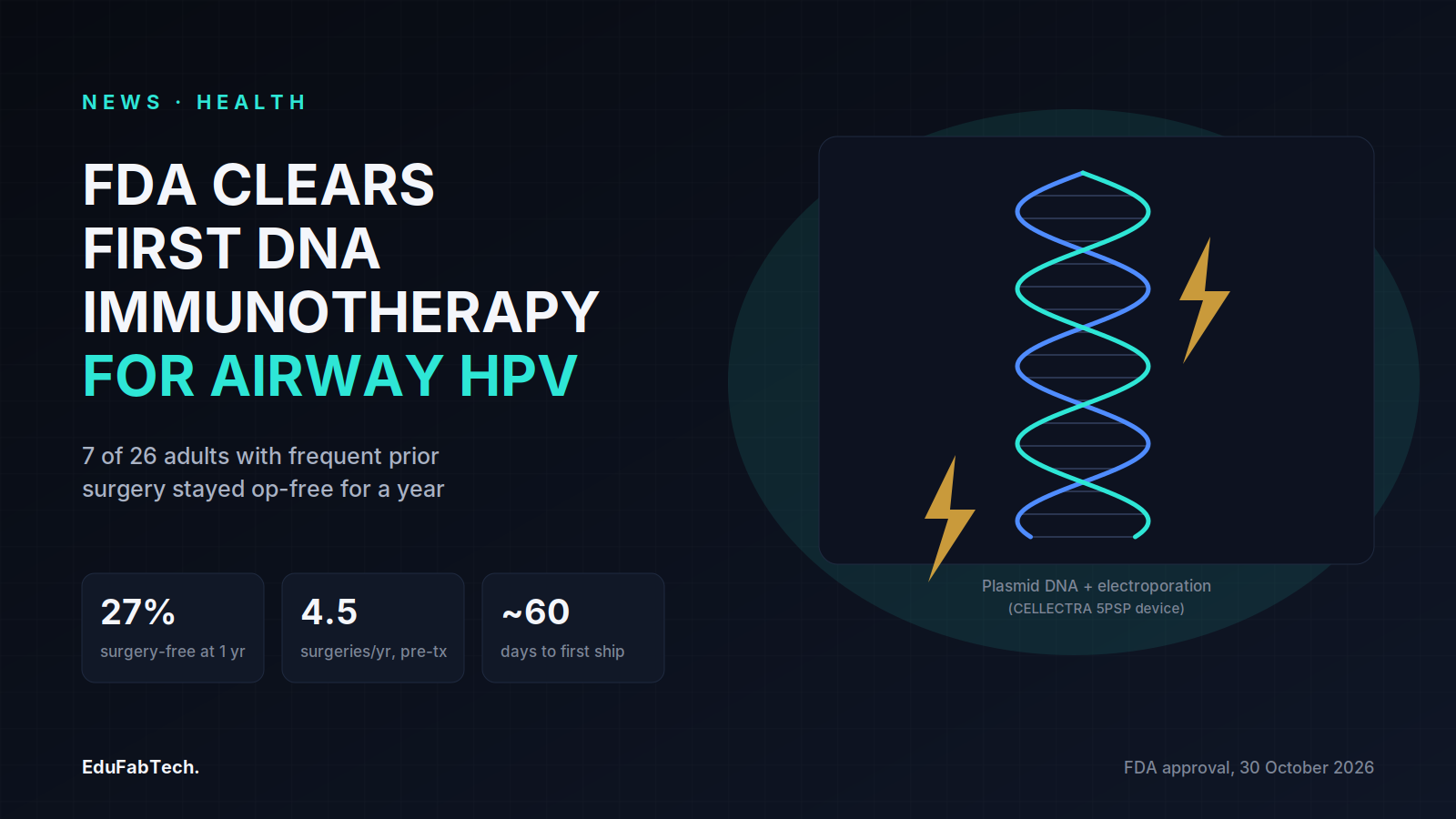
On 30 October 2026, the US Food and Drug Administration granted accelerated approval to Voceryq (INO-3107), which the agency describes as the first plasmid DNA-based immunotherapy approved in the United States, for adults with recurrent respiratory papillomatosis (RRP). The decision, laid out in an FDA press release, lets patients with the rare, HPV-driven airway disease receive a DNA injection instead of relying solely on repeat surgery to remove throat growths.
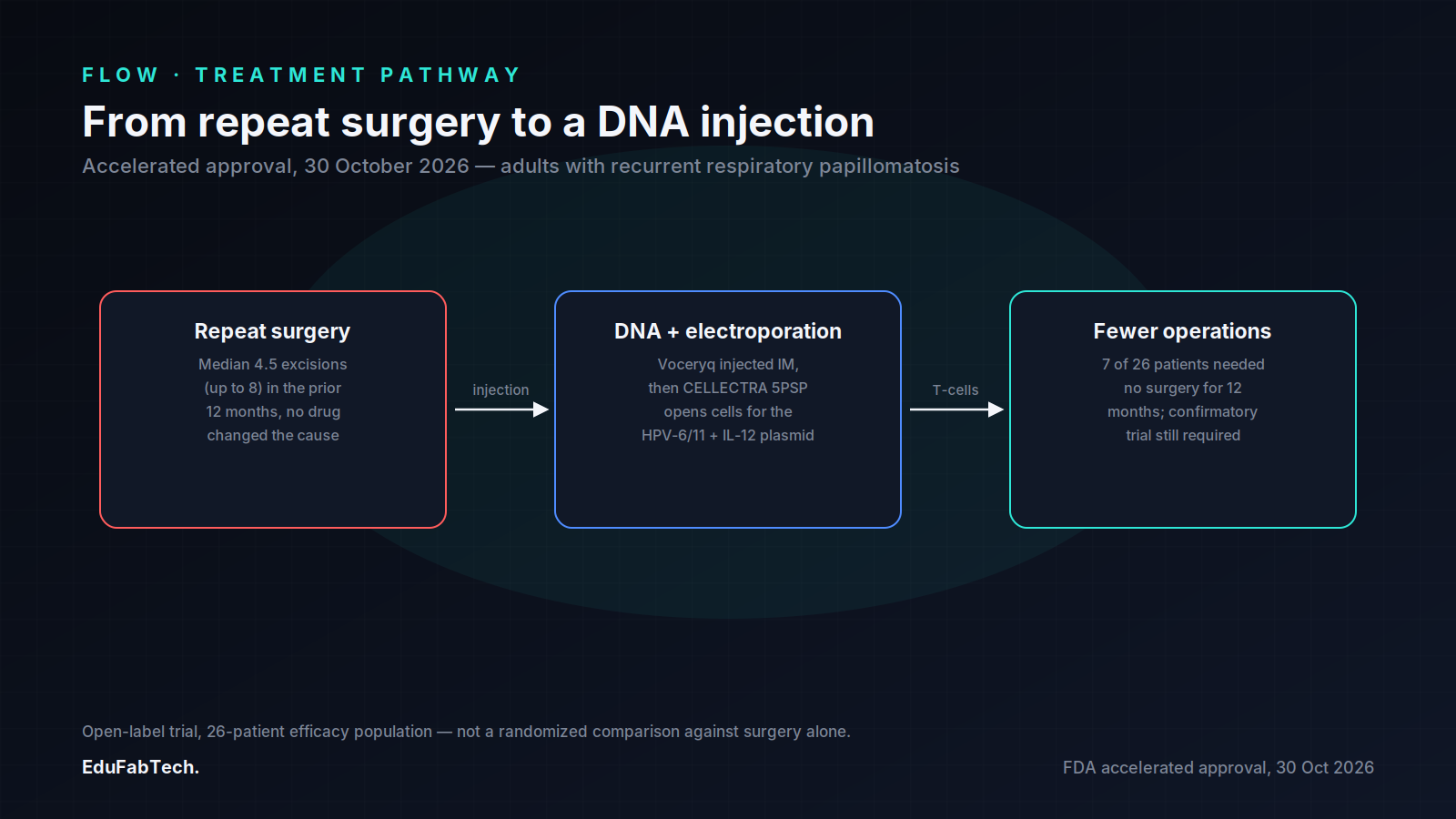
RRP is caused by human papillomavirus types 6 and 11, which seed wart-like papillomas in the larynx and airway. The FDA's announcement describes the growths as a cause of hoarseness, chronic cough, voice change and, in severe cases, difficulty breathing. Because the papillomas regrow, people with RRP can need surgical removal every few months for years; the efficacy population in the pivotal trial had a median of 4.5 excisions, and as many as eight, in the 12 months before treatment, according to HCPLive's report on the approval.
Voceryq is given by intramuscular injection followed by electroporation with Inovio's CELLECTRA 5PSP device, which briefly opens pores in nearby cells so the plasmid DNA can enter them, HCPLive's report on the dosing regimen notes. The plasmids encode HPV-6 and HPV-11 E6 and E7 proteins together with the cytokine interleukin-12, an approach meant to prime T cells to recognise and clear virus-infected cells rather than to act as a conventional small-molecule drug.
What the pivotal trial measured
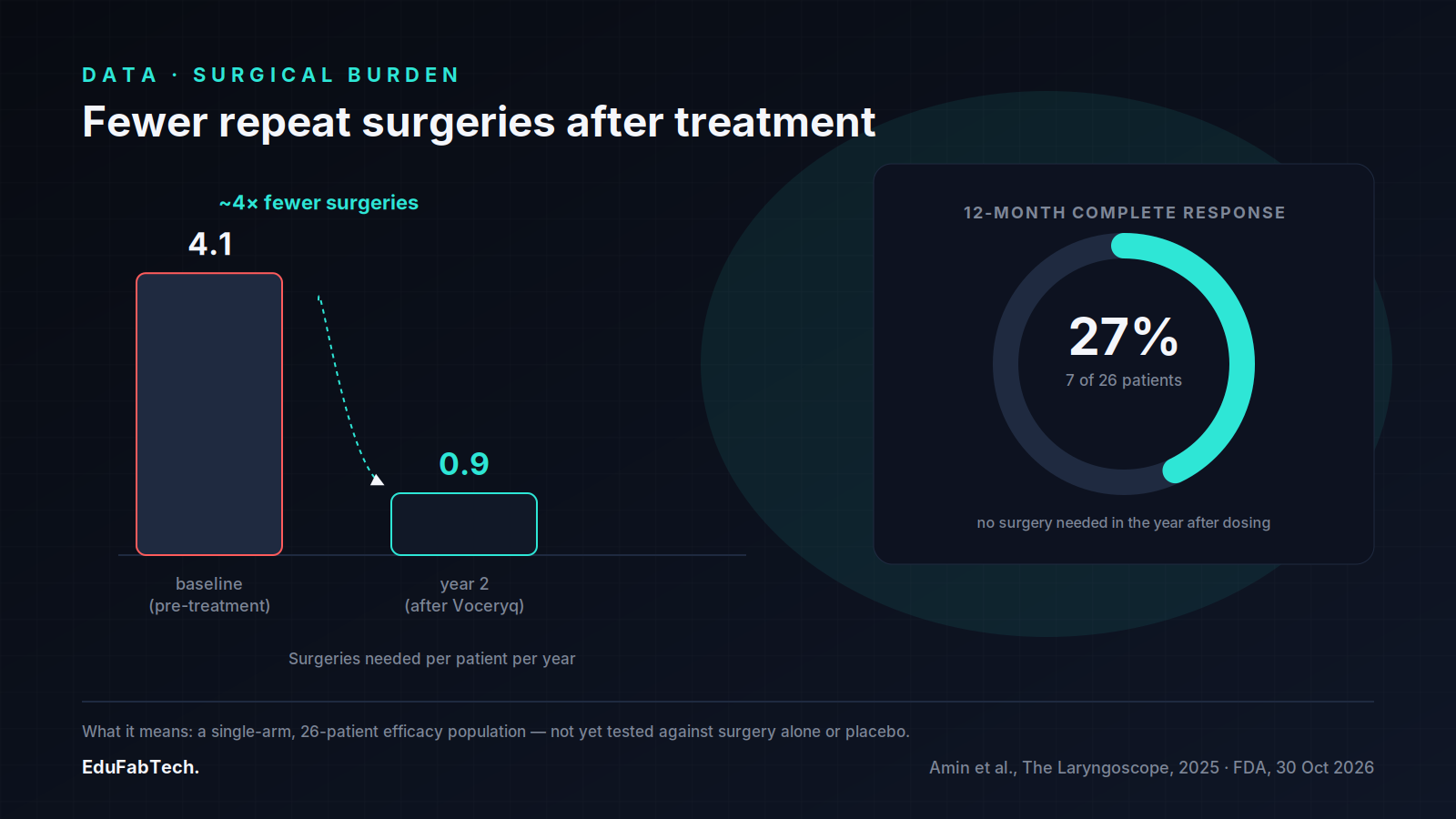
The approval rests on an open-label, multicenter trial that enrolled 32 adults with RRP who had had two or more surgeries in the previous year, according to the FDA's press release. The efficacy analysis focused on the 26 of those patients who had needed three or more surgeries in the 12 months before their first dose; among that group, 7 patients — 27%, with a 95% confidence interval of 12% to 48% — needed no surgical intervention during the 12 months after treatment, a result confirmed in HCPLive's coverage of the approval.
Longer follow-up of an earlier cohort, published by Amin and colleagues in The Laryngoscope in 2025, found the annual surgery rate falling roughly fourfold, from 4.1 procedures at baseline to 0.9 by the second year after treatment. The FDA's summary lists injection-site reactions, headache, fatigue, high blood pressure, nausea and dizziness as the most common side effects, together with transient muscle contractions and brief bleeding or anxiety tied to the electroporation step; HCPLive's report on the trial notes no grade 4 or 5 adverse events occurred.
Why the approval comes with conditions
Voceryq received its clearance through the FDA's accelerated approval pathway, alongside Breakthrough Therapy and Orphan Drug designations, rather than through standard approval. That pathway lets a therapy for a serious, rare condition reach patients on evidence the FDA judges reasonably likely to predict benefit, but it requires Inovio to run a confirmatory trial to verify that benefit, with a draft protocol due to the agency by the end of 2026. Simon Best, an associate professor of otolaryngology at Johns Hopkins University and the trial's lead investigator, is quoted by HCPLive saying "every surgery carries the risk of laryngeal injury" — the harm the reduction in procedures is meant to avoid.
Inovio has said it expects ordering and shipping for Voceryq to begin roughly 60 days after approval, with full commercial deployment planned for the first quarter of 2027, according to HCPLive's report.
What it means for students and researchers
RRP has long been managed with repeated debulking surgery because no drug had changed the underlying immune failure that lets the virus persist in airway tissue. Voceryq's approval gives researchers in virology, immunology and gene-delivery engineering a marketed case study in using a synthetic DNA plasmid, delivered by electroporation rather than a viral vector or mRNA-lipid formulation, to drive a targeted T-cell response against a chronic viral infection.
For now, the result is a conditional approval built on a single-arm trial with a 26-patient efficacy population, not a randomized comparison against surgery alone or against a placebo-electroporation control. Whether the complete-response rate holds up, and whether it changes disease burden or quality of life beyond what the trial measured, is what the FDA's required confirmatory study — and the independent clinical literature that follows it — will need to settle.
A quick question for readers
Which study habit do you think is most overrated?
Some popular habits have little evidence behind them. Which one do you think gets too much credit?
Pick an answer, create a free account in a minute, and your vote counts. Already a member? Sign in
Comments 3
Comment-
The number that jumps out is 7 of 26 - a 27% complete-response rate with a confidence interval running from 12% to 48%. That's a huge range,…
-
The number that should get more scrutiny than it does is that 95% CI: 12% to 48% on a 27% complete-response rate from 26 patients. That's a…
-
The number that actually matters here is the confidence interval, not the headline 27%: 12% to 48% on a 26-patient single-arm trial is a wid…
Join free to read the full comments and reply Comments are between members; an account takes a minute.
Source: U.S. Food and Drug Administration
Sources (3)
- U.S. Food and Drug Administration. FDA Approves First Plasmid DNA-based Immunotherapy for Adults with Recurrent Respiratory Papillomatosis. FDA, 2026. fda.gov ↗ · checked 2 Nov 2026
- HCPLive Staff. Voceryq Gains FDA Accelerated Approval for Recurrent Respiratory Papillomatosis. HCPLive, 2026. hcplive.com ↗ · checked 2 Nov 2026
- Amin, M.R., Belafsky, P.C., Best, S.R., et al.. DNA Immunotherapy (INO-3107) Results in Long-Term Surgery Reduction in RRP. The Laryngoscope, 2025. onlinelibrary.wiley.com ↗ · checked 2 Nov 2026