In 15 Days, France's Lycée Blockades Won a First Concession: Faster Replacement of Absent Teachers
After fifteen days of blockades that reached 1,027 lycées, Education Minister Édouard Geffray received student unions and parents on 2 October and promised faster replacement of absent teachers. The Union syndicale lycéenne says it is not enough and has called Act III for Tuesday 6 October.
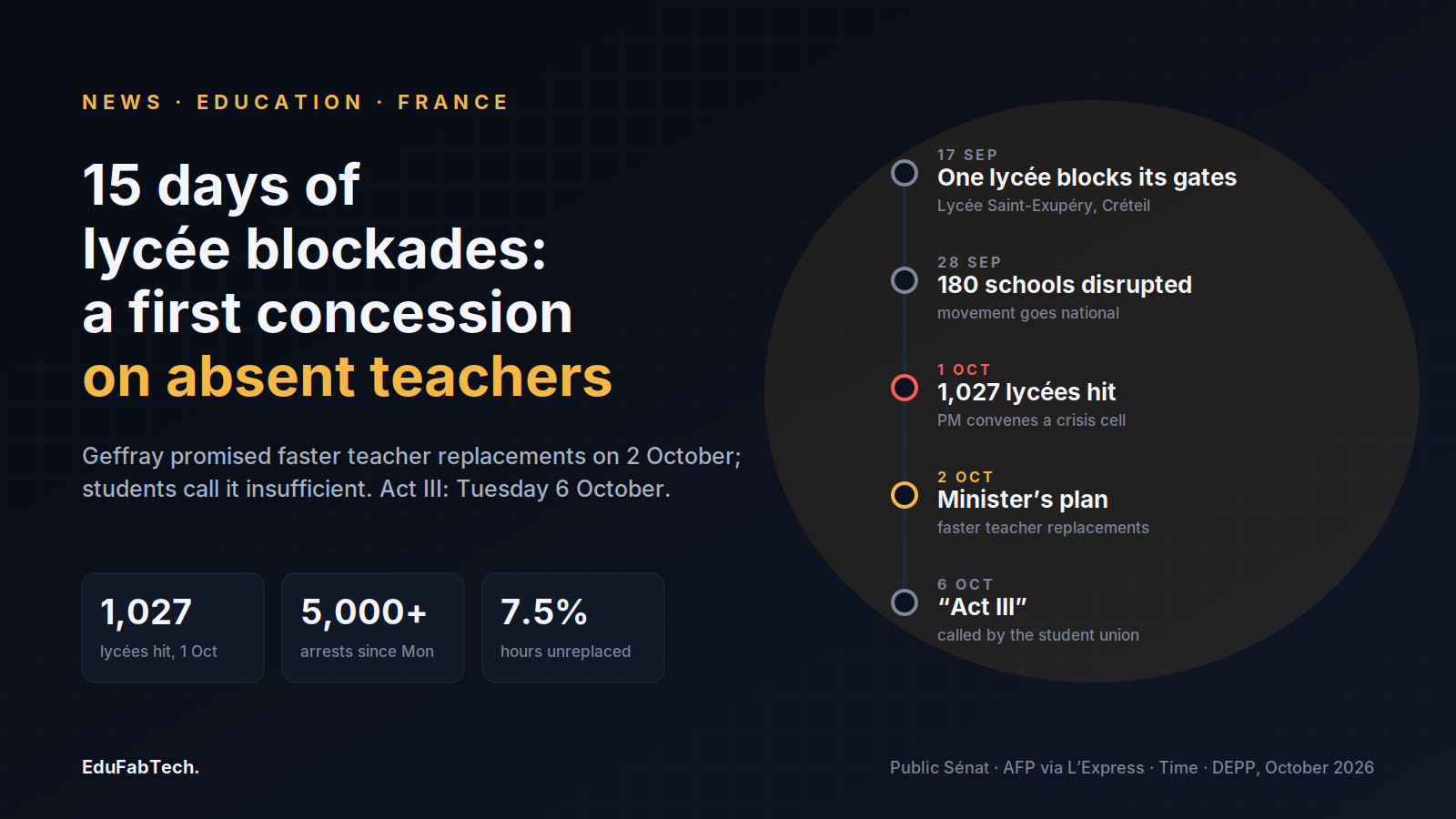
On Friday 2 October 2026, fifteen days after pupils at the Lycée Saint-Exupéry in Créteil first blocked their school gates, France's education minister Édouard Geffray received student unions, teachers' unions and parents' federations and came out with the movement's first national concession: a "plan d'action" under which every regional education authority is to be mobilised from next week to speed up the replacement of absent teachers, with priority for exam classes, according to AFP reporting carried by L'Express. The day before, the blockades had touched 1,027 lycées across the country, Public Sénat reported, and Prime Minister Sébastien Lecornu had convened a crisis cell.
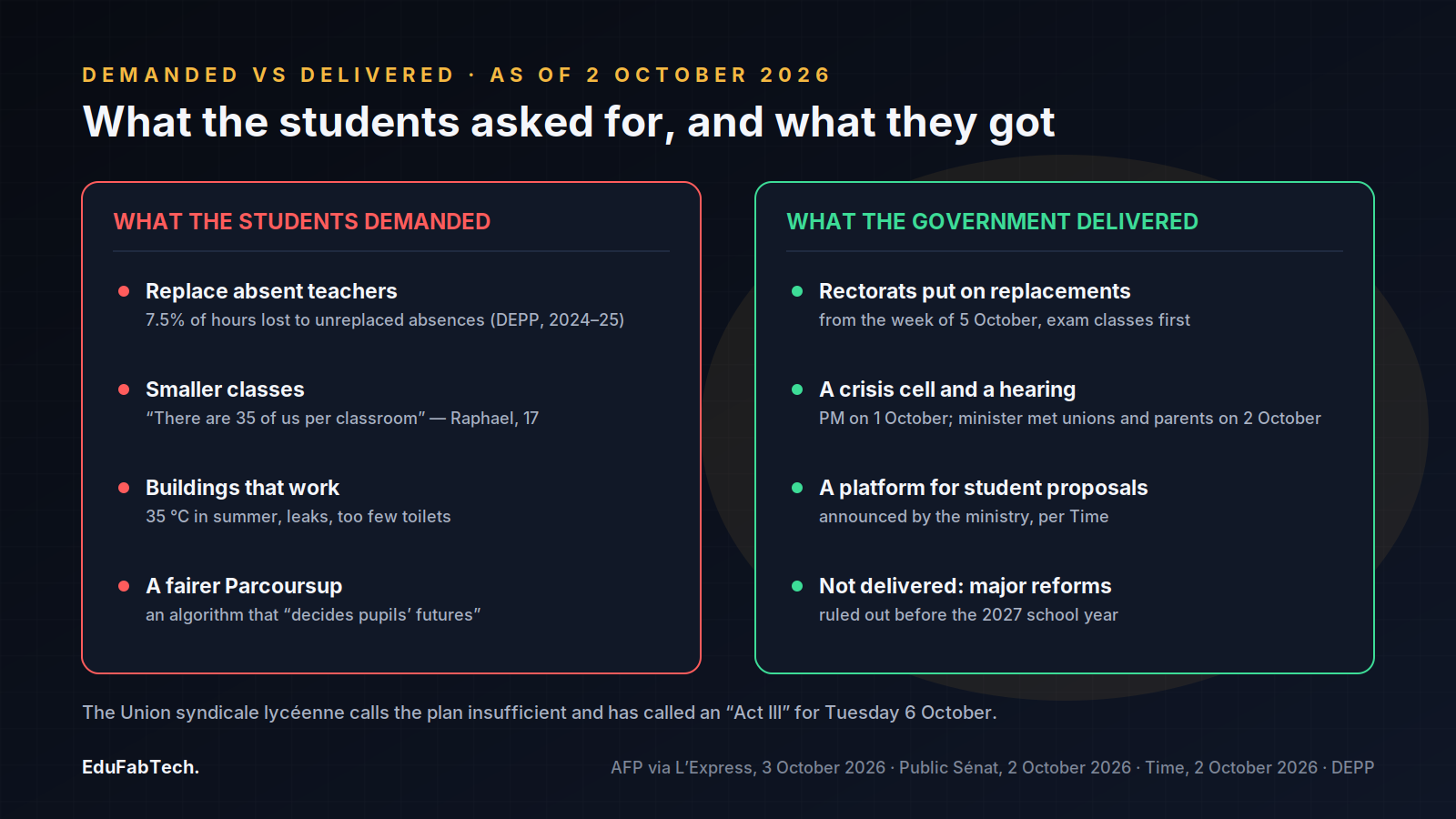
The government accused the far-left France Unbowed party of encouraging the protests, which the party denied; the demands themselves, as reported, came from classrooms. "There are 35 of us per classroom. With 35 degrees Celsius in summer, it's unbearable. There aren't enough toilets, and there are water leaks in some rooms," Raphael, 17, told Al Jazeera on 1 October. Juliette Masson, 17, of the Lycée Clemenceau, gave Public Sénat the same list: missing teachers, worn-out buildings, and Parcoursup, the university admissions platform whose algorithm she said decides pupils' futures. The figures behind the anger are the ministry's own. Its statistics office, DEPP, reported in April 2026 that 9.8 per cent of teaching hours in public secondary schools were not delivered in 2024–2025, 7.5 per cent of them because absent teachers were not replaced.
Measured against 17 September, when the movement was one school in a Paris suburb, the list of what two weeks of blockades produced is concrete. A prime minister's crisis cell on Thursday 1 October. A minister who had warned parents that "in the streets, children are in danger" receiving the Union syndicale lycéenne (USL), the Union étudiante and the parents' federations the next morning. A commitment that the rectorats will be put on replacements from the week of 5 October, exam classes first, and an acknowledgement, reported by L'Express, that pupils' worries about buildings, class organisation and timetables had been heard. Time reported that the ministry also announced a platform for students to submit reform proposals. On policing, Interior Minister Laurent Nuñez said internal investigations had been opened into brutality allegations involving three students, the parents' federation FCPE filed a complaint with the Défenseur des droits, and Amnesty International called images of police assaults on minors "extremely alarming".
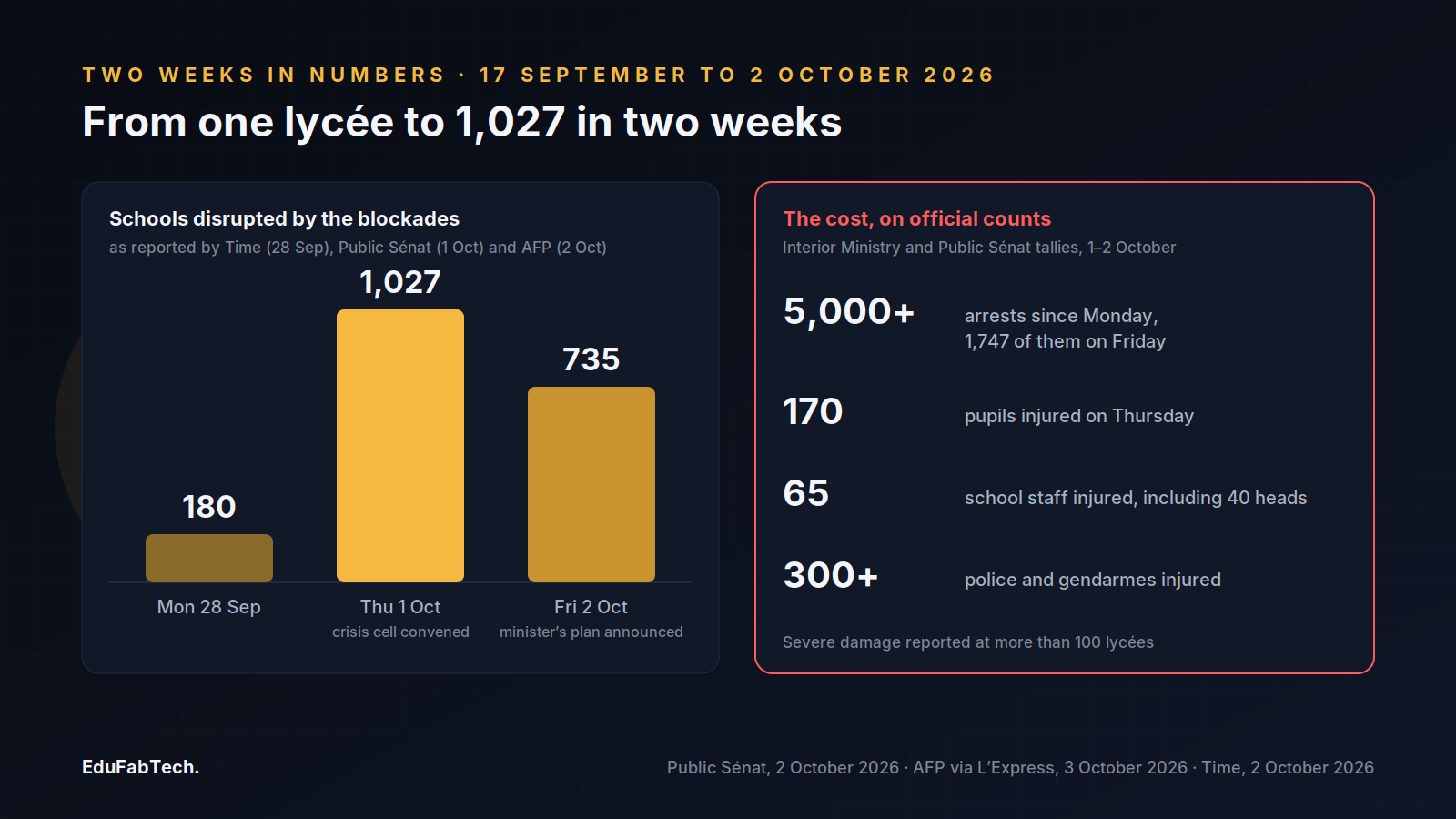
What moved the ministry was scale. Time counted 180 schools disrupted on Monday 28 September and more than 500 by the end of the week, with around 900 demonstrations on Friday alone. Al Jazeera reported at least 400 of France's 3,700 lycées closed on Friday, and university students blocking access to about 30 campuses, including in Paris and Marseille. The teachers' unions Snes-FSU and SE-Unsa demanded a national political response, an inter-union of education staff called for strike action, and the student unions La Fage and Unef called a youth demonstration for Tuesday 6 October.
The cost has been high, and the sources do not soften it. Public Sénat's tally for Thursday 1 October: nearly 2,000 arrests, 170 pupils injured, 65 school staff including 40 head teachers, more than 300 police and gendarmes, and severe damage at more than 100 lycées. Al Jazeera reported fires at the entrances of two Paris lycées, Léonard-de-Vinci and Gaston-Bachelard. By Friday evening Nuñez put arrests since Monday at more than 5,000, 1,747 of them that day, according to AFP. President Emmanuel Macron said that "none of these debates legitimizes violence"; Justice Minister Gérald Darmanin said parents should pay for damage caused by their children. The same AFP count put the number of lycées disrupted on Friday at 735, about 30 per cent fewer than the day before.
The students have not declared victory, and the minister has not conceded much beyond replacements. Geffray ruled out major reforms before the 2027 school year and said the absence of a single list of national demands made a settlement harder. USL president Ryad Rani called the plan insufficient and announced an "Act III" for Tuesday 6 October, with several teachers' unions calling on staff to join. Tuesday will show whether the first concession was the movement's end or its opening price.
For students outside France, the lesson is arithmetic rather than tactics. A movement that began at one lycée reached 1,027 of the country's 3,700 lycées in two weeks and got a national answer on its core demand within fifteen days, because the demand, replace the absent teacher, was specific, documented by the ministry's own statisticians and shared by parents. The same arithmetic runs through our World Teachers' Day piece on the 44 million teachers UNESCO says the world needs by 2030: the French figure of 7.5 per cent of hours lost to unreplaced absences is what that shortage looks like from a desk in the fourth row. Tell us in the forum whether students in your country would block a school gate over class size, and have your say in the polls.
A quick question for readers
Would you choose the same field of study again?
One of the most honest questions a student can answer — and one of the most useful for those still choosing.
Pick an answer, create a free account in a minute, and your vote counts. Already a member? Sign in
Source: Public Sénat
Sources (3)
- Blocus lycéens : 564 établissements perturbés, le gouvernement cherche une sortie de crise. Public Sénat, 2026. publicsenat.fr ↗
- AFP; L'Express. Colère lycéenne : Édouard Geffray propose un "plan d'action", un appel à la mobilisation est lancé pour mardi. Orange Actu, 2026. actu.orange.fr ↗
- Why Are Students Protesting Across France?. Time, 2026. time.com ↗