World Teachers' Day 2026: A 60-Year-Old Promise, a 44-Million Gap by 2030, and the Teacher You Never Thanked
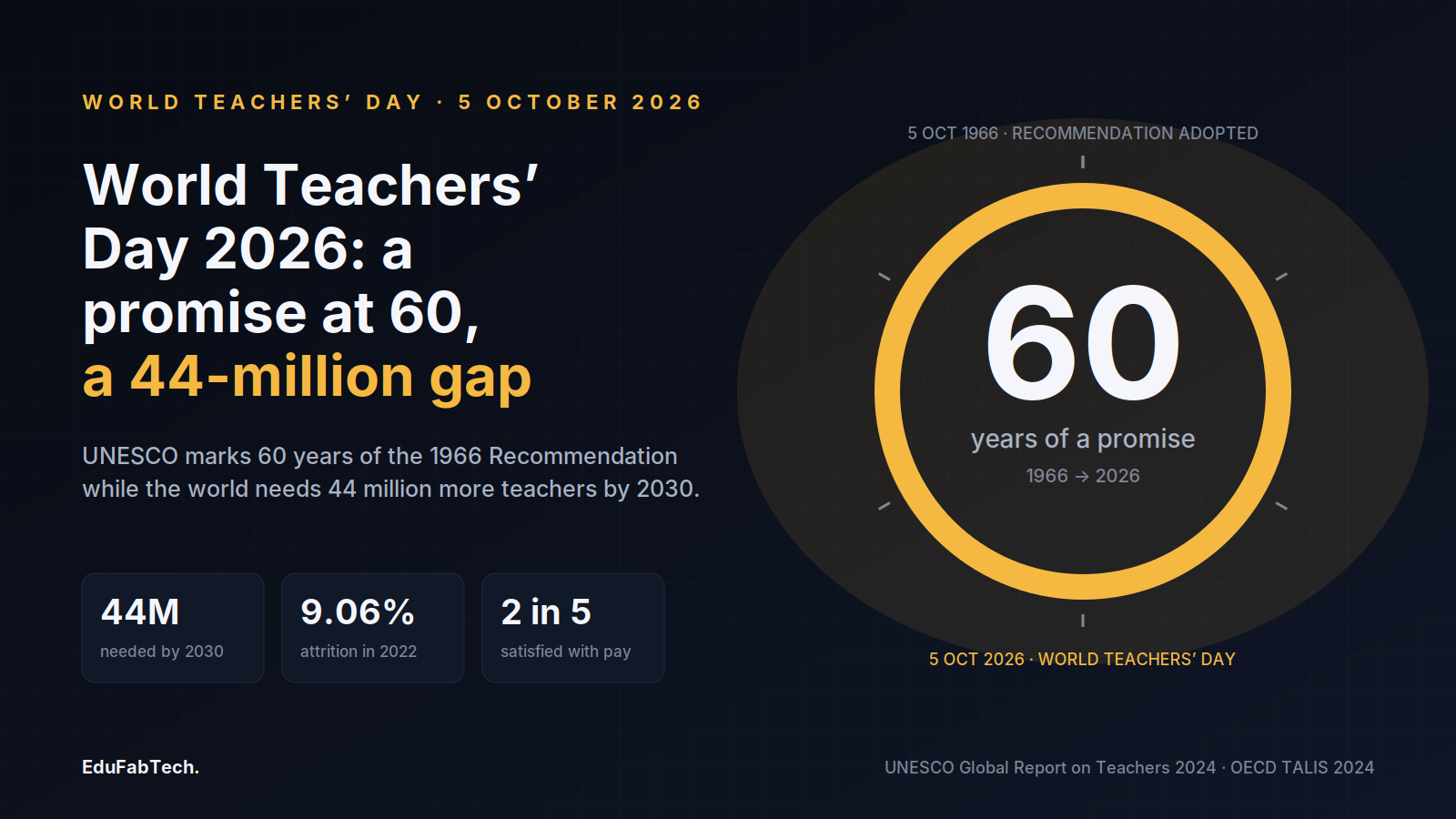
On 5 October 2026 UNESCO marks 60 years of the 1966 promise on teachers' status. Two professors who died this autumn, a 44-million shortfall by 2030 and an OECD survey of 280,000 teachers show what the promise still owes, and what you can do before Monday.
Two obituaries arrived this autumn, one from Havana and one from Houston, and both led with the same word. In Havana, Professor Julián Pérez Amarillo, the microbiologist who trained generations of paediatricians at the William Soler and Juan Manuel Márquez children's hospitals, died on 2 October 2026 at the age of 96; the Pedro Kourí Institute of Tropical Medicine called him "a passionate educator" and colleagues remembered him as a "teacher of teachers". From Houston came the obituary of Rice University economist Dagobert "Bob" Brito, whose work appeared in the American Economic Review and Econometrica and who died on 16 September 2026 at 85; his obituary says that "teaching and encouraging students were among the most important parts of his work", and that Rice named its award for the best recitation instructors in economics after him. Not the papers. The teaching.
On Monday, 5 October 2026, UNESCO's headquarters in Paris hosts World Teachers' Day from 8:00 to 18:30, with the International Labour Organization, UNICEF and Education International as co-conveners. The 2026 theme is "Standing with teachers: 60 years of protecting the profession, advancing its status and shaping our futures". The number in the theme is the point. On 5 October 1966, governments meeting in Paris adopted the ILO/UNESCO Recommendation concerning the Status of Teachers, and World Teachers' Day has marked that anniversary every year since 1994.
Obituaries are an honest ledger: they record what a life was for, not what it was paid. This article does three things with that ledger. It reads what the 1966 promise actually says. It sets that promise against UNESCO's own arithmetic of how many teachers the world is missing. And it asks the question the two obituaries answer better than any report: what is a teacher worth, and who is counting?
A 146-paragraph promise, signed in 1966
The Recommendation is longer than most people assume. It runs to 146 paragraphs in 13 sections, covering teacher preparation, employment and tenure, professional rights, class size, working hours, salaries and social security. Its best-known sentence is also its most demanding: "Teaching should be regarded as a profession: it is a form of public service which requires of teachers expert knowledge and specialized skills, acquired and maintained through rigorous and continuing study."
Two other lines matter in 2026. On freedom: "The teaching profession should enjoy academic freedom in the discharge of professional duties." On money: "Particular importance should be attached to salary", because, the text argues, the other conditions of a teacher's life depend largely on "the economic position in which they are placed". A second Recommendation, adopted in 1997, extended the same principles to teaching staff in higher education, which is where Pérez Amarillo and Brito spent their working lives.
Some of the 1966 text reads as radical in 2026. It says that teachers, "particularly qualified to judge the teaching aids and methods most suitable for their pupils", should be given "the essential role in the choice and the adaptation of teaching material". It says class sizes should allow a teacher to give pupils individual attention. It treats preparation, further training, tenure and social security as parts of one contract rather than separate favours. Sixty years on, the document is still the benchmark that governments accepted, and it is still quotable in a staff meeting.
The arithmetic: 44 million teachers by 2030
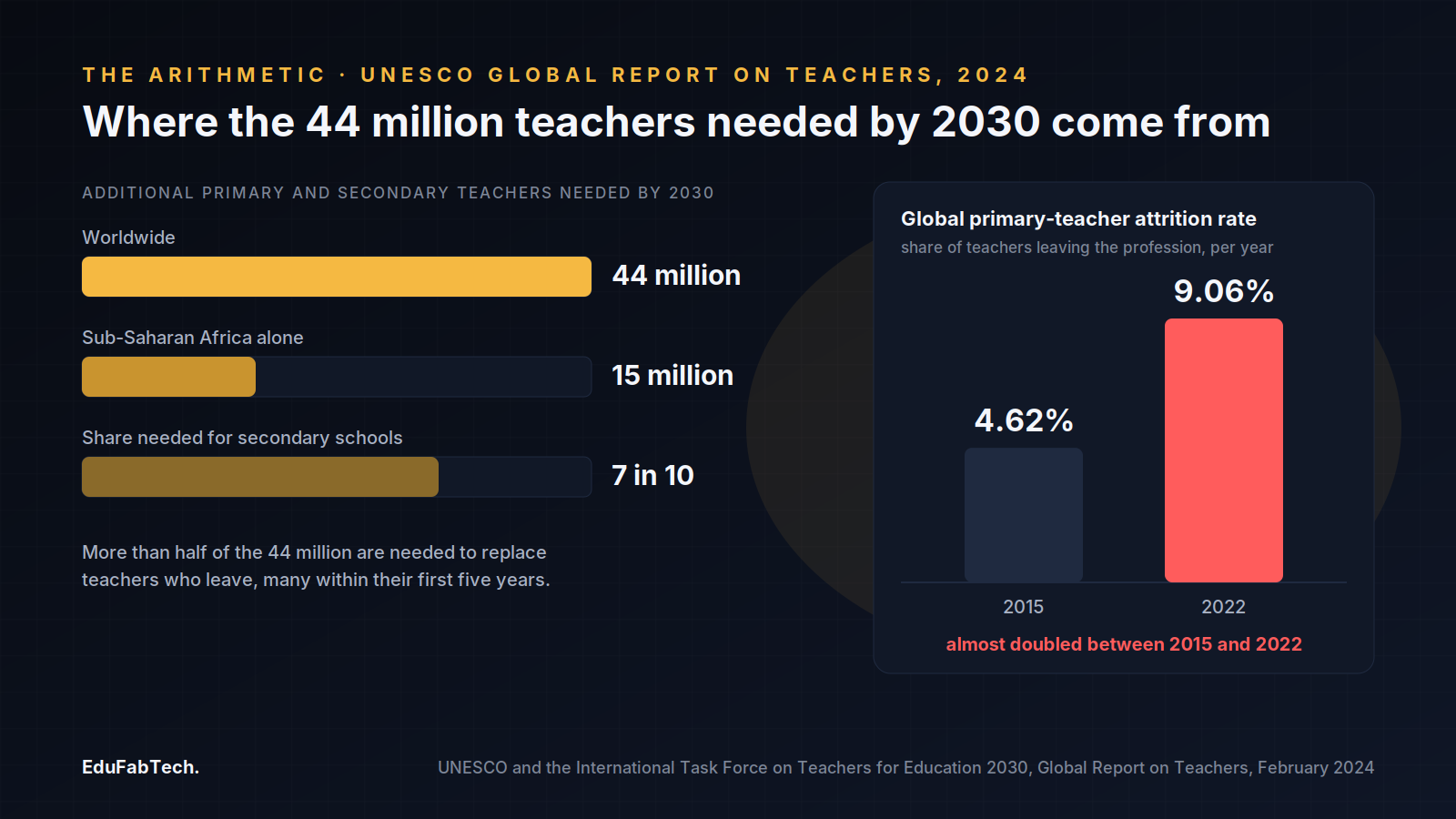
In February 2024, UNESCO and the International Task Force on Teachers for Education 2030 published the first Global Report on Teachers. Its headline figure is that the world needs 44 million additional primary and secondary teachers by 2030 to reach universal primary and secondary education. Sub-Saharan Africa alone needs 15 million of them. Seven out of ten of the teachers needed are for secondary schools.
The figure that should worry parents more than the total is its composition. According to the same UNESCO report, more than half of the 44 million are needed not to open new classrooms but to replace teachers who leave. The global attrition rate of primary teachers almost doubled, from 4.62 per cent in 2015 to 9.06 per cent in 2022, and many of those who go leave within their first five years. UNESCO puts the annual cost of the additional posts at about US$120 billion by 2030: US$12.8 billion for primary and US$106.8 billion for secondary education.
Read that as a student and the maths is personal. A teacher who leaves in year three was trained for a career and delivered a fraction of it; the pupil in the fourth row that year got a substitute, a bigger class or nothing. Read it as a parent and the question is who will be standing in front of your child in 2030. Read it as a 17-year-old choosing a degree and the question is whether anyone has ever made the case for you to be that person.
The paradox: they love the work, and they leave anyway
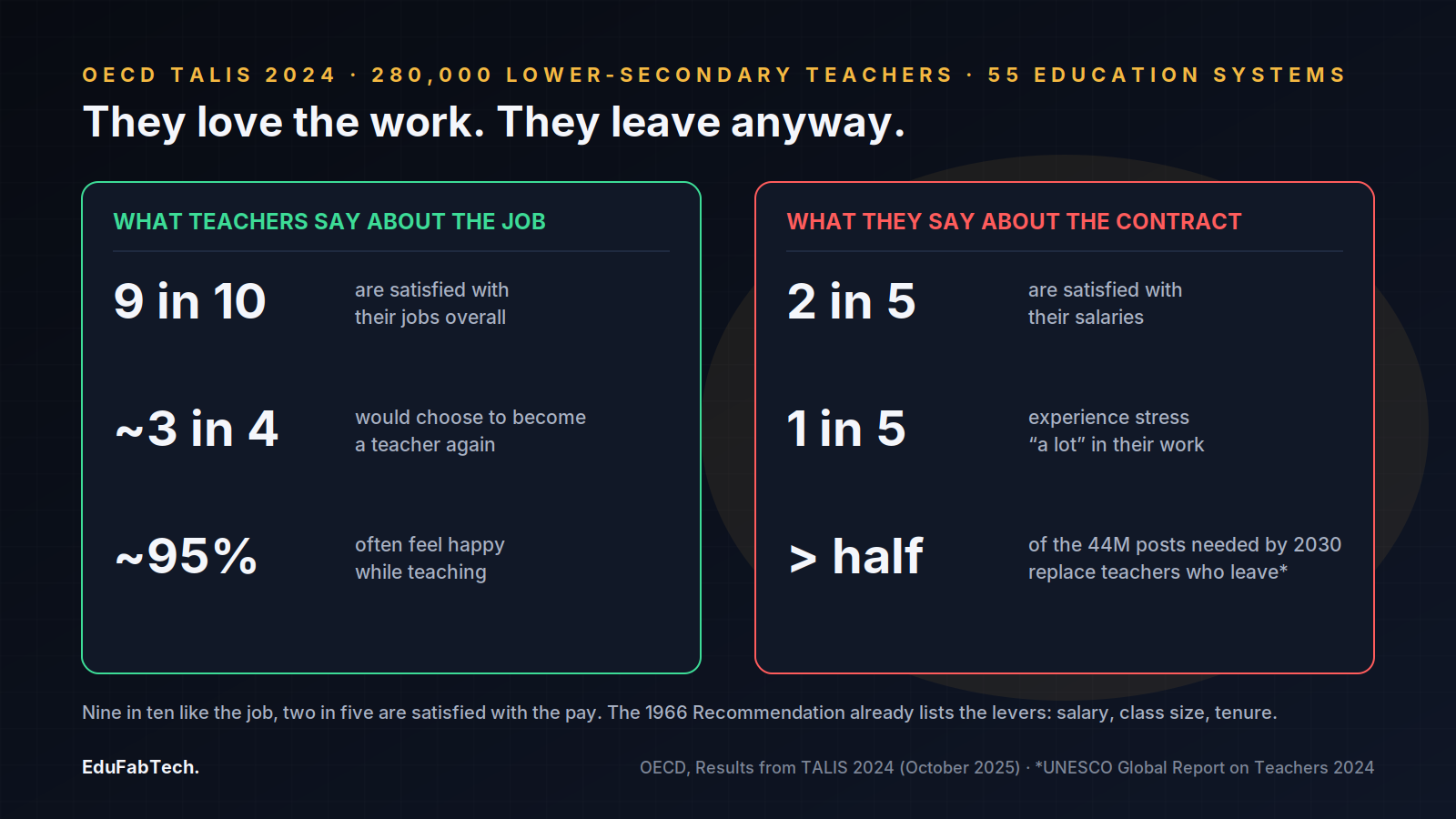
The OECD's TALIS 2024 survey, released in October 2025, asked 280,000 lower-secondary teachers in 17,000 schools across 55 education systems how they are doing. Nine in ten said they are satisfied with their jobs. Almost three-quarters would choose teaching again. Almost 95 per cent said they often feel happy while teaching. In the OECD's own summary of the results, its education director Andreas Schleicher notes that only around one in five teachers experience stress "a lot" in their work.
Then the money line: in the same OECD survey, around two in five teachers are satisfied with their salaries. The OECD also reports that teachers who believe the profession is valued by society are less likely to want to leave within the next five years. The 1966 text said the same thing in different words. Sixty years later, the survey data and the attrition data describe the same person: someone who likes the job, feels underpaid or unseen, and leaves not because the classroom failed but because the contract around it did.
That is why the 2026 theme says "standing with", not "celebrating". Celebrating is a card on 5 October. Standing with is the pay scale, the class size, and whether a ministry asks teachers before it rewrites the curriculum. The site's recent coverage of the OECD's Education at a Glance 2026 and the 2026 Academic Freedom Index shows how uneven that standing still is from one country to the next.
Three readers, three jobs before Monday
If you are a student: write down the name of one teacher who changed your path, and tell them. Pérez Amarillo's colleagues called him a teacher of teachers because the people he trained went on to train others; the chain only becomes visible at the end. If that teacher taught you ten years ago, they still remember the class.
If you are a parent: ask your child's school one question this week: how many teachers left last year, and why. The UNESCO attrition figure is a global average. Your school's number is the one that matters, and the school knows it.
If you are a teacher: the 1966 Recommendation is a document you can quote back. It sets benchmarks on preparation, pay, class size and academic freedom that your own government accepted. Monday's ceremony in Paris awards the ninth UNESCO-Hamdan Prize for Teacher Development; the other 364 days are where the 146 paragraphs either apply or do not.
If you are 18 and have never considered teaching: the OECD survey says almost three-quarters of the people who chose it would choose it again. Few professions can say that about themselves in public.
If you run a school or sit in a ministry: the attrition rate is the number to publish, not the number to manage quietly. UNESCO's report says more than half of the 44 million posts exist because someone left. Every teacher kept past year five is a post that does not need to be funded twice, and the 1966 text already lists the levers: salary, class size, preparation, tenure and a say in what is taught.
Seven numbers to carry into Monday
- 60 years since the ILO/UNESCO Recommendation concerning the Status of Teachers was adopted on 5 October 1966.
- 146 paragraphs in that Recommendation, covering preparation, pay, class size, tenure and academic freedom.
- 44 million additional primary and secondary teachers needed worldwide by 2030, according to UNESCO's 2024 Global Report on Teachers.
- 15 million of them needed in sub-Saharan Africa alone.
- 4.62 per cent to 9.06 per cent: the rise in the global primary-teacher attrition rate between 2015 and 2022, in the same UNESCO report.
- 280,000 lower-secondary teachers in 55 education systems surveyed by the OECD's TALIS 2024.
- Two in five: the share of those teachers satisfied with their salary, against nine in ten satisfied with the job.
What a teacher is worth
Brito's award at Rice is for recitation instructors, the people who take a crowded lecture and make it make sense in a small room. Pérez Amarillo's obituary mentions no prize at all, only two hospitals and the people he trained. On Monday the world will say thank you in Arabic, English, French and Spanish at UNESCO in Paris. The more useful version is shorter and can be done from a phone: a name, a message, and an honest answer to the question of who will be standing in front of the next class.
Tell us about the teacher you never thanked in the EduFabTech forum, and answer one question in the polls section: would you choose teaching as a career?
A quick question for readers
How many hours a week do you study outside class?
Everyone says they study "a lot". Add your honest number and see how students around the world really compare.
Pick an answer, create a free account in a minute, and your vote counts. Already a member? Sign in
Sources (5)
- UNESCO; International Task Force on Teachers for Education 2030. Global report on teachers: what you need to know. UNESCO, 2024. unesco.org ↗ · checked 3 Oct 2026
- UNESCO. World Teachers' Day 2026 global celebration. UNESCO, 2026. unesco.org ↗ · checked 3 Oct 2026
- ILO; UNESCO. ILO-UNESCO Recommendation concerning the Status of Teachers, 1966. International Labour Organization, 1966. ilo.org ↗ · checked 3 Oct 2026
- Schleicher, A.. Are teachers happy teaching? Insights from TALIS. OECD Education and Skills Today, 2025. oecdedutoday.com ↗ · checked 3 Oct 2026
- Professor Julián Pérez Amarillo, a distinguished Cuban microbiologist, has passed away. CiberCuba, 2026. en.cibercuba.com ↗ · checked 3 Oct 2026