Global Study of 6.1 Million People Finds Pain Rises Sharpest Before 55, Hits Lowest-HDI Nations Hardest
A Nature Medicine paper published October 5, 2026 builds the first global reference curves for pain, finding steep sex gaps and a substantially higher late-life pain burden in the lowest-HDI countries.
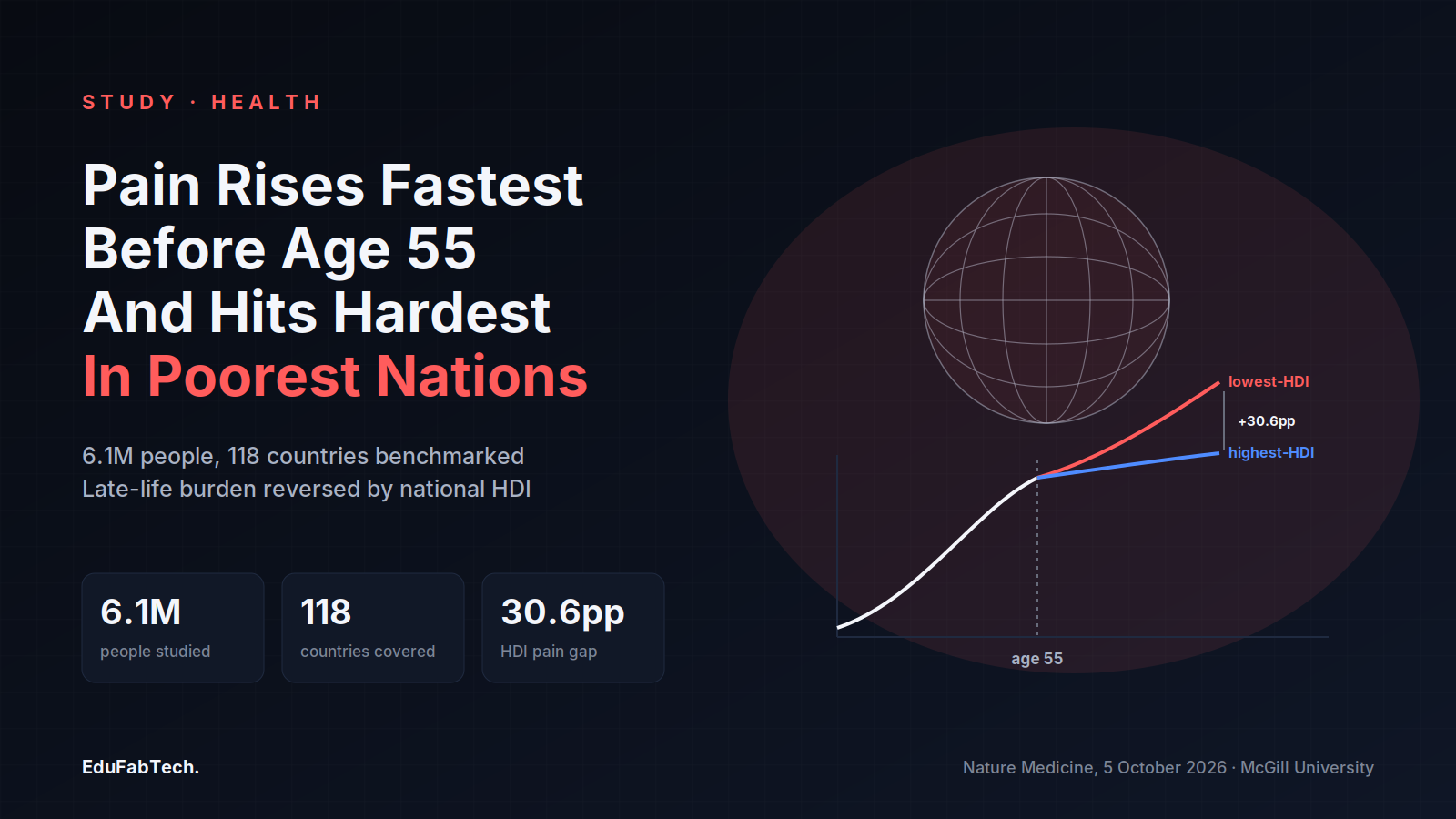
A study published in Nature Medicine on October 5, 2026 has produced the first global reference curves for pain, built from self-reported data on 6,125,459 people across 902 population-based data sources in 118 countries. Led by Matt Fillingim, Christophe Tanguay-Sabourin and Etienne Vachon-Presseau at McGill University, the paper covers participants aged roughly 5 to over 100, collected between 1990 and 2025, and sets out to give researchers and health systems a common yardstick for comparing pain burden across countries and age groups, something the authors say has not existed before.
What the reference curves show
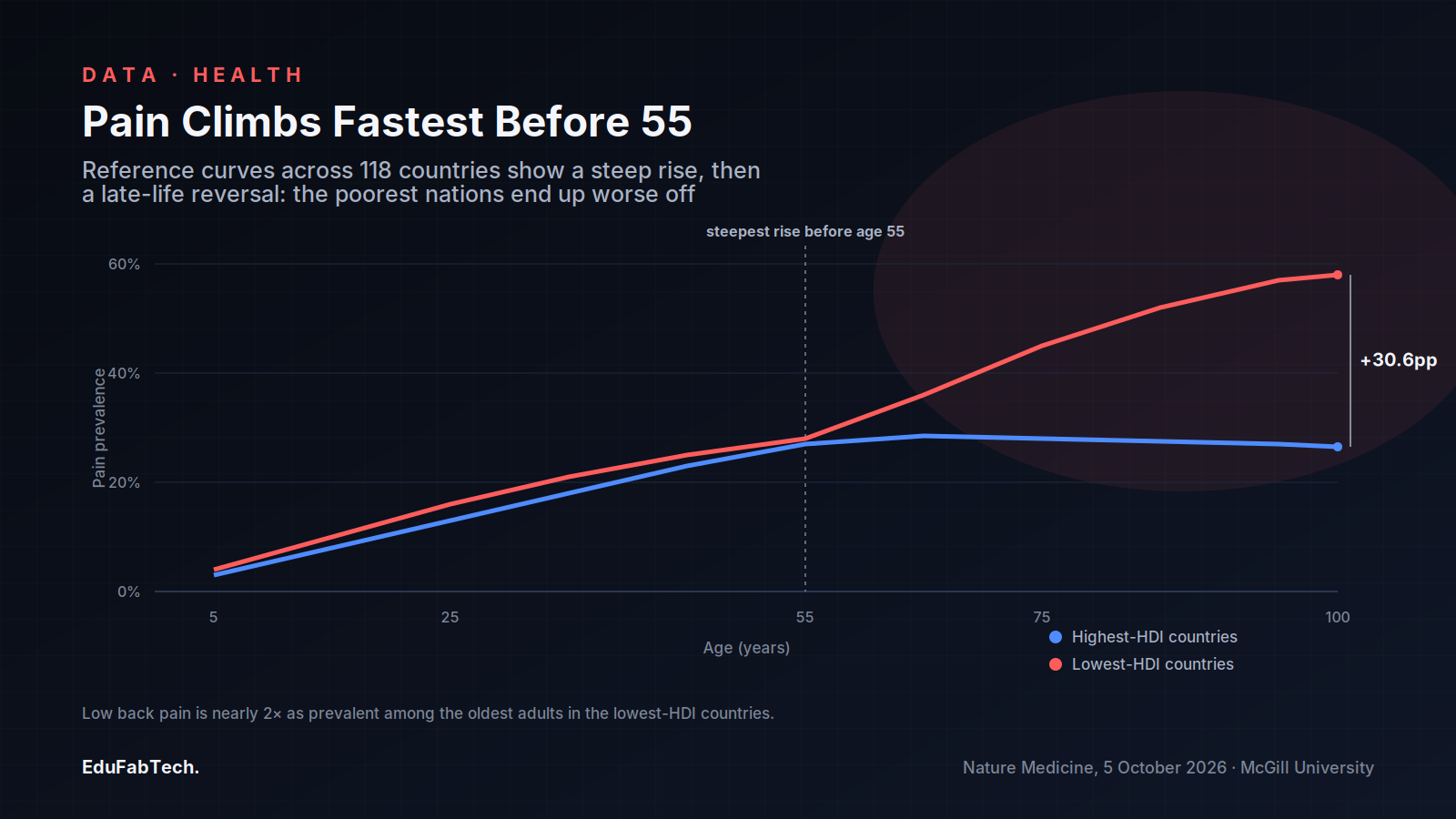
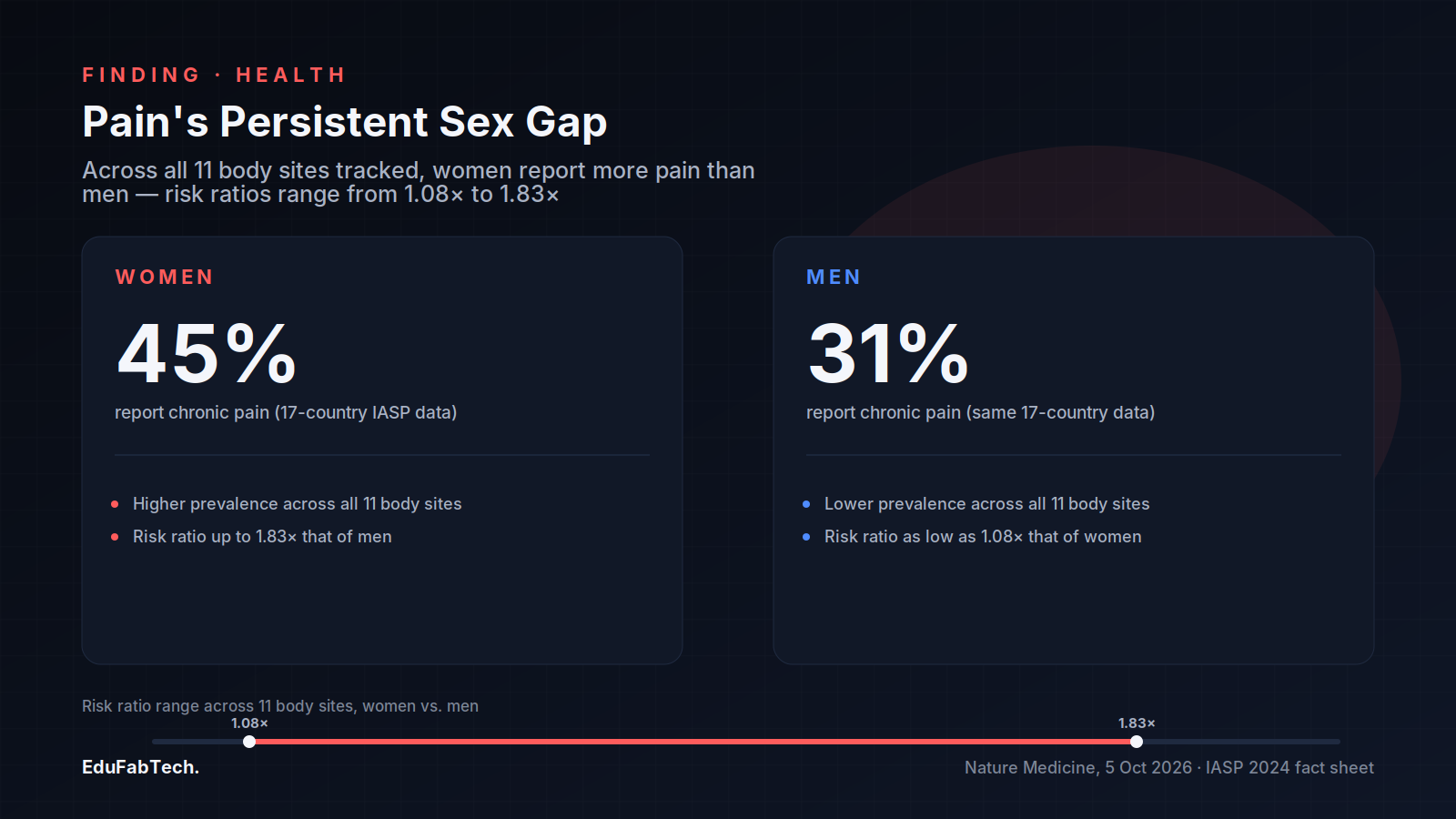
Across the eleven body sites tracked in the study, prevalence varied enormously by location: roughly 2% of people reported facial pain, compared with about 40% for back pain, according to the Nature Medicine paper. Pain of every kind was consistently more common in women than men across all eleven sites, with the risk ratio ranging from 1.08 to 1.83 depending on the body part. The paper reports that prevalence increased most steeply before age 55, a pattern the authors describe as sharper and earlier than commonly assumed life-course trajectories of pain.
A reversal on where pain is worst
The most notable finding concerns where pain is heaviest late in life. Existing estimates have generally projected a higher prevalence of pain conditions in countries with a higher Human Development Index (HDI). The new analysis found the opposite pattern in old age: people in the lowest-HDI countries had a substantially higher late-life prevalence of bodily pain than those in the highest-HDI countries, a risk difference of 30.6 percentage points (95% confidence interval: 26.9–34.3), with low back pain specifically approaching double the prevalence at the oldest ages, per the study. The preprint version posted on medRxiv frames this as "contrary to existing estimates," underscoring that the reversal is a finding of this harmonized dataset rather than a settled fact established elsewhere.
What drives the burden, and what doesn't explain it
The researchers also tested how much of the global pain burden could be attributed to three modifiable risk factors: smoking, obesity and low income. Together these accounted for 18.3% of pain burden across anatomical sites worldwide, but the share varied sharply by region, from 12.6% in sub-Saharan Africa to 27.1% in eastern Europe, according to the paper. The authors note this regional gap means the factors driving pain in lower-HDI settings are still poorly characterized, since known risk factors explain much less of the burden there than in higher-income regions.
Why the sex gap matters for care
The consistent sex gap found in the study lines up with what pain researchers have already documented. A 2024 fact sheet from the International Association for the Study of Pain (IASP) cites research across 17 countries finding chronic pain prevalence of 45% in women compared with 31% in men, and states that gender-related bias, including the dismissal of women's pain by clinicians, is a documented barrier to equitable treatment. The IASP fact sheet also notes that women have historically been underrepresented in pain research, partly because of concerns about menstrual-cycle effects on study data, which has limited the evidence base for sex-tailored treatment.
How the data was built
Rather than running a new survey, the team harmonized self-reported pain measures already collected by hundreds of existing population studies, pooling de-identified individual-level records under data-transfer agreements and public repositories, an approach reviewed by McGill University's Faculty of Medicine and Health Sciences Research Ethics Board, according to the Nature Medicine paper. Because most of the underlying surveys captured different age groups at a single point in time rather than following the same individuals over decades, the reference curves describe population-level patterns across ages rather than tracking how any one person's pain changes as they get older.
What it means for students and researchers
The authors built their reference trajectories into an open-access benchmarking platform, letting any research team or health system position a new dataset, patient cohort, or national survey against the global norms established in the paper rather than against a single-country baseline. For researchers in epidemiology, clinical pain medicine and global health policy, that gives a shared comparison point that previously did not exist for a condition the authors describe as the leading cause of disability worldwide. The authors are explicit that their findings on HDI and modifiable risk factors identify gaps in understanding rather than settled explanations, stating that what underlies pain in lower-HDI settings "remains poorly characterized" and pointing to further work needed to explain the reversal they found in late-life pain burden.
A quick question for readers
Which study habit do you think is most overrated?
Some popular habits have little evidence behind them. Which one do you think gets too much credit?
Pick an answer, create a free account in a minute, and your vote counts. Already a member? Sign in
Source: Nature Medicine
Sources (3)
- Matt Fillingim, Christophe Tanguay-Sabourin, Etienne Vachon-Presseau et al.. Global and regional reference curves for pain across the lifespan in 6.1 million individuals in 118 countries. Nature Medicine, 2026. nature.com ↗ · checked 7 Oct 2026
- Matt Fillingim, Christophe Tanguay-Sabourin, Etienne Vachon-Presseau et al.. Pain across the lifespan: global and regional reference curves from 6.1 million individuals in 118 countries. medRxiv, 2026. medrxiv.org ↗ · checked 7 Oct 2026
- International Association for the Study of Pain. Sex and Gender Differences in Human Pain. IASP Fact Sheet, 2024. iasp-pain.org ↗ · checked 7 Oct 2026