Lancet Countdown's 2026 Report Says Climate Harms to Health Are Outpacing the Response
A 146-researcher report published in The Lancet on 27 October 2026 finds heat deaths, drought and economic losses growing faster since the Paris Agreement than before it.
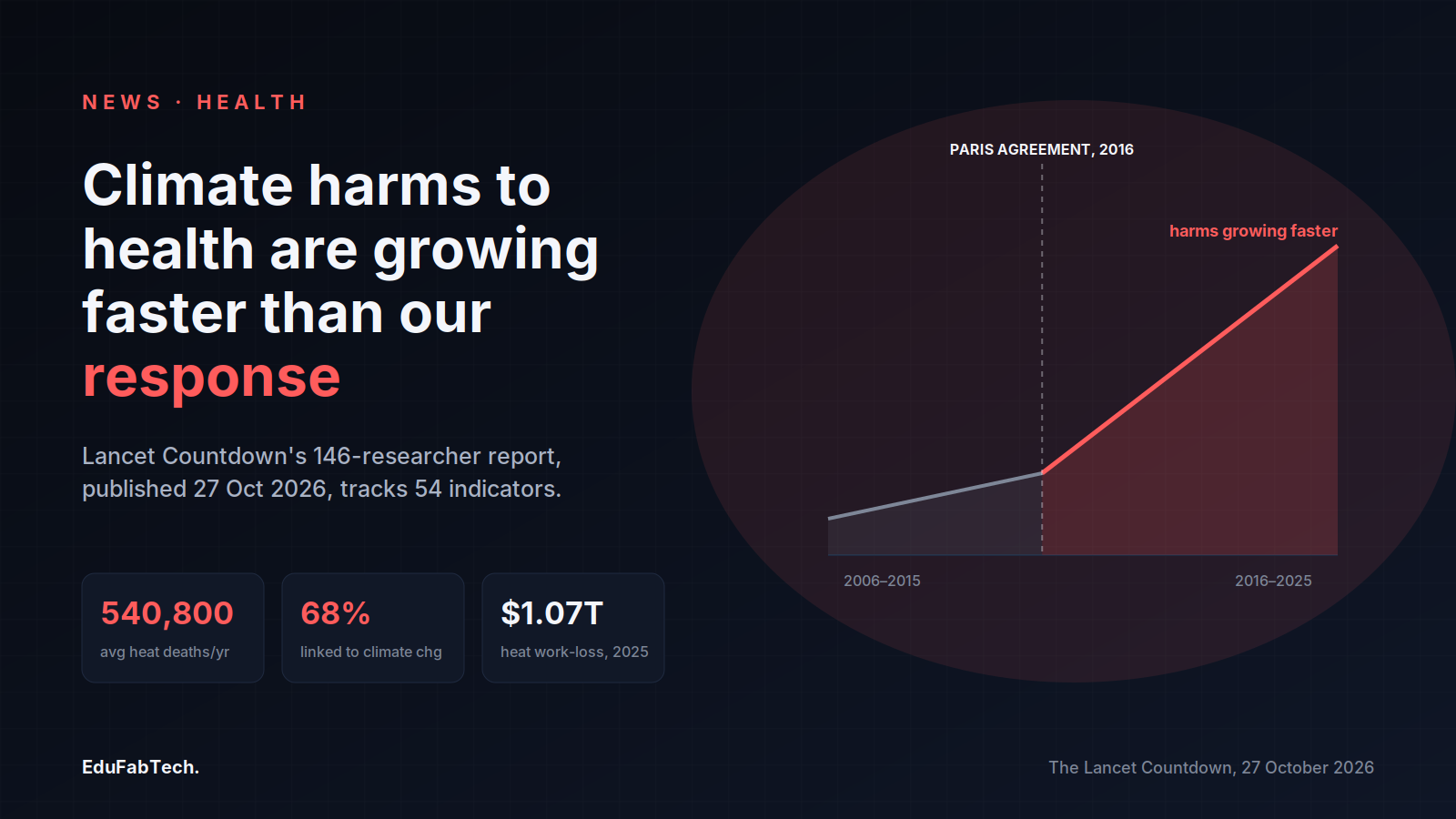
The tenth annual report of the Lancet Countdown on Health and Climate Change, published in The Lancet on 27 October 2026 and announced by the World Health Organization the following day, finds that climate-related harms to health have grown faster since the Paris Agreement took effect than in the decade before it. The report, led by University College London, brings together 146 researchers from 71 collaborating institutions across more than 30 countries, and tracks 54 indicators linking climate change and health, four of them new this year, according to the Lancet Countdown's report page.
Its central comparison is a before-and-after one: many of the health risks and harms from climate change grew faster in 2016-2025, the decade following the Paris Agreement, than they did in 2006-2015, the decade before it, the report states. The authors frame this as the reason to treat climate change as an acute threat to health rather than a slow background trend.
The Lancet Countdown's executive director, Professor Marina Romanello, says: "That is why we are calling for climate change to be formally recognised as a global health emergency, with health placed at the centre of every climate decision," according to the Lancet Countdown's report page. The WHO's director-general, Dr Tedros Adhanom Ghebreyesus, is quoted saying that "climate change is one of the greatest threats to health facing humanity" and that "the solutions are within reach," according to the same Lancet Countdown report page.
Heat deaths and the cost of lost work
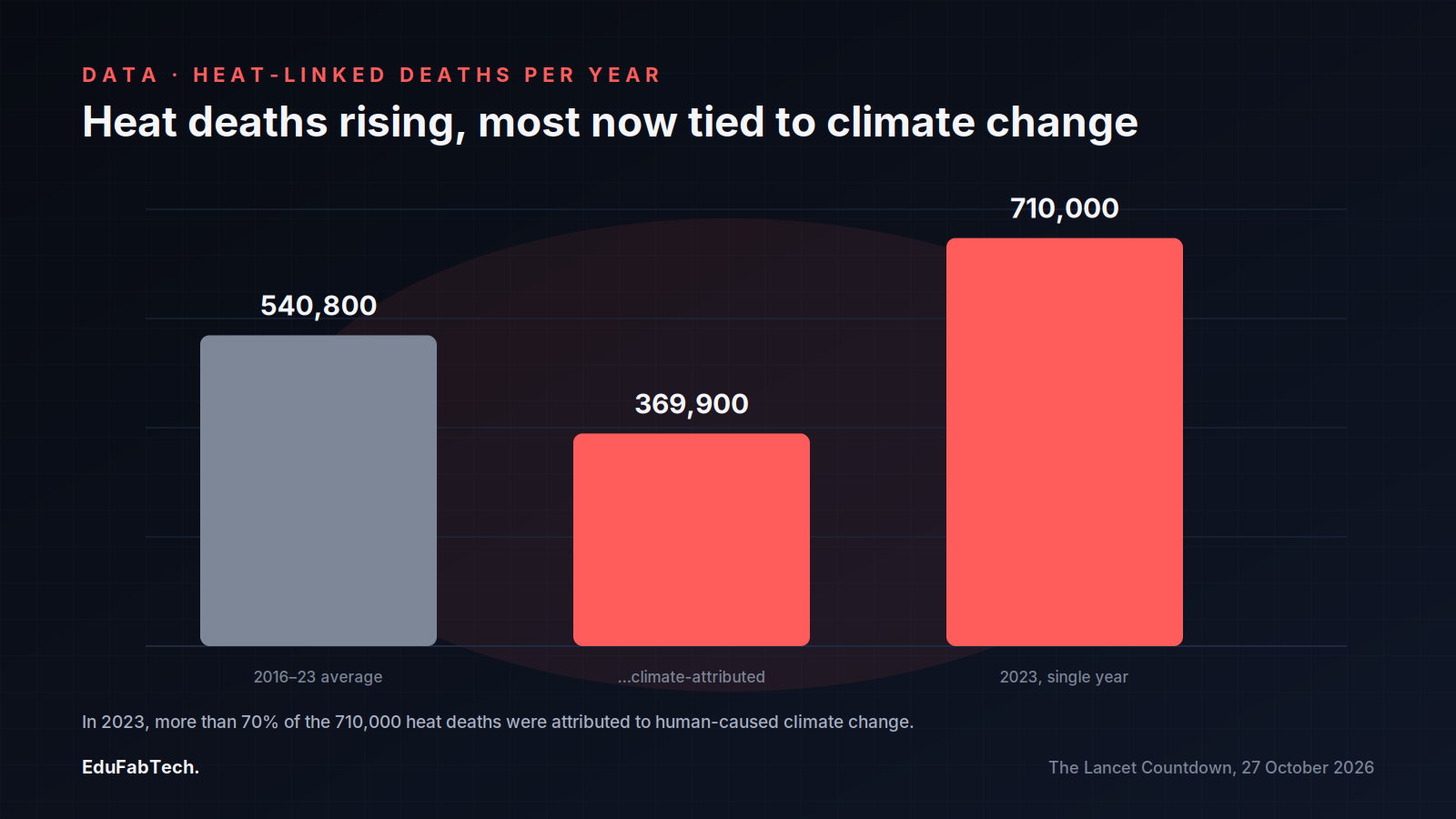
Heat was linked to an average of 540,800 deaths a year between 2016 and 2023, of which 369,900, or 68%, are attributed to human-caused climate change, the Lancet Countdown's 2026 report finds, as summarized in the WHO's statement on the report. In 2023 alone, heat was linked to 710,000 deaths worldwide, with more than 70% of that toll attributed to climate change, the same report finds.
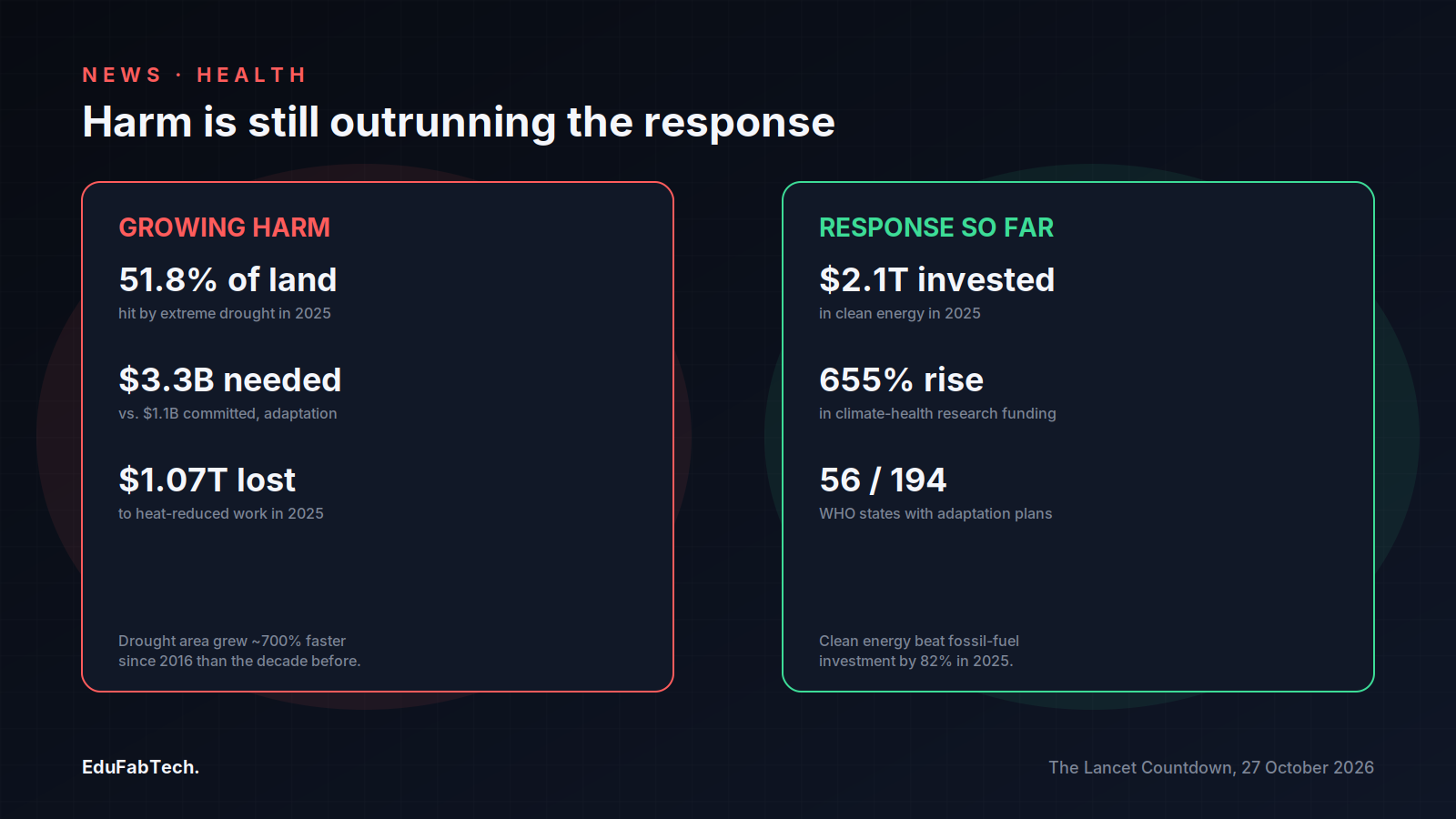
The report also estimates the economic toll of heat on labour: reduced capacity to work productively in the heat cost the global economy an estimated $1.07 trillion in potential income in 2025, equivalent to 0.91% of global economic output and the third consecutive year that losses have topped $1 trillion, according to the report's findings.
Drought, water and the gap in adaptation funding
On water extremes, the 2026 report finds that 51.8% of the world's land experienced extreme drought conditions for at least a month in 2025, with the area affected by drought growing roughly 700% faster since 2016 than in the preceding decade. Funding to help health systems adapt to these pressures remains well short of what the report estimates is needed: developing countries require an estimated $3.3 billion a year in health-adaptation finance, based on cost estimates from 48 of the 79 countries that have completed them, against $1.1 billion actually committed in 2024.
Where the report finds progress
The report does not describe the trend as one-sided. Global investment in clean energy reached $2.1 trillion in 2025, 82% more than the $1.16 trillion invested in fossil fuels that year, and funding for climate-and-health research rose 655% between 2016 and 2024, though the report notes that 84% of that funding still goes to researchers in the wealthiest countries. The World Health Organization notes that 56 of its 194 member states now have national health adaptation plans for climate change. The report's authors credit this progress with preventing illness and death, while concluding that it is still outpaced by the harm from continued fossil-fuel-driven warming.
Who is behind the call
The report's board chair, Helen Clark, former Prime Minister of New Zealand, is quoted on the Lancet Countdown's site saying "what's missing is not evidence, but the political will to act on it." The report's executive director, Professor Marina Romanello of University College London, and co-chair Professor Anthony Costello are listed as its lead authors, according to the Lancet Countdown's report page; the full indicator-by-indicator paper is published as Romanello et al. in The Lancet.
What it means for students and researchers
For researchers outside climate epidemiology, the report's value lies less in any single number than in its method: 54 standardized indicators, several of them newly added this year, tracked consistently enough to compare the decade after the Paris Agreement with the decade before it. That design gives students in public health, climate science and health economics a reusable framework for asking whether a given policy or energy transition is outpacing the harm it is meant to offset, rather than a one-off statistic to memorise. The underlying indicator data and methodology are hosted on the Lancet Countdown's site for researchers who want to examine specific indicators or regions in more detail.
A quick question for readers
Which study habit do you think is most overrated?
Some popular habits have little evidence behind them. Which one do you think gets too much credit?
Pick an answer, create a free account in a minute, and your vote counts. Already a member? Sign in
Comments 2
Comment-
The 700% figure on drought growth is the kind of number that needs a denominator before it means anything, and the article doesn't give one.…
-
The number that actually does work in this piece is the 68% versus 70%+ split — human-caused climate change accounts for 369,900 of 540,800…
Join free to read the full comments and reply Comments are between members; an account takes a minute.
Source: Lancet Countdown on Health and Climate Change (University College London)
Sources (3)
- Romanello, M. et al.. The 2026 report of the Lancet Countdown on health and climate change: a decade of escalating health harms and a decisive moment for all. The Lancet, 2026. thelancet.com ↗ · checked 29 Oct 2026
- Lancet Countdown on Health and Climate Change. 2026 Report. University College London / Lancet Countdown, 2026. lancetcountdown.org ↗ · checked 29 Oct 2026
- World Health Organization. Climate change is a growing health emergency, Lancet Countdown warns. World Health Organization, 2026. who.int ↗ · checked 29 Oct 2026