A Common Epilepsy Drug Is Linked to Longer Survival in an Almost Untreatable Childhood Brain Tumor
A Nature Medicine study led by Stanford Medicine finds that levetiracetam, taken for seizures, is associated with longer survival in diffuse midline glioma by acting on tumor-specific synapses, not its usual anti-seizure pathway.
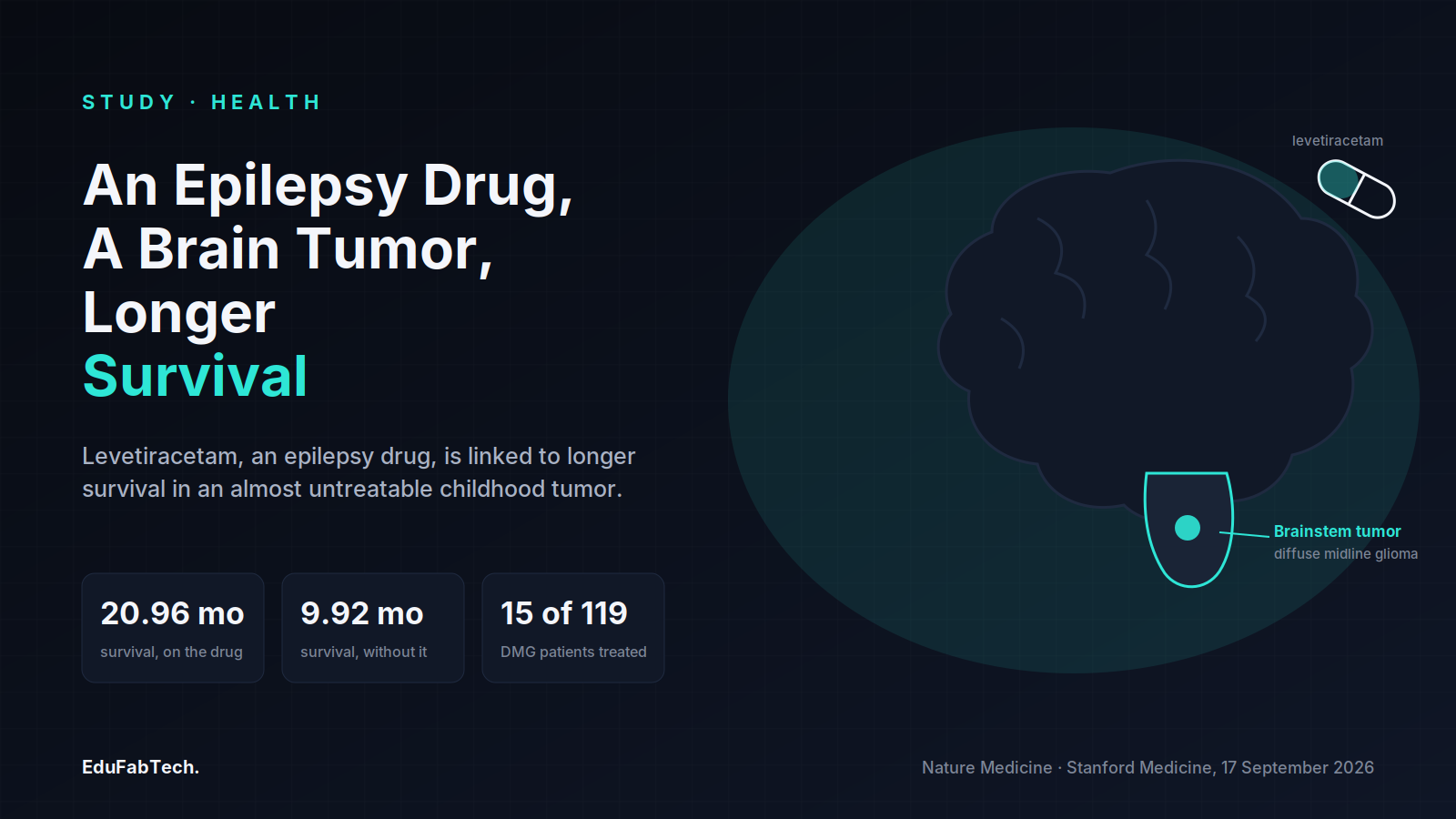
A study published in Nature Medicine on September 17, 2026 reports that children with diffuse midline glioma, an aggressive brainstem tumor with no established disease-modifying drug, lived substantially longer if they happened to be taking the anti-seizure medication levetiracetam. The team, led by Michelle Monje at Stanford Medicine with collaborators at the University of Michigan, the University of California, San Francisco, University Medical Center Hamburg-Eppendorf and the University of Helsinki, describes the finding as retrospective and preliminary, with a prospective clinical trial now being organized to test it directly.
Diffuse midline glioma grows through the brainstem, the structure that controls breathing and heart rate, which makes surgical removal impossible in almost all cases. Radiation can slow it temporarily, but no drug has been shown to meaningfully extend survival, and the tumor is fatal in nearly all children who develop it. Levetiracetam, sold under the brand name Keppra among others, is a decades-old, inexpensive epilepsy medication already prescribed to many of these children simply because the tumor's location often triggers seizures.
What the records showed
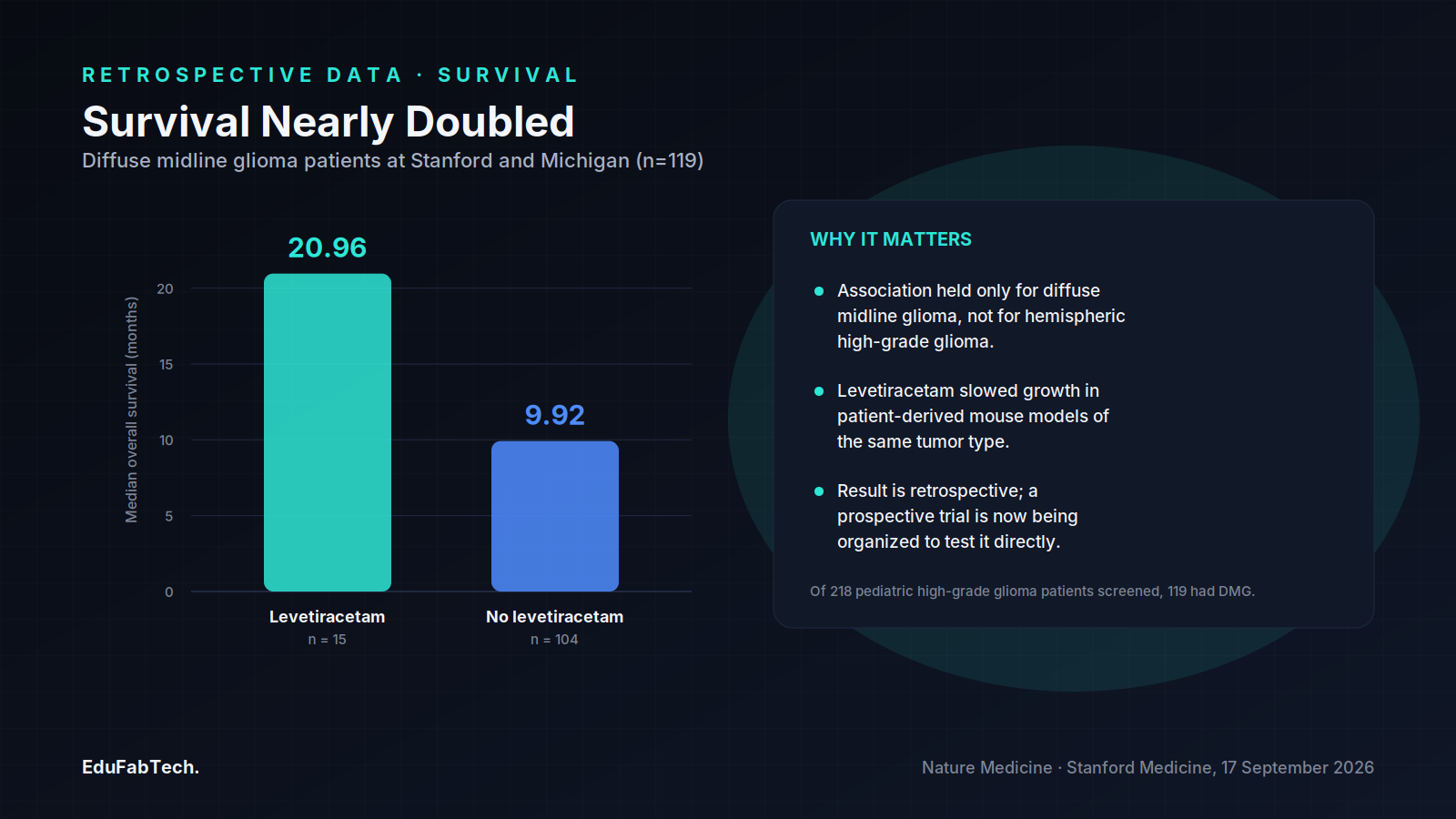
Monje's team analyzed medical records from 218 pediatric patients with high-grade glioma treated at two academic medical centers, Stanford University and the University of Michigan. Of those, 119 children had diffuse midline glioma specifically. Among that group, the 15 who were taking levetiracetam had a median overall survival of 20.96 months, compared with 9.92 months for the 104 who were not taking the drug. The levetiracetam-treated group is small, and the authors report the comparison as a retrospective association, not a controlled result. The association did not hold for children with hemispheric high-grade glioma, a different and less uniformly fatal tumor type — a distinction the authors treat as evidence that the effect is specific to diffuse midline glioma rather than a general property of the drug or of children who happen to be prescribed it.
A tumor-specific synapse, not the usual anti-seizure pathway
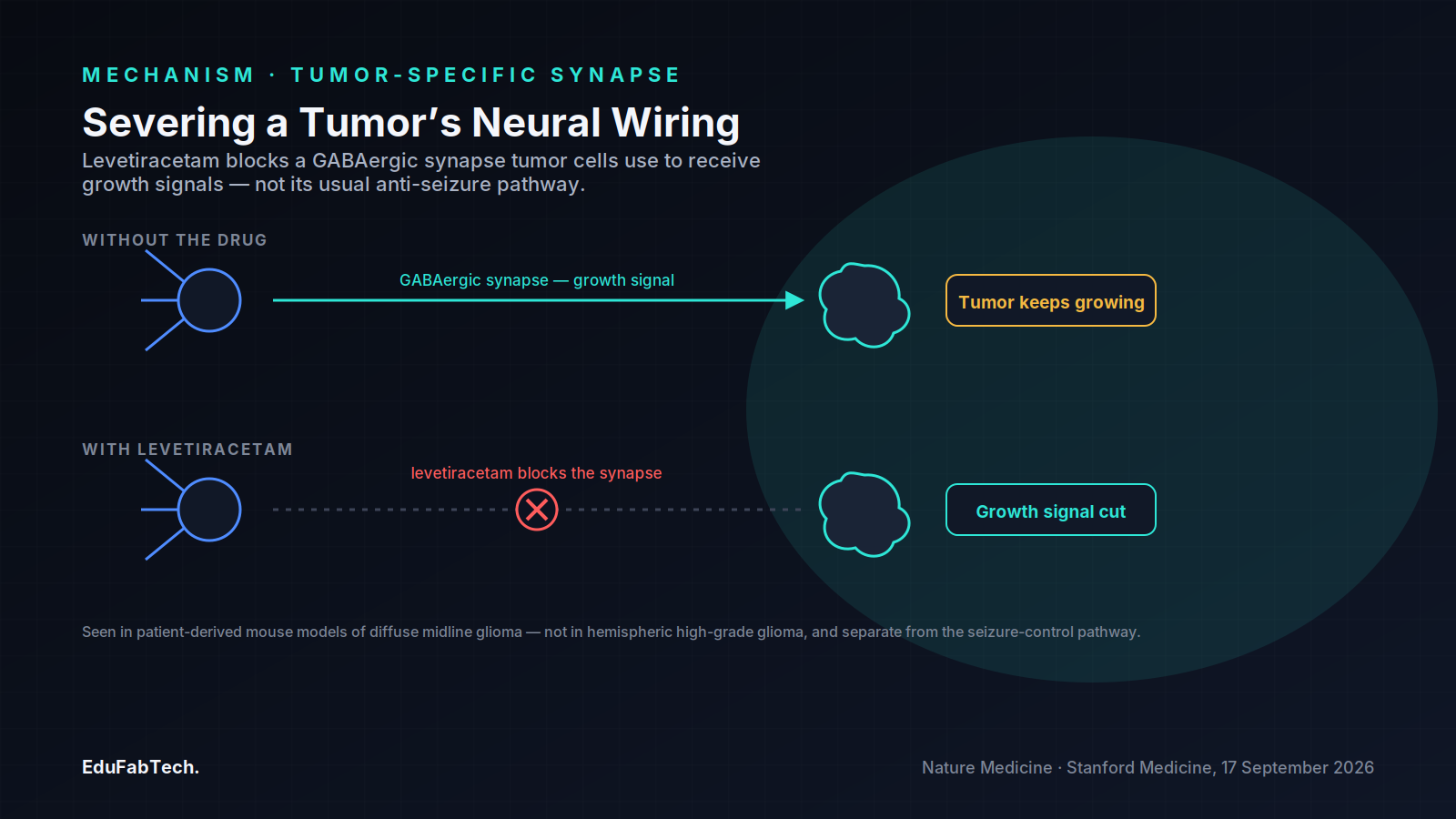
To test whether the association reflected a real biological effect, the researchers gave levetiracetam to mice carrying tumors grown from diffuse midline glioma cells taken from patients. The drug slowed tumor growth in these patient-derived models, but had no effect on mouse models of hemispheric high-grade glioma, mirroring the pattern seen in the clinical records. Mechanistically, the paper reports that levetiracetam acts on GABAergic synapses that form between healthy neurons and tumor cells — a route distinct from the drug's canonical mechanism for controlling seizures. Monje described the effect as tumor-specific in the study's press materials.
"This drug pharmacologically severs an important connection between cancer and the nervous system... What's really interesting is that this is tumor-specific."
The broader context for this line of work is a growing body of "cancer neuroscience" research showing that some tumors, including gliomas, integrate into neural circuits and use synapse-like connections to receive growth signals from surrounding neurons. If confirmed, blocking that specific circuit — rather than the seizure-suppressing action most physicians associate with the drug — would explain why a decades-old, well-tolerated medicine could have gone unnoticed as a potential cancer therapy for this long.
Why this is not a treatment recommendation yet
The authors are explicit that the clinical finding is observational: it compares children who happened to be prescribed levetiracetam, usually for seizure control, against those who were not, rather than randomly assigning the drug. That design cannot rule out confounding — for instance, differences in seizure burden, tumor subtype, or care intensity between the two groups could partly explain the survival gap, and the levetiracetam-treated subgroup numbered only 15 children. The news coverage accompanying the paper notes that a prospective clinical trial has not yet been completed, and Monje has cautioned that levetiracetam alone is unlikely to cure an aggressive tumor of this kind; the more plausible path is as one component of combination treatment.
What happens next
Stanford Medicine's team says it is now launching a clinical trial of levetiracetam in children with diffuse midline glioma and investigating whether the drug can be combined with CAR-T cell immunotherapy, an experimental approach already being tested against this tumor type. The rationale for combining the two, per Monje, is that severing the tumor's neural input might slow its growth long enough to give immune-based therapies more time to work — as she put it, "immunotherapy [is] a footrace between the tumor and immune cells."
For a disease that has seen almost no therapeutic progress in decades, a repurposed, inexpensive, already-approved drug would be a notable result if the association holds up in a controlled trial. Until then, the finding sits where the authors placed it: a statistically striking retrospective signal, backed by a mechanistic explanation in mice, that has not yet been tested prospectively in children.
- Tara Barron, Michelle Monje, et al.. Levetiracetam therapeutically targets GABAergic synapses in diffuse midline glioma. Nature Medicine, 2026. doi:10.1038/s41591-026-04646-6
- Stanford Medicine (press release distributed via EurekAlert/AAAS). Anti-seizure drug fights aggressive childhood brain tumors, Stanford Medicine-led study shows. EurekAlert!, 2026. link
- MedicalXpress. Anti-seizure drug fights aggressive childhood brain tumors, study shows. MedicalXpress, 2026. link
- News-Medical.net. Existing anti-seizure drug slows the growth of diffuse midline gliomas. News-Medical.net (AZoNetwork), 2026. link
- Inside Precision Medicine. Anti-Seizure Drug Could Slow Aggressive Childhood Brain Tumors. Inside Precision Medicine, 2026. link