Mayo Clinic Study Finds Some BRCA2 Variants Carry 20%-25% Lifetime Breast Cancer Risk, Not 50%-70%
A Nature Communications study led by Mayo Clinic with Ambry Genetics tested 70 "hypomorphic" BRCA2 variants and found 34 of them carry a moderate, lifetime breast cancer risk distinct from the gene's classical high-risk mutations, with implications for screening and PARP-inhibitor use.
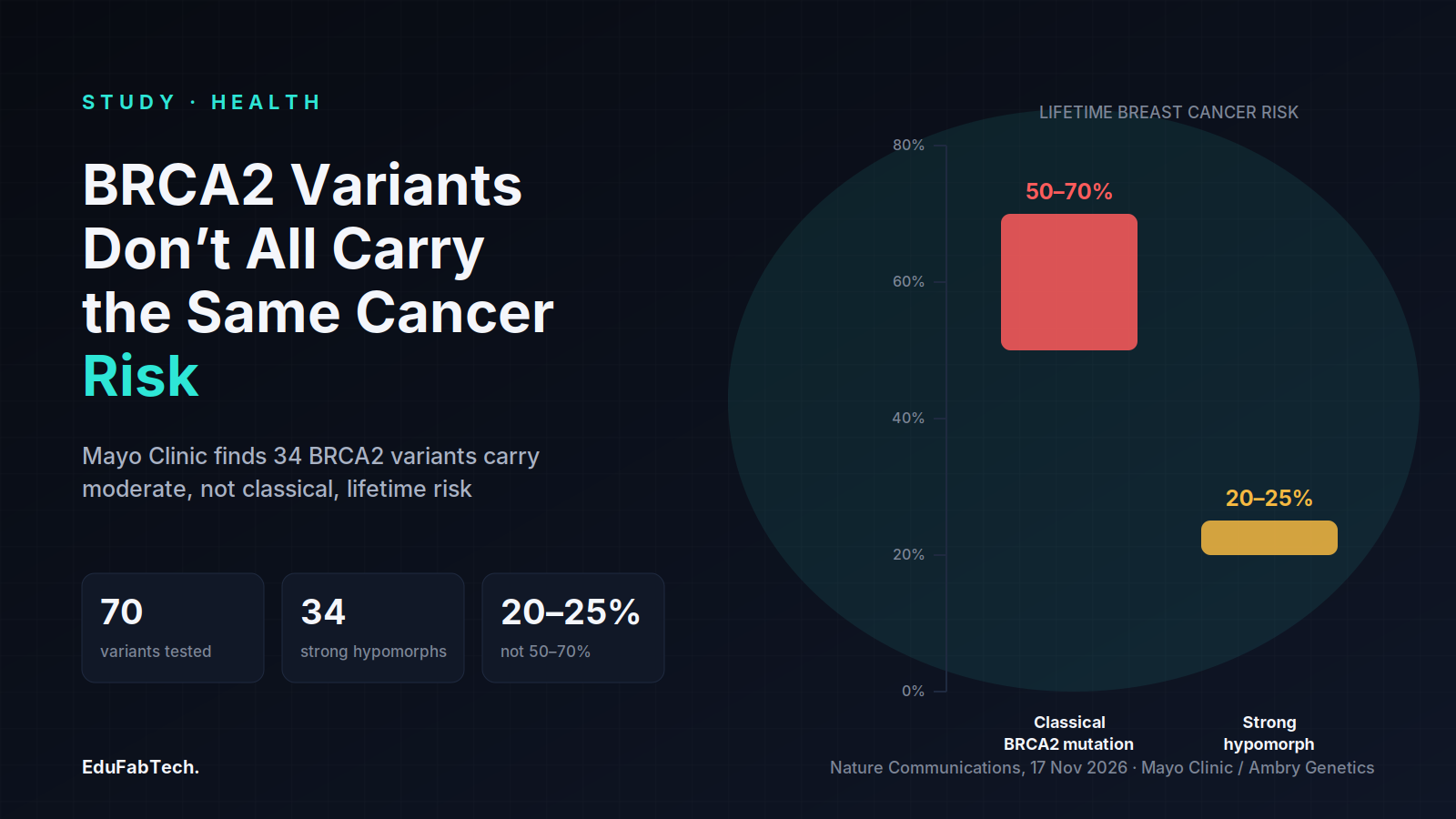
Mayo Clinic researchers, working with the genetic testing laboratory Ambry Genetics, reported in Nature Communications on 17 November 2026 that a group of BRCA2 gene variants long flagged as disease-causing actually carries a substantially lower breast cancer risk than the mutations usually associated with the gene. The study examined 70 BRCA2 missense variants that only partially disrupt the gene's DNA-repair function, a category the authors call "hypomorphic."
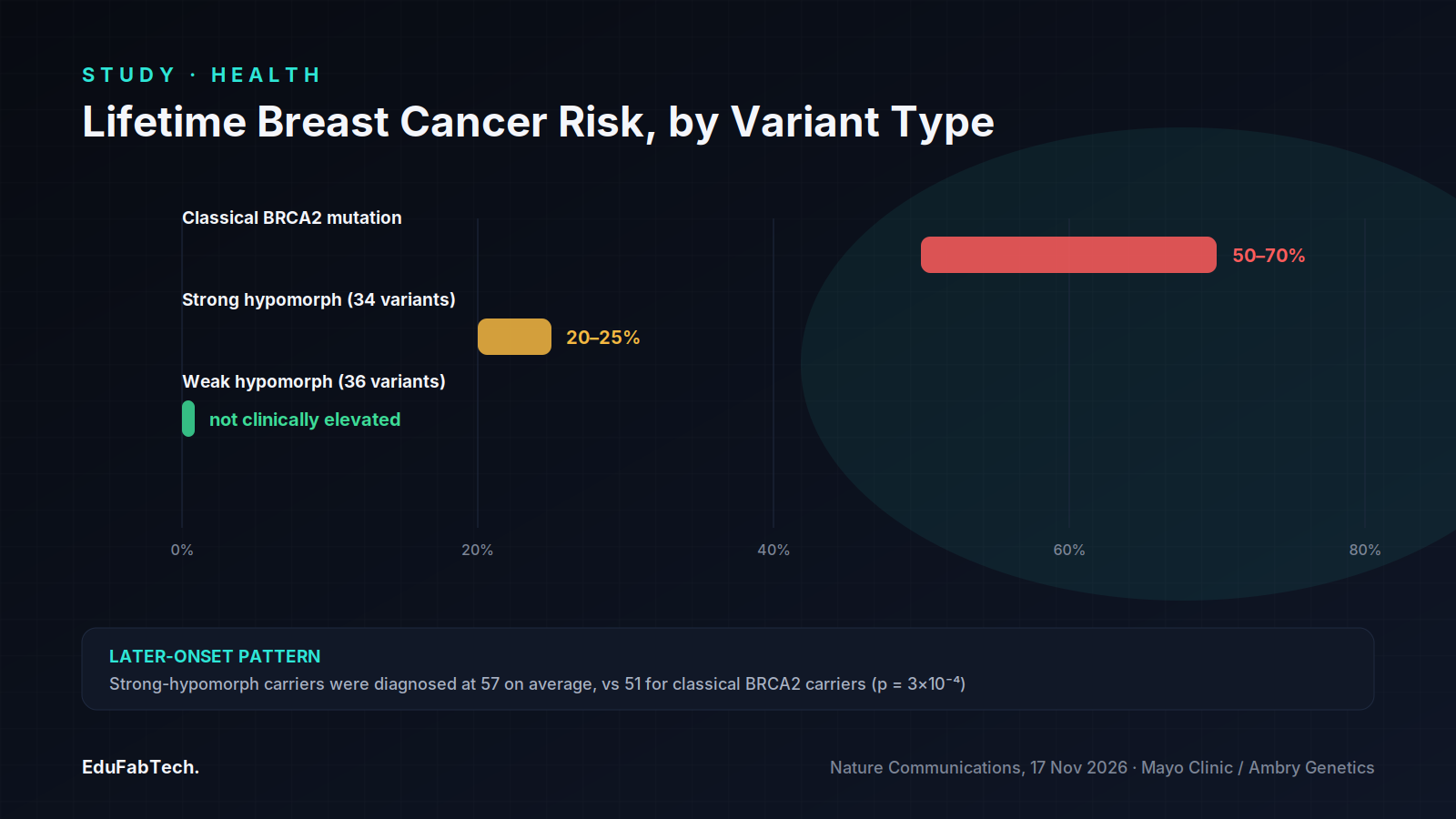
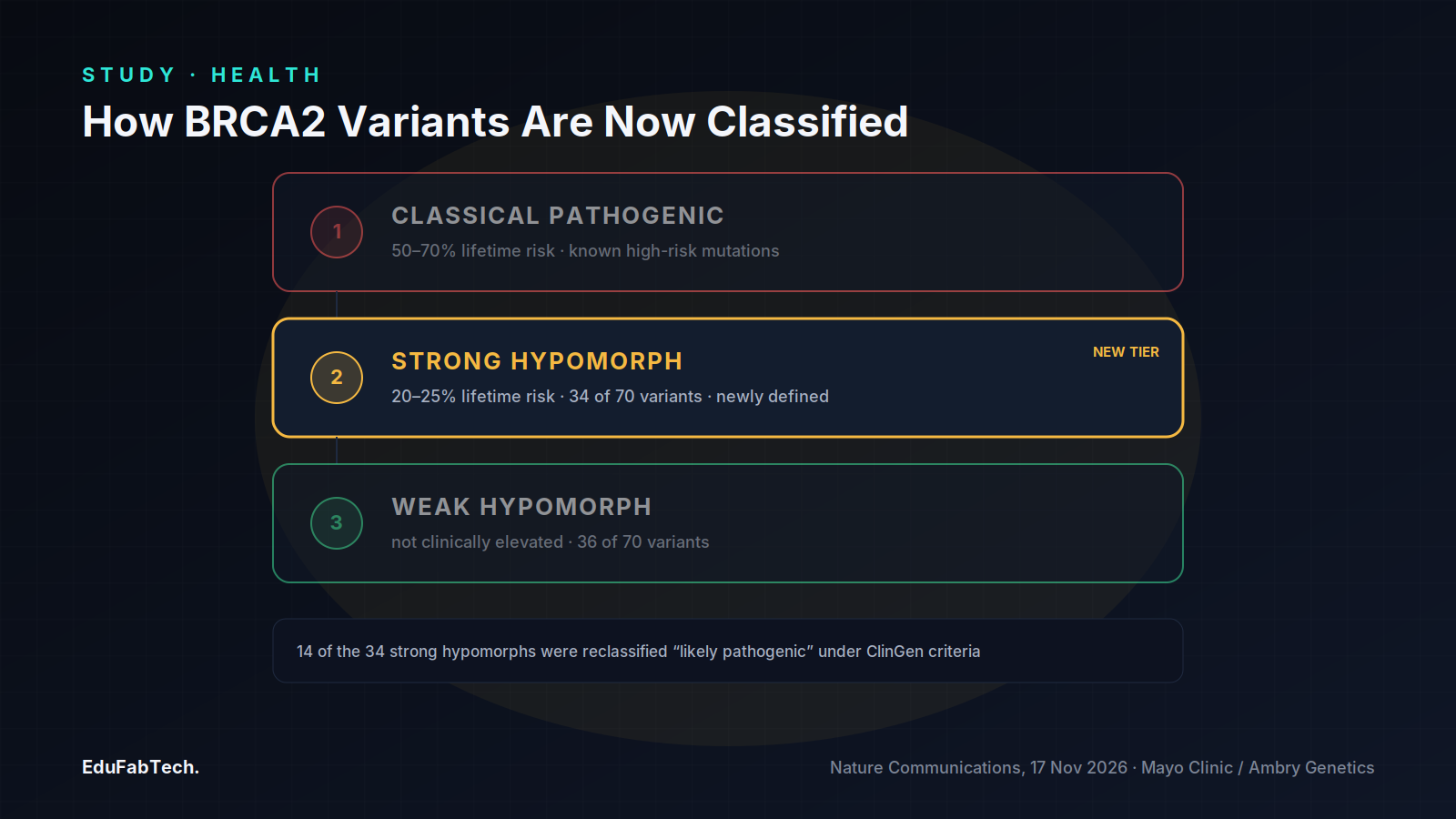
BRCA2 normally helps repair double-strand breaks in DNA through a process called homologous recombination. Classical pathogenic BRCA2 mutations knock this function out almost entirely, and carriers face a lifetime breast cancer risk of about 50% to 70%, according to the Mayo Clinic Comprehensive Cancer Center's announcement of the findings. Of the 70 hypomorphic candidates, the study classified 34 as "strong" hypomorphs, with the greatest residual loss of repair function; these carried a moderate, elevated risk, which the Mayo Clinic announcement translates to a lifetime breast cancer risk of about 20% to 25% — well below the risk tied to classical BRCA2 mutations. The remaining 36 "weak" hypomorphs did not reach a clinically relevant increase in risk, the study found.
"This shows that not all harmful BRCA2 variants carry the same level of breast cancer risk," said Fergus Couch, a researcher at the Mayo Clinic Comprehensive Cancer Center and the study's corresponding author, in the Mayo Clinic announcement.
How the variants were tested
To classify the 70 candidate variants, the researchers used a homology-directed repair assay in V-C8 cells that lack endogenous BRCA2, sorting them into the 34 strong and 36 weak hypomorphs described above, then used CRISPR/Cas9 editing in HAP1 cells to install 67 of the variants at their natural position in the genome, alongside 162 nonsense and 146 silent control variants, according to the study. RAD51 foci formation after gamma-irradiation was used as an additional readout of DNA-repair capacity.
The team also ran a drug-sensitivity screen using the PARP inhibitor olaparib and the topoisomerase 1 inhibitor exatecan. Of the 67 engineered hypomorphs, 63 showed statistically significant sensitivity to olaparib, with cumulative functional scores for the hypomorphs similar to those of fully disabling, truncating ("nonsense") variants under continuous drug exposure, the study reports.
A weaker signal in patient tumors
The researchers then checked whether that laboratory sensitivity shows up in real tumors by profiling 8,424 pan-cancer specimens from a Foundation Medicine genomic database. Tumors from carriers of strong hypomorphic variants showed loss of the second, healthy BRCA2 copy in 56% of samples, compared with 68% for tumors with classical pathogenic variants — a smaller but still substantial share, the study found. Among tumors that had lost that second copy, a machine-learning signature of homologous recombination deficiency (HRDsig) was positive in just 8 of 25 samples (32%) carrying strong or weak hypomorphic variants, compared with 83% of tumors with classical pathogenic variants and the same loss — scores for the hypomorph group clustered just below the usual positivity threshold, the study found.
In case-control genetic testing data, strong hypomorphic variants were associated with an odds ratio of 2.41 in a Myriad Genetics cohort and 2.09 in an Ambry Genetics cohort, compared with an odds ratio above 4.0 for classical pathogenic variants, the authors report; the 36 weak hypomorphs did not reach a clinically relevant odds ratio (above 2) in either cohort. Carriers of strong hypomorphs were also diagnosed with breast cancer at a later average age — 57 years, versus 51 years for carriers of classical BRCA2 mutations (p = 3 × 10⁻⁴), according to the study.
What it could mean for carriers and clinicians
Couch said the distinction matters for how doctors manage risk. "Understanding these differences could help us better match cancer prevention and screening strategies to an individual's actual risk," he said in the Mayo Clinic announcement, adding that "women and men who inherit these variants should benefit from risk management strategies tailored to the level of risk associated with the specific variant."
For carriers of the 34 strong hypomorphic variants — the moderate-risk category — that could mean enhanced surveillance, such as earlier mammography paired with annual breast MRI, rather than the risk-reducing surgery sometimes offered to carriers of classical high-risk BRCA2 mutations, the study indicates. The authors also note that combining this functional evidence with existing clinical criteria allowed 14 of the 34 strong hypomorphs to be reclassified as "likely pathogenic" under a ClinGen BRCA1/2 variant-curation model, a step that can change how genetic-testing laboratories report these variants to patients. On treatment, the Mayo Clinic announcement notes that tumors linked to hypomorphic variants may respond to PARP inhibitors in some cases, but the weaker HRD signal found in patient tumors means clinicians cannot assume that benefit without testing the tumor directly.
What the study does not yet answer
The paper's scope is limited to breast cancer risk; the authors state that further studies are needed to assess the ovarian, prostate and pancreatic cancer risks these variants carry. They also caution that, because each individual variant is too rare to study alone, their risk estimates were derived by pooling variants into the strong and weak groups — larger studies with more carriers are still needed to pin down the risk of specific individual variants rather than the pooled group. Couch said the Mayo Clinic and Ambry Genetics team plans to keep identifying additional hypomorphic variants in BRCA1 and BRCA2 to refine risk-management and treatment guidance for carriers going forward.
A quick question for readers
Which study habit do you think is most overrated?
Some popular habits have little evidence behind them. Which one do you think gets too much credit?
Pick an answer, create a free account in a minute, and your vote counts. Already a member? Sign in
Comments 3
Comment-
The thing that jumps out is how much the finding leans on pooled numbers. They didn't have enough carriers of any single variant to test it…
-
The number that actually matters here is 32% versus 83% — the HRD signature only shows up in 8 of 25 strong/weak hypomorph tumors that lost…
-
The number that actually changes my read of this is 32% versus 83%: among tumours that had already lost the healthy BRCA2 copy, only 8 of 25…
Join free to read the full comments and reply Comments are between members; an account takes a minute.
Source: Nature Communications
Sources (3)
- Fergus J. Couch et al.. Partially functional hypomorphic missense variants in BRCA2 are reduced penetrance pathogenic variants. Nature Communications, 2026. nature.com ↗ · checked 19 Nov 2026
- Mayo Clinic News Network. Mayo Clinic study finds some BRCA2 gene changes carry lower breast cancer risk. Mayo Clinic, 2026. newsnetwork.mayoclinic.org ↗ · checked 19 Nov 2026
- EurekAlert!. Mayo Clinic study finds some BRCA2 gene changes carry lower breast cancer risk. EurekAlert!/AAAS, 2026. eurekalert.org ↗ · checked 19 Nov 2026