MIT Study Ties Alzheimer's Gene APOE4 to a Myelin Defect, Partly Reversed in Mice and Organoids
A genome-wide CRISPR screen in human brain cells, published in Cell Stem Cell and announced by MIT's Picower Institute on 28 October 2026, finds APOE4 blocks a signaling pathway oligodendrocytes need to insulate neurons.
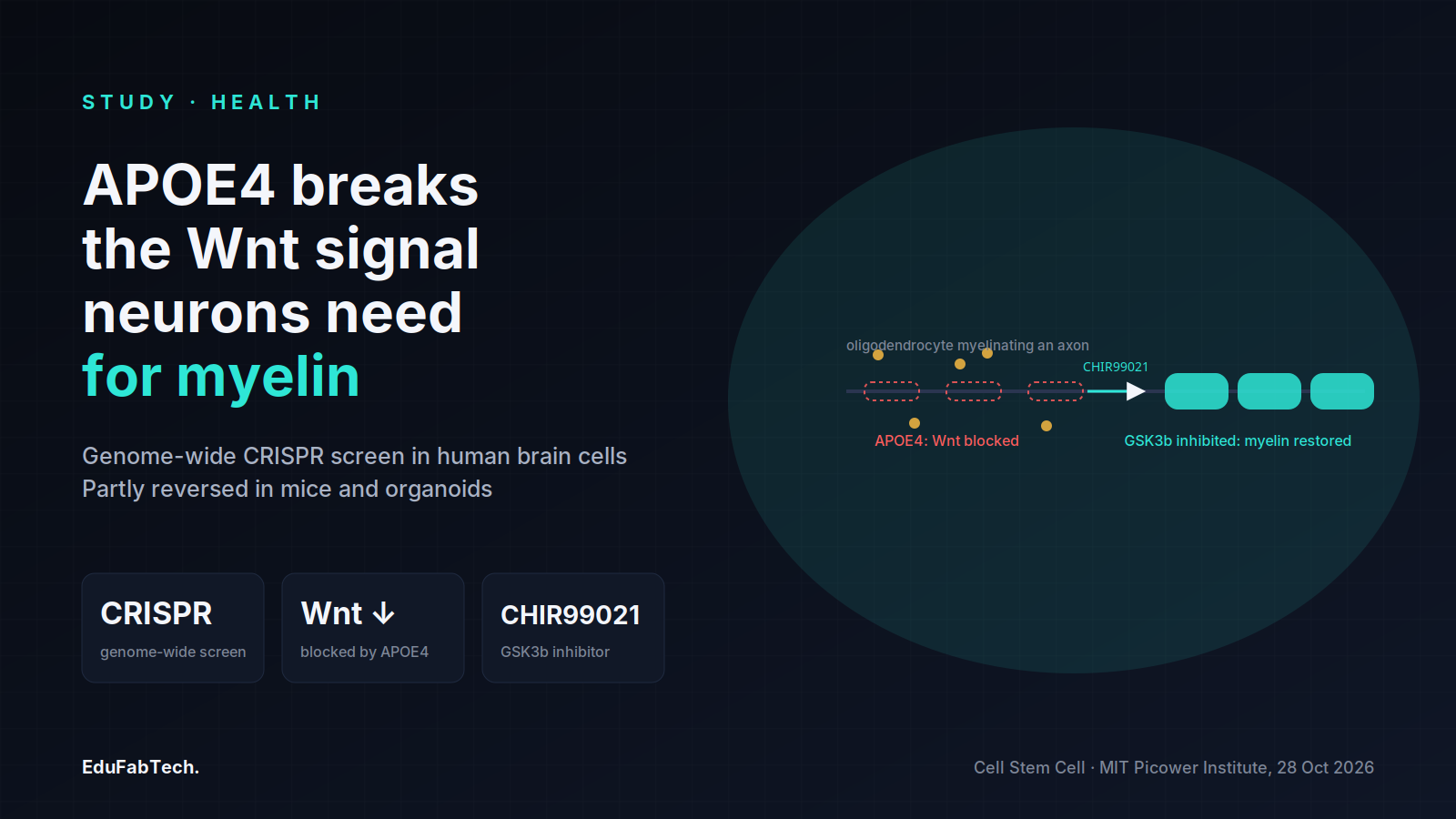
A study published online in Cell Stem Cell and announced by the Massachusetts Institute of Technology's Picower Institute for Learning and Memory on 28 October 2026 reports a mechanism linking the APOE4 Alzheimer's risk gene variant to a breakdown in myelin, the fatty insulation that wraps neurons' axons. The work, led by MIT neuroscientist Li-Huei Tsai with first author Leyla Akay, a former graduate student in Tsai's lab, used a genome-wide CRISPR screen in human stem-cell-derived brain cells to trace the defect to a specific signaling pathway, then partially reversed it with a research compound in organoid cultures and in mice, according to the MIT News account of the paper.
A genome-wide screen in human brain cells
Oligodendrocytes are the cells that produce myelin, and their dysfunction has been tied to APOE4, the most common genetic variant associated with late-onset Alzheimer's disease. To find out why, the MIT team ran a genome-wide CRISPR knockout screen in human induced-pluripotent-stem-cell-derived oligodendrocytes carrying APOE4, systematically disabling genes one at a time to see which ones affected the build-up of lipid droplets inside the cells, a hallmark of the APOE4 defect, as described by MIT News.
A pathway called Wnt, and a brake called GSK3b
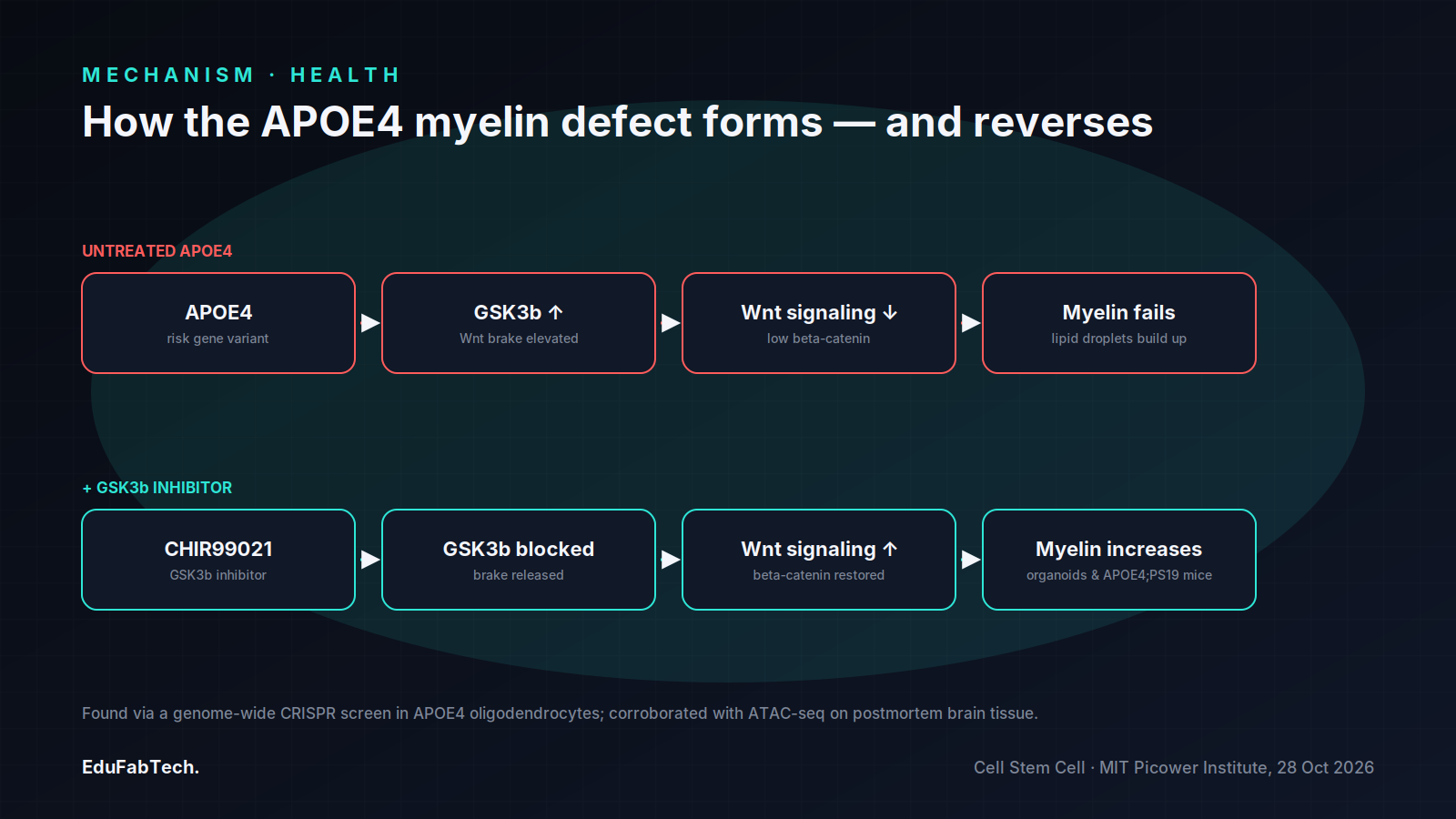
The screen pointed to the Wnt signaling pathway. According to the MIT account, APOE4-carrying oligodendrocytes showed lower levels of beta-catenin, a protein that promotes Wnt signaling, and higher levels of GSK3b, a protein that suppresses it, compared with cells carrying the more common APOE3 variant. The team corroborated this with ATAC-seq, a technique that measures which stretches of DNA are accessible for gene activity, run on postmortem human brain tissue from APOE4 and APOE3 carriers, which showed reduced accessibility of genes that promote Wnt signaling in the APOE4 samples, per the Picower Institute summary of the paper.
Reversing the defect, in dishes and in mice
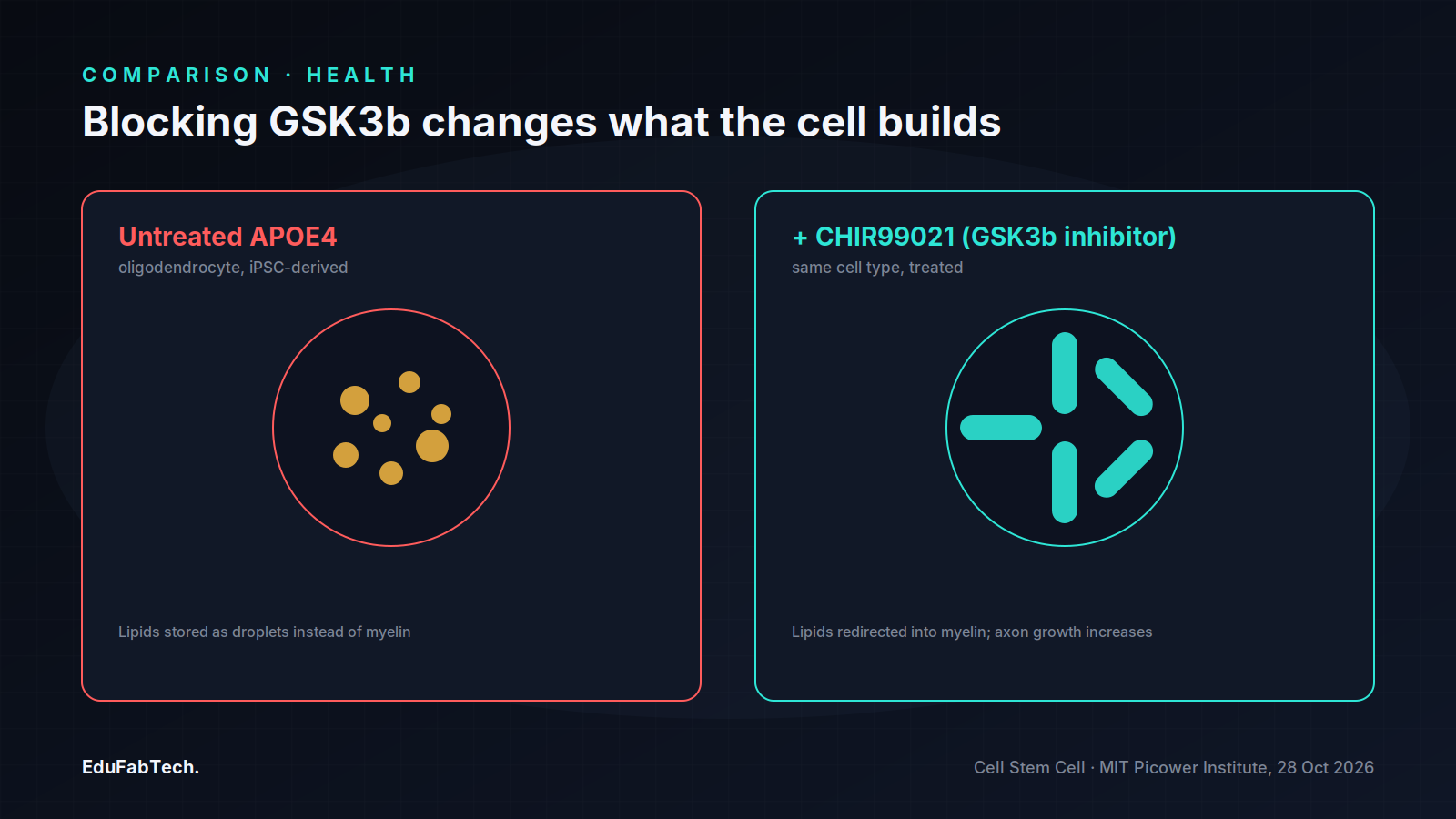
Having identified GSK3b as the brake on Wnt signaling, the researchers tested whether blocking it would help. They used CHIR99021, a chemical that inhibits GSK3b, and report that it reduced lipid droplet accumulation in APOE4 oligodendrocytes, MIT News states. In three-dimensional brain organoids combining oligodendrocytes with neurons, the same treatment increased myelination and promoted the growth of neural axons.
The team then moved into mice genetically modeling Alzheimer's-linked tau pathology while also carrying APOE4 — an APOE4;PS19 model, per the underlying Cell Stem Cell paper. Treated mice showed a reduction in lipid droplets in the hippocampus and increased myelination compared with untreated controls, according to MIT News.
Why a fat gene matters for insulation
APOE is best known for its role in transporting cholesterol and other lipids around the brain, and the APOE4 variant is the strongest common genetic risk factor identified for late-onset Alzheimer's. The new findings give that lipid-handling defect a specific cellular target: oligodendrocytes appear to misallocate lipids toward storage droplets instead of toward building myelin, and restoring Wnt signaling — by removing the GSK3b brake — appears able to redirect that balance back toward insulation, based on the mechanism described by MIT News and the Picower Institute.
What the study does, and does not, show
Tsai described the result as an early-stage finding rather than a therapy. "This proof of principle of doing CRISPR screens for genetic modifiers of APOE4-associated lipid accumulation in a central nervous system cell type is very exciting," she said, according to MIT News. CHIR99021 is a laboratory research compound, not an approved drug, and the experiments described were conducted in iPSC-derived cell cultures, organoids and mice, not in people. MIT News reports that Tsai and Akay intend to follow up on further clues from the screen about lipid metabolism and on a possible connection between GSK3b and tau phosphorylation, another process implicated in Alzheimer's disease.
For researchers working on neurodegenerative disease, the study adds a mechanistic link — Wnt signaling and GSK3b — between a well-established genetic risk factor and a specific, targetable cell type, built on a screening method that can in principle be rerun against other candidate pathways in the same cells, as the Genetic Engineering & Biotechnology News account of the paper notes.
A quick question for readers
Which study habit do you think is most overrated?
Some popular habits have little evidence behind them. Which one do you think gets too much credit?
Pick an answer, create a free account in a minute, and your vote counts. Already a member? Sign in
Comments 3
Comment-
The caveats section is doing the honest work here, and it's worth underlining: this is a CRISPR screen plus a GSK3b inhibitor that isn't an…
-
The honest part of this writeup is the framing: Tsai herself calls it proof of principle, and CHIR99021 is a lab compound, not a candidate d…
-
The part worth flagging is right there in the article: CHIR99021 is a lab research compound, not a drug, and every result — organoids, APOE4…
Join free to read the full comments and reply Comments are between members; an account takes a minute.
Source: MIT News (Picower Institute for Learning and Memory)
Sources (3)
- Leyla Akay, Li-Huei Tsai, et al.. Genome-wide CRISPR screen reveals Wnt signaling as a potential therapeutic target for lipid accumulation and impaired myelination in APOE4 oligodendrocytes. Cell Stem Cell, 2026. cell.com ↗ · checked 31 Oct 2026
- MIT News Office / Picower Institute for Learning and Memory. How the biggest Alzheimer's risk gene disrupts the process of insulating neurons. MIT News, 2026. news.mit.edu ↗ · checked 31 Oct 2026
- GEN Staff. How Alzheimer's Risk Gene APOE4 Disrupts Myelination. Genetic Engineering & Biotechnology News, 2026. genengnews.com ↗ · checked 31 Oct 2026