mRNA Melanoma Vaccine Plus Pembrolizumab Cuts Recurrence Risk 42% After Surgery
Phase 3 INTerpath-001 data presented by Merck and Moderna at ESMO 2026 on 22 October 2026 show the personalized vaccine intismeran autogene lowered two-year recurrence in resected melanoma, with survival data still immature.
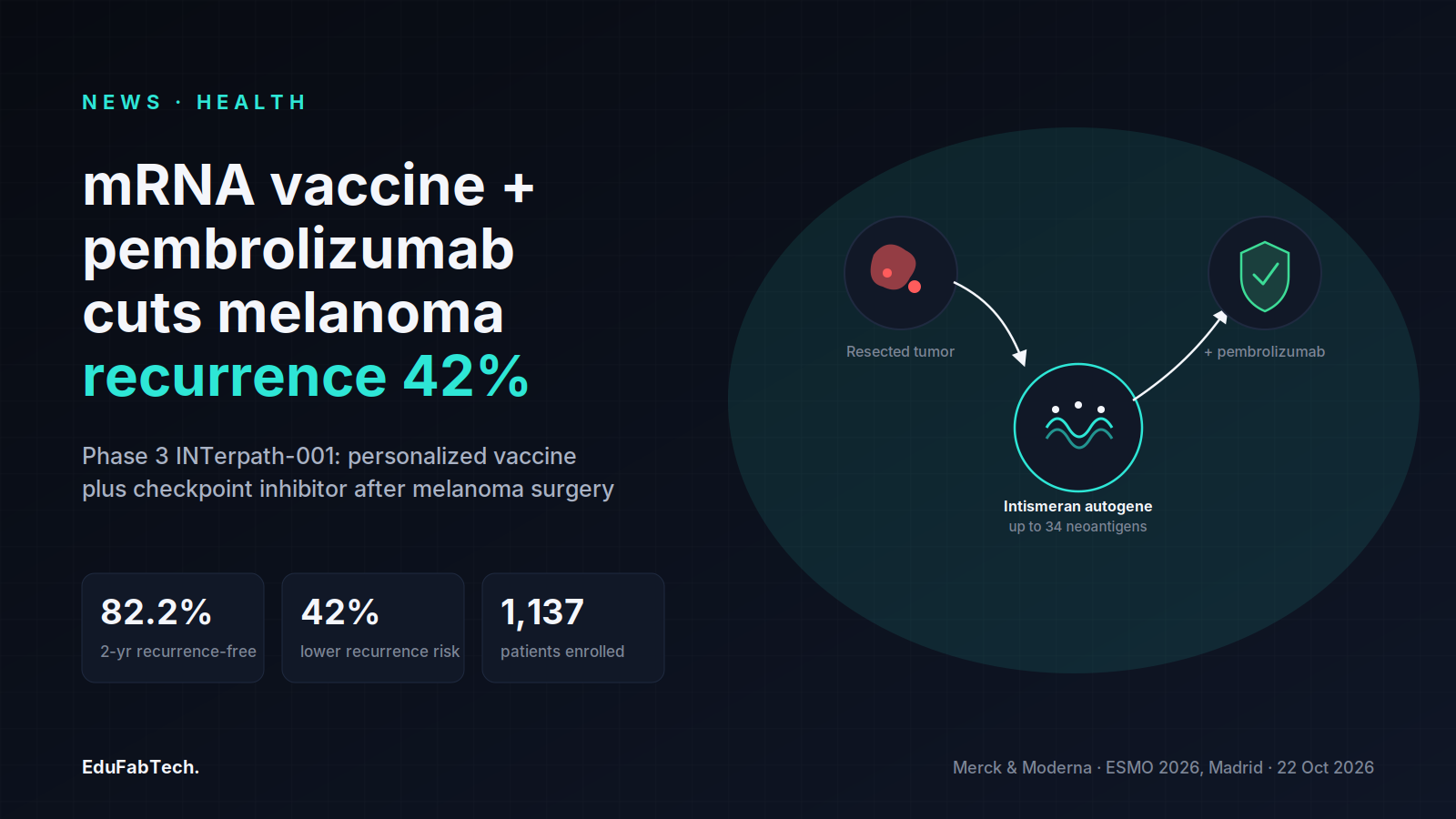
Merck and Moderna announced full results from the Phase 3 INTerpath-001 trial on 22 October 2026, ahead of a Presidential Symposium at the European Society for Medical Oncology (ESMO) Congress 2026 in Madrid, Spain. The trial tested intismeran autogene, an individualized mRNA cancer vaccine built from each patient's own tumor, given together with the checkpoint inhibitor pembrolizumab, in 1,137 people who had surgery to remove stage IIB to IV melanoma.
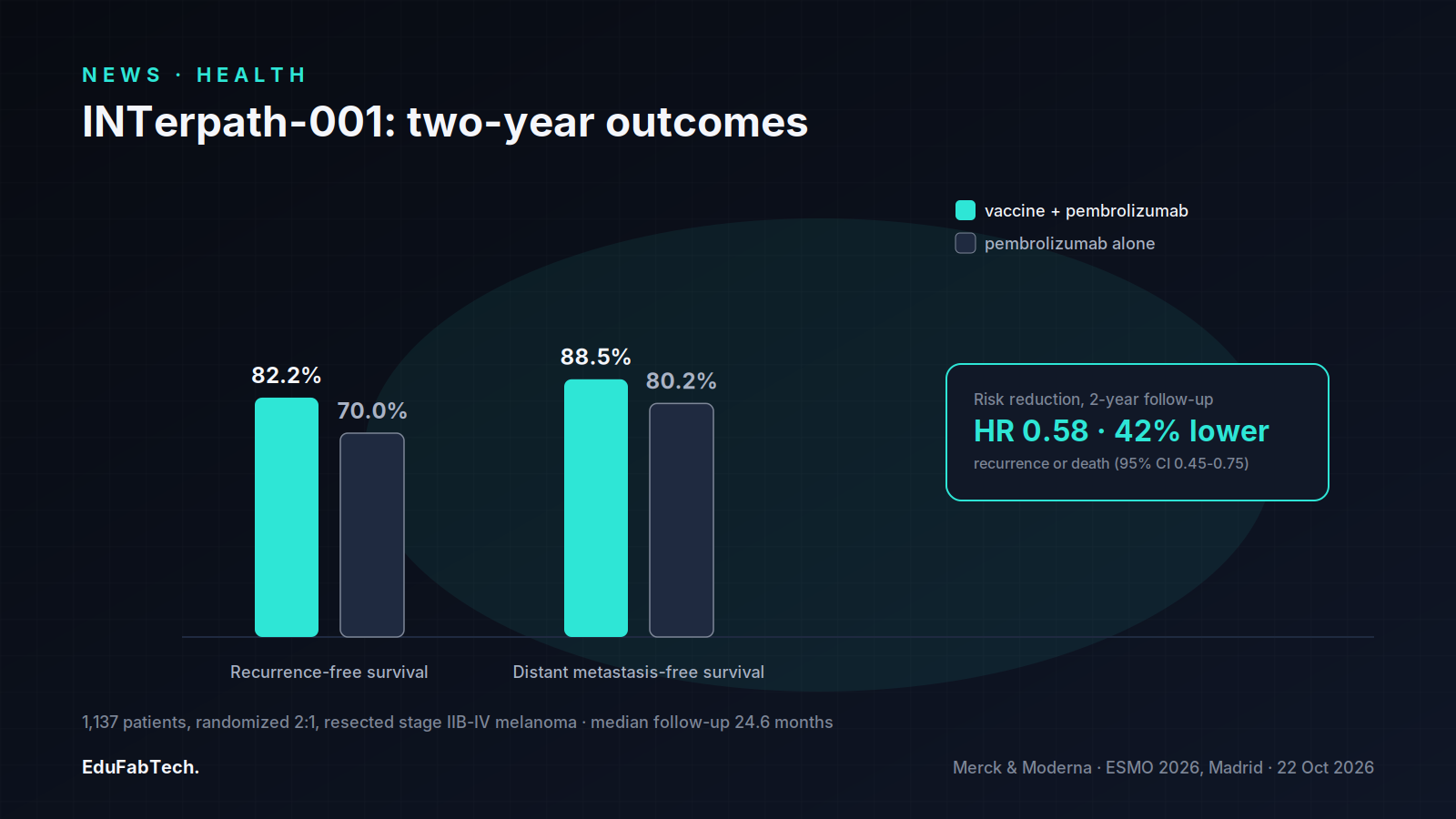
At a median follow-up of 24.6 months, the two-year recurrence-free survival rate was 82.2% (95% CI, 79.3-84.8%) for patients who received intismeran plus pembrolizumab, compared with 70.0% (95% CI, 65.0-74.5%) for those who received pembrolizumab alone, Merck and Moderna reported. That translated to a 42% reduction in the risk of recurrence or death (hazard ratio 0.58; 95% CI, 0.45-0.75; p<0.001), in patients randomized 2:1 between the two arms.
The trial's key secondary endpoint, distant metastasis-free survival, also favored the combination: the two-year rate was 88.5% versus 80.2%, a 38% reduction in the risk of distant metastasis or death (hazard ratio 0.62; 95% CI, 0.45-0.85; p=0.002), according to the same release. Merck and Moderna describe INTerpath-001 as the first phase 3 trial to report a positive result for an mRNA-based cancer treatment and for what they call an individualized neoantigen therapy — a vaccine designed from a single patient's own tumor rather than a target shared across patients.
How the vaccine is built from one tumor
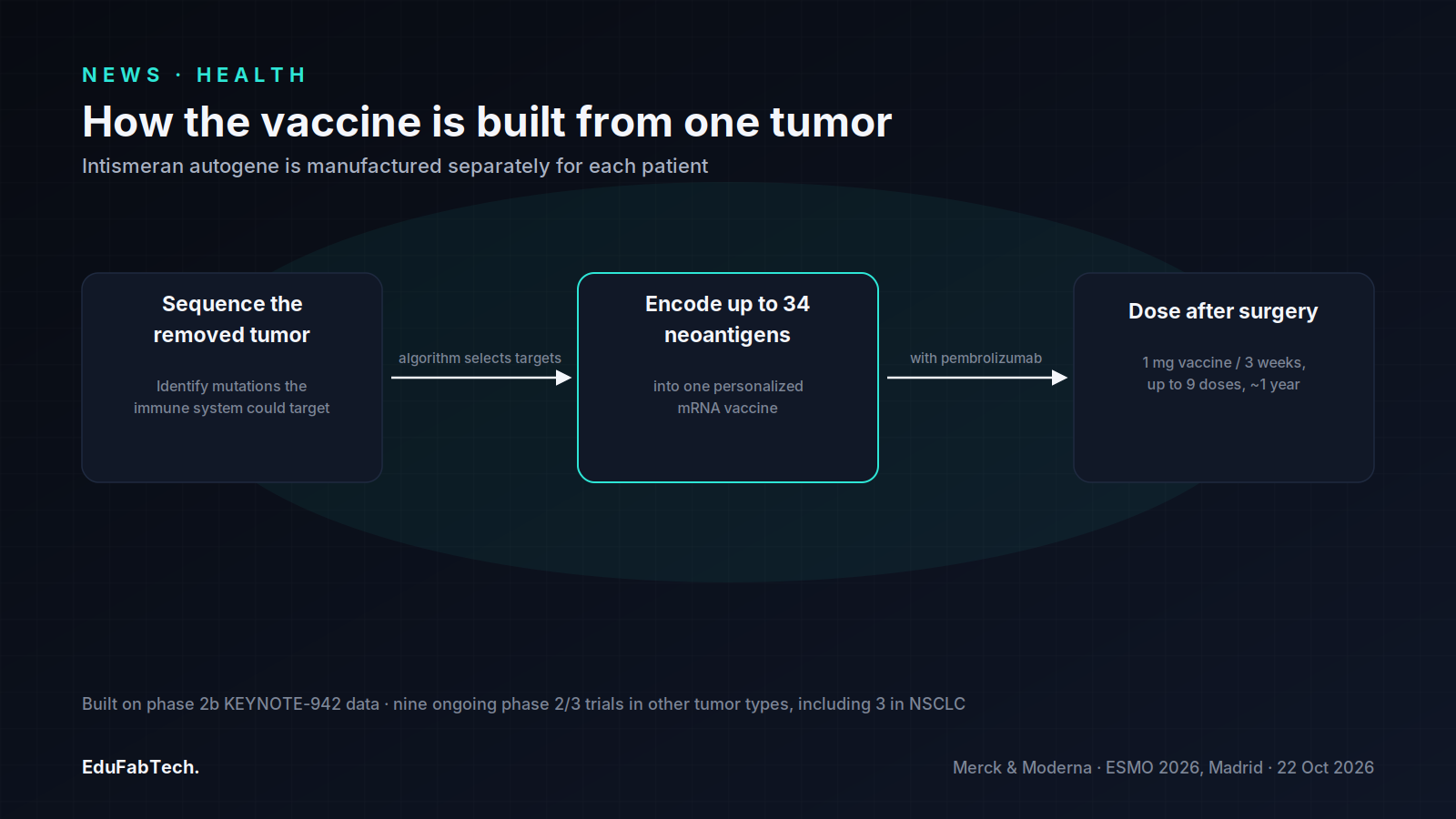
Intismeran autogene, previously tested under the codes V940 and mRNA-4157, is manufactured separately for each patient. Researchers sequence the removed tumor, identify mutations that could be presented to the immune system, and use an algorithm to select as many as 34 of these patient-specific neoantigens, which are then encoded into a single mRNA vaccine, according to reporting on the trial by AJMC.
In INTerpath-001, patients in the combination arm received intismeran at 1 mg every three weeks, for up to nine doses, together with pembrolizumab 400 mg every six weeks for up to nine cycles; the control arm received pembrolizumab alone on the same schedule, for about a year in total, per Merck and Moderna's release.
Safety, and what the trial does not yet show
Treatment-related adverse events occurred in 95.8% of patients on the combination, versus 90.0% on pembrolizumab alone, with grade 3-5 events in 14.2% and 13.4% of each group, respectively. The most common side effects tied to intismeran were fever, injection-site pain and fatigue, Merck and Moderna reported.
Overall survival, a secondary endpoint, is not yet mature enough for a formal analysis, though the companies said they have observed a favorable trend in that measure for the combination arm. AJMC reported that the detailed findings have been accepted for publication in the New England Journal of Medicine but had not yet appeared as a peer-reviewed paper at the time of the ESMO presentation, meaning independent reviewers have so far seen only the conference data and press materials.
Why melanoma first, and what is planned next
Merck and Moderna said the combination builds on earlier phase 2b data from the KEYNOTE-942 trial in the same resected-melanoma population. The companies now have nine ongoing phase 2 and phase 3 trials testing intismeran in other tumor types, including three phase 3 trials in non-small cell lung cancer, according to AJMC's coverage of the ESMO presentation.
What it means for students and researchers
INTerpath-001 gives immunology and oncology students a concrete look at what a phase 3 primary analysis of a personalized cancer vaccine actually reports: survival curves split by randomized arm, hazard ratios with confidence intervals, and adverse-event tables, rather than the single-arm or phase 2 data that dominated discussion of neoantigen vaccines until now. For researchers working on vaccine manufacturing timelines, checkpoint-inhibitor combinations or trial design, the pending New England Journal of Medicine paper should add subgroup breakdowns and methodological detail that the conference presentation and press releases did not disclose.
A quick question for readers
Which study habit do you think is most overrated?
Some popular habits have little evidence behind them. Which one do you think gets too much credit?
Pick an answer, create a free account in a minute, and your vote counts. Already a member? Sign in
Comments 3
Comment-
The number that needs more weight than it's getting is the adverse-event gap buried after the headline: 95.8% of the combination arm had tre…
-
The number worth sitting with is the gap between arms: 82.2% vs 70.0% two-year recurrence-free survival, HR 0.58 with a confidence interval…
-
The number worth sitting with is the CI on that hazard ratio: 0.45-0.75. That's still a meaningful recurrence benefit at the wide end, but i…
Join free to read the full comments and reply Comments are between members; an account takes a minute.
Source: Merck & Co.
Sources (2)
- Merck & Co. and Moderna. Merck and Moderna Will Present Results From Landmark Phase 3 INTerpath-001 Trial for Intismeran Autogene Plus KEYTRUDA (pembrolizumab) at ESMO 2026 Presidential Symposium. Merck.com, 2026. merck.com ↗ · checked 25 Oct 2026
- Pearl Steinzor. Merck, Moderna Cancer Vaccine Cuts Melanoma Recurrence Risk by 42%. AJMC, 2026. ajmc.com ↗ · checked 25 Oct 2026