Five-Lab Mouse Study Finds Psilocybin's Next-Day Effects Mostly Don't Replicate
A 30-author consortium across Stanford, UC Berkeley and UCSF ran each experiment on roughly 200 mice split across the five labs, and found only psilocybin's acute, same-day effects held up consistently.
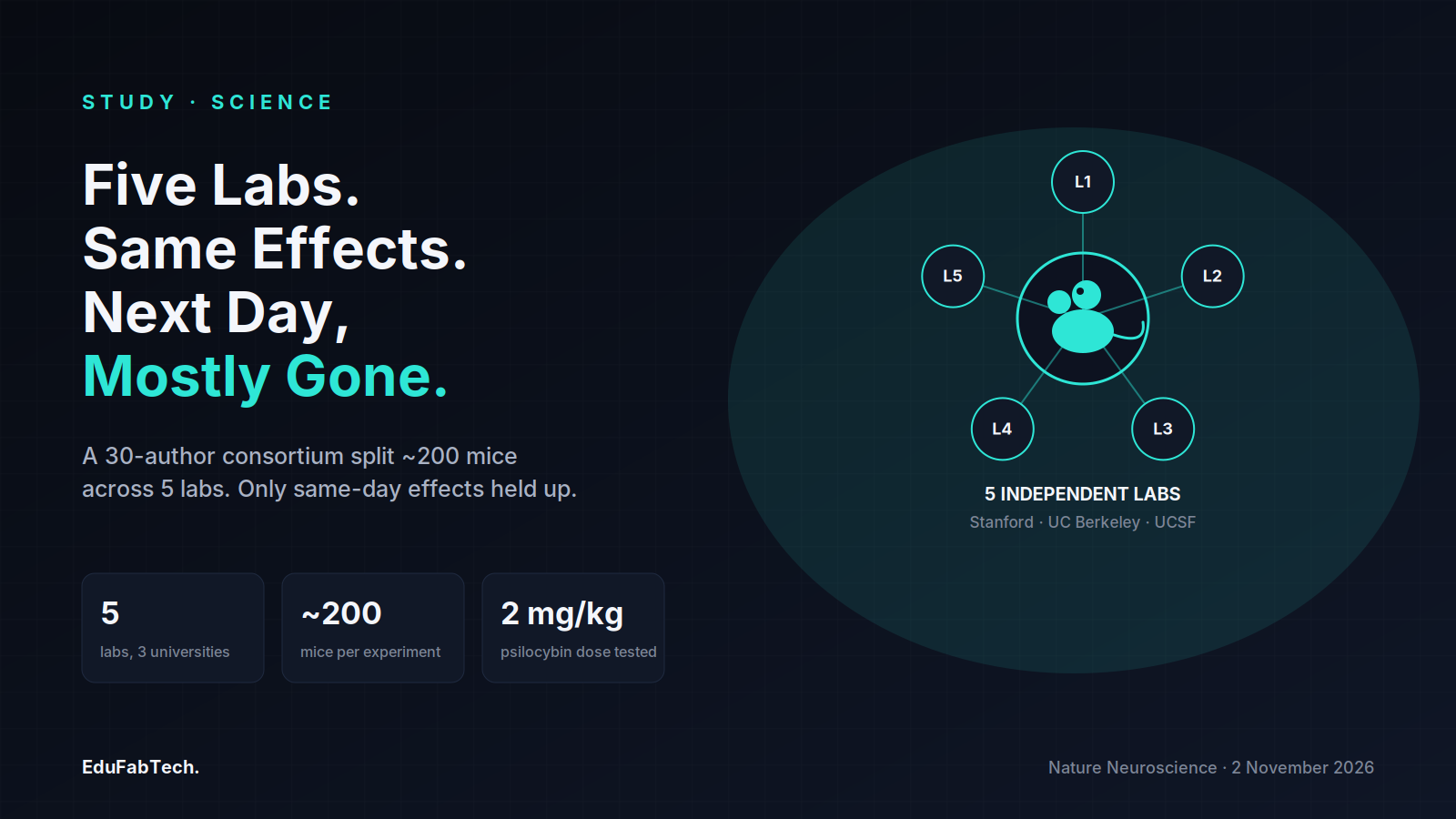
A consortium of five laboratories at Stanford University, the University of California, Berkeley and the University of California, San Francisco has published the results of parallel experiments testing psilocybin's behavioral effects in mice, in a paper titled "A multi-institutional investigation of psilocybin's effects on mouse behavior," released by Nature Neuroscience on 2 November 2026. The 30-author paper reports that psilocybin's immediate, same-day effects replicated consistently across all five sites, while most of the next-day behavioral benefits reported in earlier single-lab studies did not hold up once tested under shared, standardized conditions.
Each of the five labs ran the same protocol, dosing C57BL/6J mice with 2 milligrams of psilocybin per kilogram of body weight, with roughly 200 male and female mice in total per experiment spread across the five sites, according to the paper. The five labs involved were led by Robert Malenka and Boris Heifets at Stanford, Stephan Lammel and Andrea Gomez at Berkeley, and Mazen Kheirbek and Vikaas Sohal at UCSF, with Odilia Lu, a Berkeley doctoral student, as co-first author, per UC Berkeley's research office. The consortium was formed to address what the paper's authors describe as conflicting results across the psychedelic-research literature, where different labs using different protocols have reported different, sometimes contradictory, findings.
What replicated
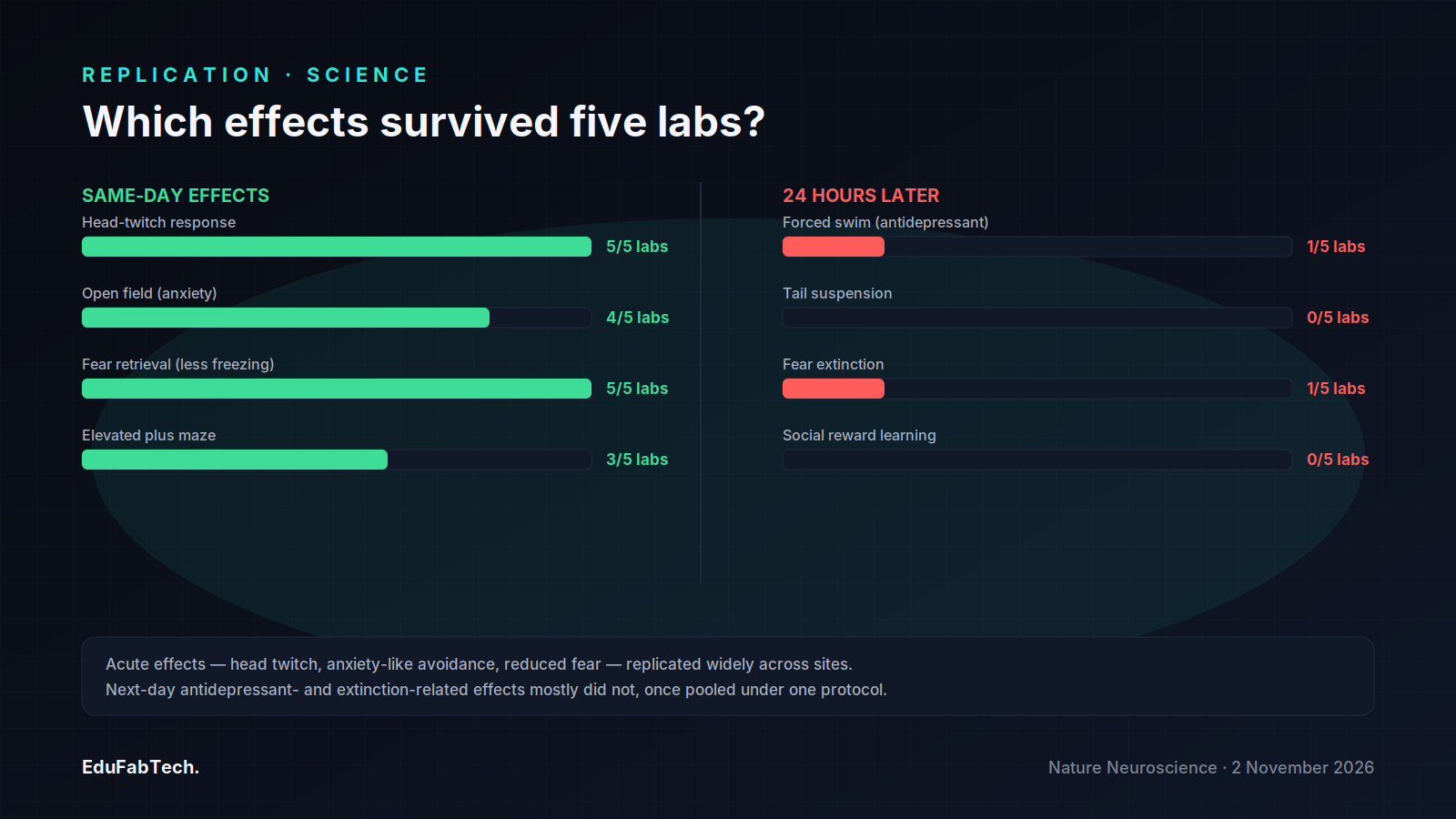
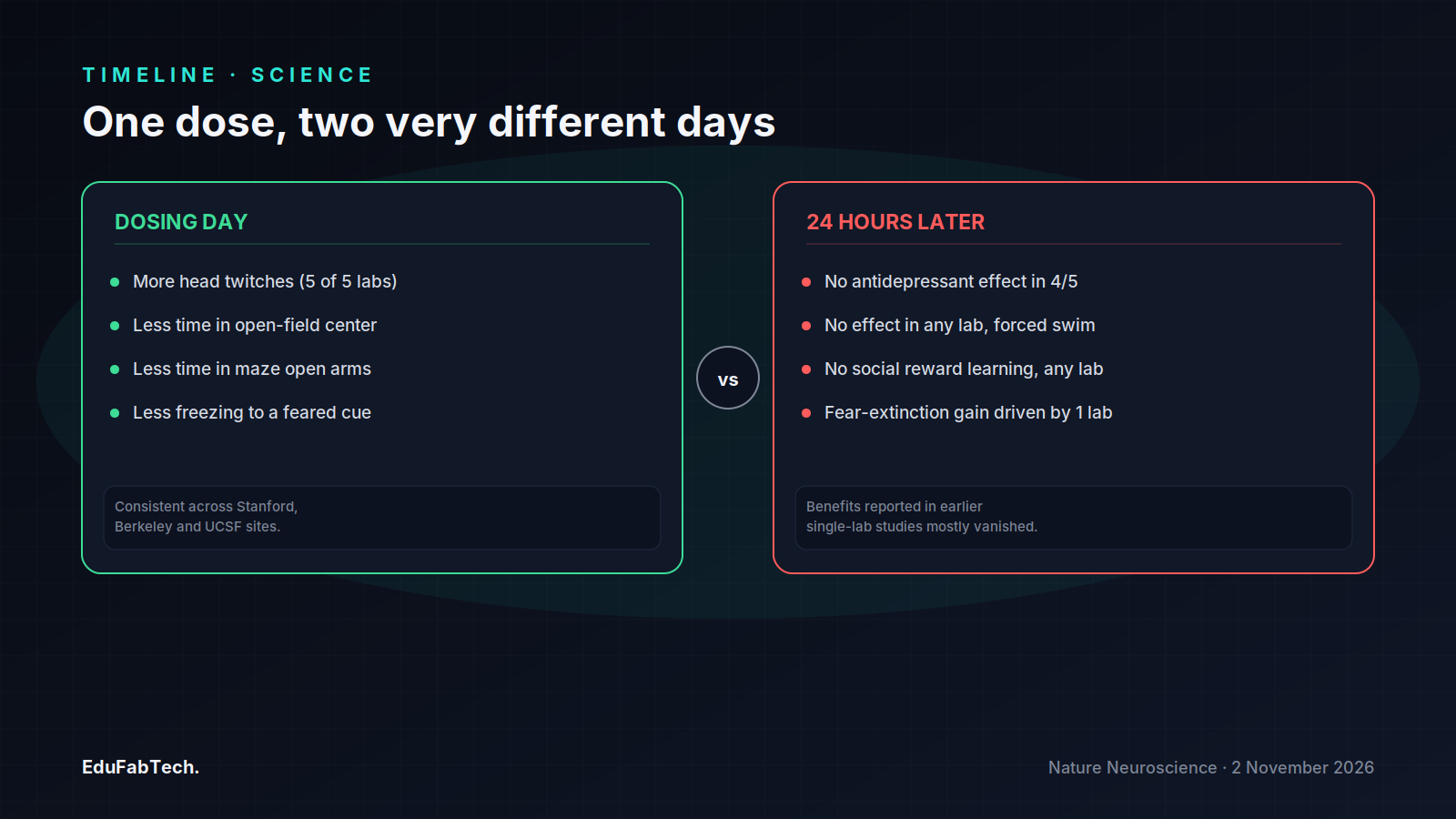
According to the abstract of the Nature Neuroscience paper, "psilocybin had several robust and replicable acute effects on mouse behavior, including increased anxiety- and avoidance-related behaviors and decreased fear expression." The head-twitch response, a reflex driven by the 5-HT2A receptor, appeared in every lab, and the paper notes that female mice generally showed more psilocybin-induced head twitches than males, per detail reported on the preprint version of the study. In the open field test, four of five labs found a significant reduction in time spent in the center of the arena ten minutes after injection, and the elevated plus maze showed a reduction in open-arm time in three of five labs; pooling data across labs still produced a statistically significant anxiogenic effect despite that lab-to-lab variability. Every lab also recorded reduced freezing behavior during fear retrieval shortly after dosing.
What did not replicate
The same pattern did not hold 24 hours after dosing. The paper states that "psilocybin did not have replicable effects 24 hours post psilocybin administration on reducing anxiety- and depression-like behaviors or facilitating fear extinction learning." In the forced swim test, four of five labs found no significant antidepressant-like effect of psilocybin, and in the tail suspension test no lab found a significant effect, according to the preprint's statistical reporting. No lab observed social reward learning following either saline or psilocybin treatment, and a small pooled effect on fear extinction was driven by results from a single lab rather than a consistent pattern across sites, according to the preprint's statistical reporting.
Why the design matters
The point of running the same protocol five times rather than publishing five separate papers was to separate a true underlying effect from the noise, and bias, that can creep into single-lab studies. Lu is quoted by UC Berkeley's press release as saying the collaboration helps "better estimate a true underlying effect size accurately and reduce the risk of publication bias." Lammel is quoted making a similar point about the field's practices, telling Berkeley's communications office: "we understand the excitement about psychedelic drugs and we have seen their therapeutic effects in humans, but let's all work together as a group" rather than publishing isolated single-lab results.
Limitations the authors flag
- The paper notes that psilocybin's effect on fear extinction has previously been reported to be dose-dependent, with maximal effects at 1 mg/kg and null effects at 2 mg/kg, the dose used in this consortium's experiments, according to the preprint.
- The authors state that how far mouse results translate to humans "remains to be determined."
- They note that some reported persistent effects of psychedelics may require a disease-like or stressed state in the animal rather than appearing in standard, unstressed laboratory mice.
What it means for researchers and students
The authors are careful to say this result does not overturn clinical findings in humans. Lammel, quoted in UC Berkeley's announcement, describes existing human trials of psilocybin for depression and PTSD as "very small clinical studies" about which "we know very, very little." The same announcement reports that the consortium sees standard mouse behavioral assays as poorly suited to capturing the psychological dimensions, including "set and setting," that appear central to psychedelic therapy in people. For researchers designing the next generation of psychedelic studies, the paper's practical message is about method: pooling data across independent labs running an identical protocol surfaced a different, more cautious picture of psilocybin's persistent behavioral effects in mice than many single-lab papers had reported individually. Lammel frames the result as "an urgent call to the field" for the community to "work together as a group, not individually, to solve this," according to the same announcement.
For students entering neuroscience or psychopharmacology, the paper is also a case study in how multi-site replication consortia work in practice: a shared dose, a shared mouse strain, a shared set of behavioral assays, and pooled statistics reported alongside each individual lab's result, rather than a single lab's finding standing in for the whole field.
A quick question for readers
When an article cites a study, do you open the source?
Every claim on this site links to a primary source. We want to know whether readers actually follow those links, or whether they …
Pick an answer, create a free account in a minute, and your vote counts. Already a member? Sign in
Comments 3
Comment-
The part that undercuts the excitement is buried in the limitations: fear extinction has previously been reported as dose-dependent, maximal…
-
The split result is the whole point here: every acute, same-day measure (head-twitch, open-field anxiogenic effect, fear-retrieval freezing)…
-
The bit that actually matters here is the dose mismatch buried in the limitations: fear extinction effects were previously reported as maxim…
Join free to read the full comments and reply Comments are between members; an account takes a minute.
Source: Nature Neuroscience
Sources (3)
- Odilia D. Lu, Robert C. Malenka, Stephan Lammel, Andrea M. Gomez, Mazen A. Kheirbek, Vikaas S. Sohal, Boris D. Heifets et al.. A multi-institutional investigation of psilocybin's effects on mouse behavior. Nature Neuroscience, 2026. nature.com ↗ · checked 8 Nov 2026
- Dan Gordon. In parallel mouse studies, researchers fail to replicate many reported effects of psilocybin. EurekAlert / UC Berkeley, 2026. eurekalert.org ↗ · checked 8 Nov 2026
- UC Berkeley. In Parallel Mouse Studies, Researchers Fail to Replicate Many Reported Effects of Psilocybin. UC Berkeley Office of the Vice Chancellor for Research, 2026. vcresearch.berkeley.edu ↗ · checked 8 Nov 2026