NASA Publishes 800GB of Artemis II Moon Data, Including Five Faint Impact Flashes
The October 7, 2026 release to NASA's Planetary Data System includes over 11,000 images and 8.5 hours of crew audio from April's lunar flyby, alongside a report NASA itself calls preliminary.
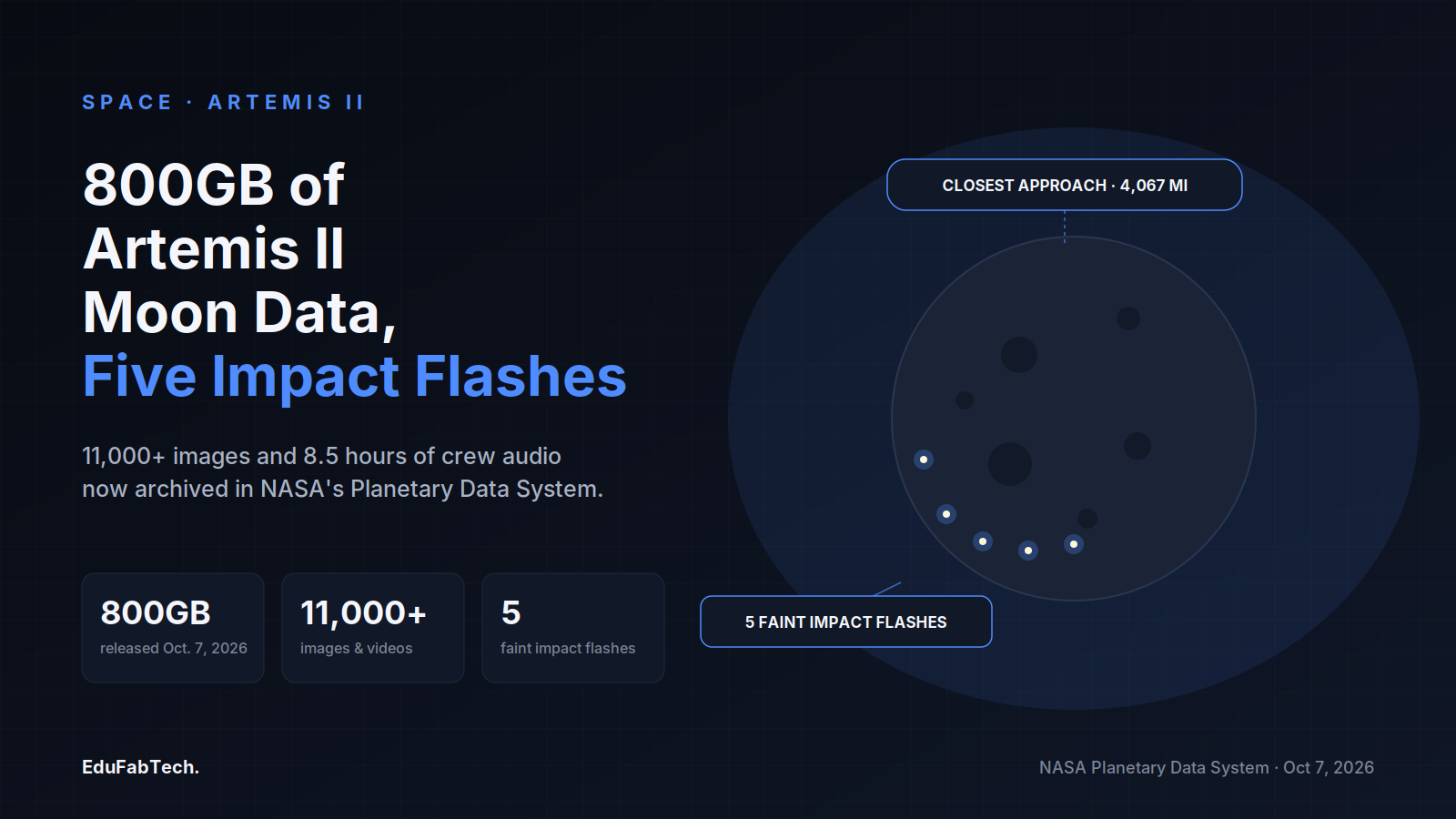
NASA uploaded more than 800 gigabytes of data from the Artemis II lunar flyby to its Planetary Data System on October 7, 2026, six months after the mission's closest approach to the Moon on April 6, 2026. The release, described by NASA as a "first delivery," includes crew handheld camera images, Orion vehicle camera footage, mission audio with transcripts and crew annotations, cabin temperature and humidity logs, and an accompanying Preliminary Lunar Science Report.
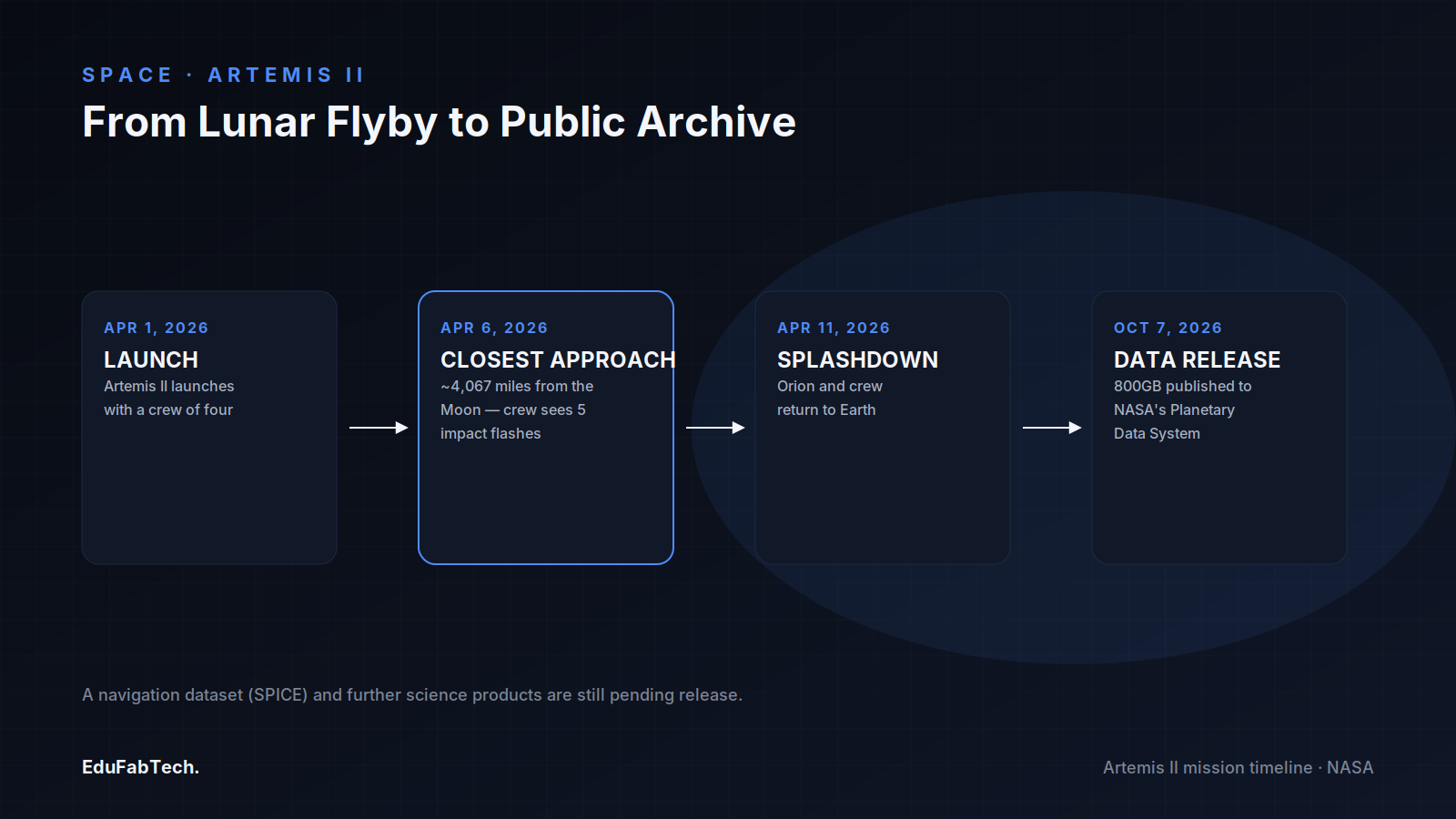
Artemis II launched on April 1, 2026 and splashed down on April 11, 2026, carrying NASA astronauts Reid Wiseman, Victor Glover and Christina Koch alongside Canadian Space Agency astronaut Jeremy Hansen on a crewed flyby that came within roughly 6,545 kilometers of the lunar farside, according to the mission timeline archived by the PDS Geosciences Node. It was the first crewed mission to travel near the Moon since Apollo 17 in 1972.
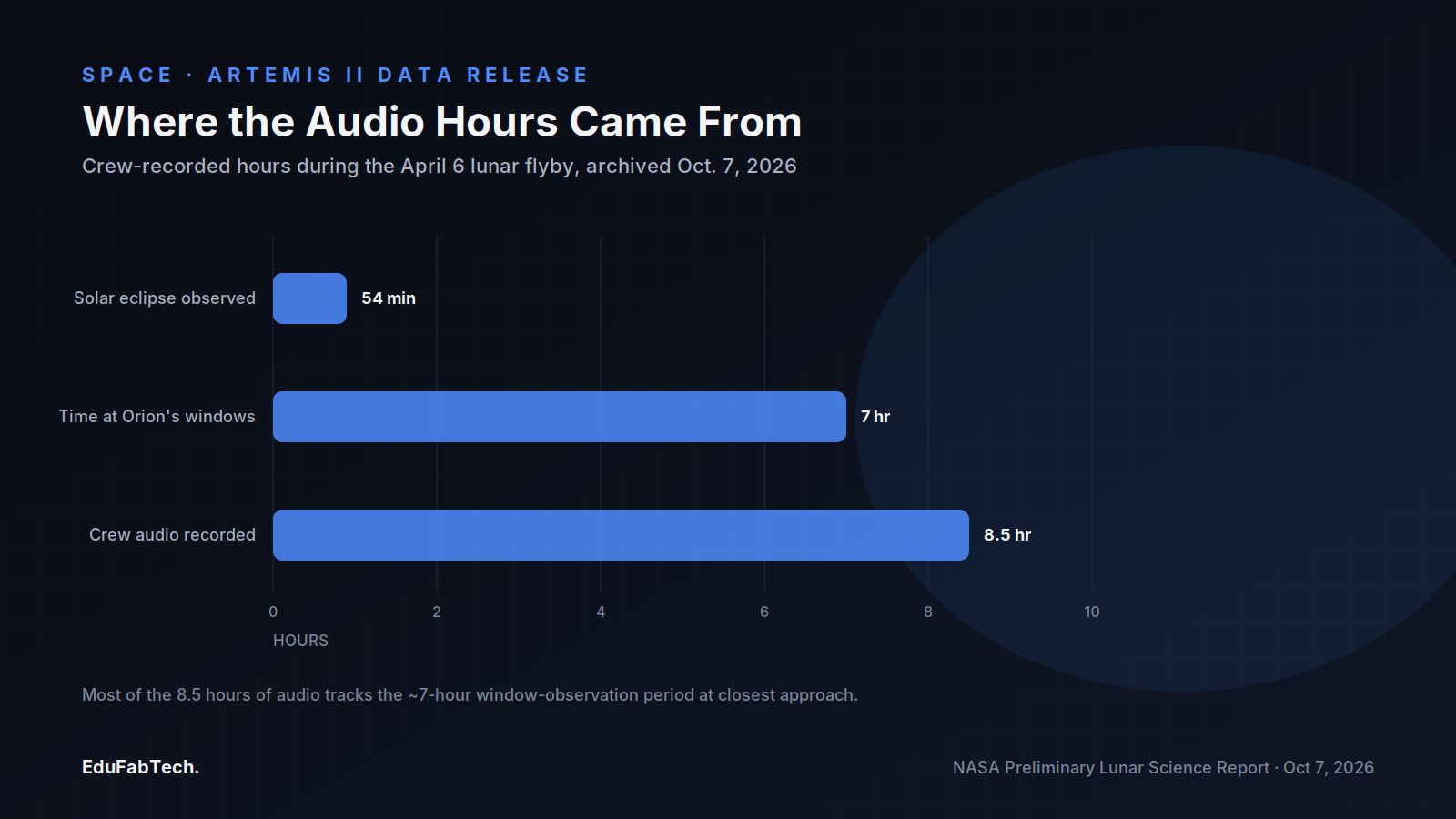
The newly archived material includes more than 11,000 full-resolution images and videos and 8.5 hours of audio documenting the crew's real-time scientific observations, NASA said in its October 7 release. The crew spent roughly seven hours at Orion's windows during the period of closest approach, when the spacecraft came within about 4,067 miles of the lunar surface.
Five faint flashes, seen with the naked eye
Among the observations now documented in detail is a set of five faint "pinprick" bursts of light that the crew saw on the lunar surface from roughly 46,000 miles away, caused by small rocky fragments — estimated at only a couple of inches wide and traveling thousands of miles per hour — striking the Moon, according to NASA's preliminary science report. The report says the crew likely caught the faintest impact flashes ever seen with the unaided human eye, a phenomenon Apollo astronauts also witnessed from lunar orbit. Commander Reid Wiseman's recorded reaction in the moment was "Dude! No way!"
The crew also catalogued color variation across the lunar surface that NASA's report frames as a "muted rainbow": blue tones associated with titanium-rich volcanic rock, browns and tans linked to varying iron content, and patches of green that the report attributes to glass formed by past volcanic eruptions or asteroid impacts. Christina Koch described one green patch as looking like "mold growing on sandwich bread," Nature reported.
During a 54-minute total solar eclipse encountered on the flight, the crew also observed the Sun's corona and pulsating plasma streamers, the planets Mars and Saturn, and zodiacal light from sunlight scattering off interplanetary dust, NASA's report states. Separately, the crew captured a full-disk nighttime image of Earth from about 6,000 miles away — labeled "Hello, World" — showing auroras, lightning, city lights and a Saharan dust plume.
Why NASA is calling this preliminary
NASA has not presented the release as a finished scientific analysis. The document is titled a Preliminary Lunar Science Report, and the PDS archive entry notes that this is a "first delivery" of science data, with a navigation and positioning dataset (the SPICE bundle) still pending release. NASA states that the observations are intended, in part, to inform camera selection, pointing strategies and imaging requirements for future Artemis surface missions, particularly around the lunar south pole, where lighting conditions are more extreme than at the equator.
What researchers can do with the archive now
The imagery, audio and annotated crew notes are hosted across NASA's Planetary Data System nodes: the PDS Geosciences Node holds mission documents and environmental logs, while the Cartography and Imaging Sciences Node holds the imaging and audio bundles, per the PDS archive listing. Because the data is openly archived rather than held for a single science team, planetary geologists, lunar cartographers and mission planners outside NASA can now cross-reference the crew's handheld photography and verbal descriptions against existing orbital maps of the targeted farside region.
A report in Nature's news section on the release, covering the same October 7 archive, notes that the material represents the first human eyes to view the Moon up close since the Apollo program ended in 1972, a point that underscores why NASA is treating crew-described color and lighting variation as data worth archiving in its own right rather than only as photographic record.
NASA has not yet said when the delayed SPICE navigation bundle or any follow-up science products tied to Artemis II will be released, and the preliminary report does not draw conclusions about the lunar surface composition beyond noting which mineral signatures are consistent with the colors the crew observed.
A quick question for readers
When an article cites a study, do you open the source?
Every claim on this site links to a primary source. We want to know whether readers actually follow those links, or whether they …
Pick an answer, create a free account in a minute, and your vote counts. Already a member? Sign in
Source: NASA
Sources (3)
- NASA. NASA Releases Artemis II Lunar Science Data, Images. NASA, 2026. nasa.gov ↗ · checked 8 Oct 2026
- NASA Science. Artemis II Preliminary Lunar Science Report. NASA Science, 2026. science.nasa.gov ↗ · checked 8 Oct 2026
- Alexandra Witze. NASA releases trove of Moon data from historic Artemis II flight. Nature, 2026. nature.com ↗ · checked 8 Oct 2026