NASA's Terra Satellite Ends 27 Years of Earth Observation on 1 December 2026
Launched in 1999 for a six-year mission, Terra will stop collecting science data on 1 December 2026 and be powered down in January 2027, NASA says.
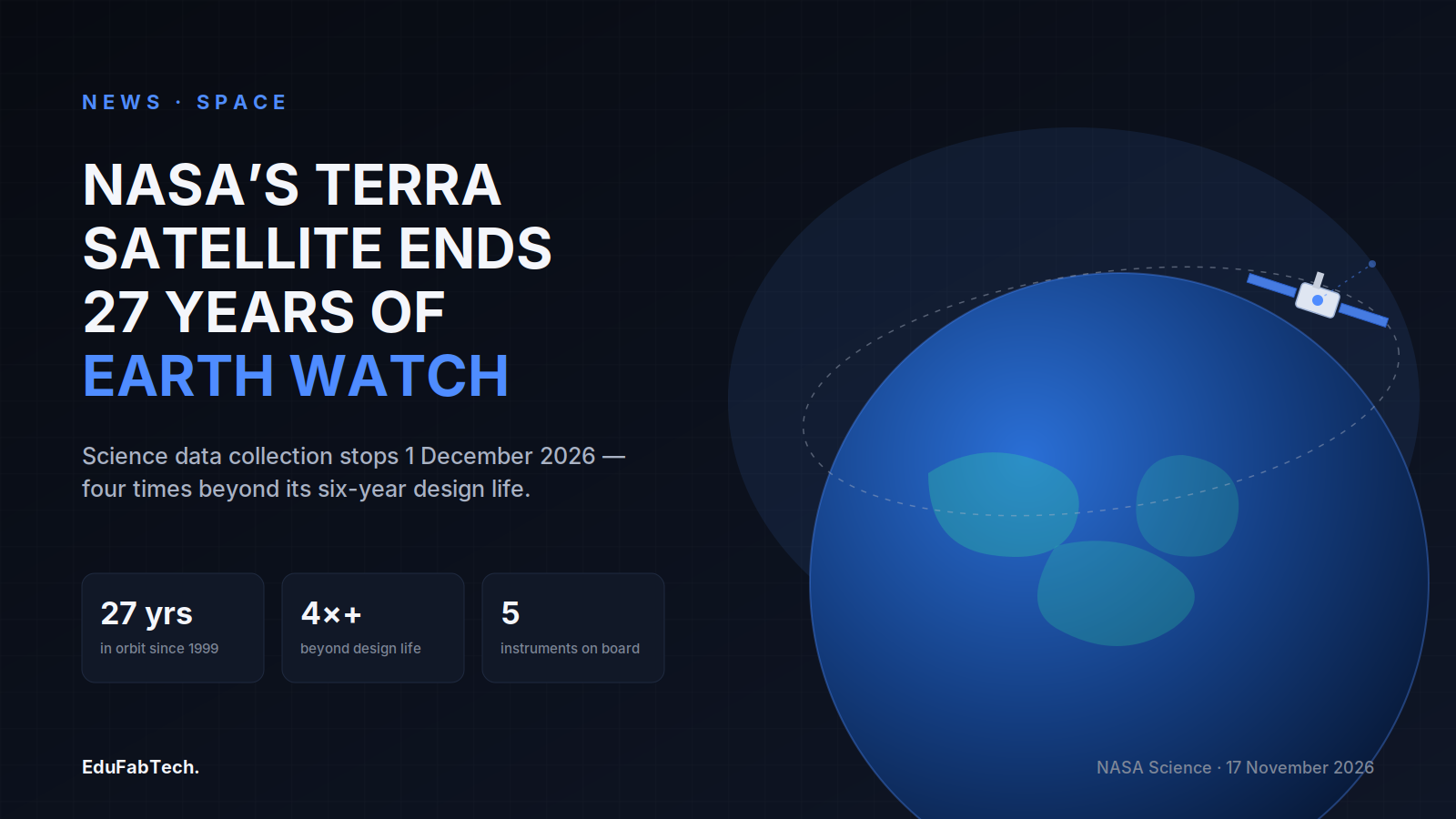
NASA said on 17 November 2026 that its Terra satellite will stop collecting science data on 1 December 2026, closing out a mission that has run for 27 years against an original design life of six, according to NASA Science. Terra launched on 18 December 1999 and has carried five Earth-observing instruments through more than four times its planned lifetime, the agency said.
What is ending, and when
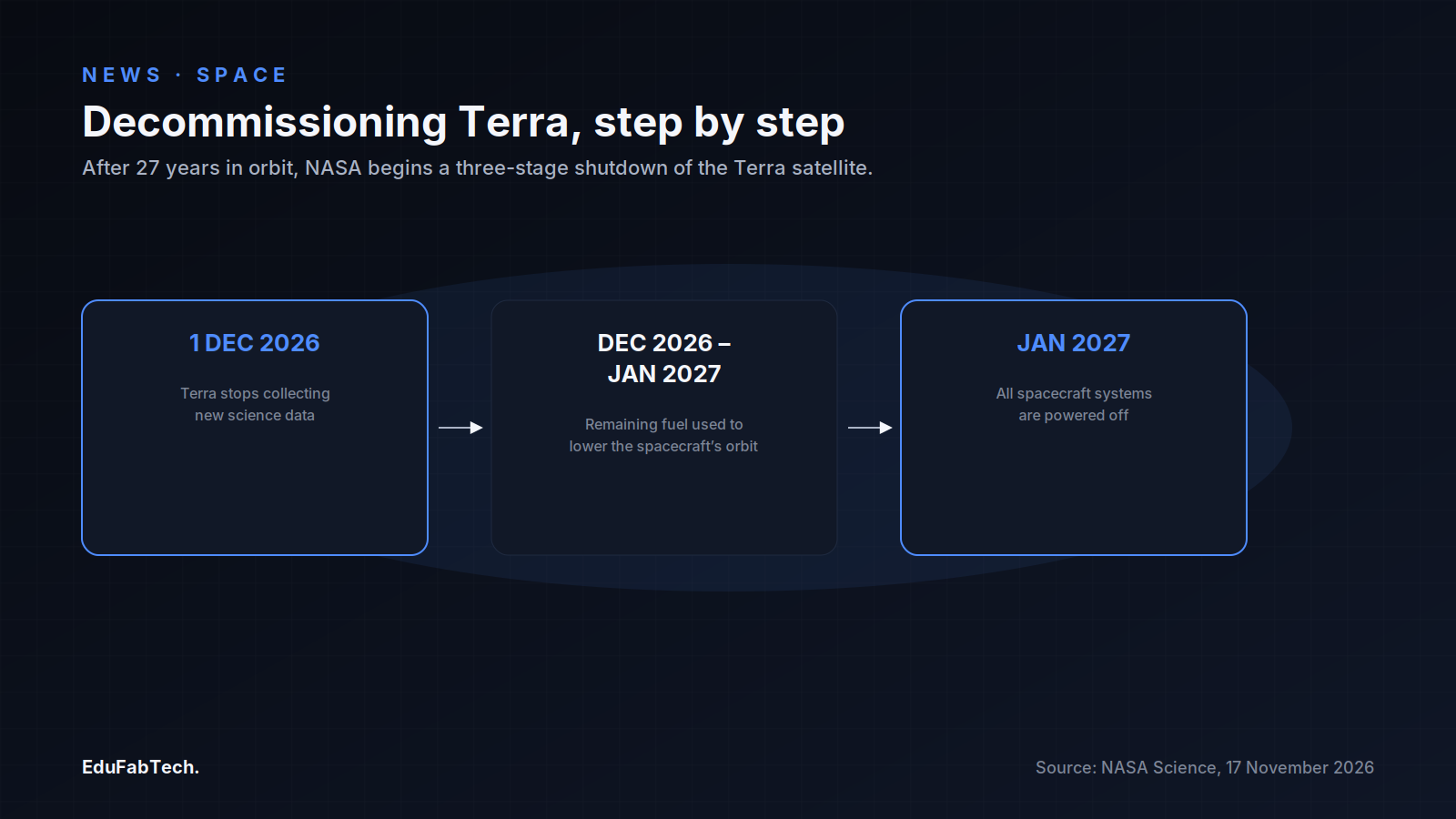
According to NASA Science, Terra's systems are aging and its orbit has been drifting, which is why the agency is now beginning the process of ending the mission. Science data collection stops on 1 December 2026, and the Terra team will then carry out a decommissioning process that uses the spacecraft's remaining fuel to lower its orbit, before all spacecraft systems are powered off in January 2027.
Terra carries five instruments: the Advanced Spaceborne Thermal Emission and Reflection Radiometer (ASTER), the Clouds and the Earth's Radiant Energy System (CERES), the Multi-angle Imaging SpectroRadiometer (MISR), Measurements of Pollution in the Troposphere (MOPITT) and the Moderate Resolution Imaging Spectroradiometer (MODIS), NASA Science reports. A separate account of the mission, reported by Karmactive, notes that MOPITT had already been shut down ahead of the wider mission end.
27 years of a single, continuous dataset
NASA Science states that over its operating life Terra has provided a detailed record of land use changes, wildfire behavior, dust and smoke transport, atmospheric composition and ice cover. The agency says data from Terra has informed decisions on public safety, agriculture and water resources, as well as a range of commercial, societal and humanitarian applications. The mission's own retrospective, "Giving Thanks for Terra 2026", adds that scientists have used Terra data to understand Earth's energy budget, ocean and atmospheric systems, wildfire and air quality events, and land cover change, and credits Kurtis Thome as the mission's NASA official.
What happens to the archive
NASA Science says that despite the end of new observations, Terra's data records will continue to be free and available to the public. For researchers and students who build on the archive, that means more than two decades of calibrated measurements will remain a reference dataset even after the satellite itself goes dark. The Karmactive summary of the announcement adds that the full archive stays accessible through NASA's Earthdata service and its Distributed Active Archive Centers.
Why this matters beyond one satellite
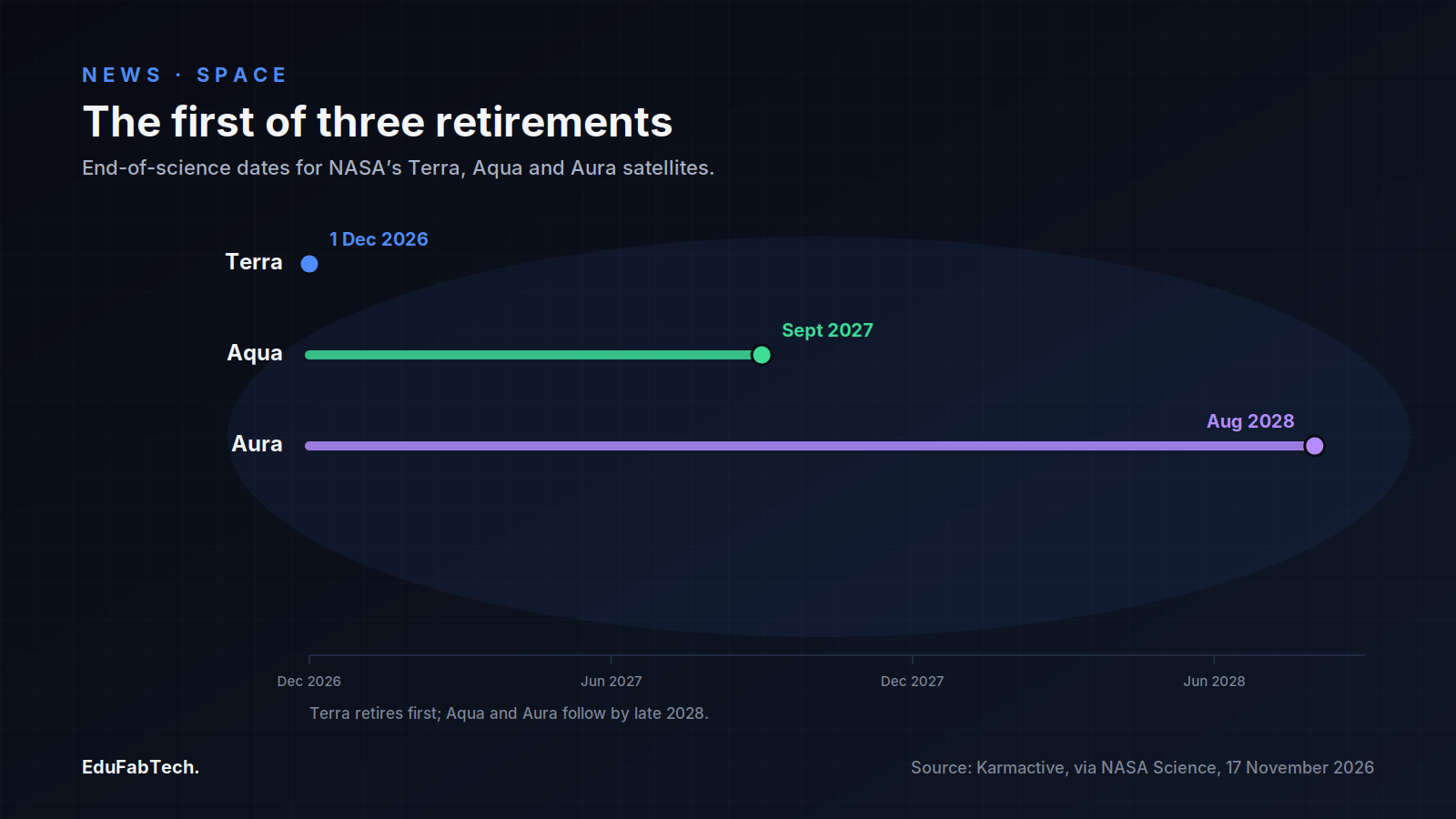
With Terra's science mission ending in December 2026, continuity work is already shifting toward the VIIRS instruments carried on the Suomi NPP and NOAA-20 satellites, which the Karmactive report describes as the route for data users who currently depend on live Terra feeds. The Karmactive summary also lists Terra's sister missions Aqua and Aura with their own projected end-of-science dates, in September 2027 and August 2028 respectively, meaning Terra's retirement is the first of a sequence rather than an isolated event.
What it means for students and researchers
For anyone doing coursework or research with MODIS, CERES, MISR or ASTER products, the practical change is that the Terra-specific feed has a hard stop on 1 December 2026, while the historical record remains open for retrospective analysis, trend studies and teaching datasets. Courses or theses that rely on continuing, near-real-time Terra observations — rather than the archive — will need to identify a successor sensor, such as the VIIRS instruments flagged in the Karmactive summary, before the instruments are powered off in January 2027. The design lesson is also notable for engineering and mission-design students: a spacecraft built for a six-year mission returned calibrated science for 27 years, which NASA Science itself describes as "more than four times" the original design life.
A quick question for readers
When an article cites a study, do you open the source?
Every claim on this site links to a primary source. We want to know whether readers actually follow those links, or whether they …
Pick an answer, create a free account in a minute, and your vote counts. Already a member? Sign in
Comments 3
Comment-
The number that actually deserves top billing is buried near the end: a six-year design life stretched to 27 years of service. That's the en…
-
The number that jumps out is the fourfold overrun on design life — six years planned, twenty-seven delivered. That's not luck, that's an eng…
-
The number that jumps out is the four: a six-year design life stretched to 27 years before anyone pulled the plug, and the cause of death is…
Join free to read the full comments and reply Comments are between members; an account takes a minute.
Source: NASA Science
Sources (3)
- Kate Ramsayer. NASA's Terra Mission to End. NASA Science, 2026. science.nasa.gov ↗ · checked 18 Nov 2026
- Terra Project Team. Giving Thanks for Terra 2026. NASA Terra Mission, 2026. terra.nasa.gov ↗ · checked 18 Nov 2026
- Sonali Tiwary. NASA Terra Satellite Mission Ends December 2026 After 27-Year Earth Observation Record. Karmactive, 2026. karmactive.com ↗ · checked 18 Nov 2026