Pelacarsen Cut Lp(a) by 78% in a Year but Did Not Reduce Heart Attacks, Phase 3 Trial Finds
The Lp(a)HORIZON trial of 8,323 patients, published in NEJM on 7 November 2026, found no cardiovascular benefit from lowering lipoprotein(a) with pelacarsen despite a near-80% drop in blood levels.
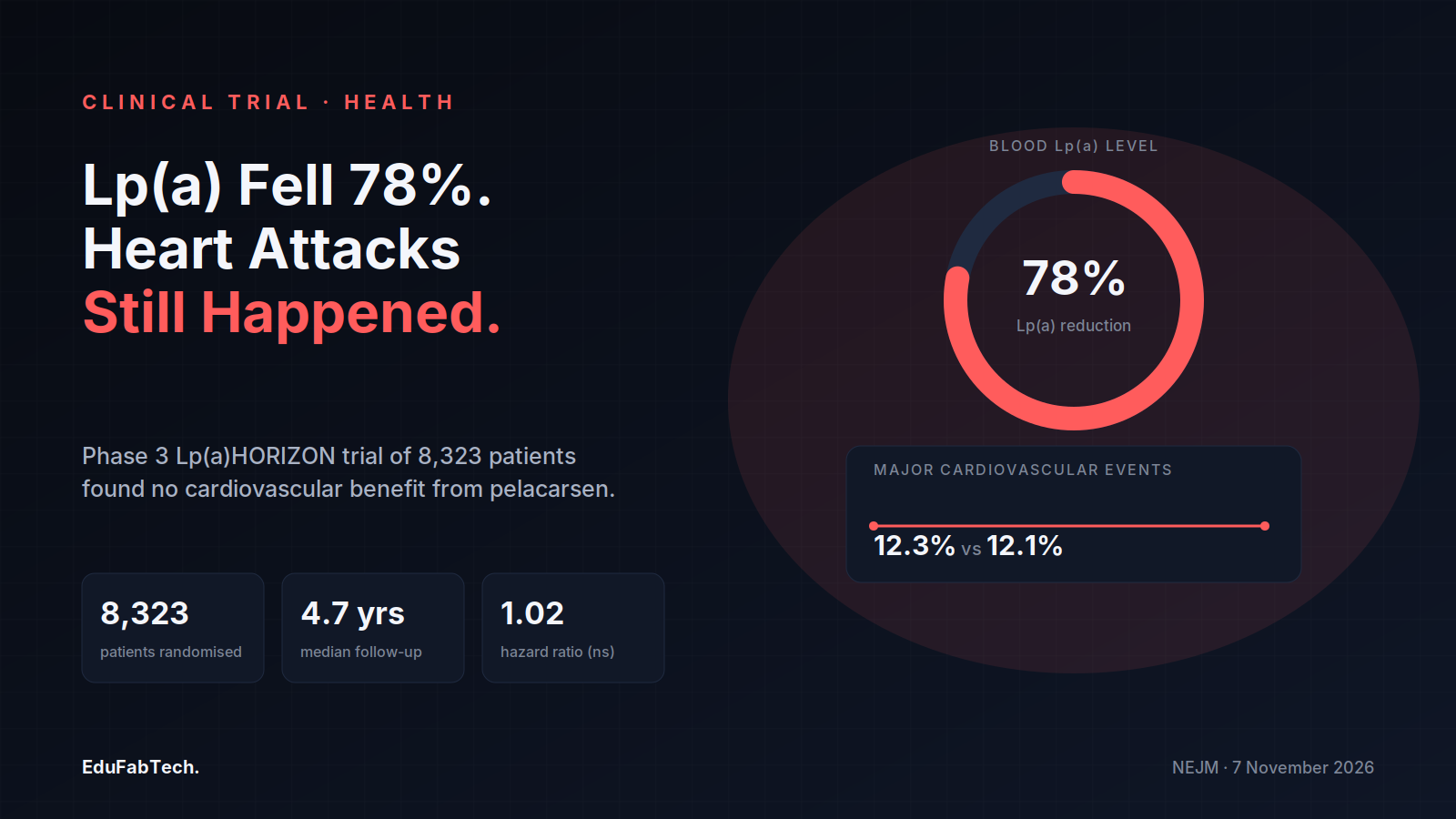
A Phase 3 trial of the injectable drug pelacarsen found that cutting lipoprotein(a), or Lp(a), by 78% did not lower the rate of heart attacks, strokes or cardiovascular death. The results of the Lp(a)HORIZON trial were presented at the American Heart Association's Scientific Sessions 2026 in Chicago and published simultaneously in The New England Journal of Medicine on 7 November 2026.
The trial, sponsored by Novartis, randomised 8,323 adults with established cardiovascular disease and a baseline Lp(a) of at least 70 mg/dL across 797 sites in 42 countries, according to the American Heart Association's newsroom. Participants received either a monthly subcutaneous injection of pelacarsen, an antisense oligonucleotide designed to block the liver's production of apolipoprotein(a), or a matching placebo.
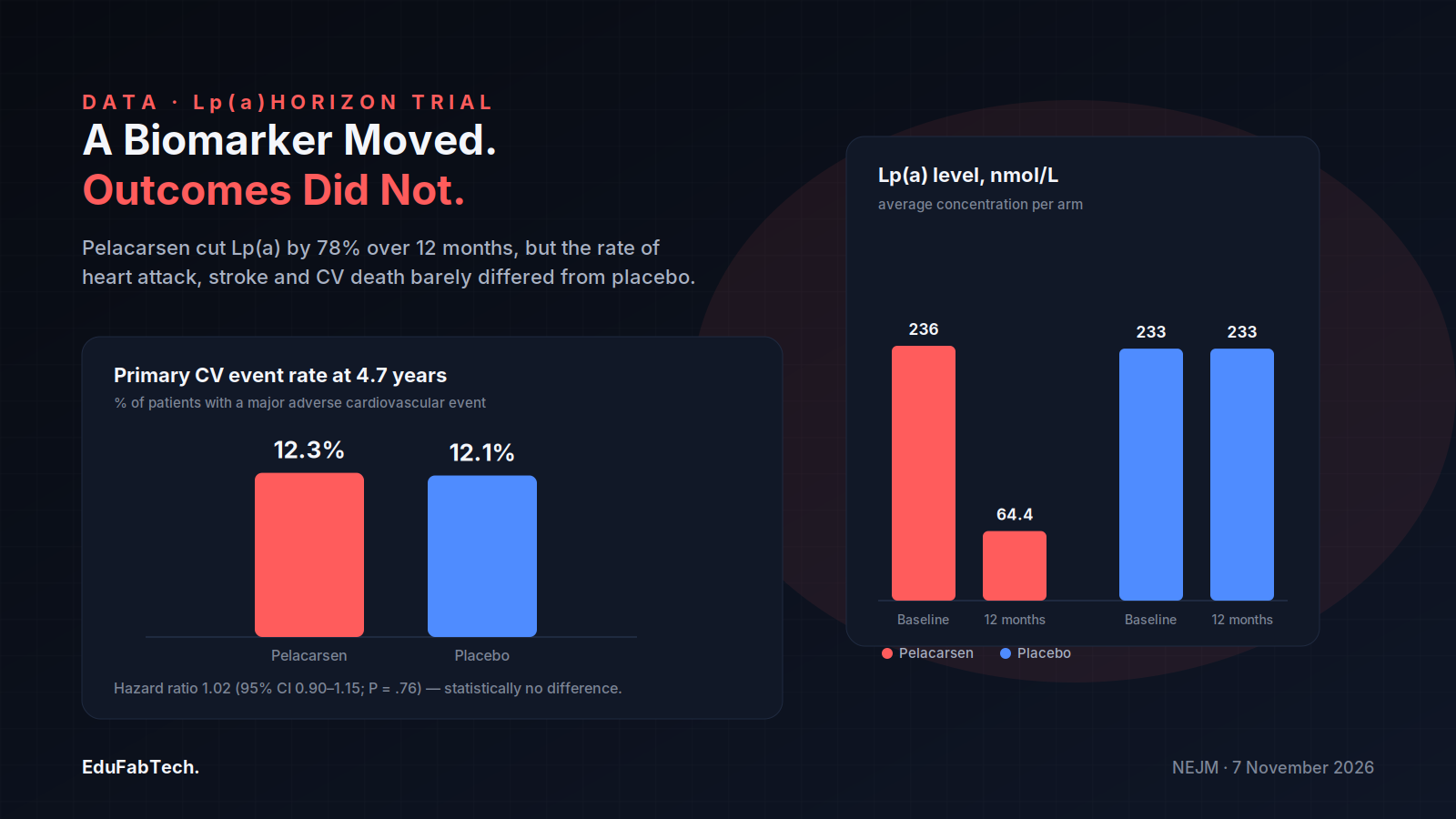
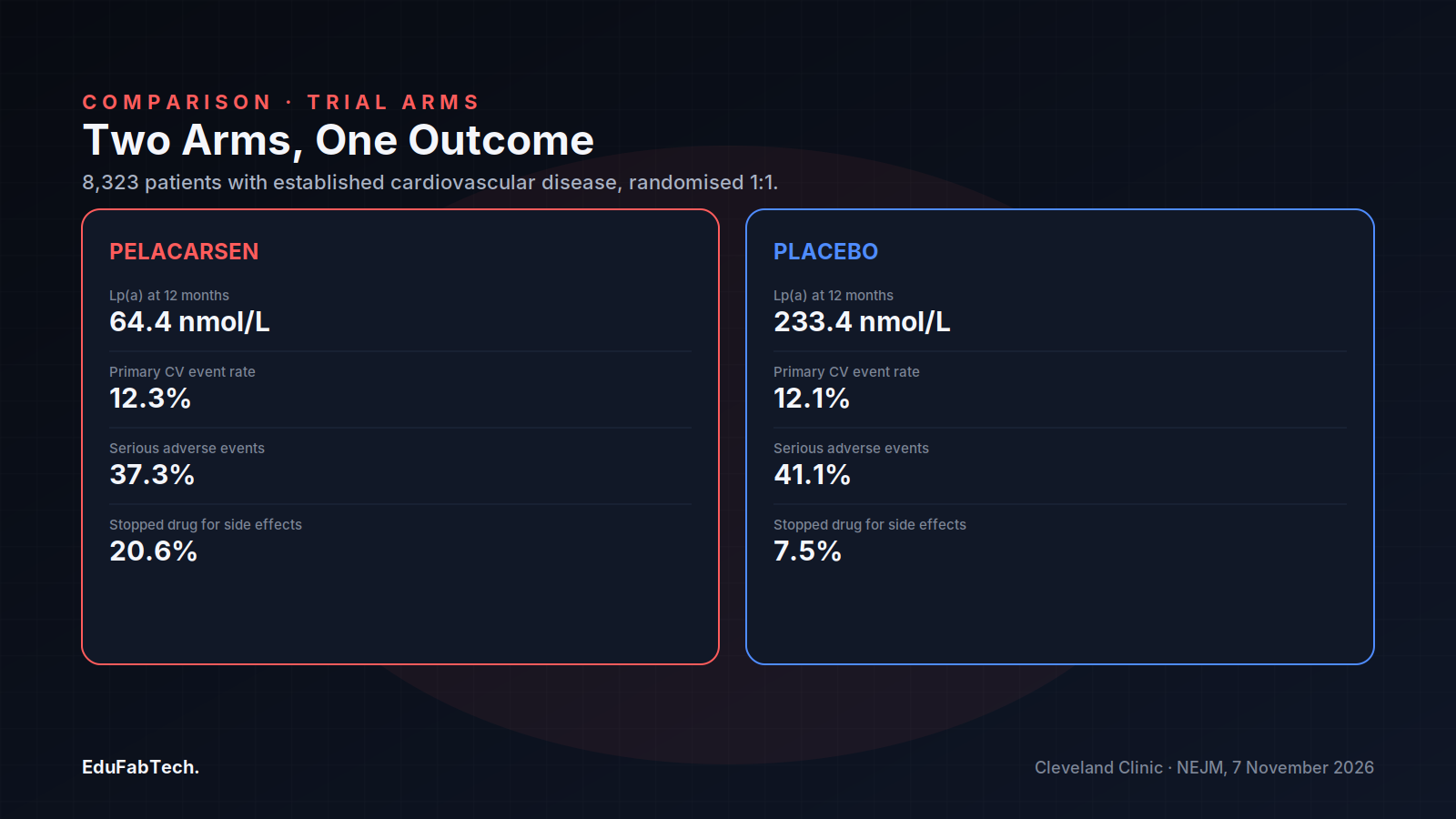
Over a median follow-up of 4.7 years, the primary endpoint — a first major adverse cardiovascular event, meaning cardiovascular death, nonfatal myocardial infarction, nonfatal stroke or urgent coronary revascularization — occurred in 12.3% of patients on pelacarsen and 12.1% of patients on placebo, a hazard ratio of 1.02 (95% CI, 0.90–1.15; P = .76), according to Healio's report on the published results.
A biomarker that moved, an outcome that did not
Lp(a) is a cholesterol-carrying particle whose blood level is set almost entirely by genetics rather than diet or exercise, and large genetic studies have long associated higher lifelong Lp(a) with higher rates of atherosclerotic disease. That association is the premise behind pelacarsen and several competing drugs now in development: if genetically low Lp(a) tracks with less heart disease, pharmacologically lowering it should too. The Lp(a)HORIZON trial was designed to test that premise directly in people who already had cardiovascular disease.
Pelacarsen reduced Lp(a) from a baseline average of 236 nmol/L to 64.4 nmol/L at 12 months in the treatment group, a mean reduction of about 78%, while the placebo group's average Lp(a) was essentially unchanged at 233.4 nmol/L, according to Healio's account of the published data. A prespecified subgroup of patients with Lp(a) of at least 90 mg/dL, who might plausibly benefit most, also showed no difference: a 12.3% event rate in both arms, with a hazard ratio of 1.0 (95% CI, 0.87–1.15; P = .99).
Safety and who left the trial
Serious adverse events were reported in 37.3% of patients on pelacarsen versus 41.1% on placebo, according to the Cleveland Clinic's newsroom account of the trial it helped coordinate. Pelacarsen was linked to more flu-like symptoms, injection-site reactions and rare hypersensitivity reactions, and patients stopped the drug for adverse effects more often than those on placebo — 20.6% versus 7.5% — with overall discontinuation from assigned treatment higher on pelacarsen (35.1%) than placebo (18.3%), per Healio's report on the published results.
What the investigators say it does and does not show
Steven E. Nissen, chief academic officer of the Heart, Vascular & Thoracic Institute at Cleveland Clinic and senior author of the trial report, said plainly of the primary result: "I cannot avoid the disappointing conclusion – it didn't work. Pelacarsen improved Lp(a) measures significantly – 78% lower; however, cardiovascular outcomes were unchanged," according to the American Heart Association's newsroom. In the Cleveland Clinic's own account, he added that "although the results are disappointing, neutral trials also provide scientific insights that help inform future research efforts." Writing for the American Heart Association, Nissen also said that "a single trial does not provide definitive evidence of a lack of benefit of lowering lipoprotein(a) as a strategy to reduce cardiovascular risk," noting that other trials testing different Lp(a)-lowering drugs are still under way.
Why it matters beyond this one drug
For students of pharmacology and epidemiology, Lp(a)HORIZON illustrates why genetic-association evidence and randomized, causal evidence can diverge once a drug is tested directly: large genetic studies had linked higher lifelong Lp(a) to greater cardiovascular risk, but a seven-year, randomized, placebo-controlled outcomes trial found no such benefit from lowering it pharmacologically. The American Heart Association's newsroom reports that three other cardiovascular outcomes trials, testing different Lp(a)-lowering compounds, are still under way — meaning it will be those trials, not the genetic associations alone, that determine whether lowering Lp(a) helps patients.
A quick question for readers
Which study habit do you think is most overrated?
Some popular habits have little evidence behind them. Which one do you think gets too much credit?
Pick an answer, create a free account in a minute, and your vote counts. Already a member? Sign in
Comments 3
Comment-
What gets me is the subgroup that was supposed to be the strongest case for this drug: patients with Lp(a) of 90 mg/dL or higher still lande…
-
The subgroup analysis is the part that actually kills the 'wrong population' excuse: even restricting to Lp(a) of at least 90 mg/dL, where a…
-
The subgroup result is the part that actually kills the hope angle for me - even patients with Lp(a) at 90+ mg/dL, who you'd expect to show…
Join free to read the full comments and reply Comments are between members; an account takes a minute.
Source: The New England Journal of Medicine
Sources (3)
- Lp(a)HORIZON Investigators. Pelacarsen and Cardiovascular Outcomes in Patients with High Lipoprotein(a). The New England Journal of Medicine, 2026. nejm.org ↗ · checked 12 Nov 2026
- American Heart Association Newsroom. Lp(a) HORIZON trial: Lp(a) fell by 78%, but cardiovascular outcomes unexpectedly neutral. American Heart Association, 2026. newsroom.heart.org ↗ · checked 12 Nov 2026
- Cleveland Clinic Newsroom. Cleveland Clinic Trial Shows Novel Lipoprotein(a) Drug Did Not Reduce Major Cardiovascular Events After Nearly 5 Years. Cleveland Clinic, 2026. newsroom.clevelandclinic.org ↗ · checked 12 Nov 2026