One 30-Minute Finnish Sauna Session Mobilises White Blood Cells, Study Finds
A University of Eastern Finland-led trial of 51 adults found a single sauna session raised circulating white blood cells, with effects fading within 30 minutes afterward.
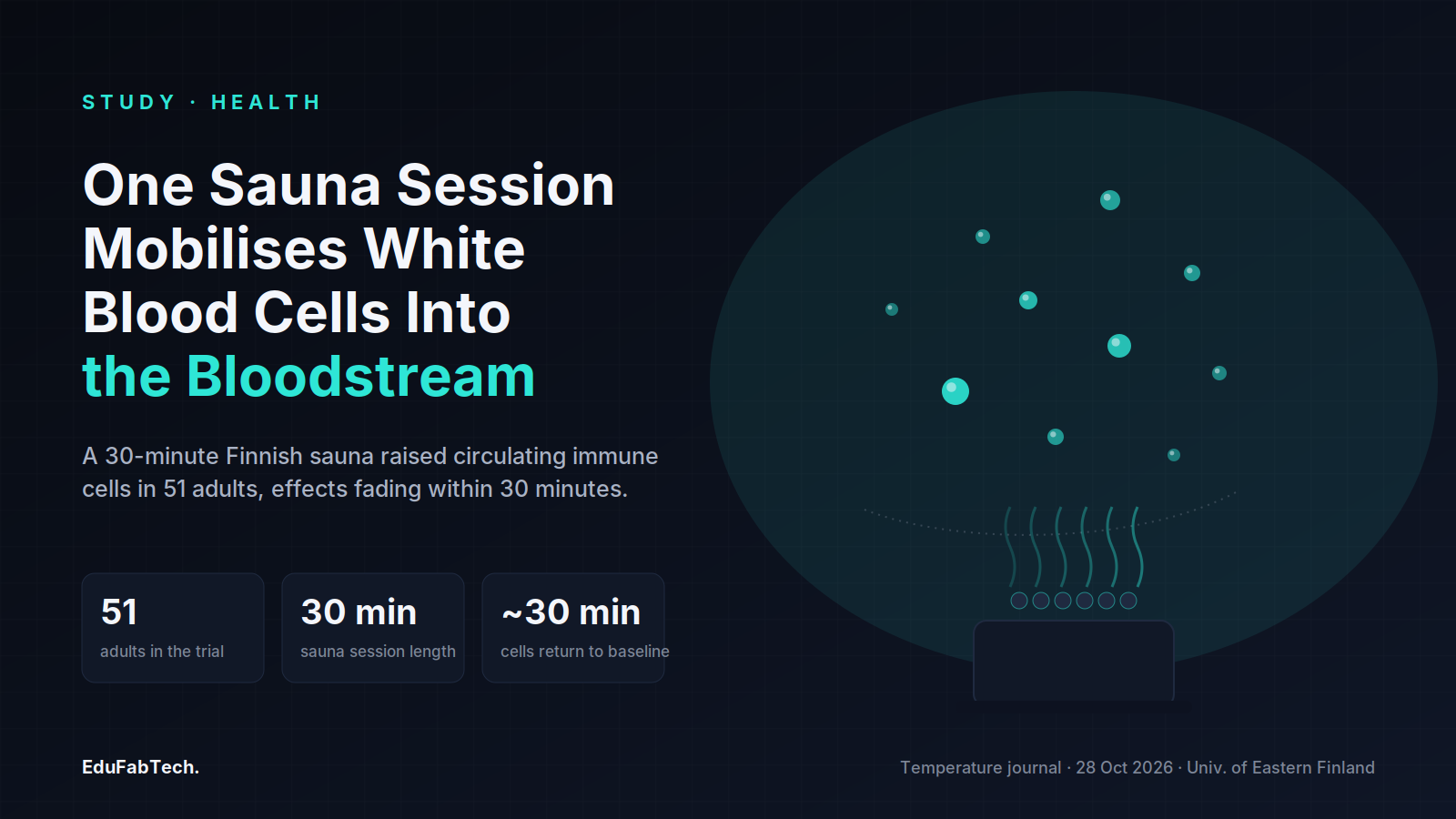
A single 30-minute Finnish sauna session temporarily increases the number of white blood cells circulating in the blood, according to a study of 51 adults published in the journal Temperature on 28 October 2026. The research, led by Professor Jari Laukkanen of the University of Eastern Finland and the Wellbeing Services County of Central Finland, together with Academy Research Fellow Ilkka Heinonen of the University of Turku and the UKK Institute for Health Promotion Research, measured how sauna heat exposure affects immune cells and signalling proteins called cytokines in the same volunteers over the course of one session, the university reports.
What the trial measured
The 51 participants, with a mean age of 50 years, each took a 30-minute sauna session that included a brief cooling period under a cold shower partway through, according to the University of Eastern Finland. Researchers drew blood at points during and after the session to track circulating neutrophils and lymphocytes — two types of white blood cell — alongside a panel of cytokines, the proteins immune cells use to coordinate a response, and changes in core body temperature, the university's summary of the study notes.
White blood cells rose, then settled back down
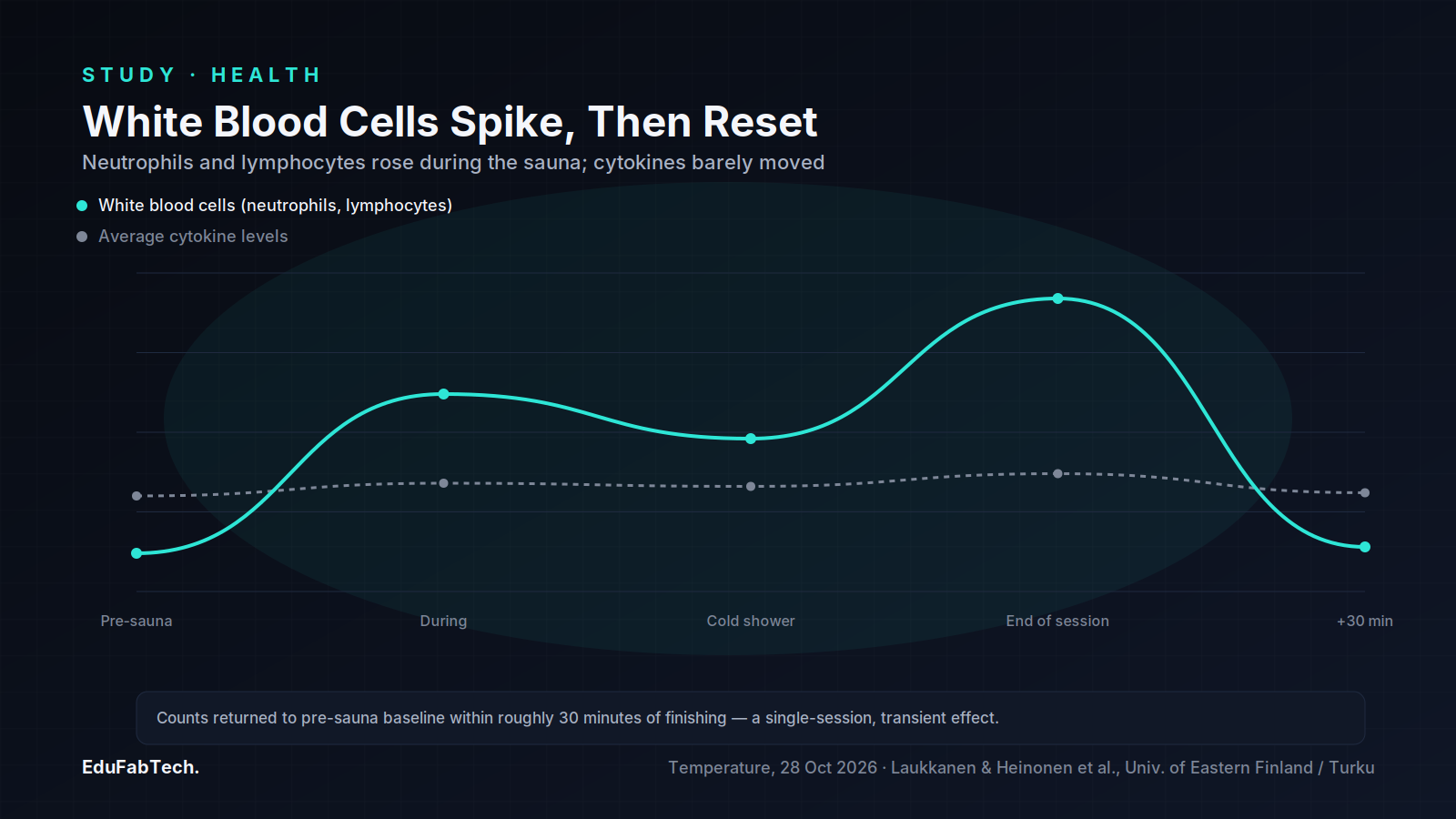
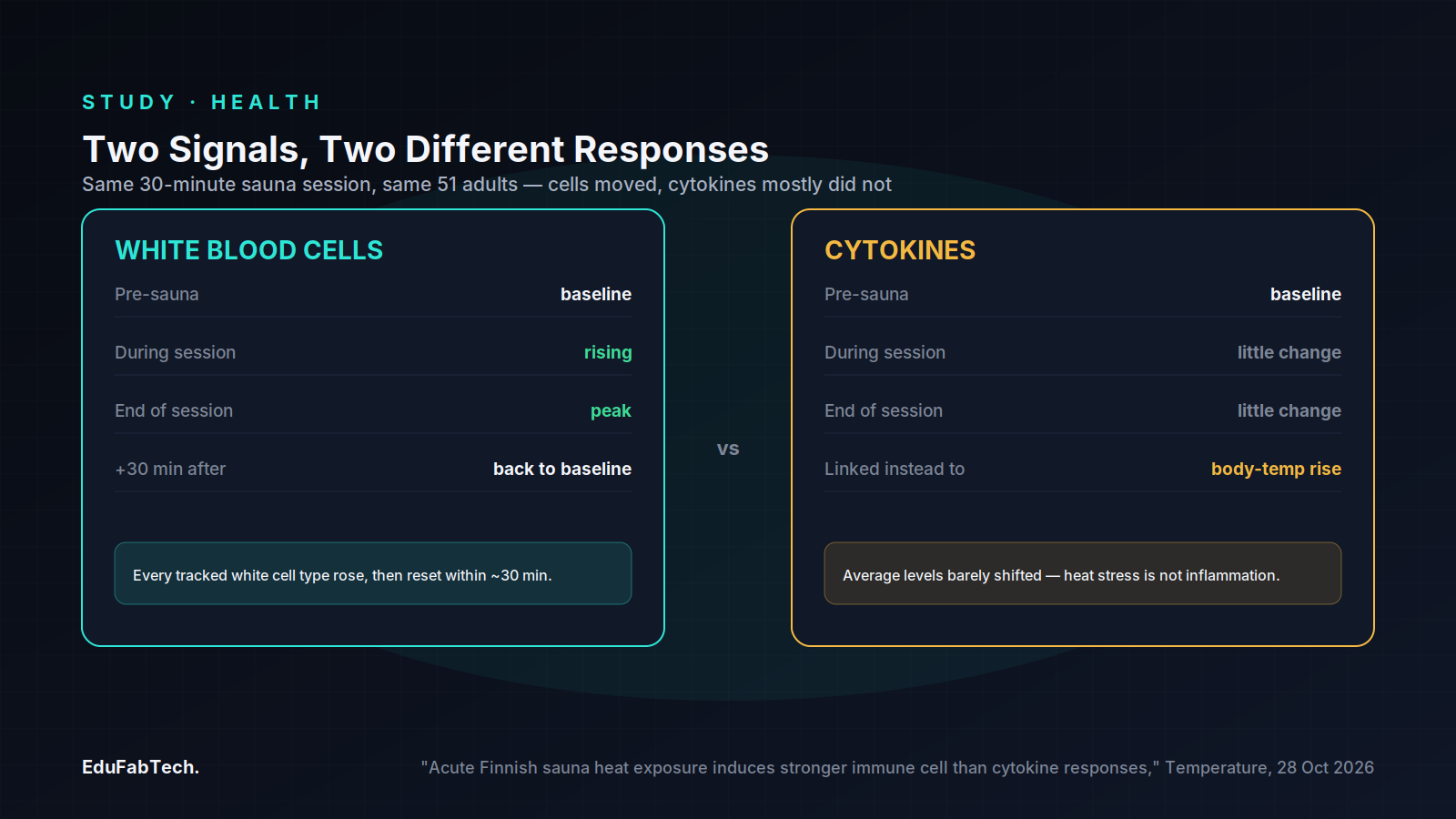
Every type of circulating white blood cell the researchers tracked increased during the sauna session, with neutrophil and lymphocyte counts returning to their pre-sauna baseline within roughly 30 minutes of finishing, University of Eastern Finland researchers found. Heinonen is quoted by the university as saying the pattern "may indicate that sauna bathing mobilises additional white blood cells into the bloodstream from tissues," where they are later redeposited, and that "this kind of periodic release of white blood cells into the bloodstream is beneficial, as once they leave their storage sites, they are better able to patrol the body," according to the University of Eastern Finland.
That pattern echoes what happens during physical exercise, when white blood cells are also temporarily redistributed into the bloodstream as part of ordinary immune surveillance, the University of Eastern Finland's account of the study states.
Cytokines barely moved on average
The cytokine results were less uniform than the white blood cell changes. Average cytokine levels showed little overall change across the group, though several cytokines varied in step with how much a participant's body temperature rose during the session — while no comparable relationship was found between white blood cell counts and body-temperature change, the University of Eastern Finland states. That distinction gives the paper its title, "Acute Finnish sauna heat exposure induces stronger immune cell than cytokine responses."
What the researchers do not claim
The authors are explicit that the trial only captured the immediate effects of one session. The University of Eastern Finland's summary states that "the study was limited to a single sauna session and its immediate effects," and that "no definite conclusions can be drawn about the development of longer-term health effects" from the data collected, according to the university. The paper does not claim that sauna bathing prevents infection or illness, and it does not compare sauna users against a non-sauna control group followed over time.
Why it matters for students and researchers
For students of physiology and immunology, the study is a clean illustration of acute, transient immune cell trafficking triggered by a heat stressor, measured with paired before-and-after blood draws rather than a single snapshot. It sits alongside the established literature on exercise-induced leukocytosis, which produces a similar temporary rise and fall in circulating white blood cells, and gives researchers a comparison point for designing further heat-exposure studies that separate innate immune cell movement from cytokine signalling.
For public-health researchers, the distinction the authors draw — a reproducible shift in cell counts against a mostly flat cytokine signal — is a reminder that whole-body heat stress and inflammatory signalling are not the same thing, and that headline claims about saunas "boosting immunity" need to specify which of the two is being measured. Replication with larger cohorts, repeated sessions over time and clinical outcomes such as infection rates would be needed before the finding could support any health recommendation beyond what the authors themselves describe: a single-session, short-term immune cell response.
A quick question for readers
Which study habit do you think is most overrated?
Some popular habits have little evidence behind them. Which one do you think gets too much credit?
Pick an answer, create a free account in a minute, and your vote counts. Already a member? Sign in
Comments 3
Comment-
The part worth flagging is the paper's own title choice: "stronger immune cell than cytokine responses" is the authors telling you cytokines…
-
The part worth flagging is right there in the piece: the cytokines barely moved on average, and only tracked with body-temperature rise in s…
-
The bit that matters here is right in the title: immune cell response, not cytokine response. Every white blood cell type tracked went up du…
Join free to read the full comments and reply Comments are between members; an account takes a minute.
Source: University of Eastern Finland
Sources (2)
- Ilkka H.A. Heinonen, Tiia Koivula, Maija Hollmén, Jaakko Immonen, Setor K. Kunutsor, Sirpa Jalkanen, Jari A. Laukkanen. Acute Finnish sauna heat exposure induces stronger immune cell than cytokine responses. Temperature, 2026. tandfonline.com ↗ · checked 30 Oct 2026
- University of Eastern Finland. Sauna bathing may boost immune responses. University of Eastern Finland News, 2026. uef.fi ↗ · checked 30 Oct 2026