Single-Dose Topical Combination Clears Scabies in Pigs, Outlasting Ivermectin to Day 42
A study in Science Translational Medicine (30 September 2026) found a 4-hour topical treatment eliminated mites and eggs in all 8 severely infested pigs, versus partial clearance with two-dose oral ivermectin.
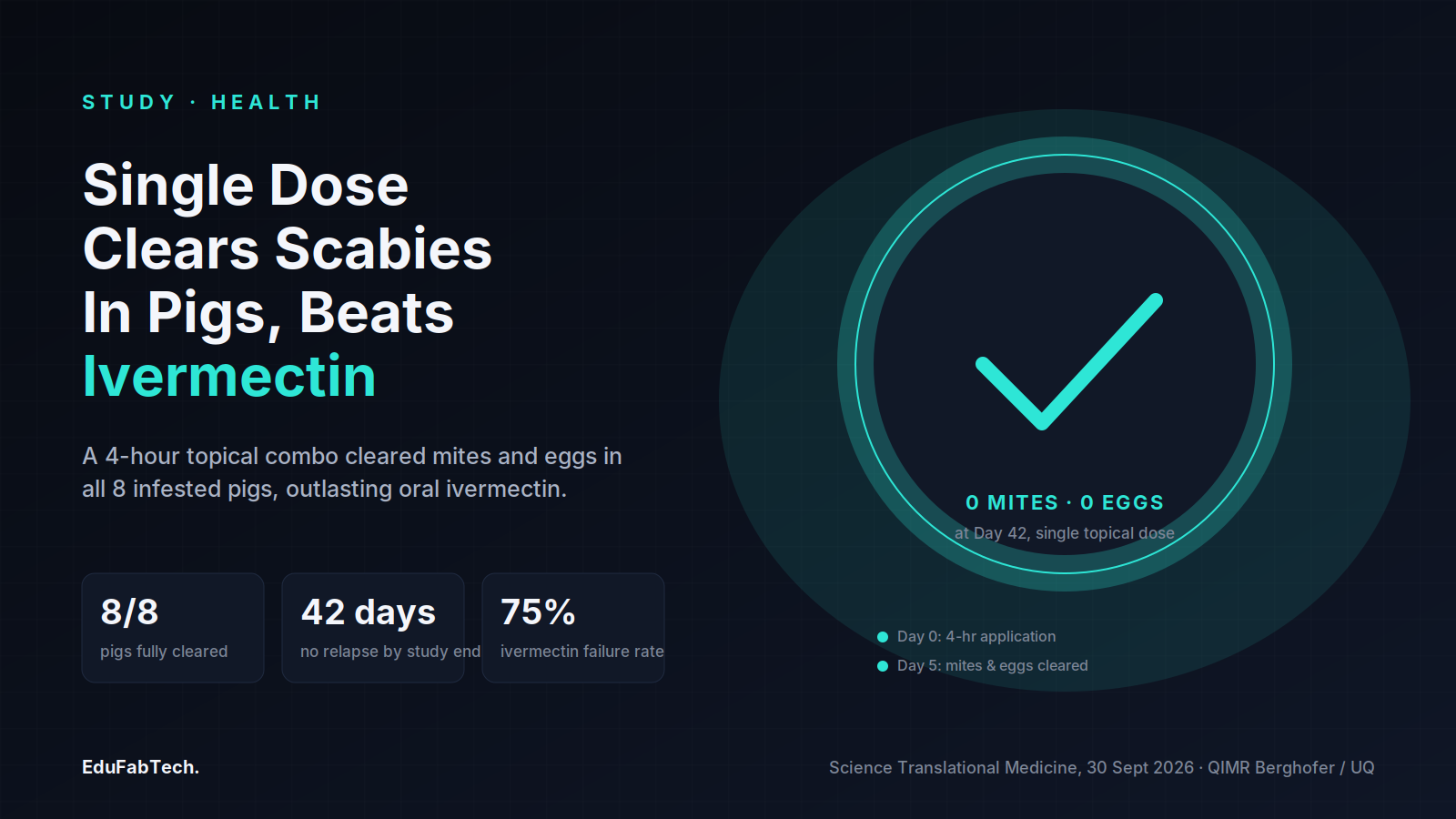
A single four-hour application of a topical drug combination cleared scabies mites and their eggs in severely infested pigs and kept them clear for 42 days, outperforming the two-dose oral ivermectin regimen that is the current standard of care, according to a study published in Science Translational Medicine on 30 September 2026. The work, led by researchers at QIMR Berghofer Medical Research Institute and the University of Queensland in Australia, tested the combination in a porcine model that the authors describe as human-relevant because pig skin and the mite Sarcoptes scabiei reproduce the disease course seen in people.
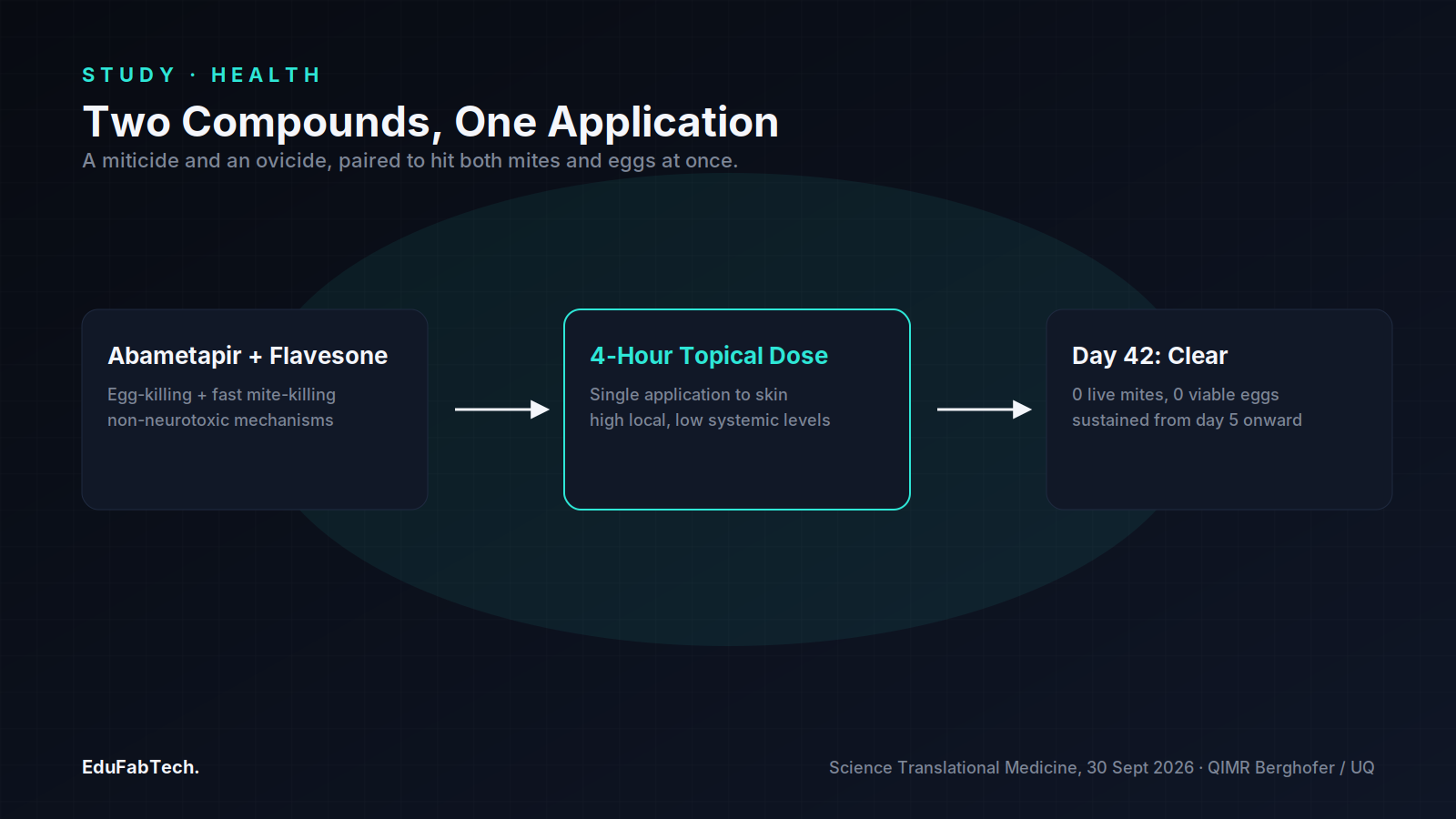
The treatment pairs two compounds with different jobs: abametapir, a metalloprotease inhibitor that kills mite eggs, and flavesone, a β-triketone that kills live mites quickly. The authors, Deepani Darshika Fernando, Sara Taylor, Gangi Rameshika Samarawickrama, Nirupama Abeysekara Nammunige, Gunter Hartel, Vern Bowles and Katja Fischer, designed the pairing specifically to hit both the adult and egg stages of the parasite through non-neurotoxic mechanisms, since neither compound alone reliably does both. Abametapir is already approved by the US Food and Drug Administration as a single-dose head lice treatment at 0.74% concentration, which the authors note as a reason the compound has an established human safety profile, even though the new combination itself has not yet been tested in people.
What the pigs showed
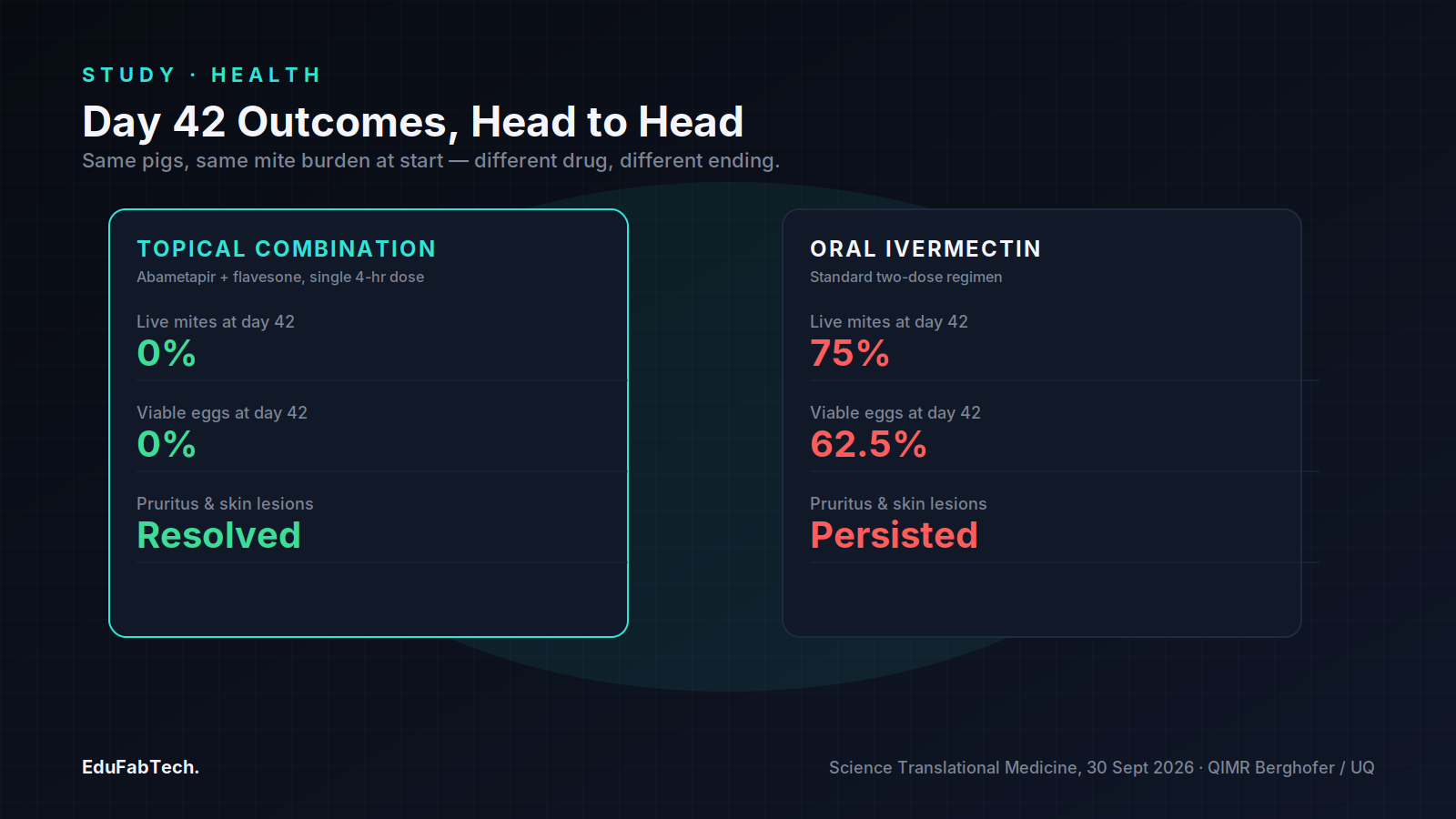
The study used 32 pigs split into four groups of eight. Animals receiving the topical combination for either four or eight hours showed zero live mites and zero viable eggs by day 5 after treatment, and stayed that way through day 42, the study's endpoint, according to the paper. Pigs on the standard two-dose oral ivermectin regimen fared worse by comparison: by day 42, 75% of ivermectin-treated animals still carried live mite infestations and 62.5% still had viable eggs, the authors report. Pruritus and skin lesions also resolved more fully in the topically treated group.
The authors attribute the topical therapy's durability to its pharmacokinetics: both abametapir and flavesone reached high concentrations in the skin quickly and stayed there, while systemic absorption remained limited. That combination, they argue, explains why a single short application outlasted a drug taken by mouth on two separate days.
Why ivermectin alone is not enough
Oral ivermectin is the mainstay scabies treatment recommended by the World Health Organization, but the WHO's scabies fact sheet notes it "should not be taken by pregnant women or children who weigh less than 15 kg," and that it is "contraindicated or not available" in some settings. The WHO estimates that at least 200 million people have scabies at any given time and that more than 400 million people are affected cumulatively each year, a burden concentrated in tropical regions. The disease was formally designated a neglected tropical disease by the WHO in 2017.
Neither ivermectin nor the topical scabicides already in use, such as permethrin, reliably kill mite eggs, which is why repeat dosing is standard practice and why treatment failure is common when a course is missed or incomplete. A combination that kills eggs as well as live mites in a single application could simplify treatment in mass drug administration campaigns, where multiple dosing rounds are logistically difficult to sustain across large populations.
What is preliminary here
The authors are explicit that these are preclinical findings in an animal model, not a human trial. The paper states that the data "support further clinical development of this promising topical drug combination," language that signals the next required step rather than a finished therapeutic. A related in vitro study by overlapping authors, published in the Journal of the American Academy of Dermatology in 2026, examined the same two-compound combination's activity against mites in laboratory conditions before the porcine work, but no registered human trial of the combination has been identified.
What it means for researchers and clinicians
For parasitology and dermatology researchers, the result is a mechanistic proof of concept: pairing a short-acting miticide with a longer-acting ovicide can, in principle, clear both life stages of Sarcoptes scabiei with one application, rather than relying on repeat dosing to catch eggs that hatch after the first treatment. For public health programmes planning mass drug administration in scabies-endemic regions, a single-application topical option — if it clears human trials — would reduce the number of contacts needed per person treated, a practical constraint that has limited ivermectin-based campaigns.
For now, the porcine data stand on their own. Whether the same pharmacokinetics and efficacy hold in human skin, across different ages and body surface areas, and under field conditions rather than controlled housing, is the open question the authors say their findings now justify testing.
A quick question for readers
Which study habit do you think is most overrated?
Some popular habits have little evidence behind them. Which one do you think gets too much credit?
Pick an answer, create a free account in a minute, and your vote counts. Already a member? Sign in
Source: Science Translational Medicine
Sources (3)
- Fernando DD, Taylor S, Samarawickrama GR, Nammunige NA, Hartel G, Bowles V, Fischer K. A single-dose topical therapy cures scabies in a human-relevant porcine model. Science Translational Medicine, 2026. science.org ↗ · checked 5 Oct 2026
- World Health Organization. Scabies (fact sheet). WHO, 2023. who.int ↗ · checked 5 Oct 2026
- Fernando DD, Samarawickrama GR, Nammunige NA, Hartel G, Bowles V, Fischer K. In vitro assessment of a combination therapy of abametapir and flavesone as a novel topical single-dose scabies treatment. Journal of the American Academy of Dermatology, 2026. jaad.org ↗ · checked 5 Oct 2026