Google's Smartwatch AI Flags Hypertension Signs in a 196-Person Nature Study
A Nature study published 5 November 2026 found an AI model reading smartwatch pulse and motion sensors caught more hypertension cases than a single office blood-pressure check, without needing a cuff for calibration.
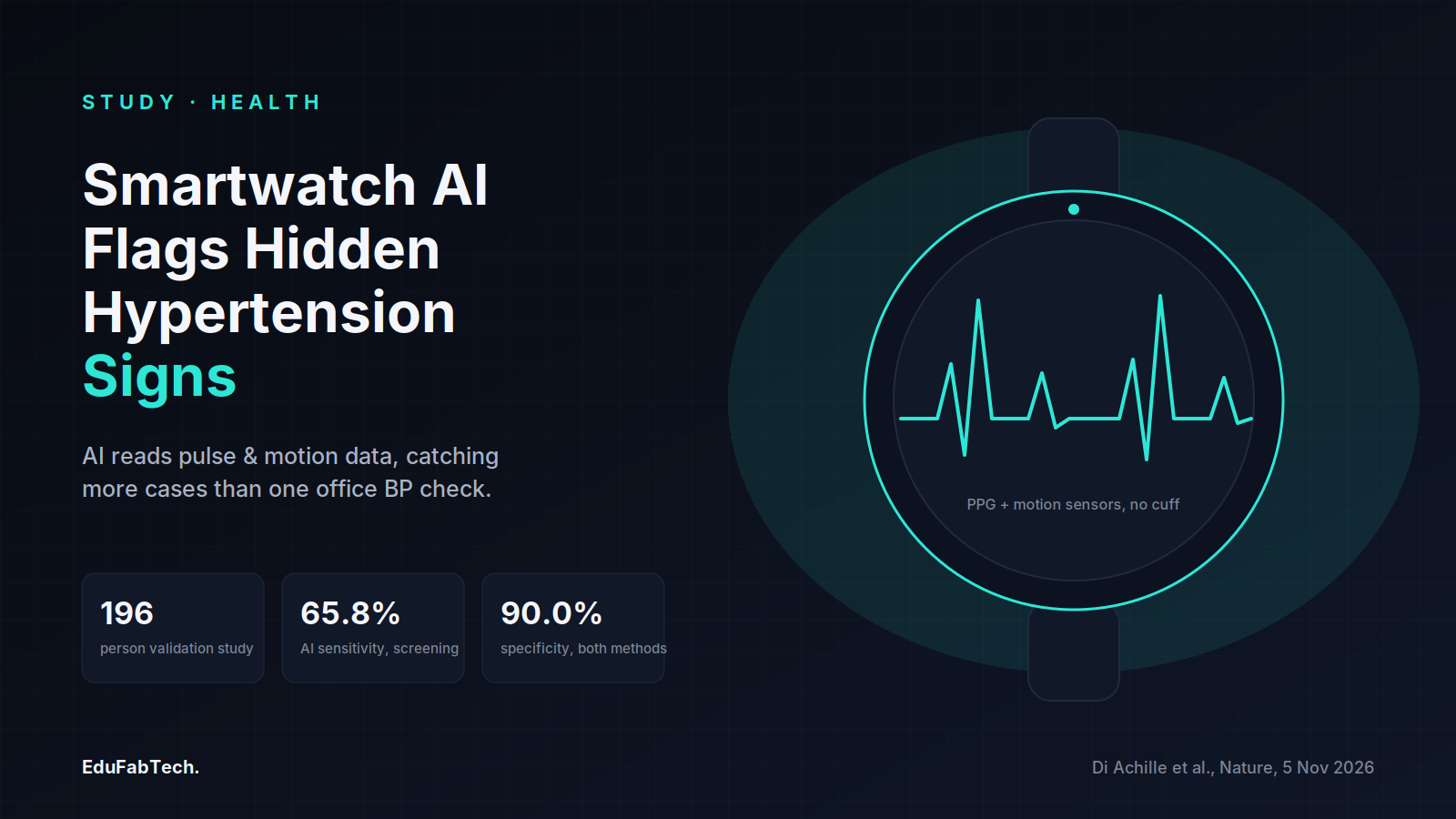
Google Research, working with collaborators at Beth Israel Deaconess Medical Center and Harvard Medical School, reported in Nature on 5 November 2026 that an artificial intelligence model reading sensor data from a consumer smartwatch can flag signs of hypertension without any blood-pressure cuff calibration, matching or exceeding routine office screening in a 196-person validation study (Di Achille et al., Nature, 2026).
Hypertension often goes undiagnosed because it produces no symptoms and is usually caught only during a clinic visit, if at all. The researchers describe their approach as "opportunistic" screening: a passive background signal, drawn from a device people already wear, meant to prompt an at-risk person toward a formal clinical check rather than to diagnose on its own, according to Google Research's announcement of the study (Google Research, 2026).
The system, which the researchers call AI-PPG-ACC-HTN, combines two signals a smartwatch already records: photoplethysmography (PPG), the optical pulse sensor used for heart-rate tracking, and accelerometer (ACC) data, which captures motion. The model also factors in the wearer's height. None of the three inputs requires a blood-pressure cuff (Google Research, 2026).
To build the underlying representation of the waveforms, the team pretrained a model using self-supervised contrastive learning on 492,347 hours of PPG and accelerometer data gathered from 2,109 consenting participants, working with overlapping 15-second windows rather than hand-engineered features (Google Research, 2026). That pretrained representation was then evaluated in a separate prospective, multicenter study at five sites in the United States, enrolling 196 participants who were free of known cardiovascular disease and not on blood-pressure medication. Twenty-four-hour ambulatory blood-pressure monitoring (ABPM), the clinical reference standard, was used to establish who actually had hypertension (Di Achille et al., medRxiv, 2025).
What the numbers show
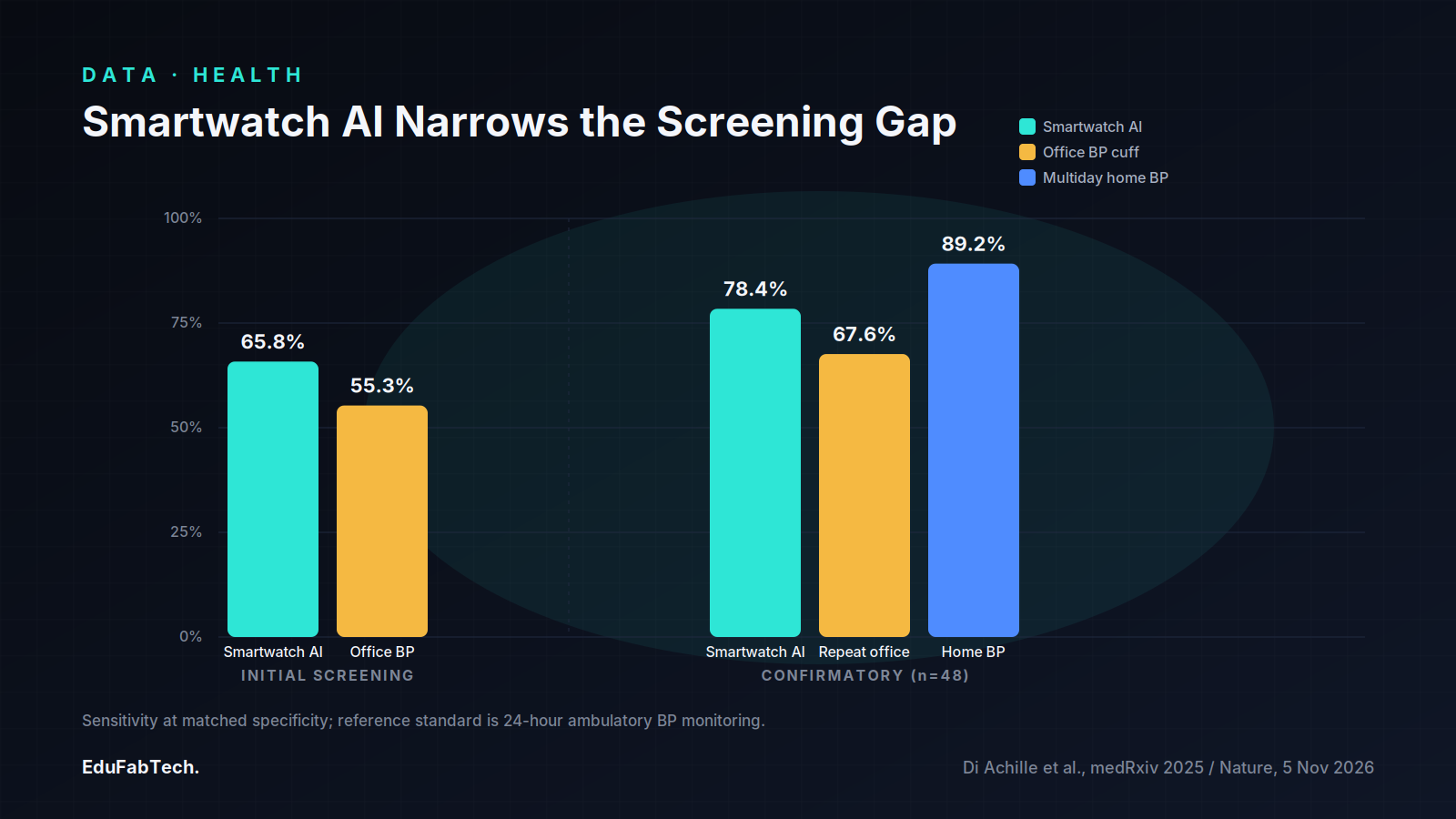
In the initial-screening scenario, the smartwatch algorithm reached 65.8% sensitivity (95% CI, 54.0–76.3%) and 90.0% specificity (83.2–94.7%), with a positive predictive value of 80.6% (68.6–89.6%). A single office blood-pressure reading in the same population reached lower sensitivity, 55.3%, at the same 90.0% specificity, with a positive predictive value of 77.8% (Di Achille et al., medRxiv, 2025).
A 48-person subset who had screened positive on an initial office reading went on to confirmatory testing. There, the smartwatch model reached 78.4% sensitivity (61.8–90.2%) and 90.9% specificity (58.7–99.8%), with a 96.7% positive predictive value (82.8–99.9%) — ahead of a repeat office reading (67.6% sensitivity, 63.6% specificity) and close to multiday home blood-pressure monitoring (89.2% sensitivity, 81.8% specificity) measured in the same comparison (Di Achille et al., medRxiv, 2025).
| Method | Sensitivity | Specificity | PPV |
|---|---|---|---|
| Smartwatch AI, initial screening | 65.8% | 90.0% | 80.6% |
| Office BP, initial screening | 55.3% | 90.0% | 77.8% |
| Smartwatch AI, confirmatory (n=48) | 78.4% | 90.9% | 96.7% |
| Repeat office BP, confirmatory | 67.6% | 63.6% | 86.2% |
| Multiday home BP, confirmatory | 89.2% | 81.8% | 94.3% |
What it does not show
Google Research describes the work as "early feasibility research" with "purely exploratory" methods, and states that smartwatch-based screening is not intended to replace a clinical arm cuff or stand in for a diagnosis (Google Research, 2026). The validation cohort excluded people with known cardiovascular disease or existing blood-pressure medication, so the reported accuracy does not describe how the model performs in those groups. The study also ran at five sites in the United States; the authors do not report results from other countries or health systems.
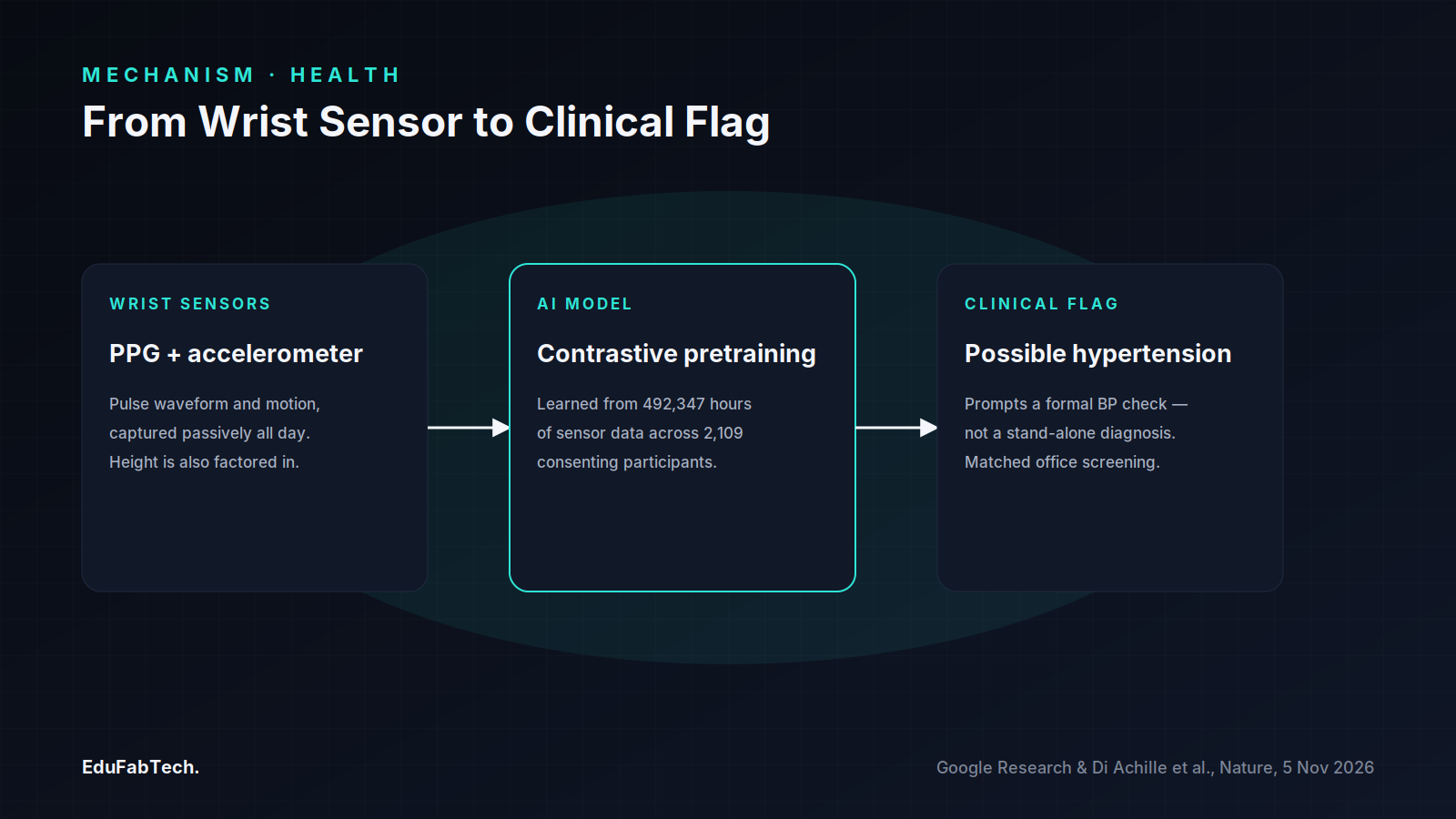
The model's pretraining was self-supervised: it learned from raw, unlabelled PPG and accelerometer waveforms in one cohort, and that representation was then evaluated against a labelled clinical outcome — hypertension status confirmed by ambulatory monitoring rather than a single cuff reading — in a separate cohort. Google says the findings have already fed into the blood pressure trends Health Guardian feature in the Google Health app, though it gave no date for a wider rollout (Google Research, 2026).
A quick question for readers
Which study habit do you think is most overrated?
Some popular habits have little evidence behind them. Which one do you think gets too much credit?
Pick an answer, create a free account in a minute, and your vote counts. Already a member? Sign in
Comments 0
CommentNo comments yet. Members start the conversation.
Source: Nature
Sources (3)
- Paolo Di Achille et al.. Opportunistically Detecting Signs of Hypertension on a Consumer Smartwatch. Nature, 2026. nature.com ↗ · checked 6 Nov 2026
- Google Research. Detecting signs of hypertension using wearable sensors. Google Research Blog, 2026. research.google ↗ · checked 6 Nov 2026
- Di Achille et al.. Opportunistically Detecting Signs of Hypertension on a Consumer Smartwatch. medRxiv, 2025. medrxiv.org ↗ · checked 6 Nov 2026