Urine RNA Test Detects 95% of Localized Bladder Cancers in 683-Sample Stanford Study
Published in Nature Medicine on October 2, 2026, the uRARE-seq method also predicted which patients would respond to BCG immunotherapy versus chemotherapy, though researchers say prospective trials are still needed.
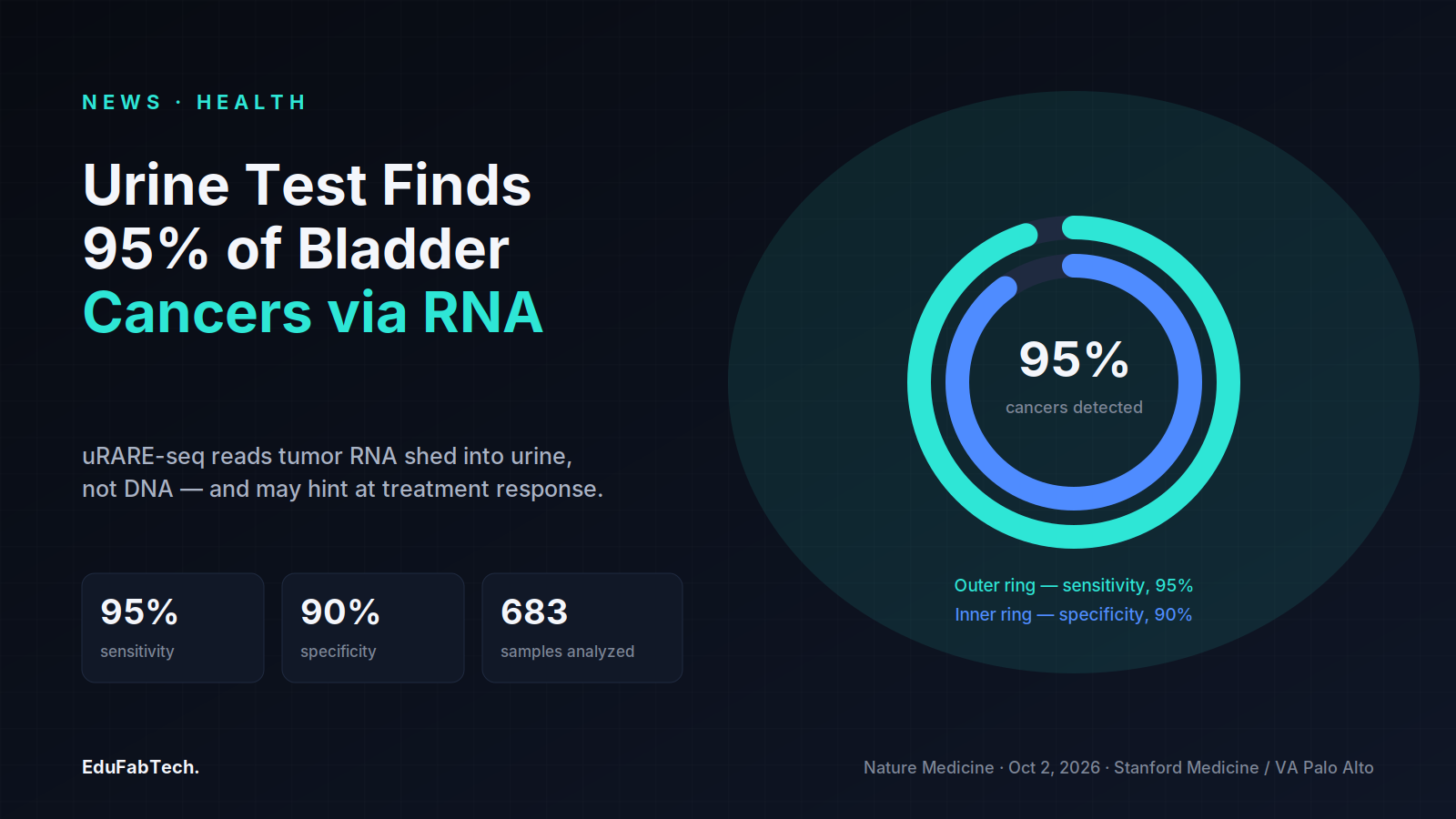
A urine test that reads RNA rather than DNA correctly identified 95% of localized bladder cancers and gave an accurate clean result to 90% of people without the disease, according to a study published in Nature Medicine on October 2, 2026. The work, led by graduate student Kevin J. Liu with senior authors Maximilian Diehn, Joseph Liao and Ash Alizadeh at Stanford Medicine and the VA Palo Alto Health Care System, analyzed 683 urine samples from patients with bladder, kidney and prostate cancer as well as healthy volunteers, according to Stanford Medicine's account of the study.
Reading RNA instead of DNA
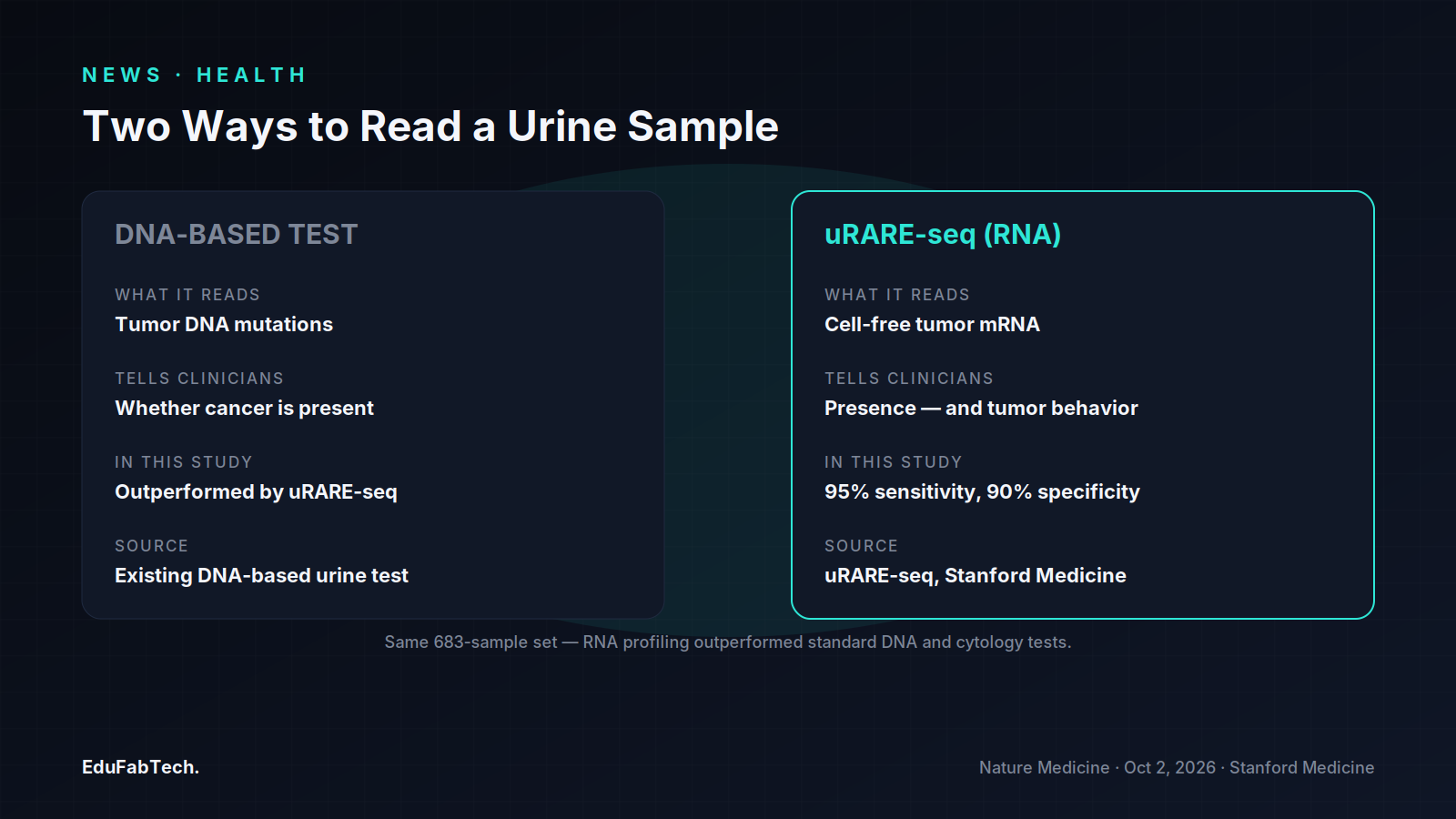
Most existing liquid-biopsy tests, including urine-based ones, look for tumor DNA — fragments of genetic material bearing the mutations that mark a cell as cancerous. The new method, called uRARE-seq (urine random priming and affinity capture of cell-free RNA fragments for enrichment analysis by sequencing), instead measures messenger RNA that tumor cells shed into urine. "Measuring tumor DNA in urine can tell us whether a cancer is present. Analyzing RNA can tell us not only whether a cancer is present — but also what it's doing," Diehn said, according to the Stanford Medicine news release.
Because RNA reflects which genes a cell is actively using rather than which mutations it carries, the approach can in principle work even when a tumor's specific mutations vary from patient to patient. Alizadeh put the distinction this way in the same release: RNA analysis looks for "a biological signature" of disease rather than an exact genetic match.
How it compares with the current standard
Bladder cancer is currently diagnosed and monitored largely through cystoscopy, in which a clinician threads a camera into the bladder, and through urine cytology, in which a lab technician checks a urine sample under a microscope for cancer cells. According to Stanford Medicine's summary of the findings, uRARE-seq outperformed both standard urine cytology and an existing DNA-based urine test in the same sample set, and cystoscopy itself can miss a meaningful share of tumors, which is part of the motivation for a reliable urine-based alternative.
The 95% sensitivity and 90% specificity figures reported in the Nature Medicine paper come from a training cohort of 251 samples (151 bladder cancer cases, 100 controls) and an independent validation cohort of 282 samples (142 cases, 140 controls) within the larger 683-sample set; the authors have not reported how the test performs in an unselected screening population outside these cohorts.
Predicting who responds to which treatment
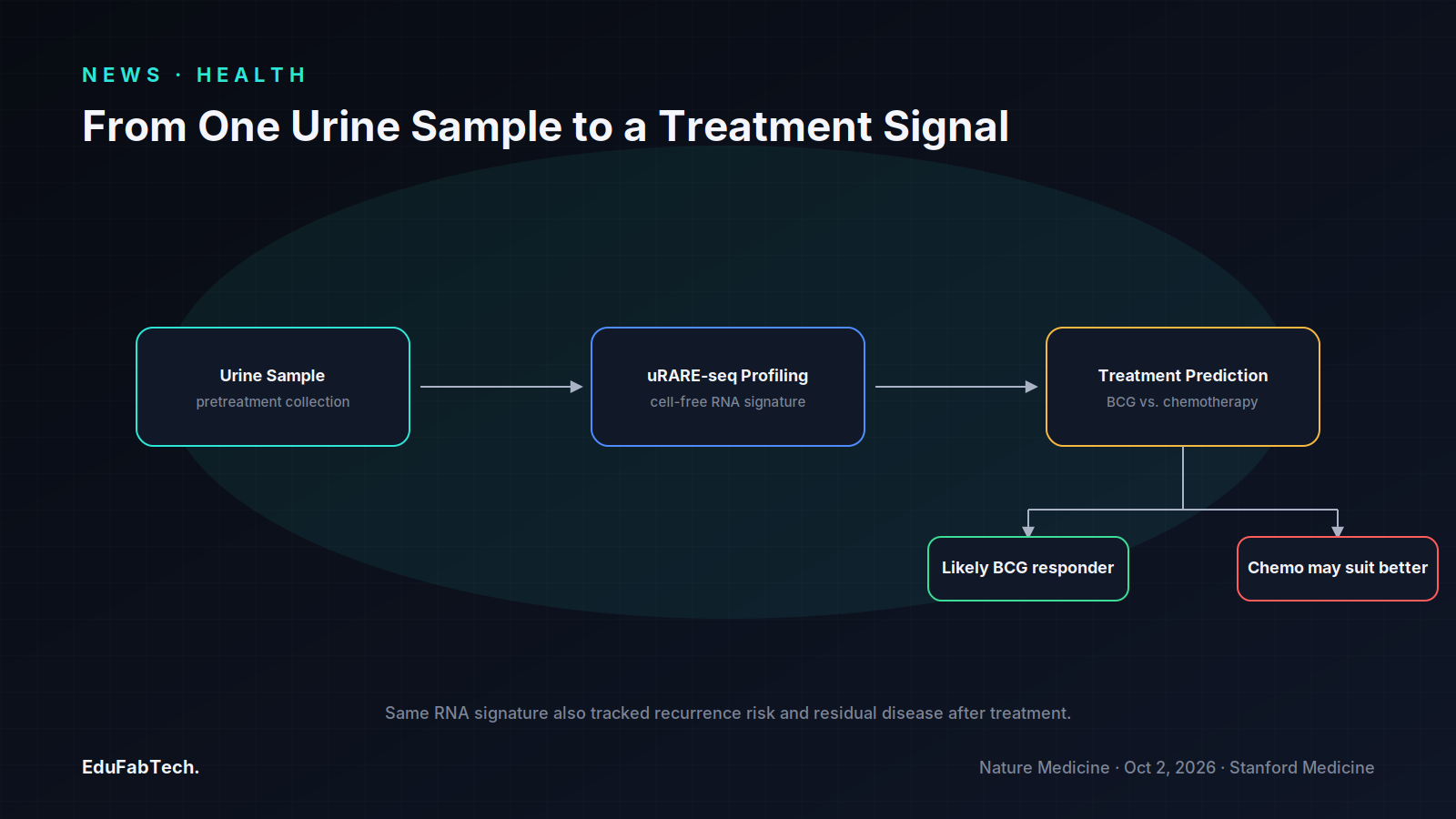
Beyond detection, the researchers used pretreatment urine RNA profiles to build a biomarker intended to predict whether a patient with non-muscle-invasive bladder cancer would respond better to BCG immunotherapy or to chemotherapy, and found this signature was also associated with risk of recurrence. "If we can guide those choices, we have the potential to help both" patients and clinicians, Liao said, according to the Stanford Medicine release. The same RNA-based approach was also used to track minimal residual disease after treatment and to distinguish complete molecular responses following surgery from those following BCG therapy.
What the researchers say is still needed
The study's authors describe uRARE-seq as a research tool validated on a retrospective sample set, not yet a test ready for clinic use. Stanford Medicine's summary states that the team plans larger, prospective trials across multiple medical centers before the test could move toward routine care. The current results, drawn from 683 samples at centers associated with Stanford and the VA Palo Alto Health Care System, have not yet been replicated in an independent, multi-site cohort.
Why it matters beyond one cancer type
Bladder cancer is often treated through repeated, invasive monitoring because of its tendency to recur, making a reliable non-invasive test for both initial diagnosis and surveillance clinically useful on its own. For students and researchers following liquid biopsy more broadly, the study is also a data point in an active methodological debate: most cancer liquid-biopsy research to date has focused on circulating or urinary tumor DNA, and this paper is among a smaller body of work testing whether cell-free RNA can do some of the same jobs, with the added possibility of signaling tumor behavior rather than just tumor presence. Diehn, Liao and Alizadeh's team frames the RNA-based approach as complementary to DNA-based testing rather than a wholesale replacement, since the paper's reported advantages are specific to the bladder, kidney and prostate cancer cohorts it examined.
The full peer-reviewed methodology, including the statistical handling of the treatment-response biomarker, is available in the Nature Medicine paper itself; a plain-language summary of the clinical implications is provided by Stanford Medicine and by the study's EurekAlert release.
A quick question for readers
Which study habit do you think is most overrated?
Some popular habits have little evidence behind them. Which one do you think gets too much credit?
Pick an answer, create a free account in a minute, and your vote counts. Already a member? Sign in
Source: Nature Medicine
Sources (3)
- Kevin J. Liu, Maximilian Diehn, Joseph Liao, Ash Alizadeh, et al.. Urine cell-free RNA for bladder cancer detection and treatment response prediction. Nature Medicine, 2026. nature.com ↗ · checked 6 Oct 2026
- Stanford Medicine News Center. Urine test may improve bladder cancer diagnosis and guide treatment decisions. Stanford Medicine, 2026. med.stanford.edu ↗ · checked 6 Oct 2026
- EurekAlert (AAAS). Urine test may improve bladder cancer diagnosis and guide treatment decisions. EurekAlert, 2026. eurekalert.org ↗ · checked 6 Oct 2026