Voyager 1 Becomes the First Human-Made Object to Reach One Light-Day From Earth
NASA and JPL announced on 19 November 2026 that Voyager 1 crossed one light-day from Earth on 18 November, as the 1977 probe runs on two working instruments and a fading plutonium power source.
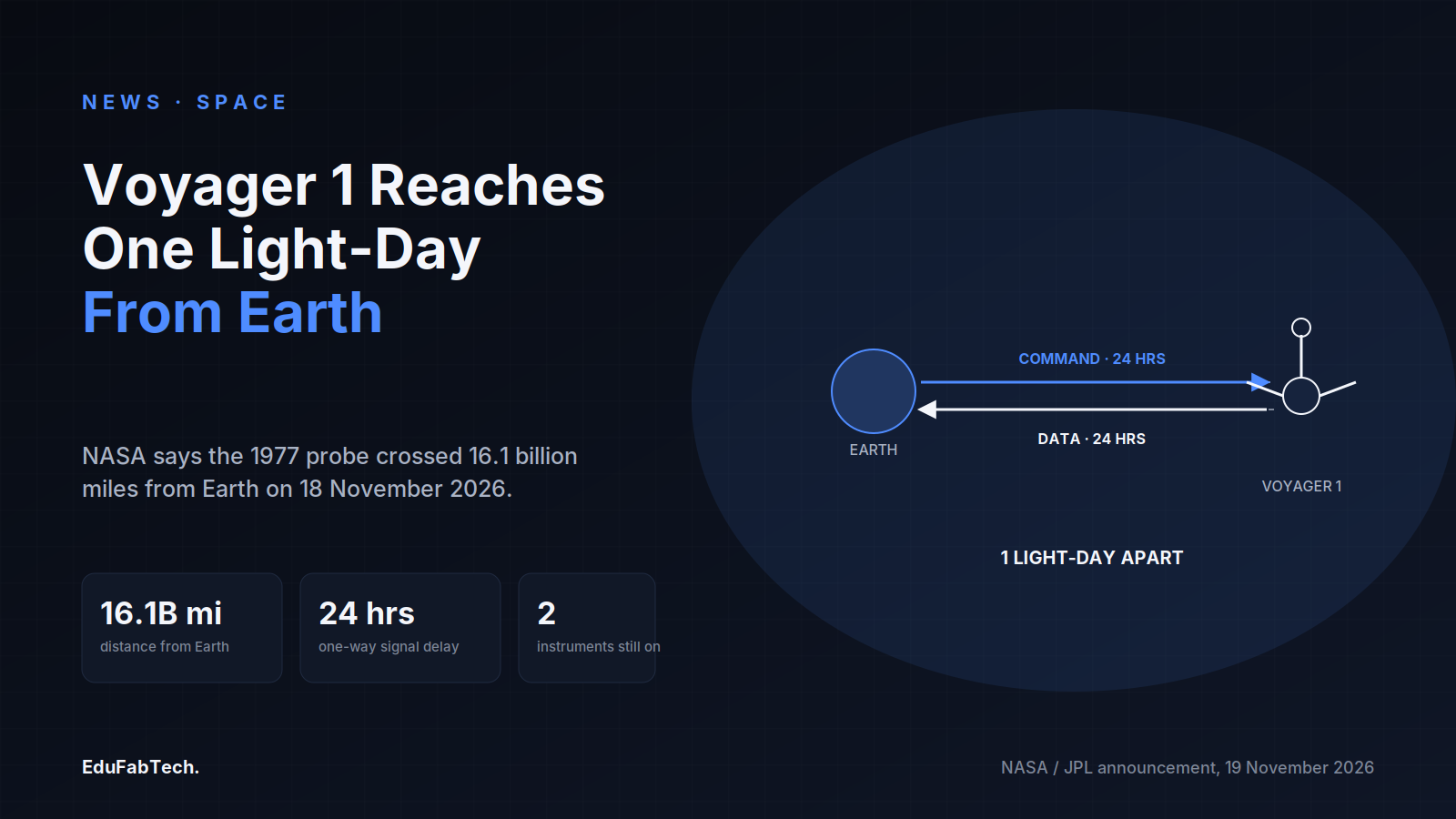
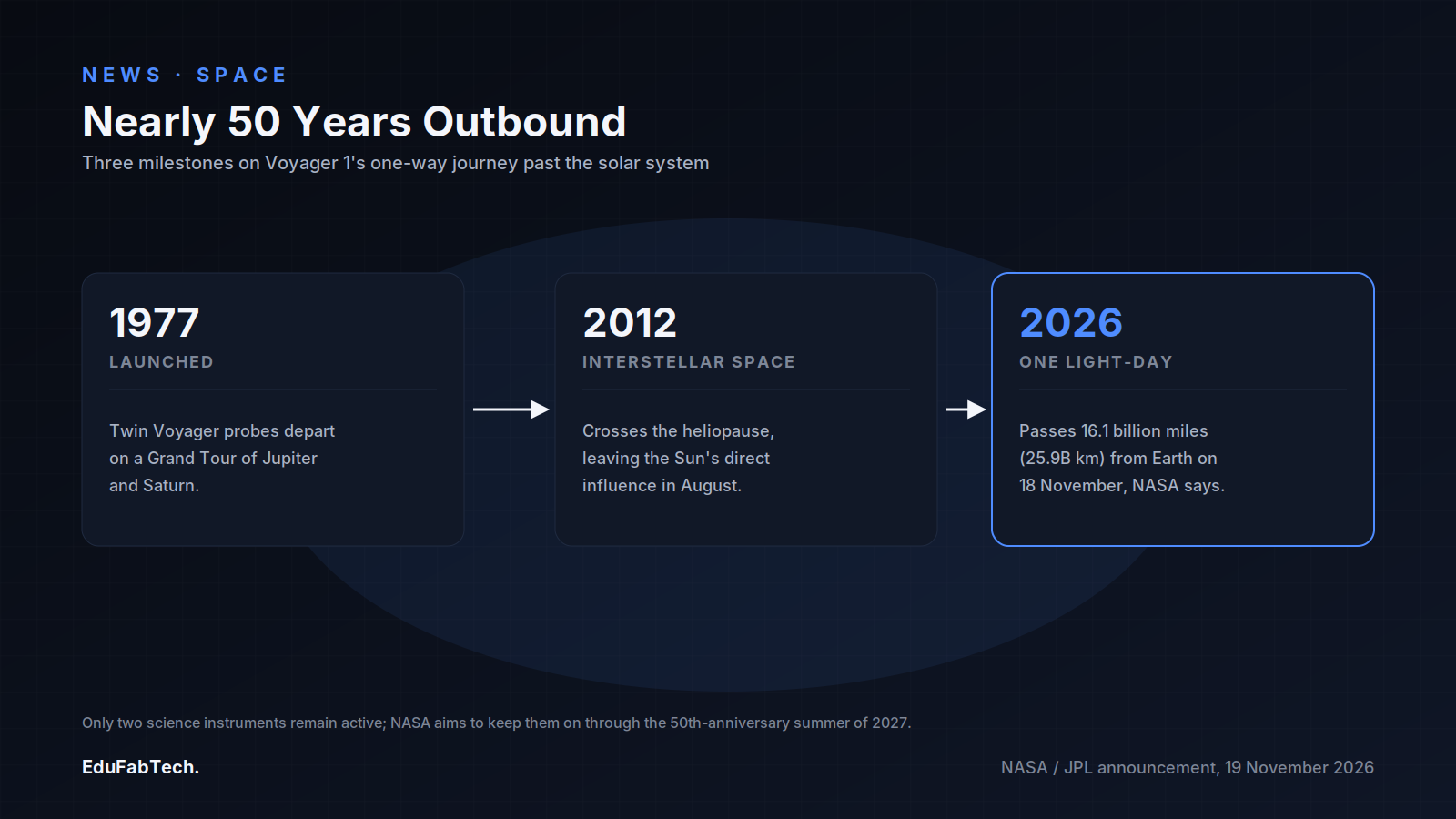
NASA's Jet Propulsion Laboratory (JPL) announced on 19 November 2026 that Voyager 1, launched in September 1977, crossed one light-day of distance from Earth — 16.1 billion miles, or 25.9 billion kilometers — at 2:16 a.m. PST (5:16 a.m. EST) on 18 November 2026, according to the JPL announcement. No other human-made object has traveled this far.
What "one light-day" means for communication
A light-day is the distance light travels in 24 hours. At that range, a radio command sent from Earth now takes a full day to reach Voyager 1, and any reply takes another day to return, JPL states in its announcement. "We listen to Voyager 1 every day and send commands to the spacecraft weekly," said Suzanne Dodd, Voyager Project Manager at JPL, in the release. "It just takes a little longer to communicate than it used to. Even traveling at the speed of light, signals now take 24 hours to reach the spacecraft and 24 hours to reach us."
The spacecraft is moving away from Earth at roughly 38,000 miles per hour (61,155 kph), a speed built up through gravity assists at Jupiter in 1979 and Saturn in 1980, according to Scientific American's coverage of the milestone. Voyager 1 crossed the heliopause and entered interstellar space in August 2012, a boundary marking the edge of the Sun's direct influence.
A fading power supply
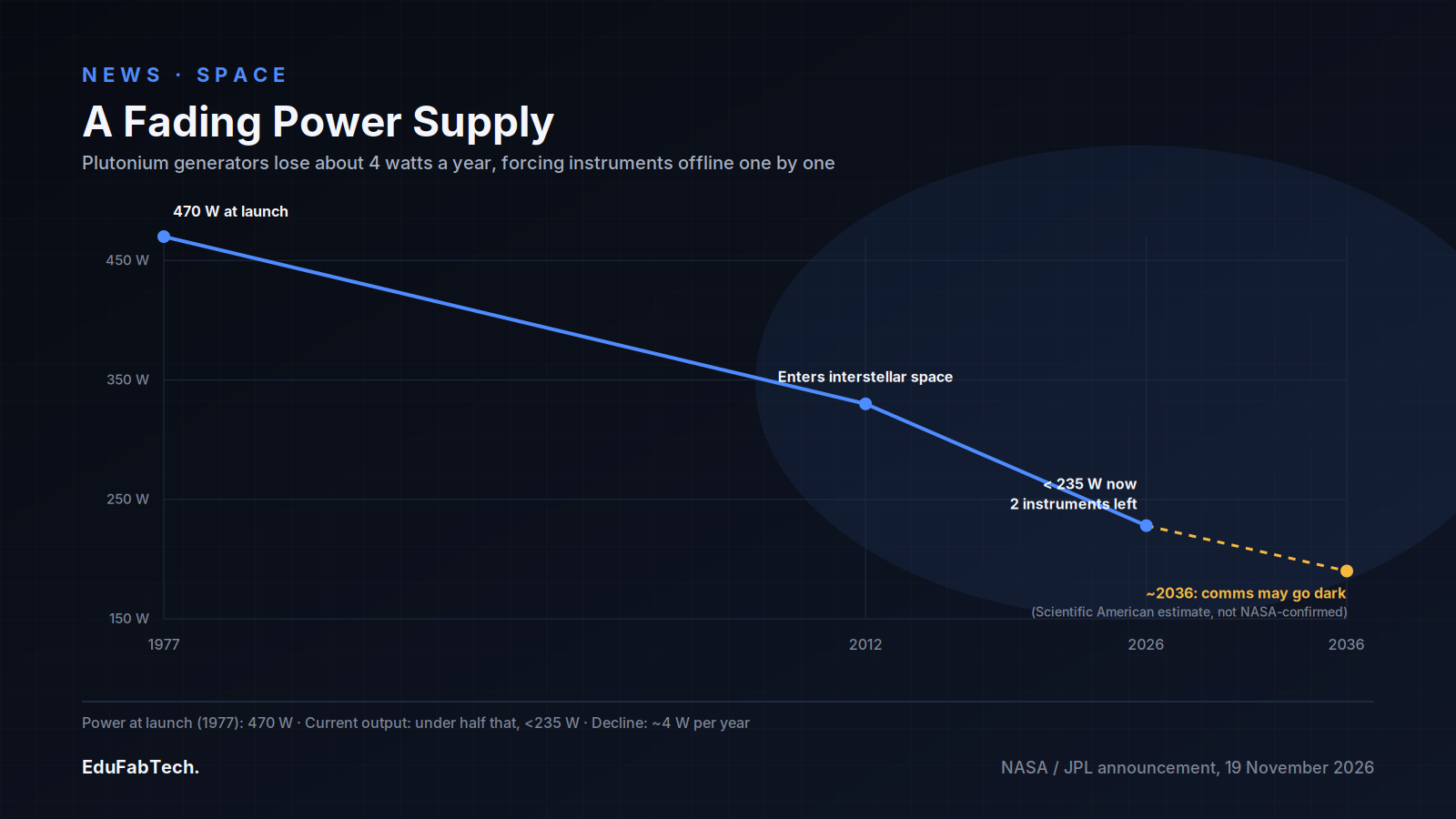
Voyager 1 is powered by radioisotope thermoelectric generators that convert the decay heat of plutonium-238 into electricity. JPL's announcement notes the spacecraft's power system loses about 4 watts every year, a decline that has already forced engineers to switch off science instruments one at a time to keep the remaining ones running. Scientific American reports that the generators produced roughly 470 watts at launch and now produce less than half that, leaving only two science instruments still functioning: the magnetometer and the plasma wave subsystem.
JPL's release states that the mission team expects to keep operating Voyager 1's science instruments at least through the spacecraft's 50th launch anniversary in summer 2027. Scientific American's report goes further, citing an expectation that Voyager 1 will lose the power needed to communicate with Earth around 2036, though NASA's own announcement does not commit to that date.
Scientific contributions cited by NASA and Caltech
JPL, which built and operates Voyager 1 under contract to NASA, credits the mission with reshaping understanding of the heliosphere, the bubble of solar wind and magnetic field surrounding the solar system. "The Voyagers are revolutionizing our understanding of interstellar space, a previously unexplored region outside the heliosphere," said Linda Spilker, Voyager Project Scientist at JPL, in the announcement. "One big surprise is the extent to which our Sun continues to affect interstellar space, all the way out to Voyager 1. Where does the Sun's influence end and pristine interstellar space begin? Perhaps Voyager may endure long enough to answer that question."
Joe Westlake, director of NASA's Heliophysics Division, is quoted in the same release describing the mission's dual legacy: "The Voyager mission would be remarkable just for what it contributed to planetary science with the Grand Tour of the outer planets. But it went on to become central to NASA's fleet of heliophysics missions offering insights into the star that we all revolve around, the Sun." Caltech president Ray Jayawardhana, whose institution manages JPL for NASA, linked the milestone to the mission's original project scientist: "Its epic journey reflects the vision of Ed Stone, the Caltech physicist and JPL director who guided the mission for decades."
Why this matters beyond the anniversary
For researchers studying the heliosphere and the local interstellar medium, Voyager 1's magnetometer and plasma wave instrument remain the only direct, in-situ measurements available from beyond the Sun's immediate influence; every other observation of that region is indirect, from telescopes or models. JPL's Deep Space Network, the global system of antennas that commands and receives data from the spacecraft, is the only infrastructure built to maintain contact at this range, and the growing one-way delay is now a fixed operational constraint for the team rather than a technical curiosity.
JPL's announcement frames the spacecraft's eventual silence as a transition rather than a failure: Suzanne Dodd said that when Voyager 1 "can no longer communicate with Earth," it will become "humanity's silent ambassador to the stars." Scientific American notes that once its instruments and transmitter go dark, the probe will continue on its current trajectory indefinitely, carrying the Golden Record first attached in 1977.
A quick question for readers
When an article cites a study, do you open the source?
Every claim on this site links to a primary source. We want to know whether readers actually follow those links, or whether they …
Pick an answer, create a free account in a minute, and your vote counts. Already a member? Sign in
Comments 3
Comment-
The number that got buried for me is the 4 watts a year drain and that Scientific American's 2036 comms cutoff doesn't even come from NASA's…
-
The number that actually stands out to me isn't the distance, it's the power curve: 470 watts at launch, losing about 4 watts a year, down t…
-
The number that actually stops me is 4 watts a year. That's a steady, almost boring decay rate, but stacked over decades it's exactly why th…
Join free to read the full comments and reply Comments are between members; an account takes a minute.
Source: NASA Jet Propulsion Laboratory
Sources (3)
- Jet Propulsion Laboratory. NASA's Voyager 1 Makes History Reaching One Light-Day From Earth. NASA/JPL, 2026. jpl.nasa.gov ↗ · checked 26 Nov 2026
- NASA. NASA's Voyager 1 Makes History Reaching One Light-Day From Earth. NASA, 2026. nasa.gov ↗ · checked 26 Nov 2026
- Christopher K. Walker. Voyager 1 Reaches 'One Light-Day' Milestone. Scientific American, 2026. scientificamerican.com ↗ · checked 26 Nov 2026