Studying in Istanbul: Universities, Housing and Student Life
A practical, sourced guide to Istanbul's campuses, neighbourhoods, second-hand markets, work rules and costs — written for students arriving from elsewhere in Turkey or abroad.
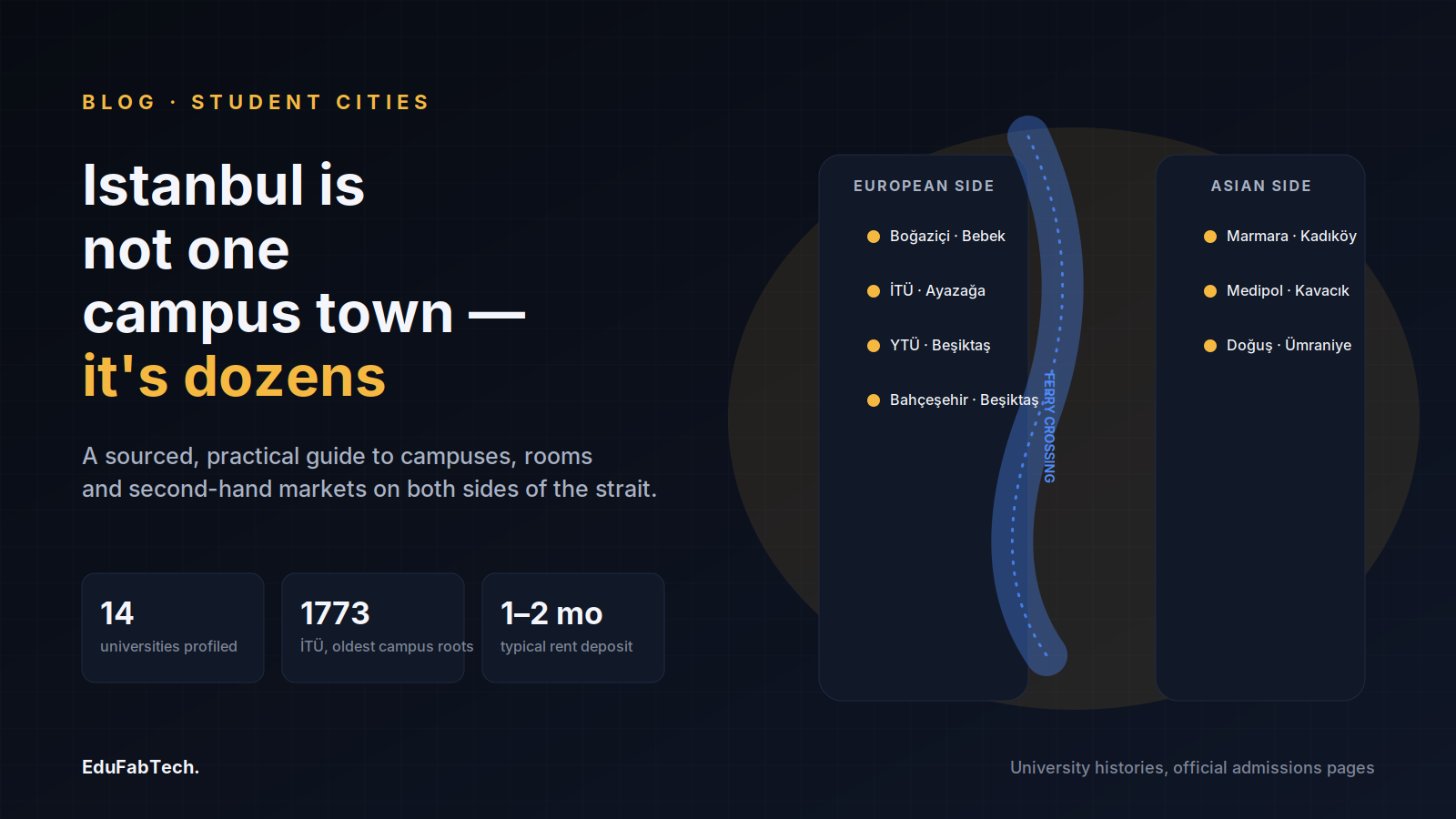
Istanbul is not one campus town but dozens of them, scattered across a metropolitan area split by the Bosphorus, held together by ferries, an underground network still being extended, and a commuter rail line that tunnels beneath the strait. A student here might live on the European side and cross to the Asian side twice a week for a lab, or never cross at all. The city does not organise itself around its universities the way a smaller student city does — it absorbs them, and you have to go looking for the parts of it that work for you.
That absorption cuts both ways. Istanbul offers genuine depth: state universities with centuries of institutional history, private universities built inside a former Ottoman power station, a specialist library that never closes, and second-hand markets that have supplied furnished student rooms for generations. It also means no single office, neighbourhood or price list can tell you everything — you piece the city together from several sources, the way its own students do.
This is a working guide to that piecing-together: which universities are where, how students actually find and check a room, where to buy things second-hand, what the rules around part-time work look like, where to study, how to get around, and what things genuinely cost — with sources for every figure, and honesty about what is hard.
The universities, and what is actually true about each one
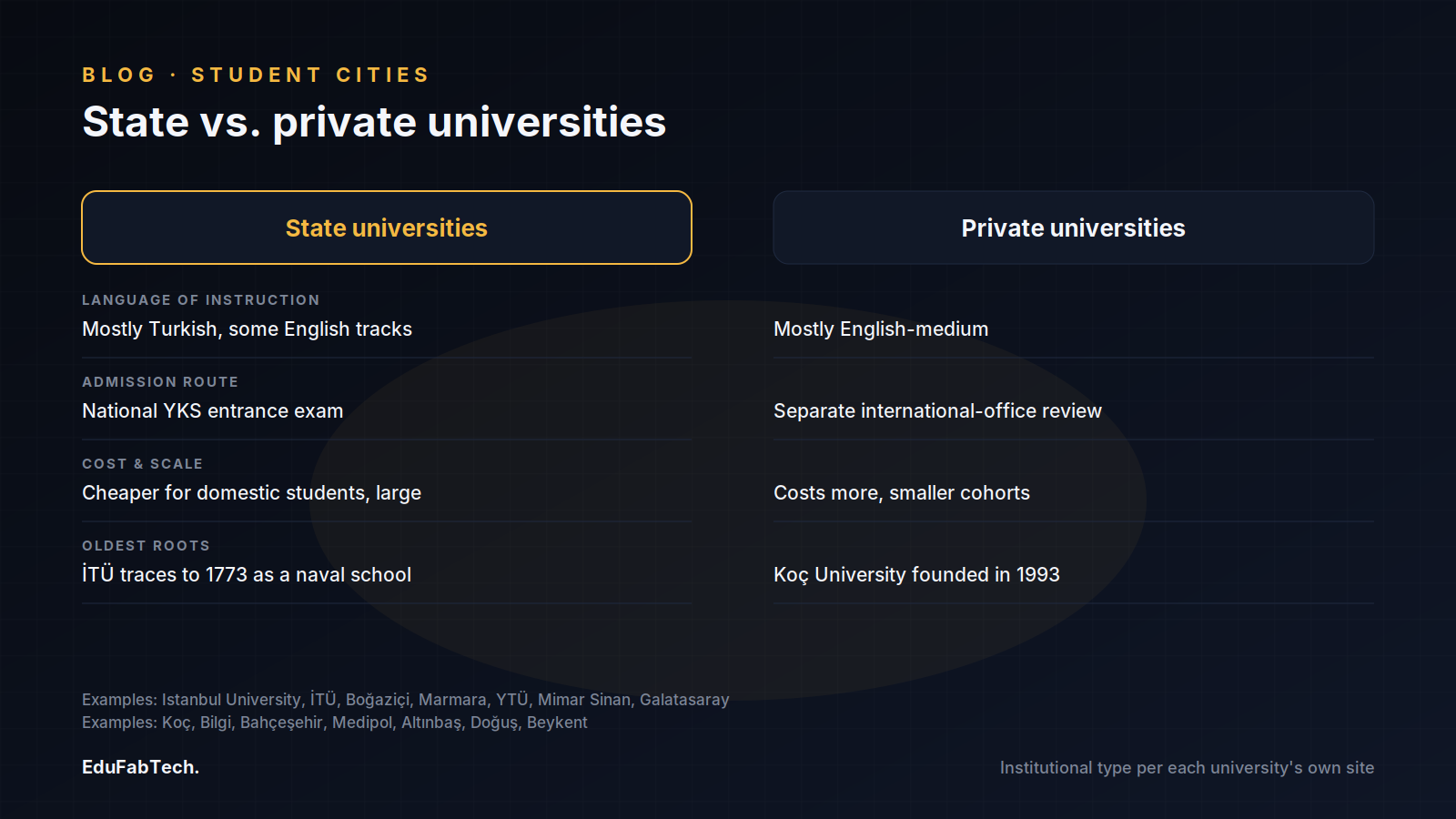
Istanbul hosts both large state universities that trace their institutional lineage back to the Ottoman era and a dense cluster of private, non-profit universities founded from the 1990s onward. Admission to Turkish-language state-university programmes runs through the national university entrance examination system; most private universities and a growing number of state-university departments teach partly or fully in English, and international applicants are usually assessed separately from the domestic entrance process — each university's own admissions office publishes its specific route. The table below lists universities with verifiable, specific facts about each, drawn from the universities' own sites and standard reference sources.
| University | Type | Main campus | Worth knowing |
|---|---|---|---|
| Istanbul University | State | Beyazıt, Fatih | Reorganised in 1933 out of the late-Ottoman Darülfünun; one of Turkey's oldest and largest state universities, with faculties spread across five campuses, per Britannica's institutional profile. |
| Istanbul Technical University (İTÜ) | State | Ayazağa/Maslak, plus Taşkışla and Gümüşsuyu near Beşiktaş | Traces its founding to 1773 as an Ottoman naval-engineering school, making it one of the oldest technical universities in continuous operation anywhere, according to İTÜ's own history page. |
| Boğaziçi University | State | Bebek/Rumelihisarı, on the Bosphorus | Grew out of Robert College, founded in 1863 as the first American college established outside the United States; the Bebek campus was transferred to the Turkish state in 1971, per the university's official history. Instruction is largely in English. |
| Marmara University | State | Göztepe (Kadıköy), plus faculties including one in Üsküdar | Traces to an 1883 school of commerce; today one of Turkey's largest universities by enrolment, with its Göztepe campus on the Asian side near the Acıbadem metro station. |
| Yıldız Technical University (YTÜ) | State | Beşiktaş (former Yıldız Palace grounds) and Davutpaşa | Founded in 1911; its historic Beşiktaş campus occupies part of the old Yıldız Palace complex, while its Davutpaşa campus is a converted 19th-century Ottoman army barracks. |
| Koç University | Private, non-profit | Rumelifeneri, Sarıyer | Founded in 1993 by the Vehbi Koç Foundation; moved to its current campus near the Black Sea mouth of the Bosphorus in 2000. Selective, English-medium, comparatively small. |
| Mimar Sinan Fine Arts University (MSGSÜ) | State | Fındıklı, Beyoğlu | Descends from the Ottoman Empire's first fine-arts school, founded in 1882 by painter and archaeologist Osman Hamdi Bey; the main campus building is a mid-19th-century former Ottoman palace. |
| Galatasaray University | State, bilingual | Ortaköy, Beşiktaş | Established under a Turkish–French bilateral agreement signed in 1992, becoming a university under its own charter in 1994, building on a much older Galatasaray educational lineage; teaching is partly in French. |
| Istanbul Bilgi University | Private, non-profit | Santralistanbul, Kâğıthane, plus Dolapdere and Kuştepe | Founded in 1996; its Santralistanbul campus occupies the former Silahtarağa Power Plant, Istanbul's first electricity plant, decommissioned in the 1980s and converted into classrooms, a concert hall and an energy museum. |
| Doğuş University | Private | Ümraniye/Üsküdar area, Asian side | Founded in 1997. |
| Istanbul Beykent University | Private | Ayazağa-Maslak, plus Beylikdüzü and Taksim campuses | Founded in 1997 by the Adem Çelik–Beykent Educational Foundation. |
| Bahçeşehir University (BAU) | Private | Beşiktaş main campus on Çırağan Avenue, plus further campuses in Beşiktaş, Galata and Göztepe | Founded in 1998; the main campus sits directly on the Bosphorus shore. |
| Istanbul Medipol University | Private | Kavacık, Beykoz | Founded in 2009; North and South campuses sit at the Asian foot of the Fatih Sultan Mehmet Bridge. Strongly health-sciences focused. |
| Altınbaş University | Private | Mahmutbey, near Bağcılar | Founded in 2008 as Istanbul Kemerburgaz University, renamed Altınbaş in 2017. |
What studying at these places actually feels like depends heavily on which kind of institution you land in. Large state universities are affordable for domestic students, crowded, and run mostly in Turkish, with English-medium tracks concentrated in a handful of departments. Private universities are smaller, teach mostly in English, cost substantially more, and tend to have more exchange and international-degree infrastructure aimed specifically at foreign applicants. None of this is ranked here — treat rankings you see elsewhere with the same scepticism the site applies to any unsourced claim, and check a specific programme's accreditation and language of instruction directly on the university's own site before assuming anything about it.
Finding a room without losing money
Most students in Istanbul live in one of three arrangements: a shared flat with two to four roommates (by far the most common route for both domestic and international students), a private studio or one-bedroom apartment, or a private dormitory or "student residence" operated as a business separate from any university. A smaller number live in the state dormitory system, which is generally cheaper but allocated through its own separate application process and often has long waiting lists in Istanbul specifically, given how many students compete for places in the country's largest city. University international offices can usually point new students toward whichever of these routes their own institution has arrangements with.
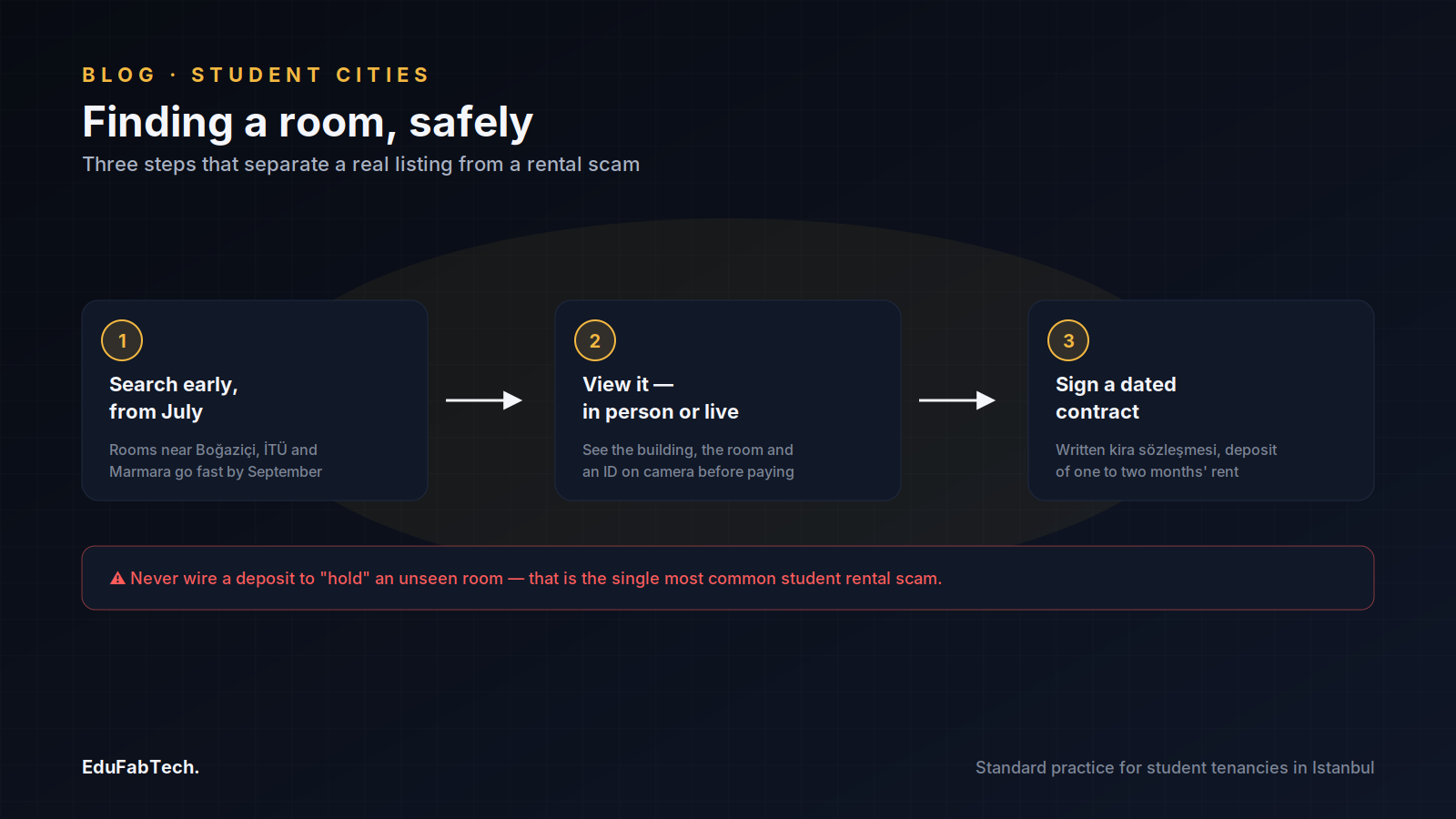
Room-hunting in Istanbul starts early relative to term dates: competition for flats near the most popular campuses picks up from July, and by the first week of September, the cheapest and best-located options near universities such as Boğaziçi, İTÜ and Marmara are largely gone. A written, dated rental contract (kira sözleşmesi) is standard practice and something to insist on regardless of nationality; it typically specifies the deposit (commonly one to two months' rent), the notice period, and who is responsible for utility registrations.
Rental fraud targeting students is a real and recurring problem in large cities, and Istanbul is no exception. Never send a deposit by bank transfer, gift card or cryptocurrency to "hold" a room you have not seen — insist on viewing it in person, or over a live video call where you can see the building's exterior, the room, and ask the person on camera to show identification. Be wary of any landlord who is conveniently "abroad" and cannot show the flat, whose price is well below comparable listings, or who pressures you to pay before signing anything. A listing on EduFabTech's Istanbul room listings or any other platform is a starting point for a search, not a substitute for seeing the place yourself.
Where students actually live
Kadıköy, on the Asian side, is probably the single most popular student neighbourhood in the city. It sits close to Marmara University's Göztepe campus, has a dense cluster of bookshops, cafés and independent cinemas, and reaches the European side by a short ferry ride rather than a bridge crossing. It is no longer cheap by Istanbul standards, but it remains one of the more walkable, less car-dominated districts.
Beşiktaş sits on the European shore directly across from Kadıköy and is within easy reach of Boğaziçi University's Bebek campus, Yıldız Technical University's historic Beşiktaş site, Galatasaray University in neighbouring Ortaköy, and Bahçeşehir University's main campus. It is central, well served by ferries and buses, and correspondingly among the more expensive options for student housing.
Şişli, further inland, is a dense, largely residential district with strong metro connections and a lower profile than Beşiktaş or Kadıköy; it draws students from several nearby private universities and from Yıldız Technical University's Davutpaşa faculties, and functions as a mid-priced alternative to the Bosphorus-front districts.
Fatih — specifically the Aksaray, Laleli and Beyazıt area around Istanbul University's main campus — is the historic, budget end of student housing: older apartment stock, some of the cheapest shared rooms in the central city, and a location within walking distance of the Grand Bazaar, the Sahaflar book market and Beyazıt State Library. It is also one of the most crowded and least green parts of the city.
Üsküdar, on the Asian side north of Kadıköy, hosts faculties of Marmara and Doğuş universities and has a quieter, more conservative character than Kadıköy, with lower rents and a longer ferry or Marmaray commute into the historic peninsula.
Sarıyer, at the northern, Black Sea end of the Bosphorus, is where Koç University's Rumelifeneri campus and part of İTÜ's wider campus network sit. It is green and relatively quiet, but genuinely far from the city centre — a real trade-off for students who want easy access to the rest of Istanbul outside class hours.
Furnishing a room cheaply
Istanbul has a strong second-hand culture, and furnishing a first room here rarely means buying anything new. Horhor Bit Pazarı in Fatih, a seven-floor building housing roughly 200 dealers near the Aksaray tram and metro stop, specialises in second-hand and antique furniture, from wardrobes to lighting, according to the Istanbul provincial tourism directory; prices are negotiable but the market is not the cheapest in the city, since much of the stock is genuinely old rather than simply used. For everyday household items at lower prices, the Kadıköy Tuesday and Friday market (Tarihi Salı Pazarı), held in Göztepe a short walk from the M4 metro's Göztepe station, mixes fresh produce with second-hand furniture, kitchenware, books and clothing, and is a regular stop for students furnishing a flat on the Asian side, according to local reporting on the market. For books specifically, the Sahaflar Çarşısı book market, wedged between the Grand Bazaar and Istanbul University's Beyazıt campus, has sold second-hand and antiquarian books for generations and remains noticeably cheaper than shops in the tourist-heavy Sultanahmet area nearby. Most residential districts also run their own smaller weekly neighbourhood markets (semt pazarı), a cheap source of both food and, on their edges, informal second-hand goods, as described in general market guides to the city such as this overview of Istanbul's flea markets. For a running local list rather than a one-off shopping trip, EduFabTech's own second-hand, furniture and free-stuff listings for Istanbul are worth checking before any market trip, since what's given away for free often beats even market prices.
Part-time work: what the rules actually say
This is an area where the details change and where getting it wrong has real consequences, so this section describes the general shape of the rules and points to the official source rather than offering legal advice. A student residence permit on its own does not grant the right to work in Turkey; a separate work permit is generally required, and the standard route requires an employer willing to sponsor the application on the student's behalf. Commonly cited parameters — that undergraduates typically become eligible only from their second year of study, that graduate students can generally work from the start of their programme, and that term-time hours are capped while full-time work is permitted during official holiday periods — are widely repeated across student-advice sites, but rules, caps and exceptions can change, and the only way to be certain of your own situation is to check the national migration authority's official guidance on work permits and, ideally, your own university's international office before taking any job, formal or informal. EduFabTech's Istanbul jobs listings are a place to see what part-time and student-friendly work looks like locally, not a substitute for confirming your own legal eligibility first.
Libraries and places to study
The single most distinctive public study space in the city is the Beyazıt State Library, next to Istanbul University's main campus, which has run a genuinely continuous 24-hour service since 2017, making it one of the only libraries in the country open around the clock, according to Anadolu Agency's reporting at the time the policy began. It is free to enter and sits inside a former 16th-century imaret building, which makes it as much a destination as a study hall. Istanbul's municipal library network runs additional branches across the city, including converted historic buildings, and membership is generally open to residents rather than restricted to students. University libraries vary sharply in how open they are to outsiders: Koç University's Suna Kıraç Library, for instance, restricts day-to-day borrowing access to its own students, staff and paying external members rather than the general public, which is typical of Istanbul's private universities — worth checking before you plan to rely on a library that is not your own. For a broader list of places to sit down and work, from cafés to co-working spaces, EduFabTech's Istanbul study spaces listings track options beyond the obvious library choices.
Getting around the city
Istanbul's public transport runs on a single card, Istanbulkart, valid across buses, the growing metro network, the Marmaray cross-Bosphorus rail tunnel, the Metrobüs rapid-bus corridor along the city's main highway, trams and ferries. Students enrolled at a Turkish institution can generally register for a discounted student fare, applied automatically once the card is linked to verified student status through the transport operator. Under the city's transport tariff that took effect on 20 July 2026, a single ride cost 46.20 Turkish lira on a standard card versus 22.55 Turkish lira on a registered student card, while the monthly unlimited pass cost 3,628 lira standard against 653 lira for students, according to reporting on the fare update. Because these fares are revised periodically, treat the ratio — a student ride costs roughly half the standard fare — as the durable fact, and check current figures directly before budgeting. Ferries remain one of the cheapest and most pleasant ways to cross between the European and Asian sides, and are worth using even when a bridge route would technically be faster.
| Fare type | Standard | Student |
|---|---|---|
| Single ride | 46.20 TL | 22.55 TL |
| Monthly pass | 3,628 TL | 653 TL |
What it costs, and what is honestly hard about the city
Hard, sourced numbers on day-to-day living costs go stale quickly in Turkey's current price environment: annual consumer-price inflation stood at 30.89% in December 2025, and the housing component of that index was still rising at 49.45% year-on-year the same month, according to Anadolu Agency's report on official price data. In practical terms, that means any specific lira figure for rent quoted today will be understated within months, and a relative framing is more useful than a fixed number: expect central, campus-adjacent neighbourhoods such as Beşiktaş and Kadıköy to cost noticeably more than Üsküdar, Şişli or the districts around Istanbul University, and expect whatever you're quoted to be renegotiated at your next contract renewal.
Istanbul draws students from a genuinely large international pool: Türkiye hosted nearly 340,000 international students in 2025, according to an ICEF Monitor analysis of national higher-education enrolment data, and Istanbul's concentration of universities means a large share of that population studies here. That scale is part of what makes the city work as a student destination — deep peer networks, a huge rental and second-hand market to draw on, transport built for millions of daily commuters rather than a small campus population.
It is also part of what makes the city hard. Commutes across a metropolitan area of this size are long by design — crossing from a Sarıyer campus to a Kadıköy flat, or the reverse, can easily eat two hours a day. Housing near the most desirable campuses is genuinely scarce at the start of each academic year, and price competition from the wider rental market pushes against student budgets. The city also sits in a seismically active region: a widely cited study published in Science, co-authored with the US Geological Survey, put the probability of strong earthquake shaking near Istanbul at 62% (± 15%) for the thirty years from 2000 to 2030 — a window now closing without the anticipated rupture on the fault segment nearest the city, though the underlying hazard has not gone away. None of this is a reason to avoid the city; it is a reason to budget time for the commute, start housing searches early, and not treat the earthquake risk as background noise when choosing a building.
A checklist for the first weeks
- Confirm your university's language of instruction and international-office contact before you commit to a neighbourhood — it will shape which campus, and therefore which district, actually matters to your daily life.
- Start looking for housing by July if you can; the cheapest rooms near the most popular campuses are gone by early September.
- Never pay a deposit before seeing the room in person or on a live video call, and get a written, dated rental contract before handing over money.
- Register for a residence permit early — most other paperwork, including a discounted transport card and, eventually, a work permit application, depends on it.
- Before taking any paid work, check the official work-permit guidance directly rather than relying on secondhand advice, including this article's summary of it.
- Visit Horhor, the Kadıköy Tuesday market or Sahaflar Çarşısı before buying anything new for your room.
- Use the room, job, free-item and study-space links earlier in this guide as a starting point, not a final answer, for each of these searches.
- ICEF Monitor. Türkiye: After a decade of dramatic growth, a goal to host 500,000 international students by 2028. ICEF Monitor, 2025. link
- Anadolu Agency. Türkiye's year-end annual inflation eases to 30.89%. Anadolu Agency, 2026. link
- Cumhuriyet. İstanbul toplu taşıma zammı Temmuz 2026: Mavi kart, aylık akbil ve öğrenci abonman ücretleri ne kadar oldu?. Cumhuriyet, 2026. link
- Anadolu Agency. Beyazıt Devlet Kütüphanesi 24 saat hizmet veriyor. Anadolu Agency, 2017. link
- Tom Parsons, Shinji Toda, Ross S. Stein, Aykut Barka, James H. Dieterich. Heightened Odds of Large Earthquakes Near Istanbul: An Interaction-Based Probability Calculation. Science, 2000. doi:10.1126/science.288.5466.661
- Boğaziçi University. History of Boğaziçi University. Boğaziçi University, 2024. link
- Istanbul Technical University. History. Istanbul Technical University, 2024. link
- Koç University. Rumelifeneri Campus. Koç University, 2024. link
- Istanbul Bilgi University. History. Istanbul Bilgi University, 2024. link
- Mimar Sinan Fine Arts University. Kurum Tarihi. Mimar Sinan Fine Arts University, 2024. link
- Marmara University. Göztepe Campus. Marmara University, 2024. link
- Galatasaray University. Home. Galatasaray University, 2024. link
- Republic of Türkiye, Presidency of Migration Management. Work Permit. Presidency of Migration Management, 2024. link
- Yabangee. Street Market Smarts: Tarihi Salı Pazarı (Göztepe, Kadıköy). Yabangee, 2023. link
- Istanbul.com. Flea Markets in Istanbul: Best Markets to Browse. Istanbul.com, 2024. link
- Istanbul Provincial Directorate of Culture and Tourism. Fatih Horhor Bit Pazarı - Antika Eşya. Istanbul Provincial Directorate of Culture and Tourism, 2024. link
- Koç University Suna Kıraç Library. External Members. Koç University, 2024. link