In Mice, Yale-Led CRISPR Screen of 2,485 CAR-T Gene Pairs Finds Top NR4A1-SOCS3 Combo
A Nature study published 4 November 2026 by Yale and Wistar Institute researchers paired CRISPR knockouts in CAR-T cells and found that disabling NR4A1 and SOCS3 together outperformed single-gene edits and other gene-pair combinations from the same screen — in mouse tumor models, not yet in people.
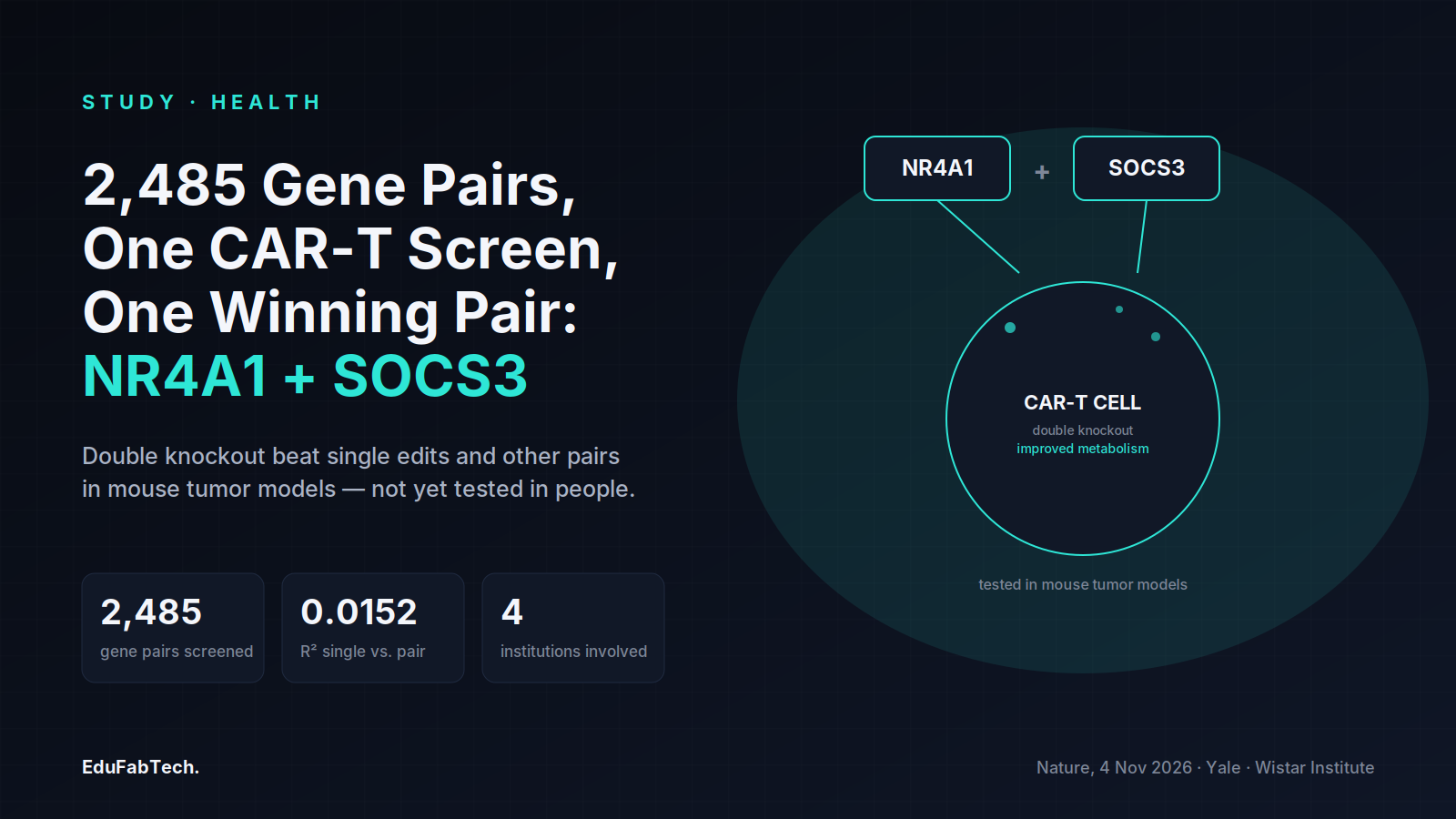
A study involving researchers at Yale University School of Medicine, the Wistar Institute, Baylor College of Medicine and the University of Pennsylvania, published in Nature on 4 November 2026, describes a screen of 2,485 paired gene knockouts carried out directly inside engineered CAR-T cells and tested in mouse tumor models. The lead authors, credited as contributing equally, are Liqun Zhou, Paul A. Renauer and Kaiyuan Tang; the senior authors are Xiaoyu Zhou of the Wistar Institute and Sidi Chen of Yale's Department of Genetics, according to the Nature paper and the Sidi Chen Lab's publication listing.
Why testing genes one at a time falls short
CAR-T therapy already works by removing a patient's own T cells, equipping them with a chimeric antigen receptor that recognizes a tumor marker, and returning them to the body. A persistent problem is that edited T cells tire out inside solid tumors, losing their killing power before they clear the disease. Many groups have tried knocking out single genes thought to drive that exhaustion, but the Yale-led team's screen tested knockouts in pairs, on the premise that two genes disabled together can change T-cell behavior in ways neither one does alone.
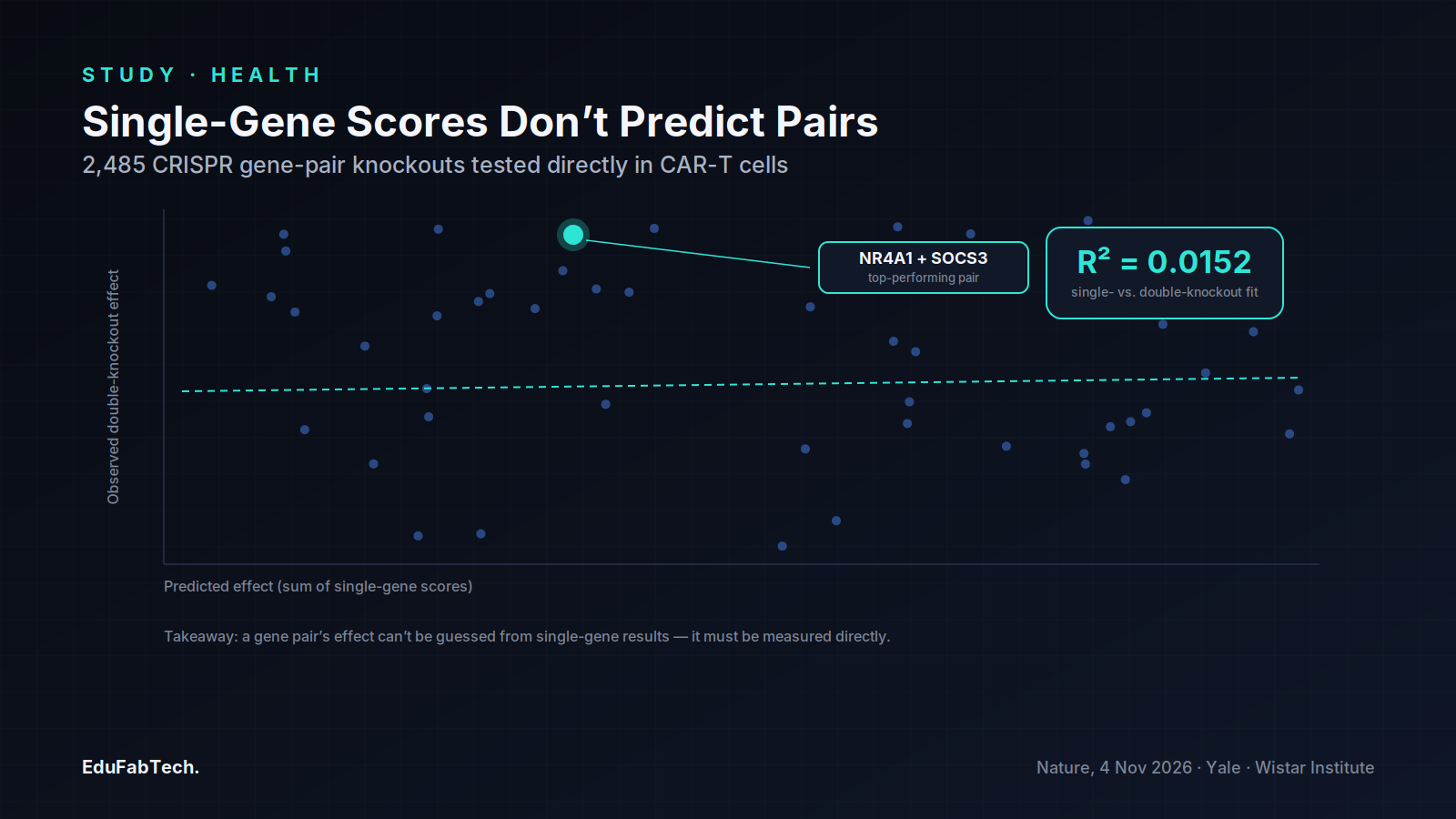
That premise held up numerically. Across the 2,485 gene-pair combinations tested, the Nature paper reports that the antitumor responses of double knockouts correlated only weakly with what would be predicted from each gene's individual single-knockout effect, with a reported R² of 0.0152. In practice, that means a pair's effect could not be guessed by simply adding up the two single-gene results — it had to be measured directly.
The pair that stood out: NR4A1 and SOCS3
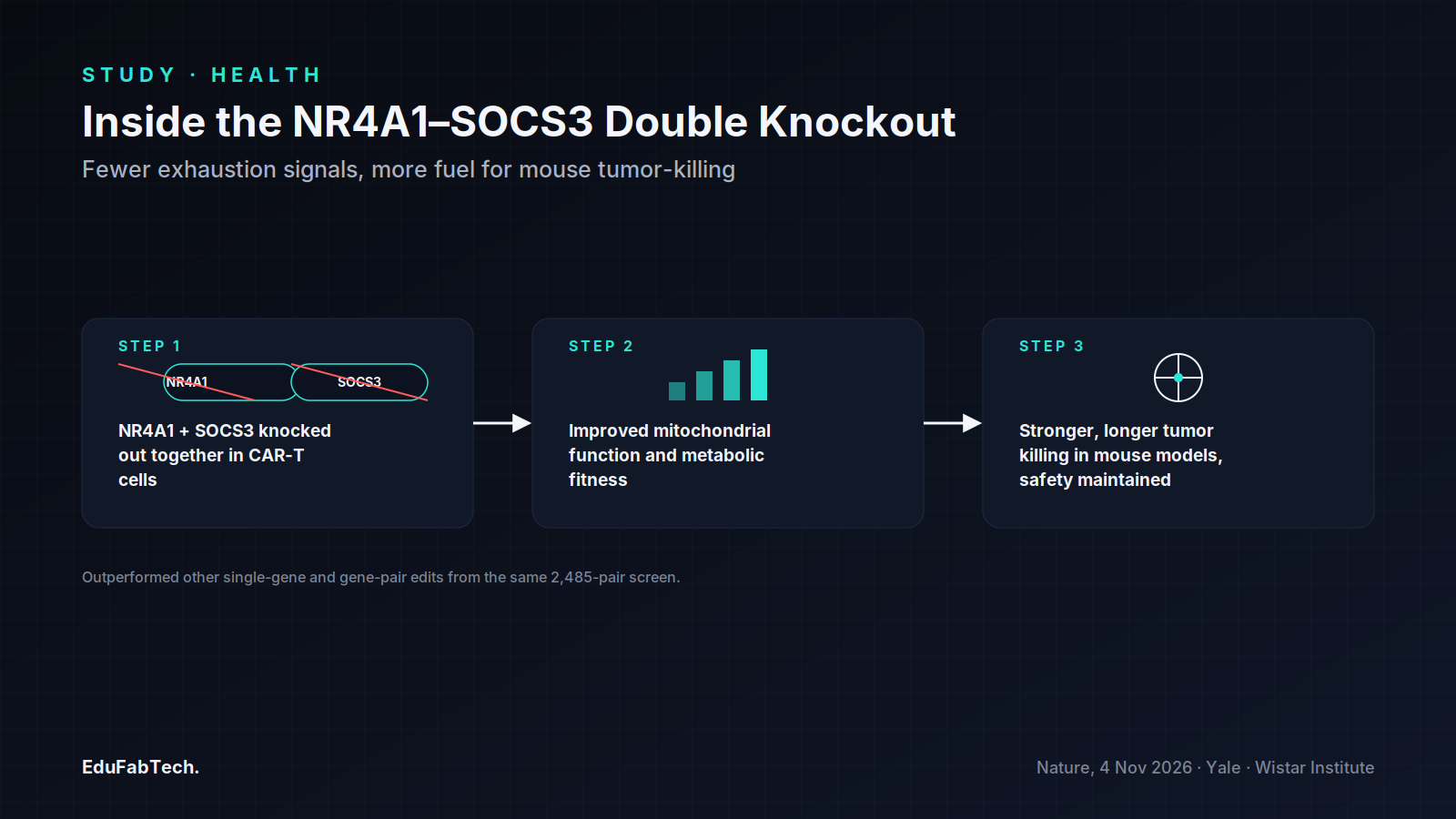
The strongest combination to emerge from the screen paired NR4A1, a transcription factor previously linked to T-cell dysfunction, with SOCS3, a protein that normally dampens cytokine signaling inside immune cells. According to the Nature paper, CAR-T cells with both genes knocked out showed improved metabolic fitness and mitochondrial function compared with cells carrying either single knockout, while maintaining a safety profile across the multiple tumor models the authors tested.
According to the Nature paper, the NR4A1–SOCS3 double knockout also outperformed the other leading single-gene and gene-pair edits uncovered earlier in the same 2,485-pair screen — described in the paper as "benchmark perturbations." The paper cites separate, earlier studies of checkpoint-gene editing (including CTLA-4 knockout in CAR-T cells) as background literature, but it does not report running a head-to-head test of the NR4A1–SOCS3 edit against a checkpoint-editing strategy itself.
How the screen was built
Running a screen of this size inside living animals, rather than in a culture dish, is itself part of what the paper reports as new. Pooled libraries of paired CRISPR guides were introduced into CAR-T cells before the cells were transferred into tumor-bearing mice, so that the selective pressure of an actual tumor environment — not just a plate of cancer cells — determined which gene pairs survived and expanded. The authors also used single-cell transcriptomic profiling to look at how the top-performing edited cells differed from controls, which is how they identified the shift toward metabolic and mitochondrial pathways in the NR4A1–SOCS3 cells.
The underlying sequencing data have been deposited in the Gene Expression Omnibus under accessions GSE272887 and GSE335215, and in the Sequence Read Archive under PRJNA1477126, with analysis code posted on GitHub, per the data-availability statement accompanying the Nature paper.
What is, and is not, established
Everything reported here comes from engineered human CAR-T cells tested in mouse tumor models, not from patients. The paper does not describe a clinical trial, a dosing regimen, or any testing of the NR4A1–SOCS3 edit in human recipients, and nothing in the materials reviewed for this article suggests the authors are claiming otherwise. Moving a double-knockout CAR-T product from a mouse study to a human trial typically involves years of additional manufacturing, safety and regulatory work, none of which this paper addresses.
For students and researchers, the more durable takeaway may be methodological rather than clinical: an R² close to zero between single- and double-knockout outcomes is a concrete demonstration that gene-interaction effects in engineered immune cells cannot be reliably predicted from single-gene screens, at least for the 2,485 pairs tested here. That argues for building pairwise or combinatorial screening into future CAR-T engineering work rather than treating single-gene knockout data as sufficient on its own. The full gene-pair dataset and screening approach, now public through the deposited accessions, give other labs a way to test whether the same pattern holds in their own tumor models and cell-therapy platforms.
A quick question for readers
When an article cites a study, do you open the source?
Every claim on this site links to a primary source. We want to know whether readers actually follow those links, or whether they …
Pick an answer, create a free account in a minute, and your vote counts. Already a member? Sign in
Comments 3
Comment-
The number that'd stop me from getting excited is the R² of 0.0152 between predicted and actual double-knockout effects. That's a striking m…
-
The number that actually matters here is the R² of 0.0152 between single- and double-knockout effects, not the NR4A1-SOCS3 headline. If doub…
-
The number I'd put on a slide is that R² of 0.0152 between predicted and actual double-knockout effects. That's basically zero - it's the pa…
Join free to read the full comments and reply Comments are between members; an account takes a minute.
Source: Nature
Sources (2)
- Liqun Zhou, Paul A. Renauer, Kaiyuan Tang, Sidi Chen, et al.. In vivo CAR-T double knockout screen maps synergistic antitumour gene pairs. Nature, 2026. nature.com ↗ · checked 7 Nov 2026
- Sidi Chen Lab, Department of Genetics, Yale University School of Medicine. Publications. Sidi Chen Lab, Yale University, 2026. sidichenlab.org ↗ · checked 7 Nov 2026