6-to-12-Month Pill Course Kept a Hypertension Cause in Remission for 2 Years in 14 Patients, NEJM Finds
A New England Journal of Medicine letter dated 7 November 2026 tracked 14 people with primary aldosteronism for up to two years after stopping treatment and found blood pressure and hormone levels still suppressed.
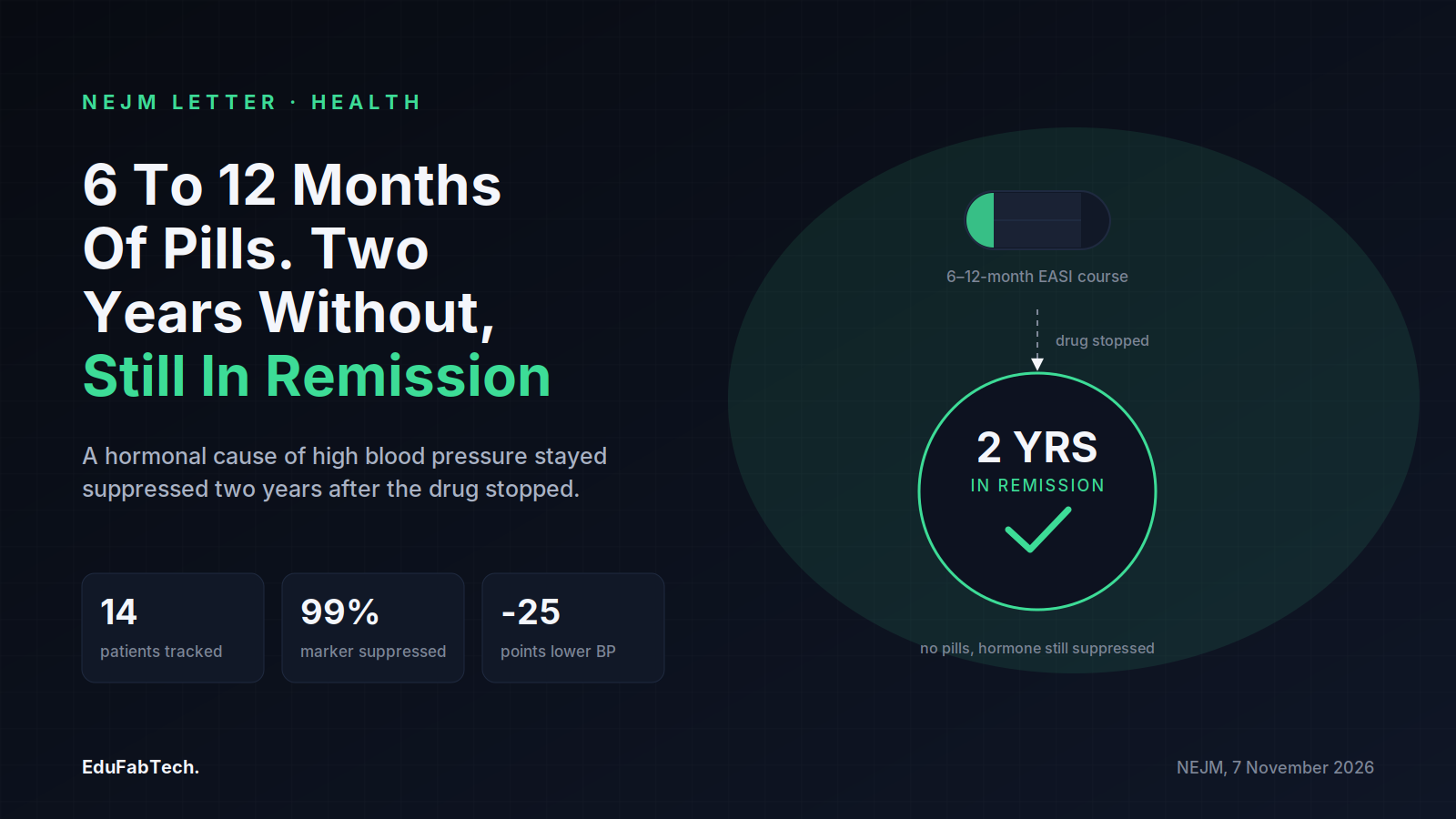
A letter published in the New England Journal of Medicine on 7 November 2026 reports that 14 people with a hormonal cause of high blood pressure kept lower blood pressure and suppressed hormone levels for up to two years after they stopped taking a drug that blocks aldosterone production. The letter, "Hyperaldosteronism Remission after Extended Aldosterone Synthase Inhibition," is credited to Morris Brown, professor of endocrine hypertension at Queen Mary University of London, with Mason Freeman, professor of medicine at Harvard Medical School, as a co-author, according to coverage of the paper by EurekAlert.
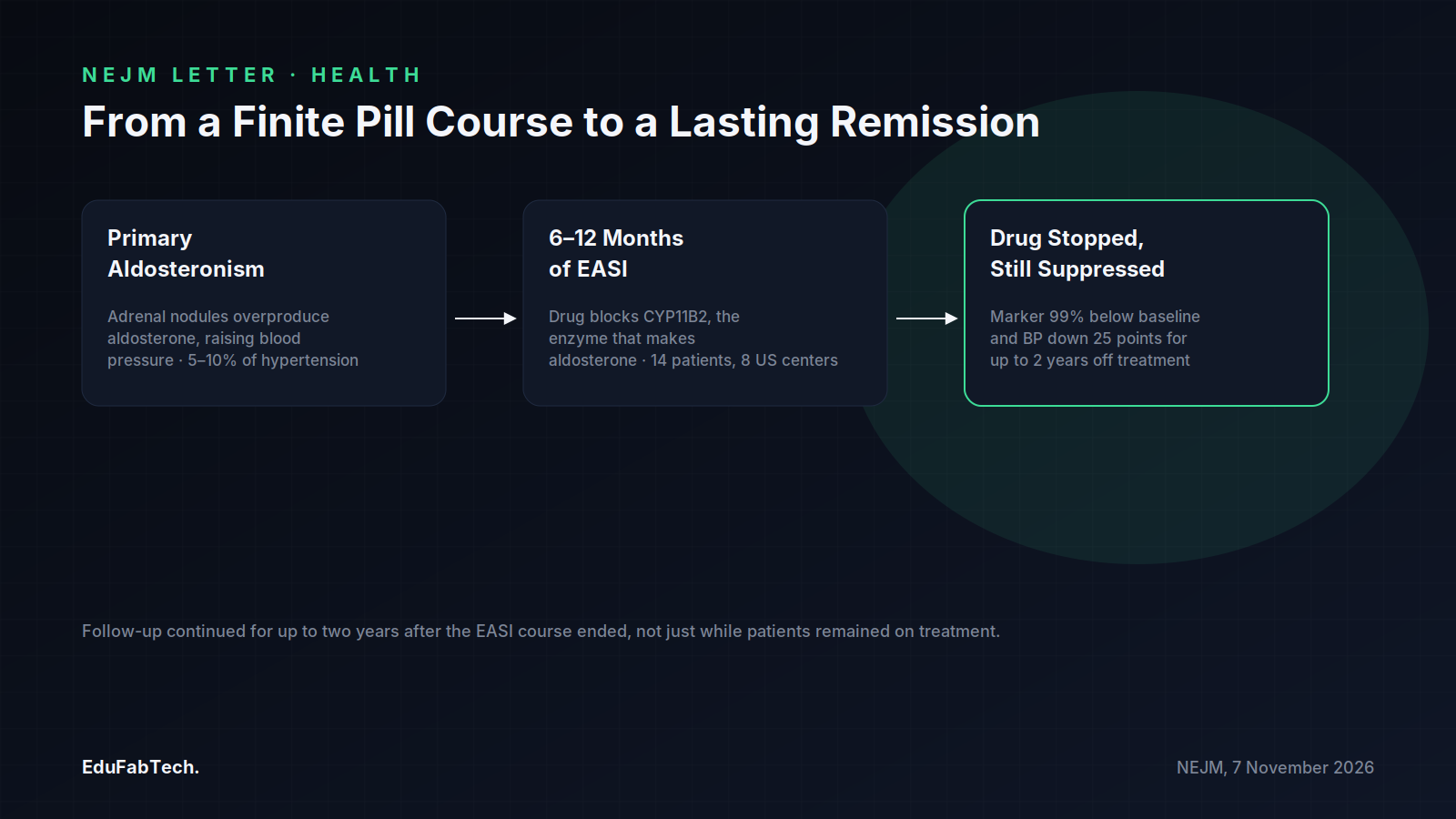
The patients all had primary aldosteronism, a condition in which benign nodules on the adrenal glands produce too much aldosterone, causing the kidneys to retain salt and raise blood pressure. The condition accounts for 5% to 10% of hypertension cases, according to the EurekAlert release describing the study. Until now, cure has generally required surgery to remove an entire adrenal gland, since standard blood pressure drugs only suppress the symptoms of the underlying hormone excess rather than treating its source.
The 14 participants were treated at eight centers across the United States with what the researchers call extended aldosterone synthase inhibition, or EASI: a 6-to-12-month course of a drug from a newer class that blocks the CYP11B2 enzyme used to make aldosterone, as described in coverage of the paper by News-Medical. Researchers then followed the patients for up to two years after the drug course ended, rather than stopping observation when treatment stopped, which is what let them check whether the effect was a temporary suppression or a lasting remission.
What stayed suppressed after the drug stopped
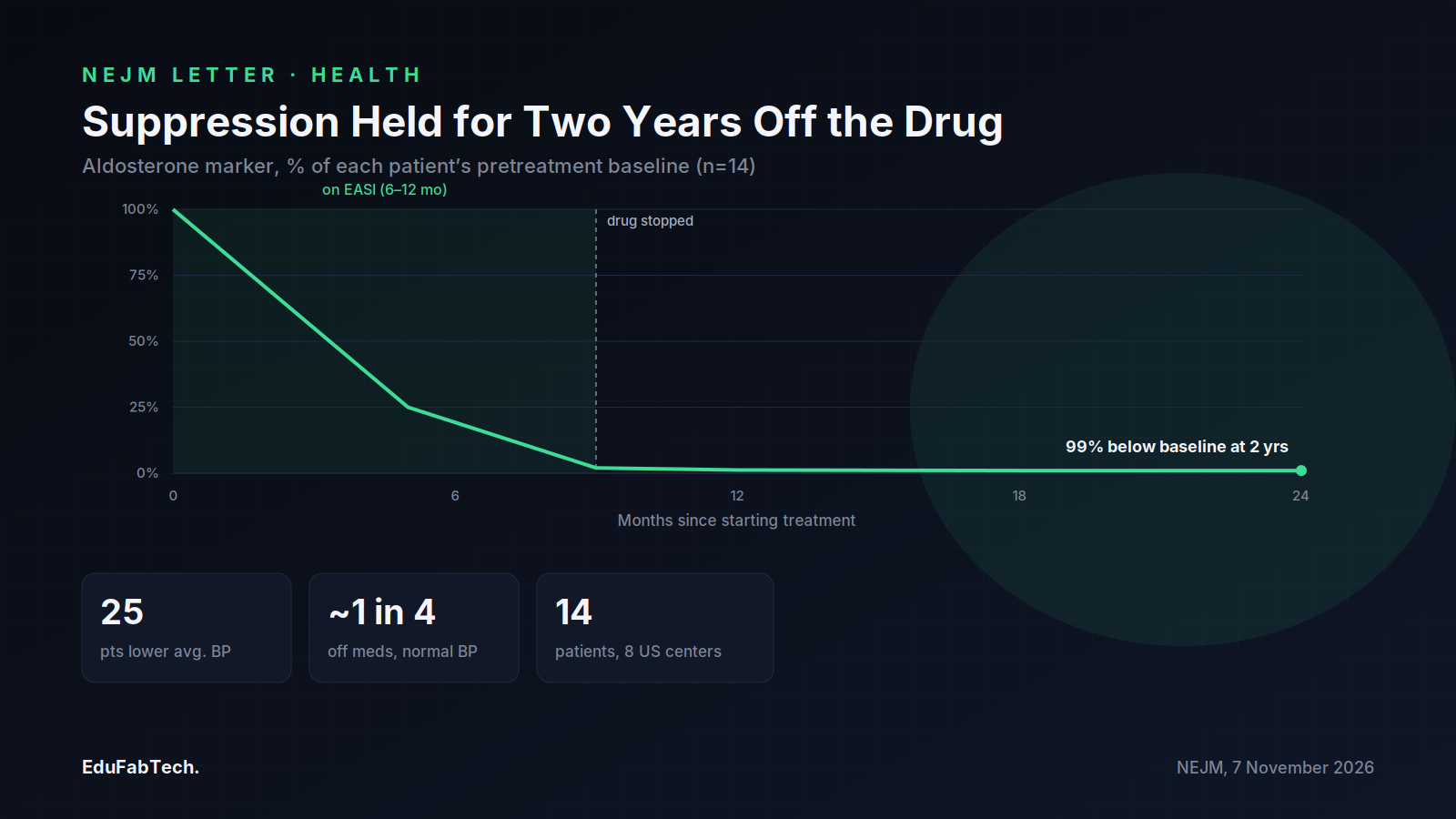
According to the NEJM letter as summarized by EurekAlert, the main marker of excess aldosterone production remained 99% lower than each patient's pretreatment baseline throughout the two-year follow-up. Average blood pressure was 25 points lower than before treatment, and close to a quarter of the 14 participants reached normal blood pressure readings without needing any further antihypertensive medication.
Those numbers describe a group that had already stopped the aldosterone synthase inhibitor months or years earlier. That persistence is what distinguishes this report from an earlier paper by the same research group, a phase 2a trial of the aldosterone synthase inhibitor baxdrostat in people with primary aldosteronism, which measured effects only while patients remained on treatment, according to that NEJM report.
Why the researchers are still cautious
Brown struck a cautious note about the results, telling EurekAlert: "While duly cautious about our findings because of the pragmatic nature of the study, they were predicted by previous experiments, and longer follow-up may justify a claim that a finite course of medication leads to infinite cure." He added that "EASI-treatment is unlikely to be the elixir for most patients with hypertension. But the possibility of tablets achieving a surgical cure has long been a holy grail for this common type of hypertension" — a comment that also explains the name of the follow-up trial described below.
The researchers predicted, before this report, that prolonged treatment with an aldosterone synthase inhibitor might shrink or clear the hyperactive aldosterone-producing cell clusters in the adrenal gland, rather than producing a purely pharmacological suppression that should have worn off once the drug cleared the body, according to the EurekAlert summary. That mechanism remains a hypothesis to be tested rather than a demonstrated finding.
What comes next
Brown and Freeman's group is now leading a larger prospective trial named ELIXIR to test whether EASI produces a lasting cure for primary aldosteronism in a bigger cohort, according to the EurekAlert account of the letter. The ELIXIR trial will use molecular imaging of the adrenal glands to look directly for whether prolonged aldosterone synthase inhibition causes the aldosterone-producing cell populations to disappear, rather than inferring it indirectly from hormone levels and blood pressure readings as the 14-patient report did.
Why it matters beyond this one condition
For students and researchers in endocrinology and cardiology, the result is notable less for its size — 14 patients is a small case series, not a powered trial — than for its design: a drug course with a defined stop point, followed by a multi-year observation window to see whether the benefit outlasts the treatment. Most antihypertensive regimens are built around indefinite daily dosing, and a therapy that could be time-limited rather than lifelong would change how primary aldosteronism is managed in people who cannot or do not want adrenal surgery. Whether that holds will depend on the outcome of the larger ELIXIR trial the same research group has now launched.
A quick question for readers
When an article cites a study, do you open the source?
Every claim on this site links to a primary source. We want to know whether readers actually follow those links, or whether they …
Pick an answer, create a free account in a minute, and your vote counts. Already a member? Sign in
Comments 3
Comment-
The thing that jumps out is the gap between what was measured and what's being claimed in the headline framing. They tracked hormone levels…
-
Fourteen patients is the number that matters here, and the article is upfront about it being a case series, not a powered trial — fair enoug…
-
Fourteen patients is the number that matters here, and not in the way the headline wants it to. The design is genuinely clever - following p…
Join free to read the full comments and reply Comments are between members; an account takes a minute.
Source: The New England Journal of Medicine
Sources (3)
- Morris Brown, Mason Freeman et al.. Hyperaldosteronism Remission after Extended Aldosterone Synthase Inhibition. New England Journal of Medicine, 2026. nejm.org ↗ · checked 9 Nov 2026
- EurekAlert / Queen Mary University of London. New treatment may cure common hormonal cause of high blood pressure. EurekAlert, 2026. eurekalert.org ↗ · checked 9 Nov 2026
- News-Medical.Net. New treatment may offer lasting cure for hormone-related hypertension. News-Medical.Net, 2026. news-medical.net ↗ · checked 9 Nov 2026