Keep Them Ignorant: What Rulers Wrote Down When They Limited Schooling, from 1830 to 2026
A North Carolina statute, an SS memorandum, an apartheid minister and a UNESCO count of 1.4 million girls: the cases where limiting education to protect power is documented in the rulers' own words, the research on why it works, and the 2026 methods, from Hungary and Nicaragua to Türkiye.
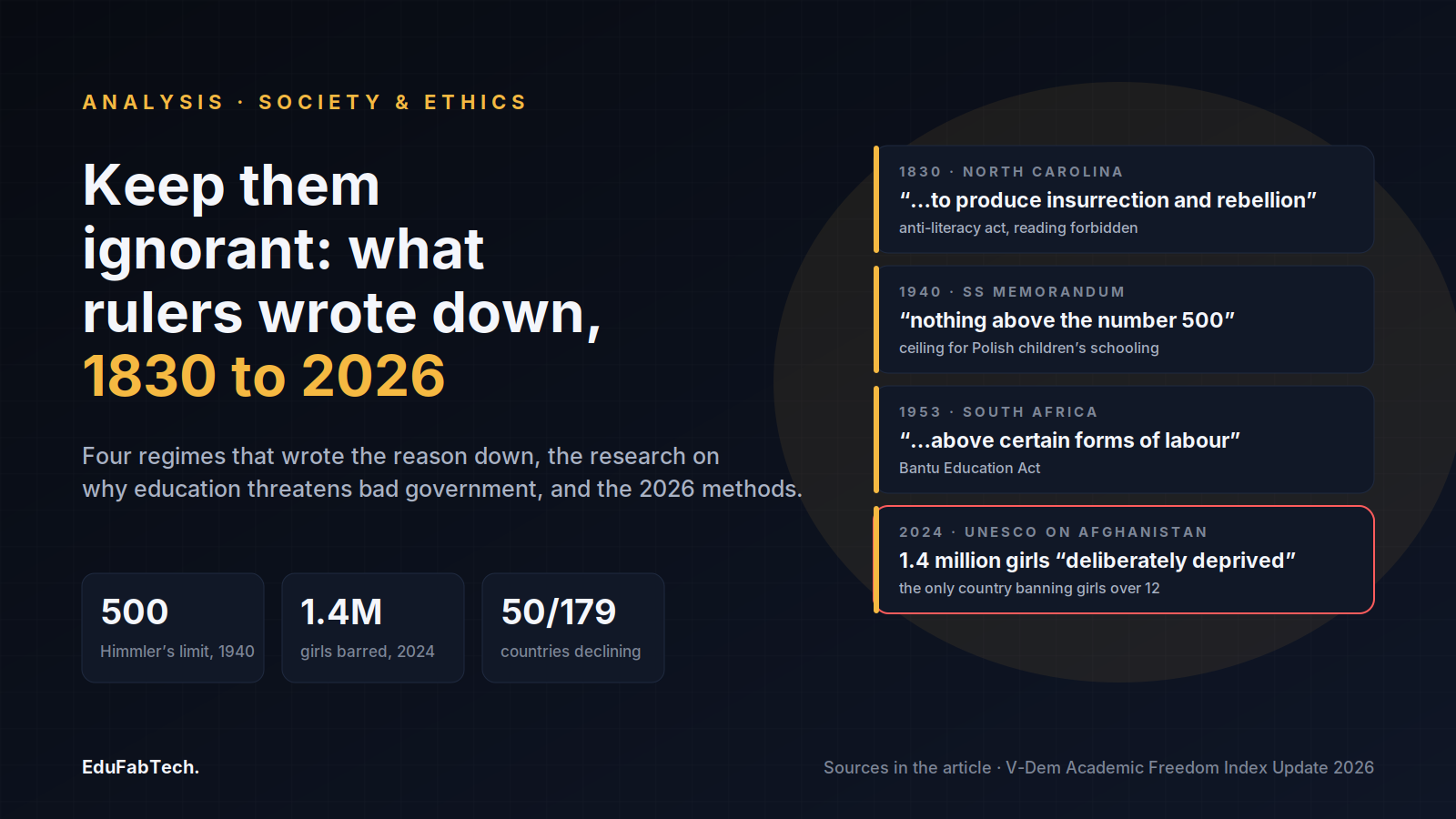
"Keep them ignorant" sounds like a conspiracy theory until you read the laws. In 1830 the General Assembly of North Carolina passed an act forbidding anyone to teach an enslaved person to read or write, and explained why in the preamble: teaching slaves to read "has a tendency to excite dis-satisfaction in their minds, and to produce insurrection and rebellion". The penalty for a free white teacher was a fine of 100 to 200 dollars or prison; for a free person of colour, up to 39 lashes. The act exempted "the use of figures": an enslaved person could be taught to count, but not to read.
The statute is unusual only in its honesty. Across two centuries, a small number of governments have written down that they limited schooling to keep a population obedient and unable to object. This article collects the cases where the intent is documented rather than inferred, sets them beside the research on why education threatens bad government, and asks what the method looks like in 2026, when almost no state closes primary schools.
The research first, because it explains the laws. In 2013, Juan Carlos Botero, Alejandro Ponce and Andrei Shleifer published "Education, Complaints, and Accountability" in the Journal of Law and Economics. Their starting fact: better-educated countries have better governments, in dictatorships as well as democracies. Their explanation, tested on World Justice Project survey data and on crime and corruption surveys: within a country, more-educated people are more likely to report the misconduct of officials, and the complaints are what create the pressure to govern better. A ruler who benefits from misconduct therefore has an interest in fewer complainers. The 1830 preamble says the same thing in the vocabulary of its time.
Four regimes that wrote the reason down
Nazi Germany, 1940. In May 1940 Heinrich Himmler sent Hitler a memorandum on the treatment of the non-German population of the occupied East. According to the United States Holocaust Memorial Museum's account of the persecution of Poles, it set the ceiling for Polish children's schooling: "simple arithmetic, nothing above the number 500; writing one's name; and the doctrine that it is divine law to obey the Germans. . . . I do not think that reading is desirable." The policy was enforced with murder: in the "Extraordinary Pacification Operation" of summer 1940, the same account records, several thousand university professors, teachers, priests and others were shot.
South Africa, 1953. The Bantu Education Act of 1953 placed Black schooling under the apartheid government's Department of Native Affairs. Its minister, Hendrik Verwoerd, explained the purpose in a sentence the South African government's own website today calls infamous: "There is no space for him in the European Community above certain forms of labour."
Cambodia, 1975 to 1979. Pol Pot's Khmer Rouge did not restrict the school; they abolished it. According to the historian Ben Kiernan's account published by Yale University's Genocide Studies Program, the regime "scattered libraries, burned books, closed schools, and murdered schoolteachers"; three-quarters of Cambodia's 20,000 teachers perished or fled abroad, and none of the country's pre-1975 professors or lecturers who remained in the country survived. In all, 1.7 million people died in four years.
Afghanistan, 2021 to today. The most recent case is also the only current one that bans schooling outright. On 15 August 2024, three years after the Taliban took Kabul, UNESCO reported that 1.4 million girls had been "deliberately deprived" of secondary schooling, that almost 2.5 million girls, 80 per cent of school-age girls, were out of education, that primary enrolment had fallen from 6.8 million in 2019 to 5.7 million in 2022, and that university enrolment had dropped by 53 per cent since 2021. "Afghanistan is the only country in the world to prohibit access to education for girls over the age of 12 and for women," said Director-General Audrey Azoulay.
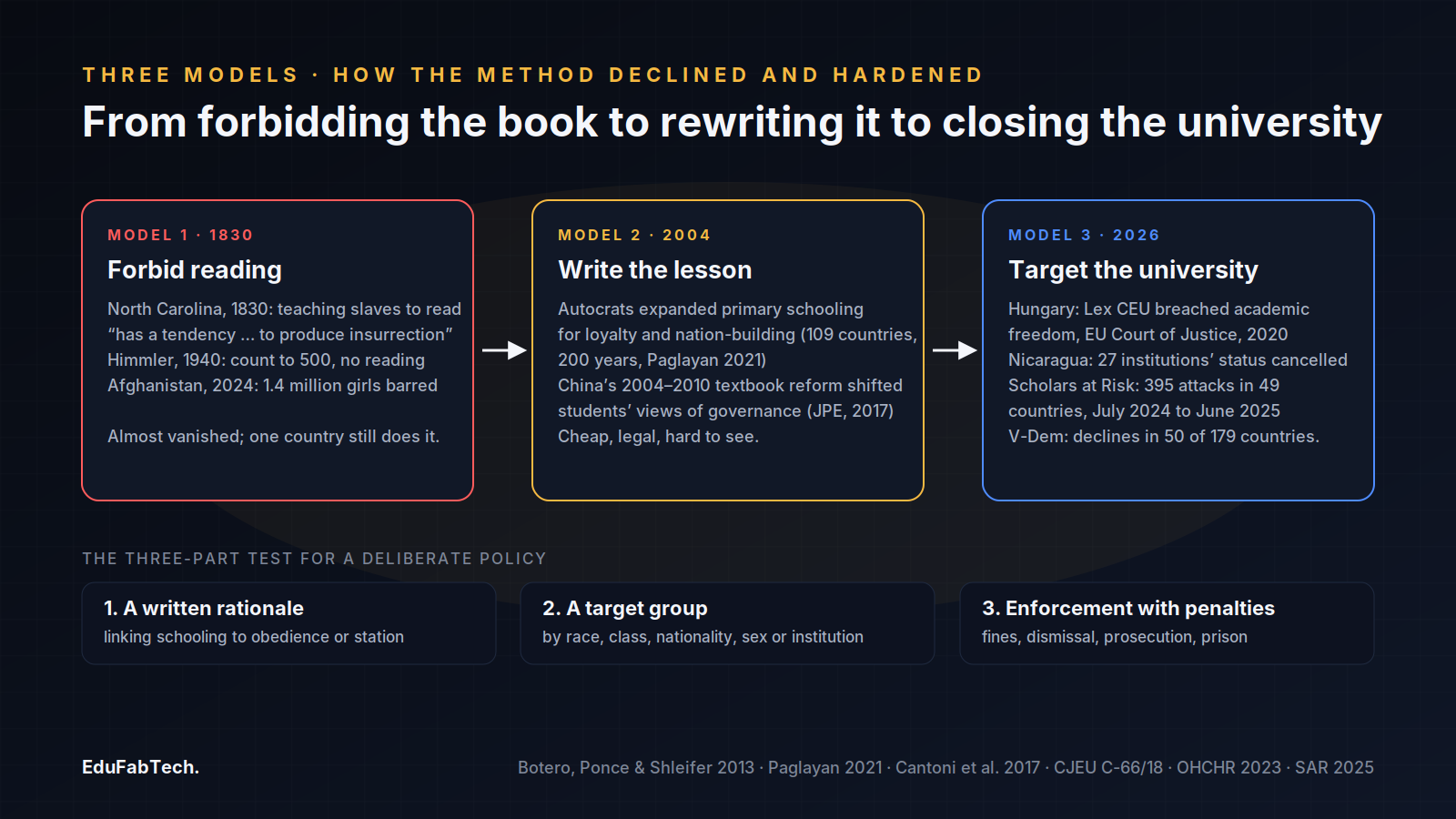
These four share three features that separate a deliberate policy from an incompetent one: a written rationale linking schooling to obedience or to a fixed station in life; a target group defined by race, class, nationality or sex; and enforcement with penalties. Keep those three in mind, because most present-day failures of education do not pass the test, and the ones that do have changed shape.
Why the crude method declined: autocrats learned to use the school
Here the evidence complicates the story, and the complication is the point. In 2021 the political scientist Agustina Paglayan published "The Non-Democratic Roots of Mass Education" in the American Political Science Review, using new datasets on 109 countries over 200 years. Her finding: democratisation had, on average, little or no effect on primary enrolment, because state-controlled schooling had usually emerged a century earlier, under non-democratic rulers; in three-quarters of the countries that democratised, a majority already had access to primary school. Autocrats expanded schooling for their own reasons: loyalty, nation-building, industry, armies.
In other words, the ruler who fears educated complainers has a second option besides closing the school: keep it open and decide what is in it. The effect of that option has been measured. A 2017 study in the Journal of Political Economy by Davide Cantoni, Yuyu Chen, David Yang, Noam Yuchtman and Jane Zhang used the staggered introduction of China's 2004 to 2010 textbook reform across provinces to isolate its effect on students. Studying the new curriculum produced more positive views of China's governance, changed views on democracy and increased scepticism towards free markets; the authors matched the changes to the aims stated in the government's own reform documents. The school stayed open. The complaints were trained out before they formed.
This is the sense in which the method has declined and hardened at the same time. The 1830 model, forbidding literacy, has almost vanished; on UNESCO's count, Afghanistan is the only country that still bars a whole group from school. The 2004 model, writing the lesson, is cheap, legal and difficult to see. And a third model has grown, aimed at the one part of an education system that keeps producing complainers even after the textbooks are rewritten: the university.
The 2026 form: the pressure moves to the top of the system
Two cases are established by a court or a United Nations body rather than by an opponent of the government; a third country, below, shows all three models at once.
Hungary. On 6 October 2020 the Court of Justice of the European Union ruled, in Case C-66/18, that the 2017 higher-education law passed under Prime Minister Viktor Orbán, which required foreign universities to hold an international treaty with their home state and to teach there as well, breached academic freedom under Article 13 of the Charter of Fundamental Rights, along with other EU and WTO obligations. The Court said academic freedom has not only an individual dimension but "an institutional and organisational dimension reflected in the autonomy of those institutions". The law was known in Hungary as "Lex CEU", after Central European University, the institution it affected most.
Nicaragua. On 12 September 2023 the UN Human Rights Council's Group of Experts on Nicaragua reported that, under the government of Daniel Ortega and Rosario Murillo, the legal status of 27 institutions had been cancelled and their assets confiscated, as part of a crackdown on independent academic institutions that the experts said amounted, prima facie, to the crime against humanity of persecution on political grounds.
Everywhere, measured. The V-Dem Institute's Academic Freedom Index update of March 2026 recorded significant declines since 2015 in 50 of 179 countries and territories, against improvements in nine, with the steepest fall among wealthy democracies in the United States; the figures are in our report on the index. Scholars at Risk's Free to Think 2025 report, published on 1 October 2025, documented 395 attacks on higher-education communities in 49 countries and territories between July 2024 and June 2025. Its executive director, Robert Quinn: universities "are among the first targets of attack in places experiencing democratic decline".
Türkiye, 2002 to 2026: all three models in one country
Türkiye is the clearest current case of the second and third models operating together, and the rationale is on the record. On 1 February 2012 Prime Minister Recep Tayyip Erdoğan, whose Justice and Development Party has governed since November 2002 and who has been president since 2014, told his party's provincial heads: "Dindar bir gençlik yetiştirme var", "there is the raising of a religious youth", adding that the government would raise a conservative and democratic generation faithful to the nation's values. That year Parliament passed the "4+4+4" schooling law, which, according to a 2019 study for the Heinrich Böll Foundation, reopened the imam-hatip religious middle schools closed in 1997.
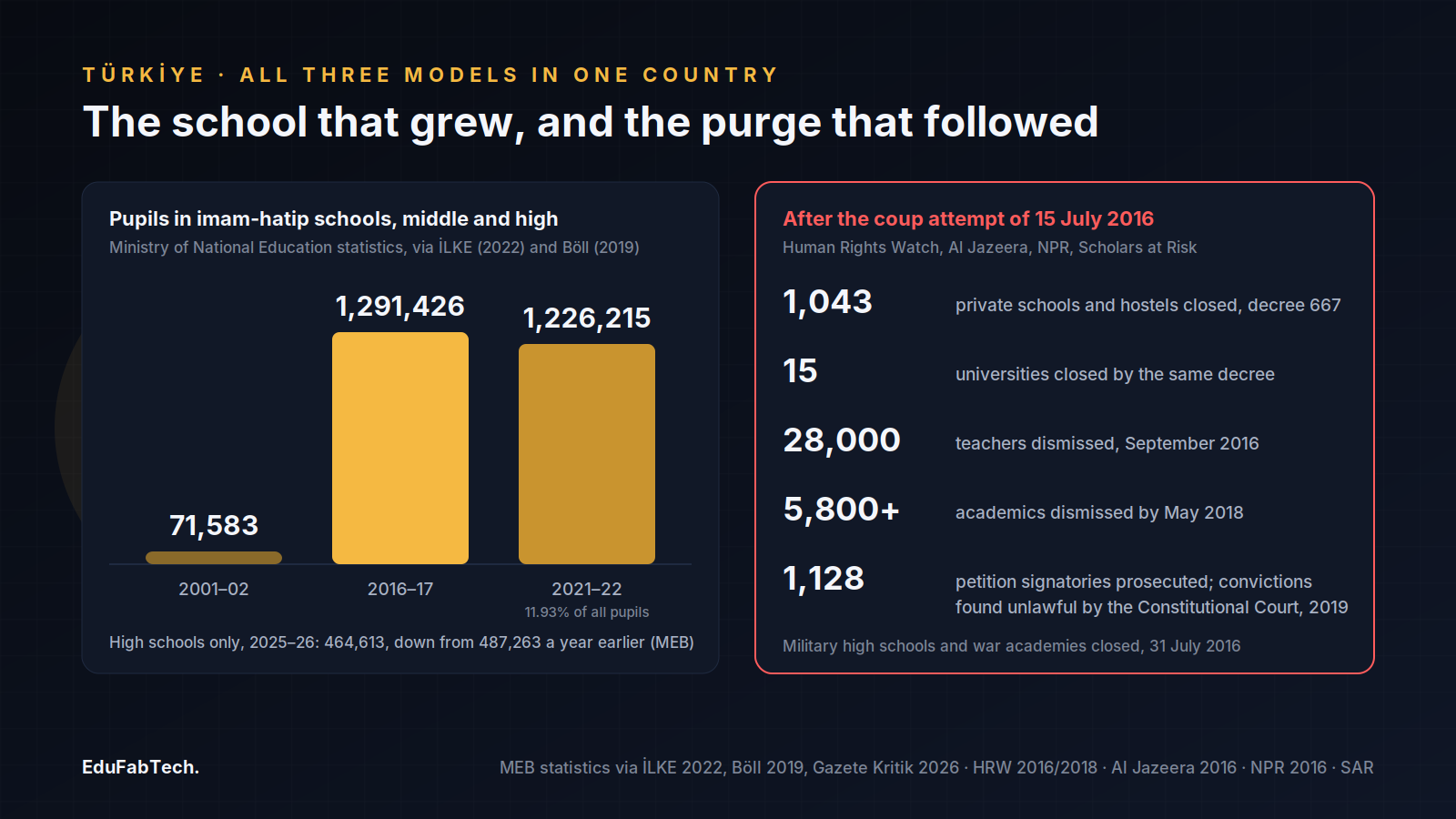
The numbers followed. Ministry of National Education statistics compiled by the İLKE Foundation put imam-hatip enrolment at 71,583 pupils in 2001–2002 and 1,226,215 in 2021–2022, 11.93 per cent of all pupils, in 3,451 middle and 1,693 high schools; the Böll study counts imam-hatip high schools rising from 537 to 1,485 between 2012 and 2017, with 1,291,426 pupils across both levels in 2016–2017. Reuters reported in November 2014 that buildings were requisitioned from existing general schools for conversions, a process the Education Reform Initiative called "rather arbitrary" and "rushed". The curve has since turned: the ministry's 2025–2026 statistics, as reported by Gazete Kritik on 2 October 2026, show 464,613 pupils in imam-hatip high schools, down from 487,263 a year earlier, out of 5,247,752 in upper-secondary education. The school can be built faster than it can be filled.
The third model arrived after the coup attempt of 15 July 2016. The first emergency decree, no. 667 of 23 July, closed 1,043 private schools and student hostels and 15 universities, according to Human Rights Watch; a decree of 31 July closed all military high schools, war academies and NCO schools and replaced them with a National Defence University, NPR reported; on 19 September the government announced the dismissal of 28,000 teachers for alleged links to terrorism; and by May 2018 Human Rights Watch counted more than 5,800 academics dismissed from public universities by decree, their passports confiscated. The stated rationale throughout was national security and the Gülen movement, which the government blamed for the coup. In parallel, the 1,128 academics from 89 universities who had signed a January 2016 petition against the fighting in the south-east were prosecuted for "propagandising for a terrorist organisation"; on 26 July 2019 the Constitutional Court ruled, nine votes to eight, that the convictions violated freedom of expression.
The lesson was rewritten in 2017: the evolution chapter was removed from the high-school syllabus, the ministry saying the topic was "too advanced for high school", while weekly religious-education hours went from one to two. University governance followed: a 2018 decree gave the President the power to appoint rectors without a vote, a power exercised at Boğaziçi University in January 2021 over weeks of protests; the Constitutional Court annulled the decree on 4 June 2024, and on 2 July 2025 Parliament re-enacted the same power by ordinary law, which Boğaziçi academics called a "democracy disgrace".
Applied to the test: the written rationale exists, but it names a generation to be shaped and a security threat to be removed, not a population to be kept from reading; the target groups are defined by affiliation, signature and institution; the penalties are dismissal, prosecution and the loss of a passport. Two of the instruments have since been found unlawful by the country's own highest court. That is the 2026 pattern in one country: the primary school stays open and grows, the lesson is rewritten, and the pressure concentrates on the people whose job is to complain.
How to tell a strategy from a failure
None of this means that every crowded classroom is a plot. France's public secondary schools lost 9.8 per cent of teaching hours in 2024 to 2025, yet when pupils blocked their lycées this autumn the government conceded a replacement plan within fifteen days, as our report on the blockades describes: no written rationale, no target group, no penalty for learning. That is a shortage, and shortages respond to complaints; so, mostly, are the 44 million teachers UNESCO says the world needs by 2030.
The documented strategy looks different. It names who may learn and how far. It writes the lesson. Or it removes the institutions, and the people, whose job is to generate the complaints that Botero, Ponce and Shleifer found at the root of better government. The 1830 statute exempted arithmetic; Himmler allowed counting to 500. Both drew the line in the same place: counting yes, reading no. The question to ask of any education policy, in any country, is therefore not whether the school is open but who is allowed to learn enough to complain, and what happens to them when they do.
Which cases would you add? Tell us in the forum, and have your say in the polls.
A quick question for readers
How much do you spend on books and course materials per term?
Amounts in US dollars. The results help show how much course materials really cost students.
Pick an answer, create a free account in a minute, and your vote counts. Already a member? Sign in
Sources (5)
- Botero, J. C.; Ponce, A.; Shleifer, A.. Education, Complaints, and Accountability. Journal of Law and Economics, 2013. journals.uchicago.edu ↗ · checked 4 Oct 2026
- Paglayan, A. S.. The Non-Democratic Roots of Mass Education: Evidence from 200 Years. American Political Science Review, 2021. cambridge.org ↗ · checked 4 Oct 2026
- United States Holocaust Memorial Museum. Poles: Victims of the Nazi Era. United States Holocaust Memorial Museum, 2000. ushmm.org ↗ · checked 4 Oct 2026
- UNESCO. Afghanistan: 1.4 million girls still banned from school by de facto authorities. UNESCO, 2024. unesco.org ↗ · checked 4 Oct 2026
- Scholars at Risk. Attacks on Higher Education Linked to Democratic Decline, Including in the US, New Free to Think 2025 Report Finds. Scholars at Risk, 2025. scholarsatrisk.org ↗ · checked 4 Oct 2026